
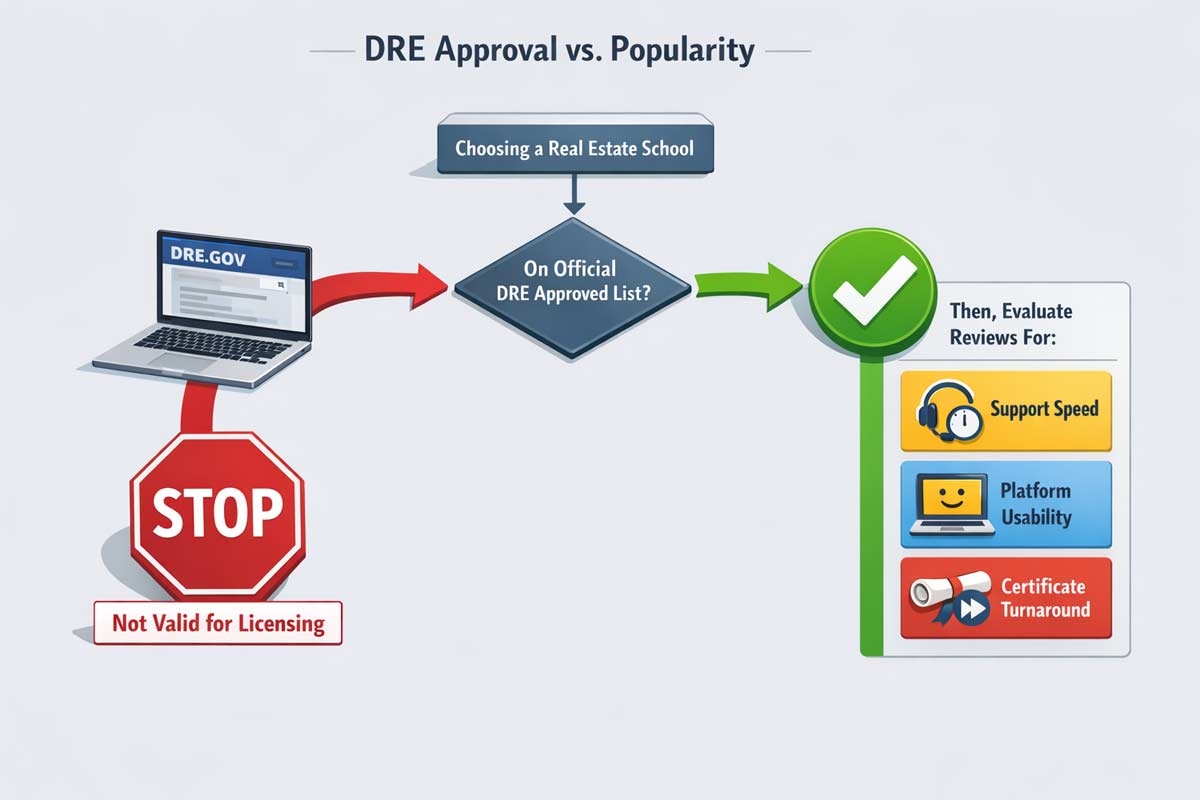
Choosing a real estate school can feel like a high-stakes decision because in some ways it is. You are investing your time, money, and career aspirations into a regulated process.
Naturally, most students turn to the digital "safety net": online reviews.
Reviews feel like certainty in an uncertain process. However, in professional licensing, a high star rating doesn't always translate to a smooth path to a license. Understanding how to weigh student feedback against regulatory facts is the difference between starting your career on time or getting stuck in a cycle of hidden fees and technical hurdles.
How important are reviews when choosing a real estate school?
Online reviews are a valuable secondary tool for evaluating student support and platform usability, but they should never be your primary filter. Reviews help you predict the student experience; DRE legitimacy predicts whether your effort produces a certificate accepted by the state. Always verify a school’s DRE approval and specific provider policies before relying on a star rating.
In over 20 years of helping California students, I’ve seen a recurring pattern: students choose a school based on a high star rating, only to realize the "support" mentioned in ratings doesn't exist when they actually need help.
Instead of looking at reviews first, use a triangulation method:
Before you trust a star rating, it is essential to understand how to know if a real estate school is legit in California.
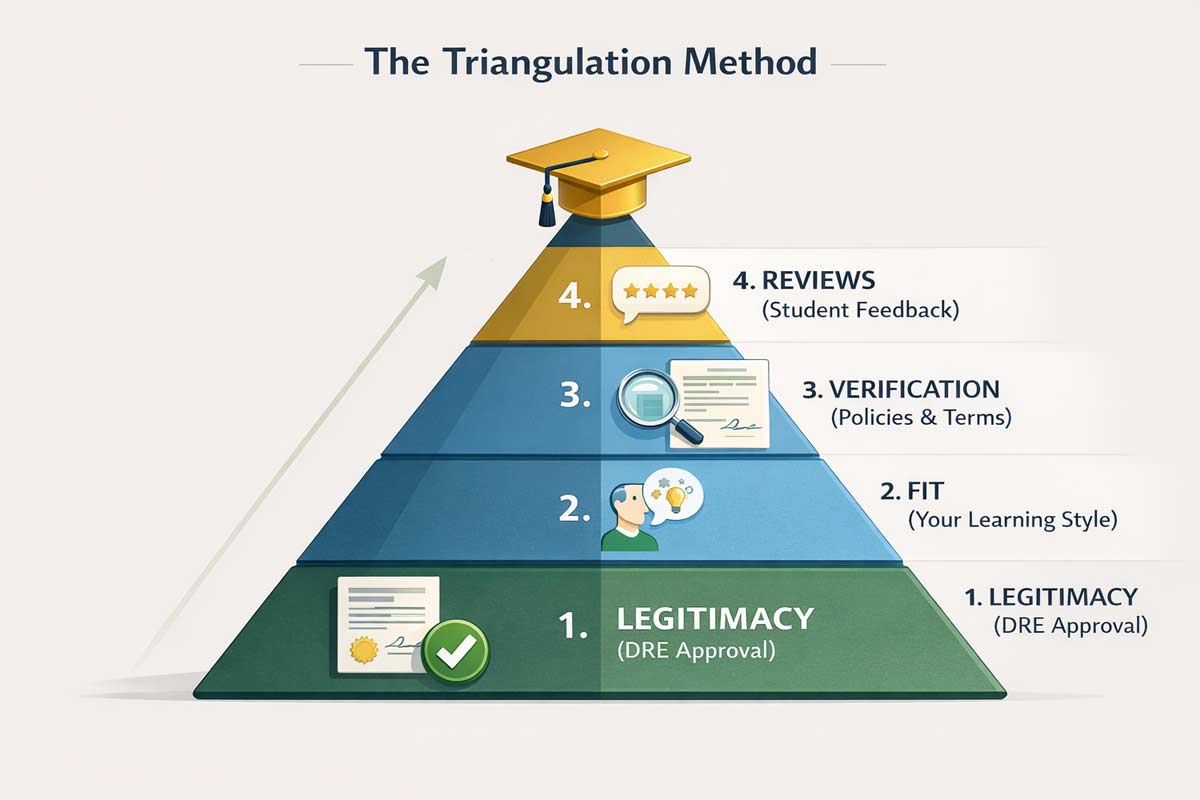
When scanning student feedback, look for "Signal" reviews that mention specific operational details:
Look for mentions of problem resolution, not just friendliness. Does the reviewer mention how long it took to get a response? You will have questions about certificates or exam applications; you need a school that provides more than just automated "ticket loops."
Provider pacing restrictions are platform rules that limit how quickly you can progress—even if you are ready—such as cooldown periods, minimum intervals between module exams, or capped progress. Look for reviews that mention being "stuck" or unable to progress at a natural speed due to these platform-imposed caps.
You cannot apply for the state exam without your completion certificates. Feedback mentioning delays in certificate processing is a high-signal warning of administrative friction that could delay your career by weeks.
Look for mentions of whether the material feels current. This is one of the red flags when choosing a real estate school that impacts your actual learning.
Online feedback often contains "noise" that can lead you toward a poor decision.
To find the truth in the comments section, apply these three filters:
Using these filters helps you avoid fake or unaccredited CA real estate schools that may use volume to mask poor service.
In California, you are buying a certificate of completion that the DRE must accept. If a school has 10,000 five-star reviews but their provider identity is unclear or they aren't on the DRE’s current list, those reviews are irrelevant to your licensing outcome.
This is why DRE accreditation matters more than online reviews. You are managing "license risk"—the risk that your time and money won't result in a license. A legitimate school will always prioritize DRE compliance over appearing popular. For a deeper dive, see our guide on why DRE accreditation matters more than online reviews.
Are online reviews reliable for choosing a real estate school in California?
Reviews are reliable for gauging student support and platform usability, but they do not guarantee a school's legitimacy. Always use them as secondary evidence alongside a DRE approval check.
What matters more: online reviews or DRE approval?
DRE approval is non-negotiable. Without it, your certificates are not valid for licensing. Reviews only tell you how pleasant (or difficult) the process of obtaining those certificates might be.
How can I spot “provider pacing restrictions” in reviews?
Look for complaints about "wait times," "cooldowns," or being "locked out" of the next chapter. These reviews indicate the school has platform-imposed limits on how quickly you can study.
Do negative reviews mean a real estate school is bad?
Not necessarily. Many negative reviews stem from an "expectation gap" where students confuse pre-license education with state exam prep. Focus on reviews that mention technical failures or poor support.
Reviews are a tool, but they aren't the blueprint. Your goal is to find a school that is transparent about its policies, responsive to your needs, and strictly compliant with California law.
Want a step-by-step framework to choose your school confidently?
Use the full evaluation system here: Best Real Estate Schools in California

Founder, Adhi Schools
Kartik Subramaniam is the Founder and CEO of ADHI Real Estate Schools, a leader in real estate education throughout California. Holding a degree from Cal Poly University, Subramaniam brings a wealth of experience in real estate sales, property management, and investment transactions. He is the author of nine books on real estate and countless real estate articles. With a track record of successfully completing hundreds of real estate transactions, he has equipped countless professionals to thrive in the industry.

"Hey guys,
I took the exam today and passed!!!!
It only took me one try which was one of my goals. I took the online
classes and follow your suggestions so I took the crash course,
used the crash course app a lot, took 7 mock tests and went
confident to present the exam. Thank you for the great job you are
doing, you guys are awesome!!!! May God continue to bless you!"
Willie V.