

You just received your license from the DRE.
You’ve joined a brokerage.
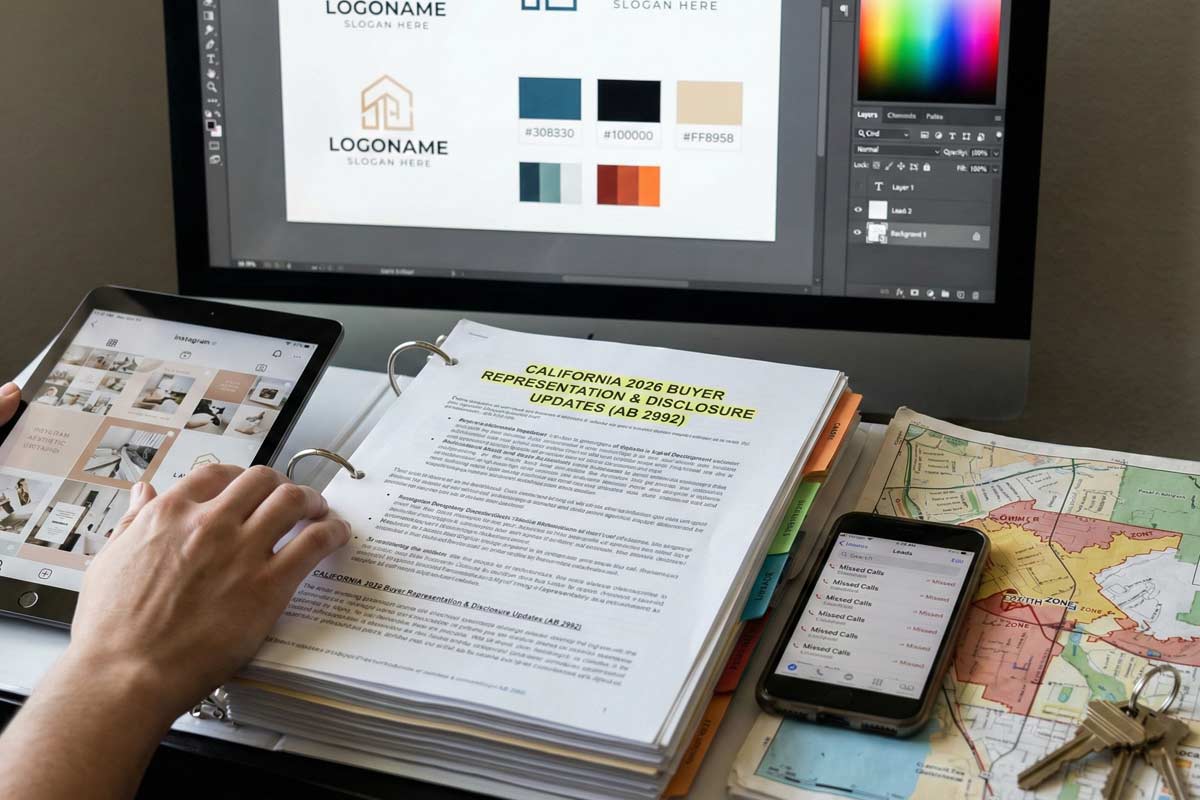
Now, you’re staring at a blank Canva template, wondering if your "brand" should be navy blue and gold or "modern minimalist" white.
Stop.
If you are spending your first week as an agent choosing fonts instead of making phone calls, you are falling into the trap of productive procrastination. You are hiding from the discomfort of lead generation behind the safety of "graphic design."
In the 2026 California market—defined by post-settlement commission transparency and a tightening insurance landscape—your brand is not a logo. Your brand is what people believe about you after an interaction. It is a lagging indicator of your behavior. You don't "build"; a brand; you earn one through proof, technical competence, and consistency.
Many new agents in California fail because they try to polish a mirror that hasn't been built yet. They believe they cannot ask for a listing until they have a high-end website and a curated Instagram aesthetic.
This is backward.
In my 20+ years of training thousands of agents at ADHI Schools, I’ve seen that the most successful "brands" start with an agent in a polo shirt showing a house at 7:00 PM on a Tuesday because they were the only ones who picked up the phone.
Your first job is your pipeline, not your polish. If you don't have clients, your brand is effectively invisible. If you want to Start a Real Estate Career in California that actually lasts, you must realize that your reputation is built in the field, not in a marketing suite.
In 2026, purely "aesthetic branding" is less effective than it used to be. With the shift in how buyer’s agents are compensated and the complexity of California’s property insurance crisis, clients are looking for technical navigators, not just friendly faces.
If you want to be known as a professional, master these observable signals:
To be a top-tier brand in 2026, you must prove you are current on new California regulations. Position yourself as an expert on these three pillars:
For your first 90 days, you only need three foundational assets. Anything more is a distraction.
Don't write a novel. Use this framework to capture long-tail search and build immediate E-E-A-T:
This is your primary conversion asset. When a buyer asks, "Why do I need to sign this agreement?" or "What do you do for your fee?", you show them this list:
Post your "Learning Wins": "Just spent 4 hours studying the latest CA disclosure updates so my clients stay protected." Crucial Rule: Never imply you represented a party if you didn't. When in doubt, anonymize.
California is too large to "do it all." Choose a lane you can genuinely service today:
Stop trying to be a "content creator" and start documenting your journey. Video platforms are increasingly important because they allow potential clients to "test drive" your personality.
For a deeper dive into this, check out How New Agents Should Use Social Media in 2026.
In 2026, the only agents who will thrive are those who realize that a brand is earned through high-level service and technical competence. Stop designing your logo. Start designing your business. If you want to build a foundation that lasts, you need to How to Create a Real Estate Business Plan (New Agents) that prioritizes client value over aesthetics.
Your Next Step: Write your 3-line bio today. Don't worry about the font. Just make it clear. If you are struggling with the daily grind, learn How to Stay Motivated as a New Agent.
1. Do I need a personal website right away? Usually, no. Most brokerages provide a profile page. Focus your energy on local networking and your "Value Slide" first.
2. Should I use my own name or a team name? In California, team names must include the broker’s identity and follow specific DRE rules. For your first year, branding your own name is the simplest and safest path.
3. How much should I spend on branding in my first year? I typically advise agents to keep this under $500. A professional headshot is your only essential cost.
4. How do I brand myself if I have no experience? Brand yourself as the "most prepared." While others rely on old habits, you are the expert on the 2026 contract changes and new disclosure laws.
5. What is the most important social media platform in 2026? Instagram and YouTube remain leaders for real estate. They allow you to show your face and voice, which builds trust faster than a static image ever could.

Founder, Adhi Schools
Kartik Subramaniam is the Founder and CEO of ADHI Real Estate Schools, a leader in real estate education throughout California. Holding a degree from Cal Poly University, Subramaniam brings a wealth of experience in real estate sales, property management, and investment transactions. He is the author of nine books on real estate and countless real estate articles. With a track record of successfully completing hundreds of real estate transactions, he has equipped countless professionals to thrive in the industry.

"Hey guys,
I took the exam today and passed!!!!
It only took me one try which was one of my goals. I took the online
classes and follow your suggestions so I took the crash course,
used the crash course app a lot, took 7 mock tests and went
confident to present the exam. Thank you for the great job you are
doing, you guys are awesome!!!! May God continue to bless you!"
Willie V.