

AdhiSchools Blog

How Long Does It Take to Start Your Real Estate Career?

How long to become a real estate agent

Reading Time :  5 minutes

If you are looking for a single, definitive number of days to become a real estate agent, you won’t find it here. Anyone offering one is oversimplifying a complex process.

After 20 years of helping students navigate this transition, I’ve found that the total time is actually determined by five interconnected clocks. The timeline is a series of moving parts: your personal study pace, the Department of Real Estate (DRE) processing speed, your background check, the state exam scheduling backlog, and your "business ramp."

This guide replaces speculation with an operational roadmap. By understanding who "owns" the time in each of these five clocks, you can stop reacting to the process and start managing it.

Note on DRE Timing: Processing and scheduling windows fluctuate significantly based on application volume. For the most accurate, real-time data, always Check DRE’s Current Processing Timeframes.

TL;DR: The Realistic Outlook

  • The Fast Track (10–14 Weeks): Full-time focus, electronic applications, and aggressive scheduling.
  • The Typical Track (4–6 Months): Part-time study with standard DRE processing.
  • TThe Slow Track (8+ Months): Inconsistent study, paper application errors, or exam retakes.
  • The Business Ramp: Expect a 3–6 month gap between getting your license and receiving your first commission check.

The "Five Clocks" Framework

To manage your expectations and your budget, you must identify what moves each clock:
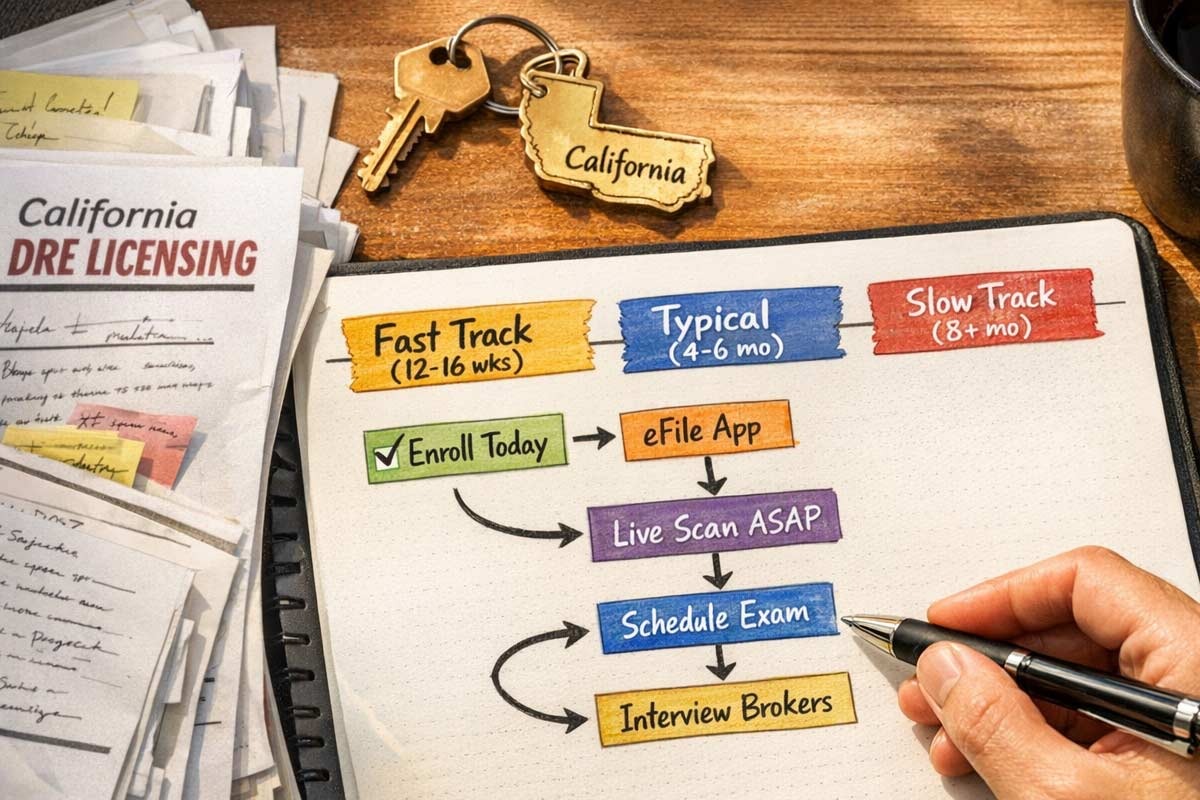
  1. Clock #1: Education – Controlled by a combination of you and state rules. DRE-approved providers like ADHI Schools enforce a minimum access period (commonly 18 calendar days per 45-hour course), so the fastest practical completion is often ~54 days.
  2. Clock #2: DRE Processing – Controlled by the State. This is the time it takes for the DRE to review your application and transcripts.
  3. Clock #3: Background Check – Controlled by DOJ/FBI. Your license generally won't be issued until your Live Scan fingerprint results are received and processed by the DRE.
  4. Clock #4: The Exam – Controlled by DRE availability. Once qualified, you must find an open seat at a testing center for the 150-question, 3-hour exam.
  5. Clock #5: Business Ramp – Controlled by you and your broker. This includes selecting a firm, lead generation, and an escrow period.

The 3 Timelines: Which Track Are You On?

timeline_real_estate_agent

1. The Fast-Track (The Organized Hustler)

  • Range: 11–14 Weeks (Approx. 3 to 3.5 months).
  • The Profile: Treats licensing like a high-priority project.
  • Vignette: Jake, a former operations analyst, utilized the provider minimum-access periods to master the material. He submitted an electronic "Combo" application on Day 55. Because he had already completed his Live Scan, his license was activated shortly after passing his exam.

2. The Typical Track (The Balanced Achiever)

  • Range: 4–6 Months.
  • The Profile: Balances licensing with a 9-to-5 or family responsibilities.
  • Vignette: Matthew, a server transitioning careers, studied 10 hours a week between shifts. It took him 16 weeks to finish the education. He monitored the Check DRE’s Current Processing Timeframes page weekly to prepare for her test date.

3. The Slow-Track (The Reactive Planner)

  • Range: 8+ Months.
  • The Profile: Struggles with consistency or paperwork errors.
  • Vignette: Sam completed his courses in 3 months but mailed a paper application with an incorrect fee. Paper applications increase the odds of mail-back delays because corrections require a physical return, and he lost 4 weeks before he could resubmit.

Step-by-Step Operational Roadmap

Step Clock # What You Actually Do Time Range Action Owner Clock Controller Micro-Action (Pro Tip)
Pre-Clock Audit your finances/goals. 1-3 Days You You Read Should You Become a Real Estate Agent in California?
1. Education #1 Complete 3 courses (135 hrs). 8–52 Weeks You School Set calendar alerts for Day 18 of each course to take your finals.
2. App/Legal #2 Submit Combo Exam/License App. Varies (Check DRE) You DRE Use eLicensing; ensure ID names match transcripts exactly.
3. Background #3 Live Scan fingerprinting. Varies You DOJ/FBI Submit fingerprints the same week you apply.Use Form RE 237.
4. The Exam #4 Pass the 150-question, 3-hour test. 3–8 Weeks You DRE Check the eLicensing portal frequently for seat cancellations.
5. Brokerage #5 Hang your license at a firm. 2–4 Weeks You You / Broker Choose your broker before taking the exam
6. First Sale #6 Close your first transaction. 3–6 Months You You / Market Read How Much New Real Estate Agents Make in California.

Top 3 Delay Traps (Ranked by Impact)

  1. The Paper Application Error (High Impact): Mailing a paper application (RE 435) is a common cause of avoidable delays because corrections require a physical mail-back from the state.
  2. The Antidote: Use the eLicensing portal for electronic submission whenever possible.

  3. The Post-Exam "Background Hold" (Medium Impact): Many wait until after they pass the exam to do their Live Scan. The DRE won't issue the license—even with a passing score—until the background check clears. Processing depends on the DOJ and delays can occur.
  4. The Antidote: Complete your fingerprints before submitting your combo exam/license application.

  5. The Education Procrastination (Medium Impact): Because pre-licensing is self-paced, many people let Clock #1 stretch from 2 months to 10 months.
  6. The Antidote: Treat the provider minimum-access period as a deadline, not a suggestion.

Your 90-Minute Launch Plan: Start Today

To gain control over the five clocks, complete these steps in order:

  1. Clock #1 (Education): Enroll in your pre-licensing courses. The provider minimum-access clock does not start until you are officially enrolled in the first course.
  2. Clock #2 (Paperwork): Create an account on the DRE eLicensing portal 2. to familiarize yourself with the requirements.
  3. Clock #3 (Background):Download Form RE 237 and find a local Live Scan vendor.
  4. Clock #4 (Exam): Decide on your target exam month and identify the two nearest testing centers to increase your scheduling options.
  5. Clock #5 (Business Ramp): Determine your starting commitment. If you are balancing this with another job, read Whether You Should Start Real Estate Part-Time in CA.
  6. Self-Assessment: Successful agents often share specific grit and organizational traits. Review The Personality Traits of Successful California Agents to see where you align.

Frequently Asked Questions

What is the fastest I can legally get my license?

The best-case scenario is ~10–12 weeks depending on DRE's Current Processing Timeframes and exam availability.

Can I do this while working full-time?

Many people do. It generally extends the timeline to the 4–6 month range. Success depends on dedicating a consistent "study block" each day.

When should I interview brokers?

Interview brokers while you are waiting for the DRE to process your application (Clock #2). Do not wait until you pass the exam, or you will stall your business ramp (Clock #5).

How long after passing the exam can I start selling?

You can start as soon as your broker "adds" you to their license via eLicensing. However, the lag between starting and getting paid is usually several months.

What if I have a past criminal conviction?

A background issue may extend Clock #3, as the DRE performs a manual review. Transparency is vital; disclosure errors often cause longer delays than the convictions themselves.

Take Control of Your Clock

The timeline to start a real estate career in California is a test of your ability to manage administrative details and personal discipline. While you cannot control State processing speeds, you can control the quality of your application and the consistency of your study habits.

Managing these clocks is your first project as a professional. Once you master the timeline, you can shift your focus to the long-term growth of your business. For a comprehensive look at the entire journey, see our roadmap on how to start a real estate career in California.

Kartik Subramaniam

Founder, Adhi Schools

Kartik Subramaniam is the Founder and CEO of ADHI Real Estate Schools, a leader in real estate education throughout California. Holding a degree from Cal Poly University, Subramaniam brings a wealth of experience in real estate sales, property management, and investment transactions. He is the author of nine books on real estate and countless real estate articles. With a track record of successfully completing hundreds of real estate transactions, he has equipped countless professionals to thrive in the industry.

Enjoy what you read?

Sign up for our newsletter and get weekly updates on our latest articles

Getting started in the real estate business

Cold Calling Scripts That Doesn’t Sound Salesy

The Real Reason Cold Calling Feels “Salesy” (And How to Fix It Fast) Most new agents pick up the phone

Read more...

Getting started in the real estate business

Buyer Consultation Script

TL;DR: The Agent’s Quick-Start Guide The Mission: Transition from an "unpaid tour guide" to a "fiduciary consultant" by leading a

Read more...

Getting started in the real estate business

Open House Scripts For New Agents

Most new agents treat an open house like a museum tour. They stand near the kitchen, offer a bottle

Read more...