

You’re stuck in traffic on the 405, your phone is buzzing with a frantic text about a repair contingency in Santa Monica, and you just realized you forgot to follow up with that listing lead from Sunday’s open house.
You feel "busy," but your production doesn't reflect the chaos.
In my 20+ years of coaching thousands of California agents at ADHI Schools, I’ve seen this movie before. Most agents mistake motion for progress. They react to their inbox, their phone, and their fires, leaving their income to chance.
Top producers—the ones with consistent listing flow and a steady referral engine—don’t have more "hustle" than you. They have a better operating system.
They protect three specific pillars every single day:
Pipeline
Operations
Visibility
Here is the exact daily habit stack used by the most successful agents in the California market.
What they do: Spend the first 90 minutes of the workday on proactive outbound lead generation (calls, texts, or door knocking) before getting deep into email.
Why it works: Your pipeline is the only thing that guarantees future commissions. If you don't feed the engine first, the fires of the day will consume your time.
How to implement:
What they do: Every day, they contact 5 new leads, 5 past clients, and 4 people in their "active" sphere.
Why it works: Real estate is a game of attrition. Most deals are lost because an agent stopped calling after the second attempt.
How to implement:
What they do: Every conversation is logged, and every contact has a "Next Action" date before the agent closes their laptop.
Why it works: A top producer’s brain is for creating solutions, not storing dates. If it isn't in the CRM, it doesn't exist.
How to implement:
What they do: A quick 20-minute daily review of all active escrows and pending contracts to ensure deadlines (contingencies, disclosures) are met.
Why it works: In California, missing a contingency date can cost your client thousands and cost you your reputation.
How to implement:
What they do: Produce one piece of "social proof" or community-focused content (a video tour, a market stat graphic, or a photo at a local business).
Why it works: Visibility amplifies ability. If people don't see you working, they assume you aren't.
How to implement:

What they do: Review the "Hot Sheet" in the MLS to see what went pending, what sold, and what price-dropped in their target zip codes.
Why it works: You cannot be an advisor if you don't know the inventory. Clients pay for your interpretation of the data.
How to implement:
What they do: Practice handling common California objections (e.g., "The rates are too high," or "I want to wait for the market to crash") for 10 minutes.
Why it works: Professional athletes practice more than they play. Top agents practice so their delivery is natural and confident.
How to implement:
What they do: Set specific "Off" times where they do not answer the phone, ensuring they recharge for the next day.
Why it works: High-performance requires recovery. Constant "on-call" status leads to the errors that kill deals.
How to implement:
What they do: Clear the desk, review the calendar for tomorrow, and identify the "Big 3" tasks that must happen.
Why it works: You win the morning the night before. This prevents the "What should I do now?" paralysis at 9:00 AM.
How to implement:
What they do: Track three specific numbers at the end of every day: conversations, follow-ups completed, and one visibility asset shipped.
Why it works: What gets measured gets repeated. This turns "I was busy" into "I moved the business forward."
How to implement:
Success is often about what you remove from your day. Top agents:
Most California agents start their day in a "reactive" state. Top producers use the time before 9:00 AM to build a mental moat:
Your routine should shift as your business matures:
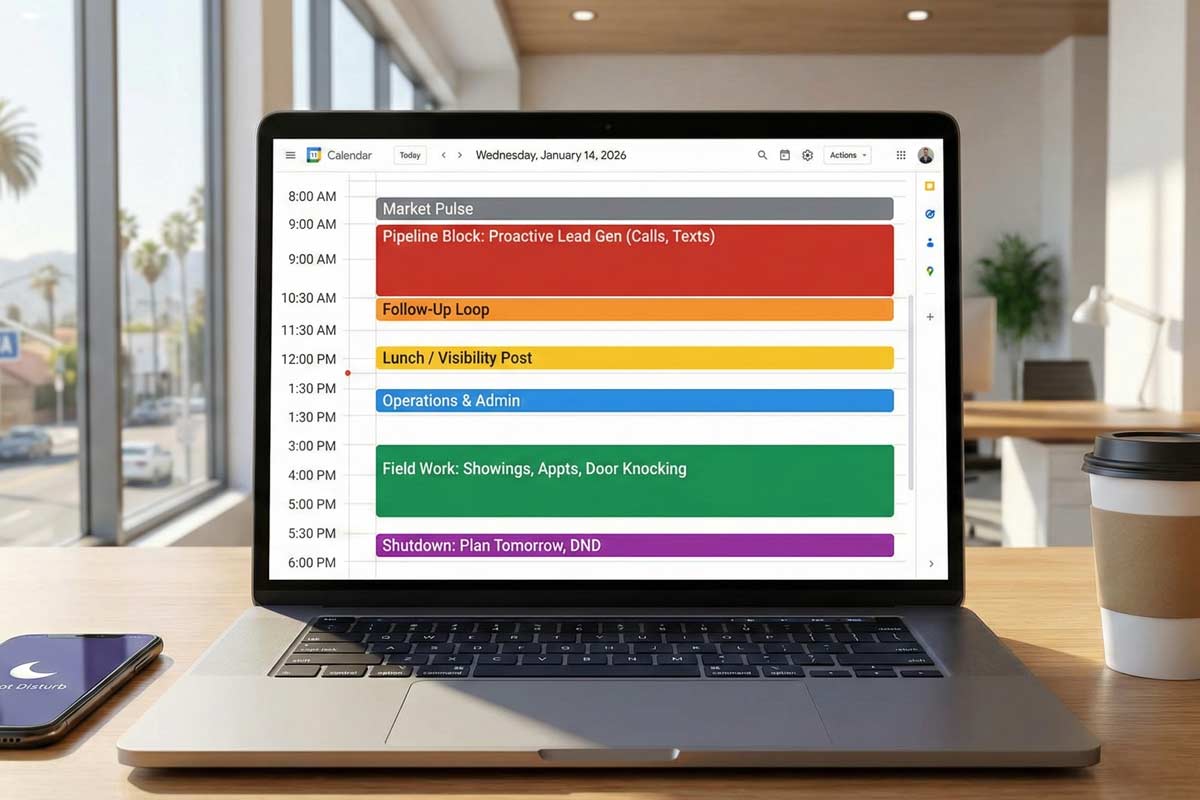
If your calendar keeps getting hijacked by non-urgent tasks, mastering your time as a real estate agent is your first priority. Use this block schedule to regain control.
Most agents fail because they are reactive. If your calendar is a blank slate, other people will write on it. This creates a "feast or famine" cycle that leads to burnout.
Never miss your daily habits two days in a row. If a closing goes sideways and you miss your morning calls today, that’s life. If you miss them tomorrow, that’s a choice. This isn’t about working longer hours—it’s about protecting the few actions that compound.
If you are overwhelmed, do this 60-minute checklist to keep your business alive:
What do top producing agents do every day?
They prioritize "Revenue Generating Activities" (RGAs) like lead generation and follow-up during their peak energy hours and leave administrative tasks for the afternoon.
How many calls do top agents make per day?
Many top producers aim for 10–20 real conversations per day and increase volume during growth phases. The key metric is meaningful conversations, not just dials.
What is a good daily schedule for a real estate agent?
A good schedule is "time-blocked," meaning specific hours are dedicated to lead gen, client meetings, and admin. This prevents administrative "busy work" from eating into your prospecting time.
How do agents stay consistent without burnout?
By setting firm boundaries and treating their "recharge" time as a non-negotiable appointment on their calendar, just like a listing presentation.
Ready to Master the Business?
Habits are the foundation, but skills are the ceiling. If you want to move from "busy" to "profitable," you need to master the full stack of Real Estate Agent Skills California required for this unique market.

Founder, Adhi Schools
Kartik Subramaniam is the Founder and CEO of ADHI Real Estate Schools, a leader in real estate education throughout California. Holding a degree from Cal Poly University, Subramaniam brings a wealth of experience in real estate sales, property management, and investment transactions. He is the author of nine books on real estate and countless real estate articles. With a track record of successfully completing hundreds of real estate transactions, he has equipped countless professionals to thrive in the industry.

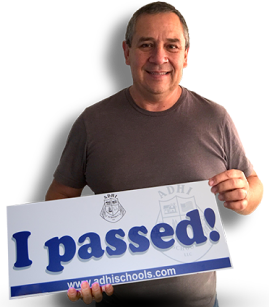
"Hey guys,
I took the exam today and passed!!!!
It only took me one try which was one of my goals. I took the online
classes and follow your suggestions so I took the crash course,
used the crash course app a lot, took 7 mock tests and went
confident to present the exam. Thank you for the great job you are
doing, you guys are awesome!!!! May God continue to bless you!"
Willie V.