
Selecting a real estate school is the first professional decision you will make in your new career. It is often the difference between getting licensed in six months or being stuck in a cycle of retakes and frustration two years from now.
Many prospective agents choose a school based solely on the lowest price or the flashiest marketing promise. However, a "cheap" course becomes expensive very quickly if the materials are outdated, the support is non-existent, or the curriculum fails to prepare you for the California Department of Real Estate (DRE) state exam.
Most students who come to us after failing elsewhere don’t lack effort—they lacked access to real instruction. After 20 years of helping students navigate this process, I’ve learned that the "best" school isn't a universal title—it’s the one that prioritizes actual learning over marketing optics.
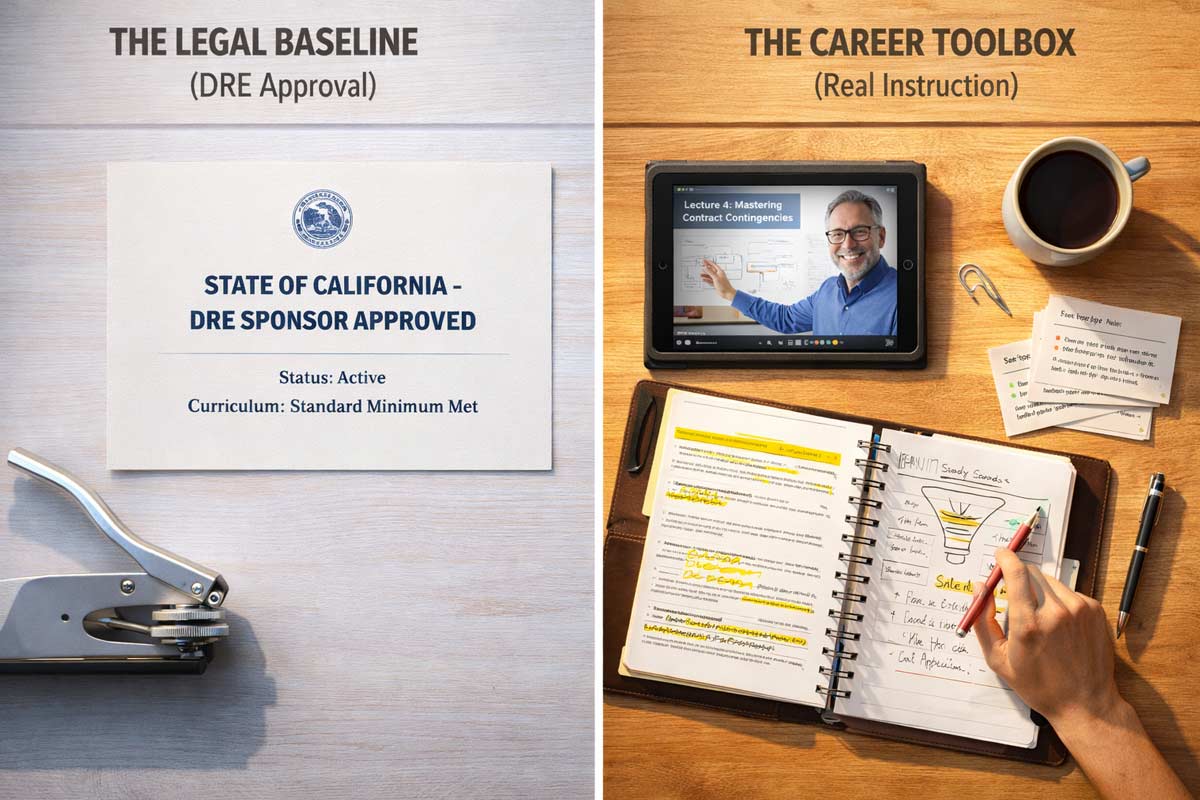
In California, you cannot sit for the state exam unless you complete three college-level courses from an approved provider. DRE approval is the absolute minimum legal requirement—it is not a rating of quality. It simply means the school has permission to offer the curriculum.
How to verify in minutes:
To understand why this approval is just the starting line, read our guide on What Makes a Real Estate School DRE-Approved?
The format of the school should match your lifestyle, not the other way around. A "self-paced" course is only a value if you have the discipline to finish it without a structured environment.
| Learner Profile | Priority | Recommended Feature |
|---|---|---|
| The Full-Time Professional | Efficiency | High-quality mobile interface & clear PDF materials. |
| The Anxious Test-Taker | Stability | Live webinars or in-person coaching components. |
| The Fast-Tracker | Support | Responsive administrative teams for finishing certificates. |
| The Career Switcher | Practicality | Instructors who provide context through California examples. |
Real-World Scenario: Many students choose a purely digital format because it's cheaper, only to realize months later they’ve stopped making progress because they have no one to ask for clarification.
Many online schools are essentially "digital bookstores." They sell you the material and leave you to navigate it alone.
If you hit a wall while studying Agency or Valuation, you need a human answer. In high-volume, low-support environments, you might wait days for a canned email response. This delay kills your momentum.
When evaluating a school, ask: “If I don’t understand a concept, can I reach out to an instructor, or am I limited to a help-desk ticket?”
Instructional depth is what prevents failure. You can learn more about this in our guide on The Role of Instructors in CA Real Estate Education.
The goal is to pass the state exam on your first attempt. High-quality exam prep is about feedback loops, not just repetition.
Scrutinizing the Guarantee:
Many schools market a Pass Guarantee. It is important to view these as administrative policies rather than trust signals. A guarantee is effectively a "post-failure" plan; it does not indicate the quality of the instruction itself. Often, the fine print requires multiple failures or specific prerequisites to qualify. Focus on the quality of the practice rationales—that is what keeps you from needing the guarantee in the first place.

A crash course is a "gap-closer," not a foundation. If the primary pre-licensing courses were low-quality, a weekend session cannot replace 135 hours of lost learning.
The Readiness Benchmark: If you are scoring 70–75% on practice exams, a crash course can provide the "test-taking logic" to secure a pass. If you are scoring 50%, you likely need to revisit the core material.
For more on timing your prep, see: Are Crash Courses Worth It in California?
The "sticker price" of a real estate school is rarely the final cost. Look for "friction points" that lead to hidden expenses:
Insider Tip: If a school’s support is slow during the enrollment process, it will likely be slower when you are waiting for your course completion certificates.
Use this rubric to evaluate providers. Score them based on substance, not marketing.
Guarantees are secondary to instructional quality. A guarantee is relevant only after you have failed. Your priority should be finding a school with active instructor support and robust practice rationales—the tools that help you pass the first time.
No. DRE approval only means the school meets the minimum legal curriculum requirements. It is a baseline for entry, not a measure of how well the school prepares you for a career or the state exam.
Prioritize "support responsiveness." When your study time is limited to late nights or weekends, you cannot afford to wait days for a response to a question. You need a school that provides the resources to keep you moving forward.
Choosing a real estate school is about finding a partner for your licensure journey. A great school makes guarantees mostly irrelevant because the instruction is designed to help you pass the first time. To see how different programs compare across the state using this objective framework, view our guide to the best real estate schools in California.

Founder, Adhi Schools
Kartik Subramaniam is the Founder and CEO of ADHI Real Estate Schools, a leader in real estate education throughout California. Holding a degree from Cal Poly University, Subramaniam brings a wealth of experience in real estate sales, property management, and investment transactions. He is the author of nine books on real estate and countless real estate articles. With a track record of successfully completing hundreds of real estate transactions, he has equipped countless professionals to thrive in the industry.

"Hey guys,
I took the exam today and passed!!!!
It only took me one try which was one of my goals. I took the online
classes and follow your suggestions so I took the crash course,
used the crash course app a lot, took 7 mock tests and went
confident to present the exam. Thank you for the great job you are
doing, you guys are awesome!!!! May God continue to bless you!"
Willie V.