How CE Helps Agents Stay Out of DRE Trouble
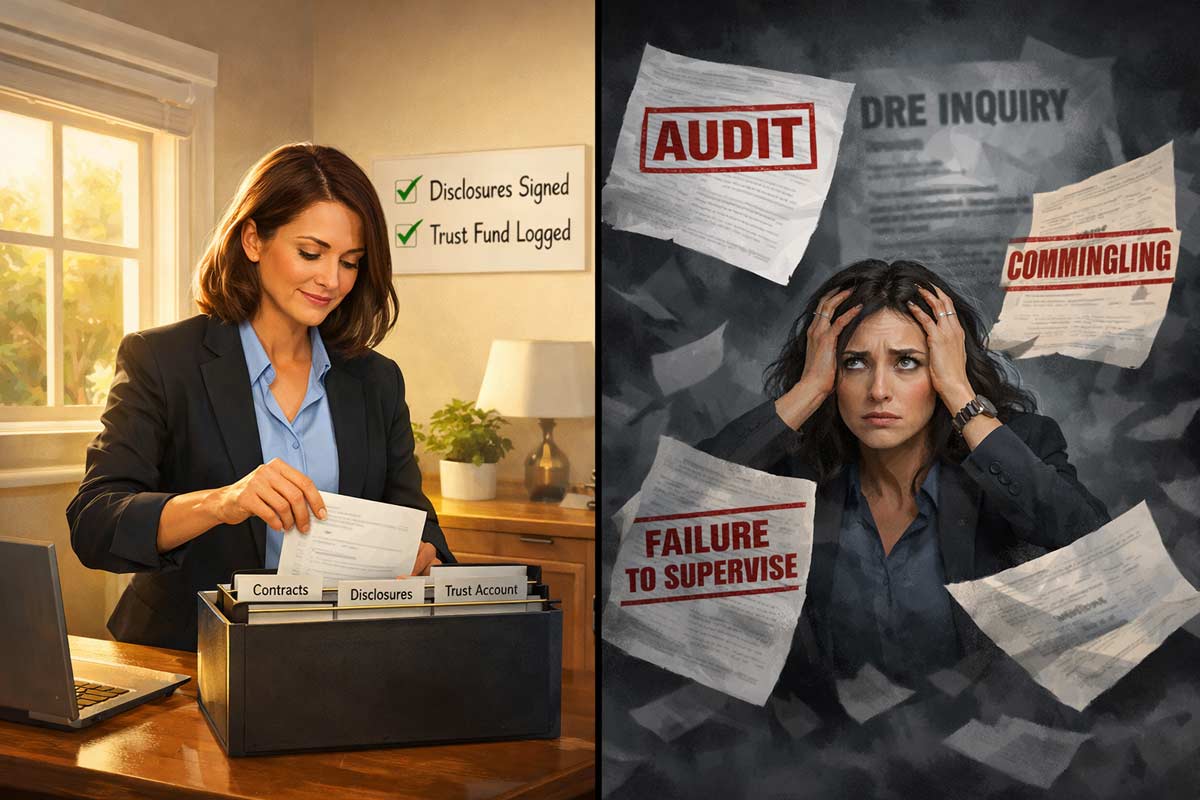
The most stressful mail a licensee can receive isn't a lost commission check—it's an inquiry letter from the California Department of Real Estate (DRE).
Most agents don’t set out to break the law; they fall into "DRE trouble" because of outdated habits or misunderstood regulations. In my 20-plus years of advising California licensees, I’ve seen that the best defense isn't a legal team—it’s a solid operational foundation. This is where Continuing Education (CE) shifts from a bureaucratic hurdle to a professional firewall to help agents avoid DRE violations.
Key Takeaways
- Reduces Complaint Risk: Identifies the "red flag" behaviors that trigger consumer grievances.
- Prevents Audit Deficiencies: Ensures your trust fund and transaction records meet DRE standards.
- Forces Documentation Habits: Moves compliance from a "memory task" to a repeatable system.
What “DRE Trouble” Actually Looks Like
DRE trouble rarely starts with a "bad" person; it starts with a bad process. Here is how the regulatory machinery typically moves:
- Consumer Complaints: Often triggered by a frustrated client, these lead to an investigative inquiry that can open up your entire file history.
- Audit/Document Requests: Whether random or "for cause," an auditor will scrutinize your transaction folders and trust fund records for technical accuracy.
- Renewal Delays: Simple errors in your CE reporting or incomplete requirements can lead to a "deficiency" notice, potentially causing your license to expire while you scramble to fix it.
- Disciplinary Actions: This can range from a private citation and fine to a public "Accusation" that may result in a restricted license or revocation.
Disclaimer: This article provides educational information on compliance and is not intended as legal advice.

The 80/20 of What Gets Agents in Trouble
The DRE focuses on patterns. Most violations happen in these high-risk zones:
- Advertising & Representation: Improper team names that omit the broker’s identity or missing license numbers on social media marketing.
- Disclosure Failures: Missing "material facts" or failing to provide Agency Disclosure forms at the earliest practical moment.
- Trust Funds & Records: The "cardinal sin." Commingling funds or failing to maintain a proper 3-column record of client money.
- Management & Supervision: A major magnet for DRE trouble. Brokers are responsible for the oversight of salespersons and unlicensed assistants; a lack of a "reasonable system of supervision" is a frequent cause for discipline.
- Records & Documentation: Failing to retain transaction-related documents for the required three-year period. If it isn't in the file, as far as an auditor is concerned, it didn't happen.
How CE Prevents Violations
When you approach your California Real Estate License Renewal with a focus on compliance, you treat each CE bucket as a defensive strategy.
1. Ethics & Disclosure
- The Misunderstanding: "I only need to disclose things that are physically broken."
- The Reality: California requires disclosure of anything that affects the value or desirability of the property.
- The Scenario: An agent fails to mention a neighbor's recurring noise complaint. The buyer finds out, files a DRE complaint, and the agent faces an inquiry around misrepresentation.
- CE Takeaway: Use your Risk Management CE to audit a recent Transfer Disclosure Statement (TDS) and Agent Visual Inspection Disclosure (AVID). If you're unsure, disclose it.
2. Fair Housing (Interactive Requirements)
- The Misunderstanding: "I'm a good person, so I'm not violating fair housing."
- The Reality: Bias in marketing and "steering" are primary DRE focus areas.
- The Scenario: An agent tells a caller, "You'd probably be more comfortable in the neighborhood across town." Even if meant "helpfully," this is steering.
- CE Takeaway: DRE renewal requirements now include interactive fair housing and implicit bias components. Use this training to practice compliant responses to client questions about "neighborhood demographics."
3. Trust Fund Handling
- The Misunderstanding: "My broker handles the money, so the timing doesn't matter for me."
- The Reality: If you touch a check, you are responsible for the record-keeping and handling according to DRE and brokerage-specific timelines.
- The Scenario: An agent holds an earnest money check for several days without a written agreement to do so. An audit reveals the delay, leading to a citation for improper handling.
- CE Takeaway: Implement a "Monday Morning" rule: any funds received must be logged and processed according to your broker's compliance manual immediately.
“Audit-Proof” CE Choices
To ensure your renewal goes smoothly and your files stay clean, use this checklist:
Post-Renewal: Your 30-Day “Stay-Out-of-Trouble” Plan
Once you’ve completed your CE, don't just file the certificates. Implement these operational habits:
| Task |
Action |
| Ad Audit |
Review your Instagram bio, email signature, and website. Do they include your DRE number and brokerage name? |
| Complaint-Proofing |
Start a "Communication Log" for every transaction. Document all verbal instructions from clients via a "confirming email." |
| File Hygiene |
Spend 10 minutes every Friday reviewing your active transaction files for missing signatures or incomplete disclosures. |
| SOP Update |
Ask your broker or manager for a simple one-page Standard Operating Procedure (SOP) for how your team handles "material fact" discoveries. |
Once you’ve handled the technical side of the law, you can focus on the growth side of your business. For more on what to do once the renewal is submitted, see our guide on What to Do After Renewing Your CA Real Estate License.
Staying Compliant Is a Choice
At ADHI Schools, we build our CE courses around real-world compliance outcomes because we know a license is more than a piece of paper—it’s your livelihood. Think of CE as your biennial "compliance tune-up." It’s the most cost-effective insurance policy you can buy.
Kartik Subramaniam
Founder, Adhi Schools
Kartik Subramaniam is the Founder and CEO of ADHI Real Estate Schools, a leader in real estate education
throughout California. Holding a degree from Cal Poly University, Subramaniam brings a wealth of experience in
real estate sales, property management, and investment transactions. He is the author of nine books on real
estate and countless real estate articles. With a track record of successfully completing hundreds of real
estate transactions, he has equipped countless professionals to thrive in the industry.