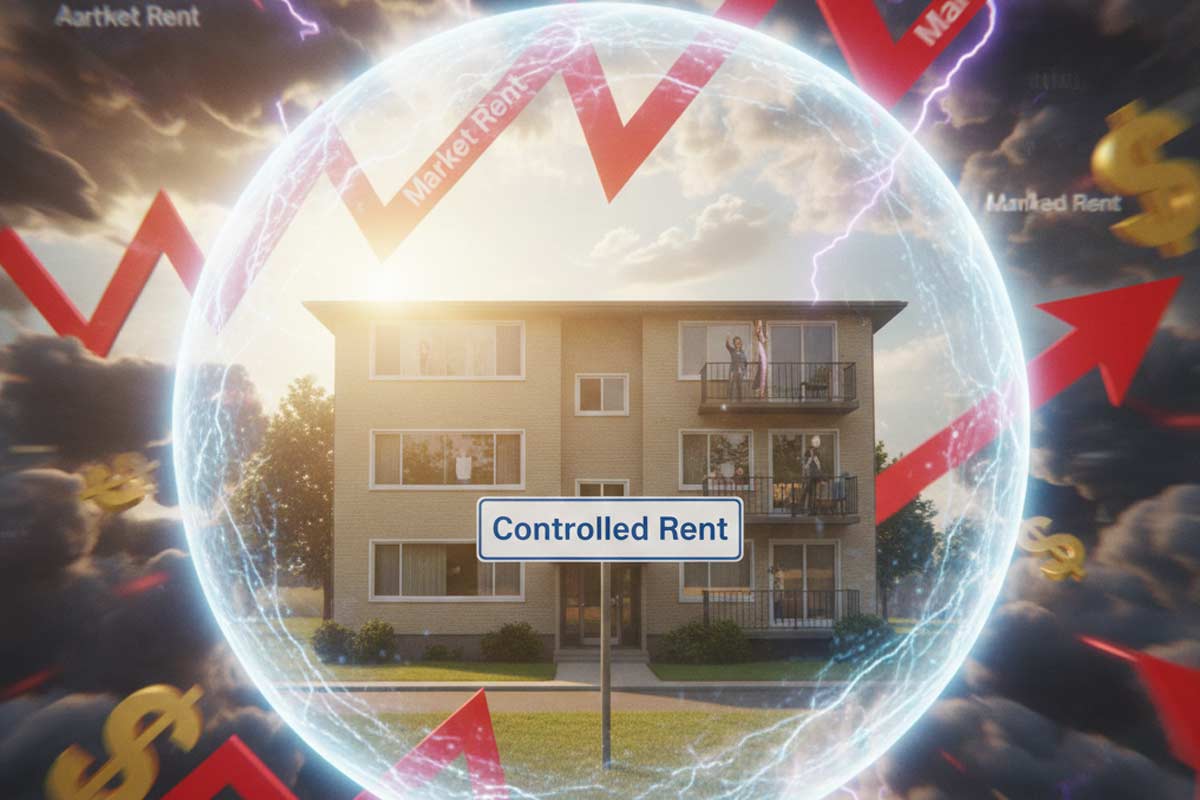
Imagine you’re the listing agent for a 1970s fourplex in Los Angeles. The seller tells you the rents are "well below market" and the buyer can easily raise them by 20% to stabilize the asset. You include Read more...
Imagine you’re the listing agent for a 1970s fourplex in Los Angeles. The seller tells you the rents are "well below market" and the buyer can easily raise them by 20% to stabilize the asset. You include this in your MLS marketing.
The buyer closes, attempts the increase, and is immediately hit with a wrongful rent increase lawsuit and a city enforcement action. It turns out that because the property is in the City of L.A., it is subject to a local 3% cap for the current cycle (specifically the period through June 30, 2027)—not the statewide 10% maximum.
As an agent, you don’t need to be a lawyer, but you must be a high-level "compliance operator." In California’s 2026 regulatory environment, a single misstatement about "market rent potential" can lead to a professional liability nightmare.
Compliance Disclaimer: This is educational and not legal advice; agents should verify current rules as of the publish date. Local rules are frequently stricter than state law; always consult qualified counsel or local housing departments for jurisdiction-specific guidance.
The Two-Layer System: Statewide vs. Local
To keep your clients safe, use this mental model for every residential transaction:
The State Baseline (AB 1482): This applies to most multi-family housing and corporate-owned rentals statewide.
The Local Card: Cities like Los Angeles, San Francisco, and San Jose have local Rent Stabilization Ordinances (RSOs). If the local rule is more restrictive, the local rule prevails.
Field Scenario: You are showing a property in a city you aren't familiar with. Before discussing rent upside, your first move should be advising the buyer to check the city’s website for a "Rent Stabilization" or "Housing Department" page.
What Agents Must Know About Statewide Rent Caps (AB 1482)
Under the Tenant Protection Act, annual rent increases are capped at 5% plus the local Consumer Price Index (CPI), or 10% total, whichever is lower.
Common Exemptions (Verify for Every Deal)
Properties that are sometimes exempt from the state cap include:
Rolling 15-Year Rule: Residential property issued a certificate of occupancy within the last 15 years (verify the specific date on the CO).
Qualifying SFHs & Condos: Generally exempt only if the owner is not a REIT, a corporation, or an LLC with a corporate member.
Owner-Occupied Duplexes: If the owner occupied one of the units at the start of the tenancy and still lives there.
Agent Pitfall: A single-family home is not automatically exempt. For the exemption to hold, the landlord must have provided the tenant with specific statutory disclosure language in the lease. If that notice is missing, the property may remain "covered" by the rent cap.
“Just Cause” and Tenant Protections in a Sale
The "Just Cause" framework means a landlord cannot terminate a month-to-month lease without a valid legal reason once a tenant has been in place for 12 months.
Vacancy Assumptions: Never promise a buyer the property will be "delivered vacant." If the tenant is protected by "Just Cause," vacancy usually requires a "no-fault" reason like an owner move-in or a substantial remodel.
Relocation Assistance: "No-fault" evictions typically require the landlord to pay the tenant relocation assistance (often equal to one month’s rent, though local laws may require more).
Renovation Requirements: For a "substantial remodel" to be valid, the work must require permits (which must be provided with the notice) and must render the unit unsafe for occupancy for at least 30 consecutive days.
The Agent’s Rent-Control Workflow
Use this checklist during your due diligence period. This is the same logic we outline in our California Real Estate Laws & Compliance Guide.
Rent Control Compliance Checklist
Verify Age: Check the original Certificate of Occupancy date (do not rely solely on assessor data).
Audit Ownership: Confirm if the owner is a person, a trust, or a corporation.
Confirm Local Rules: Check the city/county for local RSO or unincorporated area protections.
Lease Review: Scan (also advise the buyer to) the current lease for AB 1482 "Notice of Exemption" or "Notice of Coverage" language.
Verify Rent History: Request the last 24 months of rent ledgers to ensure previous increases were lawful.
Confirm CPI Basis: Use the 2026 CPI figures for that specific metropolitan area (typically based on April data for increases after August 1).
Marketing Audit: Remove any "guaranteed" income or "easy eviction" claims from the MLS.
Advertising & Pricing Claims: What Not to Say
Risky Statement
Safer Alternative
“Can raise rent to market immediately.”
“Buyer to verify rent control applicability and allowable increases.”
“Guaranteed vacancy at close.”
“Subject to tenant rights; buyer to verify vacancy procedures with qualified professionals.”
“Property is exempt from rent control.”
“Owner-reported exemption to be verified by buyer during due diligence.”
Common Deal Killers (And How to Prevent Them)
Underwriting Mismatch: Lenders often use conservative rent growth assumptions if they see the property is subject to an RSO.
SB 9 & ADU Complications: Adding a unit can sometimes trigger different regulatory layers. See California ADU Laws Explained and SB 9 Explained for Real Estate Agents.
Missing Environmental Disclosures: Rent control isn't the only risk. See Environmental Regulations California Agents Should Know.
Water Rights Issues: Especially in rural properties, see Water Rights & Easements in California Real Estate.
FAQ
How do I know if a city has stricter rent control?
Search the city name + "Rent Stabilization Ordinance." If the city has its own cap (like the L.A. 3% limit), that number overrides the state floor.
Can rent be increased after a property sells?
A change in ownership does not reset the rent cap. The new owner is bound by the same annual limits as the previous owner for any existing tenants.
What is "Vacancy Decontrol"?
This is the concept that once a tenant moves out voluntarily, a landlord can usually reset the rent to market rate. However, once the new tenant moves in, the cap usually applies again.
Do local ordinances apply in unincorporated county areas?
Yes. For example, L.A. County has a dedicated Rent Stabilization and Tenant Protections Ordinance that covers unincorporated areas.
What documents should I request during due diligence?
Always request the original lease, all addendums, the Certificate of Occupancy, and a certified rent roll for the last 2 years.
Does AB 1482 apply to duplexes or triplexes?
Yes, unless they meet specific exemptions such as the "owner-occupied duplex" rule where the owner lived there before the tenancy began.
|

The most stressful mail a licensee can receive isn't a lost commission check—it's an inquiry letter from the California Department of Real Estate(DRE).
Most agents don’t set out to break the law; Read more...
The most stressful mail a licensee can receive isn't a lost commission check—it's an inquiry letter from the California Department of Real Estate(DRE).
Most agents don’t set out to break the law; they fall into "DRE trouble" because of outdated habits or misunderstood regulations. In my 20-plus years of advising California licensees, I’ve seen that the best defense isn't a legal team—it’s a solid operational foundation. This is where Continuing Education (CE) shifts from a bureaucratic hurdle to a professional firewall to help agents avoid DRE violations.
Key Takeaways
Reduces Complaint Risk: Identifies the "red flag" behaviors that trigger consumer grievances.
Prevents Audit Deficiencies: Ensures your trust fund and transaction records meet DRE standards.
Forces Documentation Habits: Moves compliance from a "memory task" to a repeatable system.
What “DRE Trouble” Actually Looks Like
DRE trouble rarely starts with a "bad" person; it starts with a bad process. Here is how the regulatory machinery typically moves:
Consumer Complaints: Often triggered by a frustrated client, these lead to an investigative inquiry that can open up your entire file history.
Audit/Document Requests: Whether random or "for cause," an auditor will scrutinize your transaction folders and trust fund records for technical accuracy.
Renewal Delays: Simple errors in your CE reporting or incomplete requirements can lead to a "deficiency" notice, potentially causing your license to expire while you scramble to fix it.
Disciplinary Actions: This can range from a private citation and fine to a public "Accusation" that may result in a restricted license or revocation.
Disclaimer: This article provides educational information on compliance and is not intended as legal advice.
The 80/20 of What Gets Agents in Trouble
The DRE focuses on patterns. Most violations happen in these high-risk zones:
Advertising & Representation: Improper team names that omit the broker’s identity or missing license numbers on social media marketing.
Disclosure Failures: Missing "material facts" or failing to provide Agency Disclosure forms at the earliest practical moment.
Trust Funds & Records: The "cardinal sin." Commingling funds or failing to maintain a proper 3-column record of client money.
Management & Supervision: A major magnet for DRE trouble. Brokers are responsible for the oversight of salespersons and unlicensed assistants; a lack of a "reasonable system of supervision" is a frequent cause for discipline.
Records & Documentation: Failing to retain transaction-related documents for the required three-year period. If it isn't in the file, as far as an auditor is concerned, it didn't happen.
How CE Prevents Violations
When you approach your California Real Estate License Renewal with a focus on compliance, you treat each CE bucket as a defensive strategy.
1. Ethics & Disclosure
The Misunderstanding: "I only need to disclose things that are physically broken."
The Reality: California requires disclosure of anything that affects the value or desirability of the property.
The Scenario: An agent fails to mention a neighbor's recurring noise complaint. The buyer finds out, files a DRE complaint, and the agent faces an inquiry around misrepresentation.
CE Takeaway: Use your Risk Management CE to audit a recent Transfer Disclosure Statement (TDS) and Agent Visual Inspection Disclosure (AVID). If you're unsure, disclose it.
2. Fair Housing (Interactive Requirements)
The Misunderstanding: "I'm a good person, so I'm not violating fair housing."
The Reality: Bias in marketing and "steering" are primary DRE focus areas.
The Scenario: An agent tells a caller, "You'd probably be more comfortable in the neighborhood across town." Even if meant "helpfully," this is steering.
CE Takeaway: DRE renewal requirements now include interactive fair housing and implicit bias components. Use this training to practice compliant responses to client questions about "neighborhood demographics."
3. Trust Fund Handling
The Misunderstanding: "My broker handles the money, so the timing doesn't matter for me."
The Reality: If you touch a check, you are responsible for the record-keeping and handling according to DRE and brokerage-specific timelines.
The Scenario: An agent holds an earnest money check for several days without a written agreement to do so. An audit reveals the delay, leading to a citation for improper handling.
CE Takeaway: Implement a "Monday Morning" rule: any funds received must be logged and processed according to your broker's compliance manual immediately.
“Audit-Proof” CE Choices
To ensure your renewal goes smoothly and your files stay clean, use this checklist:
Verify Sponsor: Ensure the provider is a DRE-approved sponsor, like ADHI Schools, with a valid ID.
Interactive Requirements: Confirm you’ve completed the mandatory interactive fair housing and implicit bias components.
Correct Hours: Confirm you have the full 45 hours (or the required amount for your specific renewal cycle).
Storage: Save your certificates in a dedicated folder named CE-2026-Renewal-Certs.
DRE eLicensing: Upload your info early to avoid the last-minute "system is down" panic.
Post-Renewal: Your 30-Day “Stay-Out-of-Trouble” Plan
Once you’ve completed your CE, don't just file the certificates. Implement these operational habits:
Task
Action
Ad Audit
Review your Instagram bio, email signature, and website. Do they include your DRE number and brokerage name?
Complaint-Proofing
Start a "Communication Log" for every transaction. Document all verbal instructions from clients via a "confirming email."
File Hygiene
Spend 10 minutes every Friday reviewing your active transaction files for missing signatures or incomplete disclosures.
SOP Update
Ask your broker or manager for a simple one-page Standard Operating Procedure (SOP) for how your team handles "material fact" discoveries.
Once you’ve handled the technical side of the law, you can focus on the growth side of your business. For more on what to do once the renewal is submitted, see our guide on What to Do After Renewing Your CA Real Estate License.
Staying Compliant Is a Choice
AtADHI Schools, we build our CE courses around real-world compliance outcomes because we know a license is more than a piece of paper—it’s your livelihood. Think of CE as your biennial "compliance tune-up." It’s the most cost-effective insurance policy you can buy.
|
You’ve passed the real estate exam, your license is issued, and you’ve chosen a broker. Then, Monday morning hits. You sit at your desk, and the "post-license cliff" sets in: your calendar is empty, Read more...
You’ve passed the real estate exam, your license is issued, and you’ve chosen a broker. Then, Monday morning hits. You sit at your desk, and the "post-license cliff" sets in: your calendar is empty, and your phone isn't ringing.
The temptation for most new California agents is to reach for a credit card and buy leads. Every real estate office has that guest speaker pitching a magical "lead-gen tool" for $199 a month.
That is a short-term fix for a long-term problem.
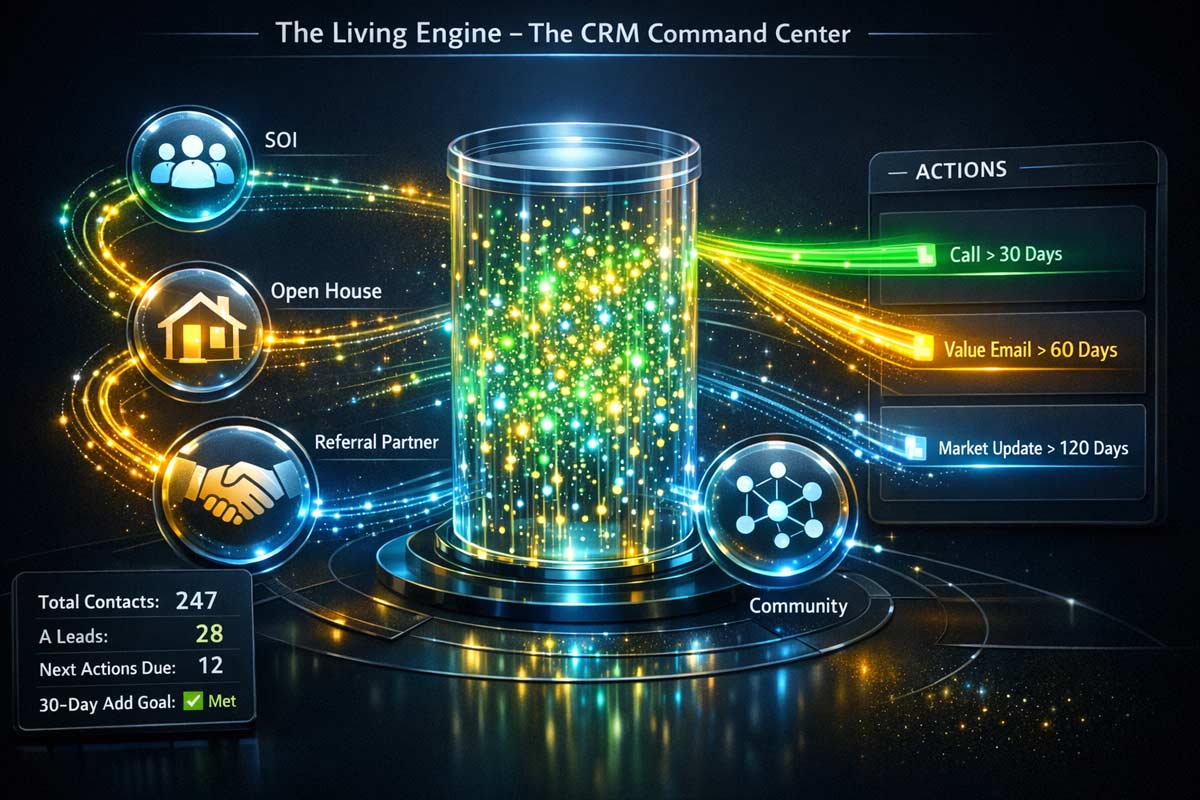
In our industry, your database is your business. It is the only asset you truly own. One clean database can produce repeat clients for 10 years; one lead-buy produces, at best, a one-time conversation.
A database doesn’t magically create deals—it creates conversations, and conversations create appointments.
A "from scratch" database isn't about empty contacts—it's about missing the system for consistent, targeted follow-up.
By the end of this guide, you will have a clear, 30-day roadmap to move from zero contacts to a professional follow-up system that produces consistent commissions.
What a "Database" Actually Means
A database is not just a list of names or an exported CSV file from your phone. A database is a list with memory. It records context (notes) and creates the next action (follow-up date).
What Should You Track in a Real Estate Database?
To turn a contact list into a revenue-generating database, you need specific data points. If you don't know what columns to make in your spreadsheet, copy this exact template:
Full Name
Phone Number & Email
Preferred Contact Method (Text, Call, or Email)
City/Neighborhood (Crucial for California's hyper-local markets)
School District/Commute Corridor (The “why” behind their location)
Relationship Status (How do you know them?)
Source (Sphere, Open House, Referral, Social, Vendor)
Tags/Categories (A/B/C ranking, Buyer, Seller)
Last Contact Date
Next Follow-Up Date
Notes (Kids’ names, pets, hobbies, real estate goals)
Your First Database Rule: One Contact = One Next Action
If someone is worth saving, they’re worth scheduling. Every new entry in your system must have either:
A next follow-up date, OR
A "Do Not Contact" note.
There is no third option. Why: if it isn’t scheduled, it won’t happen.
Choose Your Tool (Without Overcomplicating)
Do not get stuck "tool shopping." You can lose weeks comparing software features while making zero phone calls.
Choose a system based on your current volume:
Google Sheets (0–100 Contacts): The fastest way to start. Google Sheets is free, searchable, and forces you to learn the mechanics of data entry.
Basic/Free CRM (100–300 Contacts): Many brokerages provide a CRM included when you join (like BoldTrail (formerly KV Core) or Chime). Use what you already have before paying for a third-party tool.
Full CRM (300+ Contacts): Only invest in premium platforms once you have a consistent lead flow and need advanced automation.
The Rule: If you have under 100 contacts, start with a spreadsheet. If you spend more than two days "researching" CRMs, you are procrastinating. Pick one and execute.
The 8 Best Places to Get Your First 100 Contacts
You aren't starting from zero; you’re starting from "unorganized." Here is where to find your first 100 entries:
Phone Contacts: Export your contact list. Don’t “clean first.” Import them, then add 25 per day for four days. Momentum beats perfection.
Past Coworkers: Start with 10 you’d confidently ask for advice. You were a professional before you were an agent; these people already trust your work ethic.
The Gym/School/Hobby Circle: Anyone you see at least once a month belongs in the database.
Vendors: Your lender, escrow officer, and local contractors. Tag these as “Vendors” to build a referral exchange.
Open House Sign-ins: This is your primary engine. Rule: If they sign in, they go into your database before you leave the property—while the conversation is still fresh enough to write real notes. Learn how new agents should hold open houses to maximize this capture.
Social DMs: Look at who “likes” your posts. Message them: “Hey [Name], I’m updating my professional directory—what’s the best email to send my local market reports to?”
Community Groups: Local neighborhood associations or Facebook groups (be the helper, not the solicitor).
Out-of-Area Agents: Tag them as “Referral Partners.” A small group of active agents outside your zip code can become your most consistent referral pipeline.
Clean Data Beats Big Data (Hygiene)
Before you chase "more contacts," fix the basics. A messy database is a useless database.
Standardize Names: "Mike Smith," not "Mike S." or "Dad's Friend."
One Primary Contact: Identify one main phone number and email per person.
Merge Duplicates: Do not have three entries for the same person.
Add "Source": Always know where a lead came from so you can track ROI later.
Fix Bouncebacks: If an email bounces or a number is wrong, update it the same day.
The "DNC" Tag: Create a "Do Not Contact" tag so you don’t burn relationships by calling people who asked you to stop.
Tagging & Segmentation: The Power of "A-B-C"
If you treat everyone in your database the same, you will burn out. You must segment your contacts so you know who to call first.
The Starter Tag Framework
Tag Category
Examples
Purpose
Ranking
A (Referral source), B (Met once), C (Cold)
Prioritizes your daily call list.
Timeline
Hot (0–3 mo), Warm (3–12 mo), Long-term
Focuses your energy on immediate deals.
Type
Buyer, Seller, Investor, Vendor, Referral Partner
Determines what kind of content you send.
Source
Open House, Sphere, Referral
Tracks which lead sources for new California agents are working.
The Follow-Up Operating System
Building the list is only 20% of the work. The remaining 80% is the follow-up. Successful agents use new agent time management strategies to ensure they aren't just "busy," but productive.
Follow-Up Cadence
"A" Leads (Referral Sources): Contact every 30 days.
"B" Leads (Met Once/Acquaintances): Contact every 60–90 days.
"C" Leads (Cold/Distant): Contact every 120–180 days (about twice a year) with broad value.
Value-Based Scripts
The "Permission" Text (Low Pressure, High Reply):
"Hey [Name]—quick question. Would it be helpful if I kept you posted when something notable happens in [Neighborhood] (sales, price changes, anything meaningful)? If yes, what’s the best email for you?"
The "Market Micro-Update" (Email/Text):
"Hey [Name], I saw that a house just like yours around the corner sold for [Price]. It's interesting to see how [City] is holding up right now. Let me know if you’d ever like a quick look at your current home value!"
The "Direct Ask" (Voice):
"I'm taking on a couple more clients this month. Who do you know that’s mentioned moving, upsizing, downsizing, or investing—even if it’s ‘later this year’?"
30-Day Build Plan
Follow this checklist to go from a blank screen to a functioning business engine.
The 30-Day Database Blueprint
Week 1: The Foundation. Create your spreadsheet using the template fields above. Import phone contacts. Apply "A, B, C" rankings to the first 50 people.
Week 2: The Reach Out. Add 25 more names. Send the "Permission" text script to everyone tagged "A" or "B."
Week 3: The Expansion. Log all responses. Call those who replied. Research how to find your first 3 clients as a new agent to convert these conversations into appointments.
Week 4: The Routine. Establish a "Minimum Daily Action": Add 5 new people, contact 5 existing people, and log 5 sets of notes.
Common Mistakes That Kill Databases
Over the last 20+ years, Kartik Subramaniam has seen thousands of students launch their careers.
The ones who fail usually hit these eight pitfalls:
Waiting until you "feel ready" to start calling.
Saving contacts with no notes (you will forget who they are).
Failing to use tags, leading to a "messy" list you eventually ignore.
No "Next Follow-Up" date— if it isn't scheduled, it won't happen.
Relying on "Likes"— social media engagement is not a database relationship.
Buying leads before you’ve exhausted your free sphere of influence.
Sounding like a salesperson instead of a local guide.
Ignoring Open Houses as a primary way to feed the database engine.
Kartik's Insider Tip: “I’ve seen agents turn a 'maybe next year' lead into a $30,000 commission simply because they had a 'follow up in 6 months' tag and actually made the call. Most agents quit after one 'no.' The database ensures you are there when the 'no' turns into a 'now.'”
Start Your Career the Right Way
A database is the difference between a "job" and a "business." Without it, you are unemployed every time a transaction closes. With it, you have a predictable stream of referrals and repeat clients.
If you are ready to move beyond the basics, it is time to look at the bigger picture of your professional development. If you’re building your first-year foundation in California, that’s the full roadmap.
Start a Real Estate Career in California →
FAQ
1. How many contacts should a new agent have?
Aim for 100 "met" contacts as quickly as possible. This is the baseline required to generate consistent referral traffic. Once you hit 100, aim for 250.
2. Do I need an expensive CRM to start in California?
No. A simple Google Sheet is often more effective for your first 100 contacts because it forces you to stay organized without the distraction of complex features.
3. What is a "Sphere of Influence" in real estate?
Your sphere of influence (SOI) consists of everyone you know personally who already likes and trusts you—friends, family, past coworkers, and neighbors. These are your warmest leads.
4. How often should I contact my database?
Contact "A" leads (referrals) every 30 days, "B" leads every 60–90 days, and "C" leads every 120–180 days (about twice a year).
5. What is the best way to ask for a referral?
Be direct but value-focused. Ask who they know that needs help navigating the current California market, rather than just asking for a name.
|
One of the most common questions we hear sounds like: “I upgraded to a broker license—do I have extra CE hours now?” or “Do I have to take different classes than when I had my sales license?”
The Read more...
One of the most common questions we hear sounds like: “I upgraded to a broker license—do I have extra CE hours now?” or “Do I have to take different classes than when I had my sales license?”
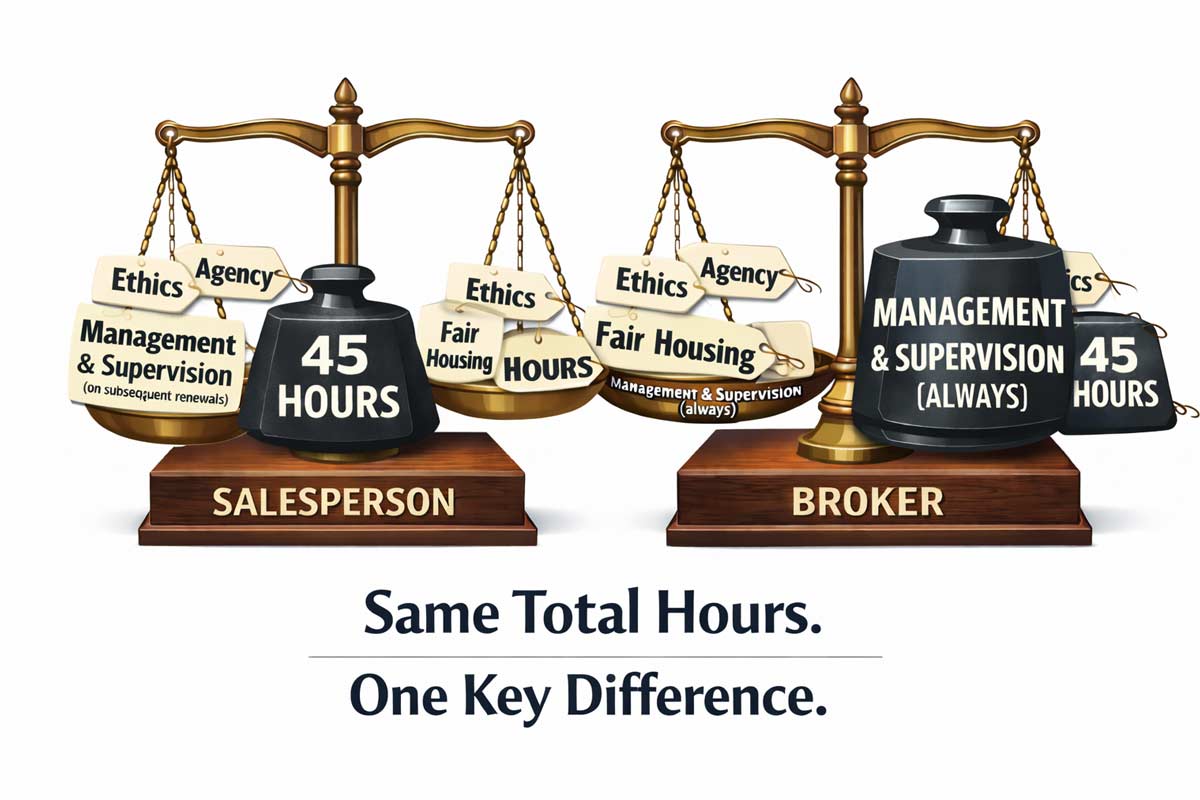
The confusion is understandable. In California, brokers carry a higher level of legal responsibility—so it feels like the DRE should require more education. The reality is simpler: the total hours are the same, but the required subject mix is where brokers can get tripped up.
Key Takeaways
Total Hours: Brokers and salespersons both complete 45 hours of DRE-approved CE each 4-year renewal cycle.
The Content Mix: Brokers must include Management and Supervision as a mandatory topic (salespersons don’t on their first renewal).
The 9-Hour Survey: For second and subsequent renewals (for licenses expiring on/after Jan 1, 2023), a 9-hour survey can cover all mandatory topics in one course.
Interactive Requirement: For licenses expiring on/after Jan 1, 2023, Fair Housing must include an interactive, participatory component.
Quick Answer: Broker vs. Salesperson CE
In California, brokers and salespersons both need 45 hours of continuing education to renew. The difference is what’s inside the 45 hours: brokers must ensure they complete Management and Supervision as part of their mandatory topic mix. While the total hour count is identical, the DRE requires brokers to undergo specific training related to their role as a potential supervisor.
Comparison Table: Salesperson vs. Broker Renewal
Feature
Salesperson (First Renewal)
Broker (First Renewal)
Second+ Renewals (Both)*
Total Hours
45 hours
45 hours
45 hours
Mandatory Core Courses
4 Subjects (3-hrs each)
5 Subjects (3-hrs each)
Included in 9-hour survey
Fair Housing
3-hr + Interactive Implicit Bias
3-hr + Interactive Implicit Bias
Included in 9-hour survey
Implicit Bias
2-hr Required
2-hr Required
Included in 9-hour survey
Mgmt. & Supervision
Not Required
Required
Included in 9-hour survey
*Applies to licenses expiring on/after Jan 1, 2023, and late renewals filed after that date.
What’s the Same for Everyone?
Regardless of license type, the DRE’s CE structure is built around consumer protection—so the baseline framework stays consistent. That’s why the California Real Estate License Renewal Requirements don’t "punish" brokers with extra hours.
The 4-year renewal cycle applies to everyone.
The total is always 45 hours—no "broker bonus hours."
Mandatory topics + consumer protection hours are the backbone of every renewal package.
What’s Different for Brokers?
If the hours are the same, why does broker CE feel different? Accountability.
A broker isn’t just responsible for their own files—they’re responsible for the supervision standard in the office: policies, advertising compliance, trust fund handling, and risk reduction. That’s why Management and Supervision is explicitly part of the broker requirement - even on the first renewal.
Operator Scenarios: Where Brokers Actually Get Exposed
The Supervision Trap: A broker assumes "supervision" just means reviewing contracts. In reality, brokers can be on the hook for agent advertising and compliance breakdowns across the entire team.
Trust Fund Risk: Most salespersons never touch trust fund handling—brokers live inside it. Small process errors can turn into big consequences during a DRE audit.
First Renewal vs. Subsequent Renewals
This is where people accidentally choose the wrong package. Your path depends on your renewal "generation."
1) First Renewal
First renewal requires the mandatory subjects as individual courses, plus the required Fair Housing and Implicit Bias components.
Salespersons: 4 separate 3-hour courses (Ethics, Agency, Trust Funds, Risk Management) + 3-hour interactive Fair Housing + 2-hour Implicit Bias.
Brokers: All of the above PLUS a 3-hour Management and Supervision course.
To avoid confusion, view the full roadmap here: California Real Estate License Renewal Guide
2) Second and Future Renewals
For licenses expiring on/after Jan 1, 2023, the DRE allows a 9-hour survey course that covers all mandatory topics (including Management and Supervision) in a single module. You then complete the remaining hours with electives—ideally from clearly qualified Courses That Count Toward CE in California.
7 Common Mistakes That Trigger Delays
REALTOR® Ethics vs. DRE Ethics: Assuming NAR training counts (it usually doesn’t unless the provider specifically issued a DRE-approved CE certificate).
Non-Interactive Fair Housing: Taking an old-style text course for Fair Housing when your license expires after Jan 1, 2023.
Missing Implicit Bias: Failing to ensure the 2-hour standalone course is in your package. See: Does California Require Implicit Bias Training for Renewal?
Overbuying Hours: Thinking brokers need more than 45. Confirm your California CE hour requirements before paying.
Unverified Providers: Using a "national" school that lacks a California DRE Sponsor Number.
Waiting Until the Final 24 Hours: Because of the 15-hour exam limit (see below), you literally cannot finish 45 hours in one day.
Wrong Package Type: A broker taking a salesperson package and missing the Management and Supervision credit.
Step-by-Step: Choosing the Right CE Package
Verify Sponsor Details: Ensure the school is DRE-approved.
Check Fair Housing: Confirm it includes the "interactive participatory component."
Respect the 24-Hour Rule: The DRE limits licensees to completing final examinations for a maximum of 15 credit hours per 24-hour period. If you have 45 hours of testing to do, you need at least three separate 24-hour windows to complete your exams.
FAQ
Do brokers need more CE hours than salespersons in California?
No. Both license types require 45 hours every four years.
Is Management and Supervision required for brokers?
Yes. It is mandatory for all broker renewals (first and subsequent).
What is the 9-hour survey course?
It's a condensed course covering all seven mandatory subjects, available only for second and subsequent renewals.
Does Fair Housing have to be interactive?
For licenses expiring on or after Jan 1, 2023, yes. This includes late renewals filed after that date.
How early can I renew?
You can submit your renewal via eLicensing up to 90 days before your expiration date.
Broker renewal shouldn’t create uncertainty or cause you to buy the wrong package. The goal is simple: meet the DRE requirements cleanly, protect your license, and keep your business.
|
You’re staring at your 45-hour renewal options and you notice a new line item: “Implicit Bias Training.”
The real question isn’t what it is—it’s whether missing it can delay your renewal.
Read more...
You’re staring at your 45-hour renewal options and you notice a new line item: “Implicit Bias Training.”
The real question isn’t what it is—it’s whether missing it can delay your renewal.
For California renewals tied to the post–January 1, 2023 CE rules, Implicit Bias is a mandatory DRE-required topic—and the only “gotcha” is how it must appear on your CE completion records depending on whether this is your first renewal or a later renewal.
This guide clarifies the rules so you can renew your license without a rejection.
Quick Answer: Do I Need This?
Yes. Implicit Bias Training is required as part of California’s renewal CE.
Requirement: 2 hours of DRE-approved Implicit Bias Training.
Does it add hours? No—it's part of your required 45 hours (not extra).
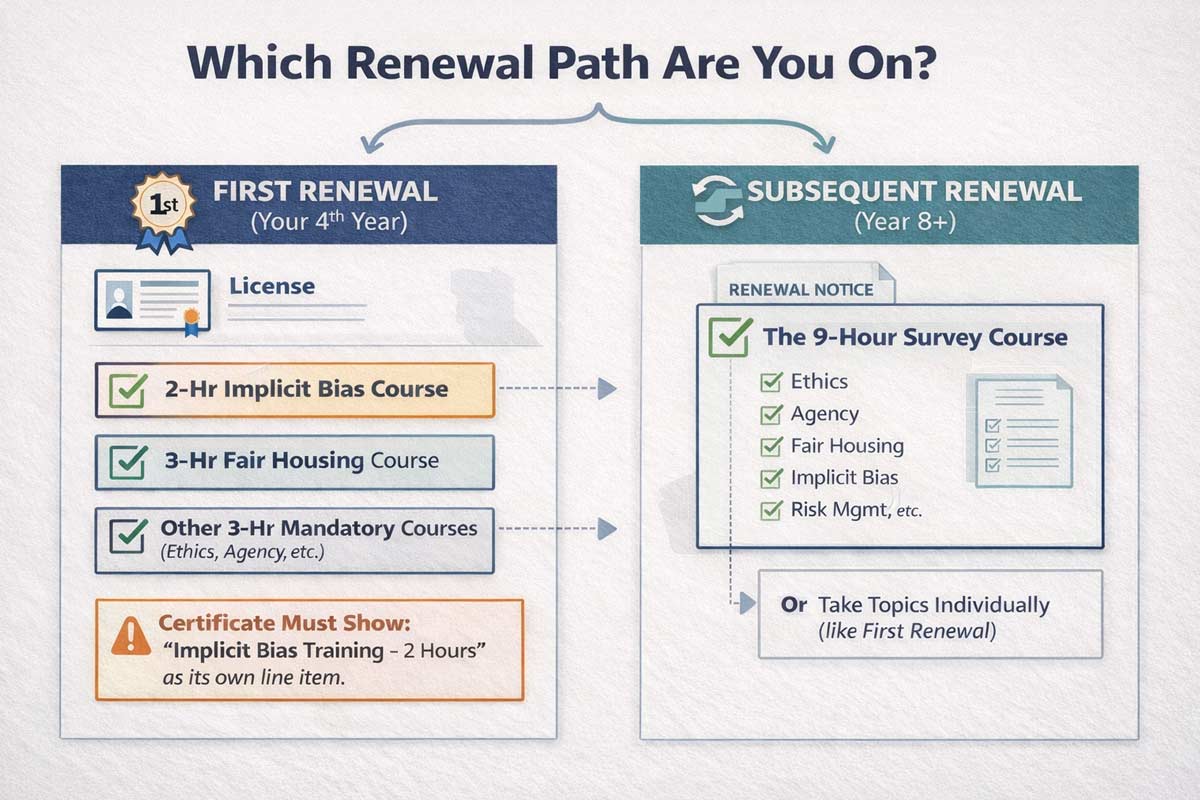
Key difference: First-time renewals must complete a standalone 2-hour Implicit Bias course. Subsequent renewals can satisfy it via the 9-hour survey course or by taking the mandatory topics as individual courses.
Related Resources:
California Real Estate License Renewal Guide
California Real Estate License Renewal Requirements (2026)
Why Is This Required? (SB 263)
This requirement comes from California’s CE rule updates implementing Senate Bill 263, which added a two-hour implicit bias training component and expanded the survey/update course to nine hours to cover the mandatory topics.
The curriculum focuses on understanding historical and systemic housing barriers and providing actionable steps to recognize unconscious bias in client interactions. The goal is risk management: protecting your license and ensuring compliance with Fair Housing laws.
The "First Renewal" vs. "Subsequent" Rule
The Department of Real Estate (DRE) has precise rules for how this training appears on your certificate. This is where most licensees make mistakes.
Scenario A: This is Your First Renewal
If you are renewing for the very first time (your 4-year anniversary), you cannot use the "survey course" shortcut. You must take separate courses.
If you are a Salesperson:
Your 45 hours must include:
Four separate 3-hour courses: Ethics, Agency, Trust Fund Handling, Risk Management.
One 3-hour Fair Housing course (with the required interactive component).
One 2-hour Implicit Bias Training course.
At least 18 hours of Consumer Protection, plus remaining hours in Consumer Protection or Consumer Service.
If you are a Broker (or Officer):
The structure is similar, but adds one more mandatory topic:
Five separate 3-hour courses: Ethics, Agency, Trust Fund Handling, Risk Management, Management & Supervision.
One 3-hour Fair Housing course (with the interactive component).
One 2-hour Implicit Bias Training course.
At least 18 hours of Consumer Protection, plus remaining hours in Consumer Protection or Consumer Service.
The Certificate Rule: You need a completion record that clearly shows "Implicit Bias Training – 2 Hours" as its own course line item.
Operator Note: If you want the full breakdown of what counts and how the DRE buckets these hours, read our guide on California Real Estate License Renewal Requirements (2026).
Scenario B: This is a Second (or Later) Renewal
For second and subsequent renewals, you have two compliant paths:
The Survey Option: Take the single 9-hour CE survey course that covers all mandatory topics (including Implicit Bias).
The Individual Option: Take the mandatory topics as individual courses instead of the survey.
Broker licensees will often ask ADHI Schools if brokers have different CE requirements in CA? A key difference is all broker licensees renewing must take a Management and Supervision course, but first time salespersons renewing do not.
Does It Count Toward My 45 Hours?
Yes. Implicit Bias is not "extra" work. It fits inside your existing bucket.
License Renewal Type
Total Hours Required
Does Implicit Bias Count?
First Renewal
45 Hours
Yes (Counts as 2 mandatory hours)
Subsequent Renewal
45 Hours
Yes (Could be taken in a 9-hr Survey course)
Late Renewal
45 Hours
Yes (Same rules apply)
To see exactly how the math works for your specific license type, check our breakdown of how many CE hours are required for CA license renewal?
"Audit-Proofing" Your Renewal
The DRE audits a percentage of renewals every month. If you are pulled for an audit simply follow the requests that the DRE makes and respond in a timely manner.
The Audit Checklist:
Check the Provider: Ensure the course provider is DRE-approved. A "Diversity Training" certificate from your other corporate job does not count. It must have an four-digit DRE Sponsor Number listed on the certificate of completion. Learn exactly what courses count toward CE in California to avoid registering for an invalid course.
Verify the Year: If you took a Fair Housing course in 2021 that didn't have the new interactive component or implicit bias module, it is invalid for a 2026 renewal.
Keep Your Records: Keep your certificates longer than you think. DRE recommends retaining CE completion certificates up to five years in case of audit, and providers are required to maintain participant records for five years.
Common Mistakes That Reject Renewals
We see licensees panic-renew 24 hours before their license expires. That is when mistakes happen.
Mistake #1: The "HR" Course. Submitting a workplace harassment or bias certificate from a non-real estate employer.
Result: Rejected.
Mistake #2: The "Old" Course. DRE rule of thumb: Continuing education credit expires four years from the course completion date, so older certificates can trigger rejection codes during renewal processing.
Mistake #3: Taking Courses From a Provider That is Not Approved. Make sure to ask for the 4 digit sponsor number of any course provider before registering.
Stay Compliant, Stay Active
Implicit Bias training is now a standard part of doing business in California. It isn't just about checking a box; it's about protecting your license and serving a diverse client base professionally.
Don't let a missing 2-hour certificate pause your career. If you are unsure exactly which courses you need based on your license status, check the full roadmap below.
California Real Estate License Renewal Guide →
FAQ
1. Can I take Implicit Bias training online?
Yes. As long as the provider is DRE-approved for correspondence or online study, you can take the course entirely online.
2. Does my Fair Housing course cover Implicit Bias?
No. They are separate requirements. However, if you take the 9-Hour Survey Course (for subsequent renewals), both Fair Housing and Implicit Bias are included in that single 9-hour block.
3. I am over 70 years old. Do I still need this?
If you are eligible for the "70/30" exemption (70+ years old AND 30 years of continuous good standing), you are exempt from all CE, including Implicit Bias. You simply submit the exemption form.
4. What happens if I renew late?
If you renew within your two-year grace period, the requirements are the same: you must complete the 45 hours, including Implicit Bias, before you can reinstate your license and pay the appropriate late fee.
|

The “Branding Panic” Reality
Most new agents think "branding" means picking a hex code, designing a logo on Canva, and maintaining a high-gloss Instagram aesthetic. The truth is that in the hyper-competitive Read more...
The “Branding Panic” Reality
Most new agents think "branding" means picking a hex code, designing a logo on Canva, and maintaining a high-gloss Instagram aesthetic. The truth is that in the hyper-competitive California real estate market, this is a dangerous distraction.
In California, branding isn't a decoration—it is pre-qualification. Before a lead ever picks up the phone, they have already vetted you online. They aren't looking for a celebrity; they are filtering for competence, trust, and consistency.
This article focuses on branding mistakes specifically, but branding is just one component of the broader Real Estate Agent Skills stack you need to succeed long-term. After 20+ years of coaching California agents at ADHI Schools, I’ve seen thousands of new licensees stall because they prioritized "vibes" over value. Despite what Instagram would have you believe, the goal of your brand isn’t fame; it is to create a predictable system for generating real estate leads.
The 60-Second Definition
Your brand is the pattern people remember: who you help, what you help them do, and proof you do it consistently. Branding is a functional system that supports your lead generation—it is not a vanity project. If you need a step-by-step framework, start with our guide on Branding Yourself as a California Real Estate Agent before you touch design tools.
12 Personal Branding Mistakes New Agents Make (And How to Fix Them)
1. Trying to Brand “For Everyone” (No Niche, No Message)
The Mistake: Posting generic "I love real estate" content and hoping anyone with a pulse calls you.
Why it Kills Trust: If you help everyone, you specialize in nothing. California consumers want a specialist.
The Fix: Pick a specific niche or neighborhood.
Do this today: Write down the one specific type of person you are best equipped to help right now (e.g., "First-time buyers in Eagle Rock").
2. Confusing Aesthetics with Positioning (Logo ≠ Brand)
The Mistake: Spending three weeks on a logo and zero hours on your value proposition.
Why it Kills Consistency: A logo doesn't sell a house; your ability to generate leads and navigate a CA purchase agreement does.
The Fix: Prioritize branding yourself as a real estate agent (California) based on your expertise first.
Do this today: Define your "Unique Value Proposition" in one sentence.
3. Copying Top Producers (The “Fake Luxury” Trap)
The Mistake: Renting a luxury car or posing in front of $10M listings you didn’t list to look "successful."
Why it Kills Trust: People can smell inauthenticity. It creates a "persona mismatch" when you finally meet in person.
The Fix: Match your branding to your actual inputs. Focus on being the "Hyper-Local Expert."
Do this today: Take a photo of yourself actually working—at a local coffee shop or touring a new listing.
4. Posting Randomly Instead of a Real Estate Marketing System
The Mistake: Posting a sunset today, a quote tomorrow, and nothing for three weeks.
Why it Kills Consistency: Inconsistency signals a lack of professional discipline. This is where agents skip the fundamentals covered in Real Estate Marketing Basics (California Edition) and mistake activity for strategy.
The Fix: Use content buckets (Market Updates, Behind the Scenes, Local Spotlights).
Do this today: Choose three "content buckets" and commit to posting one of each every week.
5. No Proof: Claims Without Evidence
The Mistake: Claiming to be an "expert" without showing any data, neighborhood knowledge, or process.
Why it Kills Trust: California buyers are data-driven. They need proof you know the market.
The Fix: Share "Proof Assets"—market trends, neighborhood walk-throughs, or process explainers.
Do this today: Find one interesting stat about your target zip code and explain what it means for buyers.
6. Over-Sharing Personal Noise
The Mistake: Posting what you ate for lunch more often than you post about real estate.
Why it Kills Leads: It creates noise, not value. Clients want a professional, not just a person with a phone.
The Fix: Follow the 80/20 rule: 80% professional value, 20% personal flavor.
Do this today: Audit your last 10 posts. If more than 3 have zero real estate relevance, delete the weakest one.
Quick gut check: If your brand disappeared tomorrow, would anyone in your database notice? If not, that’s not a failure—it just means you need a system.
7. Under-Selling: Hiding the CTA
The Mistake: Writing a great post but never asking for the business.
Why it Kills Leads: People won't take the next step unless you lead them there.
The Fix: Every piece of content should have a "Call to Action" (CTA).
Do this today: Add "DM me 'Market' for a copy of my neighborhood report" to your next post.
8. Talking Like a Brochure (Generic Slogans)
The Mistake: Using generic slogans like "Honesty, Integrity, Results."
Why it Kills Trust: These are "table stakes"—everyone says them, so they mean nothing.
The Fix: Speak to specific problems (e.g., "I help sellers find buyers even when inventory is low").
Do this today: Replace one generic adjective on your bio with a specific problem you solve.
9. Not Owning a “Signature Framework”
The Mistake: Having no repeatable way to explain your process to a lead.
Why it Kills Trust: It makes you look like you’re "winging it."
The Fix: Create a 3-step or 5-step "Roadmap to Closing."
Do this today: Outline the 5 steps you take a buyer through from consultation to keys.
10. Ignoring the Trust Engine: The Real Estate Newsletter
The Mistake: Relying solely on social media algorithms you don't own.
Why it Kills Consistency: If the algorithm changes, your brand disappears.
The Fix: Learn how to create a real estate newsletter to stay top-of-mind.
Do this today: Start a simple list of 50 people you know and send them a "market-at-a-glance" email.
11. Mistaking Followers for Leads (The Wrong Scoreboard)
The Mistake: Focusing on "Likes" from other agents instead of "Leads" from potential clients.
Why it Kills Leads: You end up performing for peers rather than serving prospects.
The Fix: Measure your brand by the number of conversations it starts.
Do this today: Check your DMs. Count how many "real estate" conversations you started this week.
12. Branding Over Skill-Building
The Mistake: Having a world-class brand but 1st-grade contract knowledge.
Why it Kills Trust: You will get the lead, but you will lose the client if you can't perform.
The Fix: Align your brand with actual Real Estate Agent Skills (California).
Do this today: Spend 30 minutes reading a standard CAR form instead of scrolling.
Brand Kit Lite: The Fast System
Avoid the "branding trap" by sticking to this simple checklist:
1-Sentence Positioning: "I help [Target Audience] in [Location] achieve [Outcome] without [Common Pain Point]."
3 Content Buckets: Market Data, Local Lifestyle, Process Explainers.
1 Lead Capture Habit: A bi-weekly real estate newsletter for agents to nurture your database.
1 Proof Asset: A "Neighborhood Guide" PDF you can offer for free.
California-Specific Reality Checks
In California, you aren't just competing with the agent down the street; you are competing with tech-enabled platforms and highly sophisticated consumers. Your brand must communicate high-level competence.
Practical advice for real estate agents in the Golden State: Your brand is built in small reps. It’s the consistency of your messaging followed by the consistency of your follow-up.
Real-World Scenario: The Random Posting Trap
An agent posts a "Sold" post from their office, and a generic "Happy Friday" on Friday. A potential seller sees a hobbyist. Contrast this with an agent who posts a video explaining why property taxes in Orange County are calculated the way they are. One is noise; the other is a brand.
Building Your Career Stack
Personal branding is a critical skill, but it is only one piece of the puzzle. To succeed in California, you must integrate your marketing with technical mastery and client service.
To see how branding fits into the bigger picture of your career, explore our comprehensive guide on Real Estate Agent Skills.
|

You’re stuck in traffic on the 405, your phone is buzzing with a frantic text about a repair contingency in Santa Monica, and you just realized you forgot to follow up with that listing lead from Sunday’s Read more...
You’re stuck in traffic on the 405, your phone is buzzing with a frantic text about a repair contingency in Santa Monica, and you just realized you forgot to follow up with that listing lead from Sunday’s open house.
You feel "busy," but your production doesn't reflect the chaos.
In my 20+ years of coaching thousands of California agents at ADHI Schools, I’ve seen this movie before. Most agents mistake motion for progress. They react to their inbox, their phone, and their fires, leaving their income to chance.
Top producers—the ones with consistent listing flow and a steady referral engine—don’t have more "hustle" than you. They have a better operating system.
They protect three specific pillars every single day:
Pipeline
Operations
Visibility
Here is the exact daily habit stack used by the most successful agents in the California market.
The 10 Daily Habits of Top-Producing Agents
1. The Morning Pipeline Block
What they do: Spend the first 90 minutes of the workday on proactive outbound lead generation (calls, texts, or door knocking) before getting deep into email.
Why it works: Your pipeline is the only thing that guarantees future commissions. If you don't feed the engine first, the fires of the day will consume your time.
How to implement:
Set a "Do Not Disturb" on your phone from 8:00 AM to 9:30 AM.
Use a simple script: "Hi [Name], I was looking at the latest comps in [Neighborhood] and thought of you. Have you had any thoughts on the market lately?"
Common mistake to avoid: Checking your "Escrow is closing" emails first. That money is already earned; go find the money you haven't earned yet.
2. The 5-5-4 Follow-Up Loop
What they do: Every day, they contact 5 new leads, 5 past clients, and 4 people in their "active" sphere.
Why it works: Real estate is a game of attrition. Most deals are lost because an agent stopped calling after the second attempt.
How to implement:
Use your CRM to pull a daily "Touch List."
If you're struggling with what to say, check out our guide on how to set goals as a new real estate agent to align these calls with your production targets.
Common mistake to avoid: "Checking in" without offering value (like a market update or a vendor recommendation).
3. Strict CRM Hygiene
What they do: Every conversation is logged, and every contact has a "Next Action" date before the agent closes their laptop.
Why it works: A top producer’s brain is for creating solutions, not storing dates. If it isn't in the CRM, it doesn't exist.
How to implement:
Spend 15 minutes at the end of every meeting logging notes. Tag leads by "Temperature" (Hot, Warm, Cold) so you know who to prioritize tomorrow.
Learn how to build a real estate CRM that actually works to automate this process.
Common mistake to avoid: Keeping lead info on sticky notes or in your phone’s "Notes" app.
4. The "Deal Protection" Audit
What they do: A quick 20-minute daily review of all active escrows and pending contracts to ensure deadlines (contingencies, disclosures) are met.
Why it works: In California, missing a contingency date can cost your client thousands and cost you your reputation.
How to implement:
Create a checklist for every transaction.
Ask: "Who is the ball currently with—the lender, the escrow officer, or the other agent?"
Common mistake to avoid: Assuming the escrow officer or TC (Transaction Coordinator) is handling everything without your oversight.
5. One Daily Visibility Action
What they do: Produce one piece of "social proof" or community-focused content (a video tour, a market stat graphic, or a photo at a local business).
Why it works: Visibility amplifies ability. If people don't see you working, they assume you aren't.
How to implement:
Document, don't create. Take a photo of a home inspection or a beautiful kitchen during a showing.
Post it with a caption explaining a specific Real Estate Agent Skills California trait, like negotiation or local expertise.
Common mistake to avoid: Aiming for "viral" instead of "local and helpful."
6. The 15-Minute Market Pulse
What they do: Review the "Hot Sheet" in the MLS to see what went pending, what sold, and what price-dropped in their target zip codes.
Why it works: You cannot be an advisor if you don't know the inventory. Clients pay for your interpretation of the data.
How to implement:
Set an MLS alert for your primary farm areas.
Internalize the numbers: "The average days on market in Irvine just dropped to 12."
Common mistake to avoid: Relying on national news headlines instead of local MLS data.
7. Script & Objection Mastery
What they do: Practice handling common California objections (e.g., "The rates are too high," or "I want to wait for the market to crash") for 10 minutes.
Why it works: Professional athletes practice more than they play. Top agents practice so their delivery is natural and confident.
How to implement:
Roleplay with a partner or record yourself on your phone.
Focus on empathy first: "I hear you, and many of my clients feel the same way. What I’ve found is..."
Common mistake to avoid: Winging it during a high-stakes listing presentation.
8. Hard Energy Boundaries
What they do: Set specific "Off" times where they do not answer the phone, ensuring they recharge for the next day.
Why it works: High-performance requires recovery. Constant "on-call" status leads to the errors that kill deals.
How to implement:
Use "Auto-Reply" texts after 7:00 PM: "I am currently with my family, but I will return your call first thing tomorrow morning."
Review these strategies for burnout prevention for real estate professionals.
Common mistake to avoid: Answering non-emergency client texts at 10:00 PM (it trains them to disrespect your time).
9. The End-of-Day Shutdown
What they do: Clear the desk, review the calendar for tomorrow, and identify the "Big 3" tasks that must happen.
Why it works: You win the morning the night before. This prevents the "What should I do now?" paralysis at 9:00 AM.
How to implement:
The Shutdown Checklist:
Inbox to zero (or filed).
CRM tasks updated.
Tomorrow’s "Pipeline Block" list ready.
Common mistake to avoid: Ending the day mid-task without a plan for tomorrow.
10. The 3-Number Scoreboard
What they do: Track three specific numbers at the end of every day: conversations, follow-ups completed, and one visibility asset shipped.
Why it works: What gets measured gets repeated. This turns "I was busy" into "I moved the business forward."
How to implement:
Use a sticky note, Notion, or your CRM dashboard.
Target: 10 conversations, 10 follow-ups, 1 visibility post (adjust as you scale).
Review weekly and identify what’s slipping—pipeline, operations, or visibility.
Common mistake to avoid: Tracking vanity metrics (likes, followers) instead of conversations and appointments.
Top Producer Reality Check: What They Don’t Do
Success is often about what you remove from your day. Top agents:
Don’t check email as the first act of the day.
Don’t keep lead information in text threads or DMs; it goes to the CRM.
Don’t take random vendor meetings during their Pipeline Block.
Don’t confuse "scrolling" and consuming social media with "creating" visibility.
What Top Agents Do Before 9:00 AM
Most California agents start their day in a "reactive" state. Top producers use the time before 9:00 AM to build a mental moat:
No Screens: Avoid the "inbox trap" for at least the first 30 minutes of waking.
Movement: A quick walk or workout to handle the high-stress nature of the industry.
Review the Big 3: Confirm the three non-negotiable tasks for the day before the world starts calling.
Daily Habits: New vs. Experienced Agents
Your routine should shift as your business matures:
New Agents (Years 1–2): 80% of your day should be pipeline and visibility. You have more time than clients; use it to build the database.
Experienced Agents (Years 5+): 50% pipeline/visibility and 50% systems and depth. Focus on deepening existing relationships and refining time management for California real estate agents to handle increased transaction volume.
Sample Daily Schedule: The California Operator Template
If your calendar keeps getting hijacked by non-urgent tasks, mastering your time as a real estate agent is your first priority. Use this block schedule to regain control.
Time
Activity
Focus
8:00 AM
Market Pulse
Review MLS Hot Sheets & local news.
9:00 AM
Pipeline Block
Non-negotiable outbound calls/prospecting.
10:30 AM
The Follow-Up Loop
Returning voicemails, texts, and emails.
12:00 PM
Lunch / Visibility
Eat at a local spot; post a "Day in the life" story.
1:30 PM
Operations & Admin
Listing prep, transaction review, CRM cleanup.
3:00 PM
Field Work
Showings, listing appointments, or door knocking.
5:30 PM
Shutdown
Plan tomorrow; set phone to "Do Not Disturb."
Why Most Agents Fail to Keep Habits (And the Fix)
Most agents fail because they are reactive. If your calendar is a blank slate, other people will write on it. This creates a "feast or famine" cycle that leads to burnout.
The Fix: The 2-Day Rule:
Never miss your daily habits two days in a row. If a closing goes sideways and you miss your morning calls today, that’s life. If you miss them tomorrow, that’s a choice. This isn’t about working longer hours—it’s about protecting the few actions that compound.
Start Here Today: The Minimum Viable Day (MVD)
If you are overwhelmed, do this 60-minute checklist to keep your business alive:
30 Minutes: Pipeline outreach (Contact 5 people).
15 Minutes: CRM Hygiene (Log calls/set next follow-ups).
10 Minutes: Visibility (Post one market update to social media).
5 Minutes: Plan tomorrow’s "Big 3" tasks.
Frequently Asked Questions
What do top producing agents do every day?
They prioritize "Revenue Generating Activities" (RGAs) like lead generation and follow-up during their peak energy hours and leave administrative tasks for the afternoon.
How many calls do top agents make per day?
Many top producers aim for 10–20 real conversations per day and increase volume during growth phases. The key metric is meaningful conversations, not just dials.
What is a good daily schedule for a real estate agent?
A good schedule is "time-blocked," meaning specific hours are dedicated to lead gen, client meetings, and admin. This prevents administrative "busy work" from eating into your prospecting time.
How do agents stay consistent without burnout?
By setting firm boundaries and treating their "recharge" time as a non-negotiable appointment on their calendar, just like a listing presentation.
Ready to Master the Business?
Habits are the foundation, but skills are the ceiling. If you want to move from "busy" to "profitable," you need to master the full stack of Real Estate Agent Skills California required for this unique market.
Next Steps for Your Growth:
New Agents: Start by setting your 90-day goals.
Mid-Career Agents: Audit your CRM system to find the holes in your follow-up.
|

In California real estate, "busy" is sometimes viewed a badge of honor. But after 20 years of coaching and operating in this industry, I can tell you the truth: Busy isn't the goal. Profit and freedom Read more...
In California real estate, "busy" is sometimes viewed a badge of honor. But after 20 years of coaching and operating in this industry, I can tell you the truth: Busy isn't the goal. Profit and freedom are.
This guide provides a practical, operator-level time management system for California real estate agents designed to move you from a reactive state to a systems-first mindset. If you don't control your calendar, your clients, escrow officers, and the 405 freeway will control it for you.
To master the essential Real Estate Agent Skills California requires a shift from chasing the day to owning it.
TL;DR: The California Operator System
The 3-Bucket Filter: If it creates revenue, it’s Pipeline. If it saves a deal, it’s Operations. If it builds the future, it’s Visibility.
The Morning Power: 8:00 AM – 10:00 AM is for non-negotiable follow-up. No email allowed.
The "One Window" Rule: Batch all escrow and admin tasks into a single 90-minute block.
The Guardrail: If it isn't on the calendar, it doesn't exist.
Reactive Calendar vs. Revenue Calendar
Most agents operate on a Reactive Calendar. You wake up, check your email, respond to a frustrated buyer, get lost in a DM rabbit hole, and suddenly it’s 2:00 PM. You’ve done "work," but you haven't generated a single dollar of future revenue.
A Revenue Calendar is designed to protect income-producing activities first.
Diagnostic: 5 Signs You Are Operating Reactively
You start your day by answering emails instead of making outbound calls.
You don't have a recurring "Follow-Up" block in your digital calendar.
An inspection or appraisal request can derail your entire afternoon.
You find yourself scrolling Instagram under the guise of "content research."
Your "lead generation" only happens when you realize you have no active escrows.
The 3-Bucket Decision Rule
To manage your time, you must categorize your tasks instantly. Stop treating an escrow signature with the same urgency as a cold lead follow-up. Use these filters:
Pipeline (Revenue): Does this create or advance a commission check today or tomorrow? (Follow-up, appointments, negotiations)
Operations (Delivery): Does this protect a deal currently in motion? (Disclosures, inspections, TC coordination)
Visibility (Future): Does this build my pipeline for 6 months from now? (Content creation, networking, database building)
The secret to consistency is ensuring all three buckets have a "home" in your week. This balance is one of the daily habits of top-producing agents that separates the earners from the hobbyists.
The California Agent Weekly Template
California real estate has a specific rhythm. Traffic is a factor, and weekend "work" is mandatory. Use this table as your base real estate agent schedule:
Time Block
Focus
Purpose
8am – 10am
Revenue (Pipeline)
Calls, texts, and CRM follow-up.
10am – 11:30am
Delivery (Operations)
Escrow Command Center / Admin.
12pm – 1pm
Recharge
Lunch / Personal time (No pings).
1pm – 5pm
Appointments / Field
Showings, listing presentations, previews.
5pm – 6pm
Future (Visibility)
Social media content / Networking.
The "New Agent" vs. "Busy Agent" Flex
New Agents: Spend 4+ hours daily in the Pipeline bucket. You need reps more than you need "systems" right now.
Busy Agents: Spend more time in Operations but must protect the 8 AM – 10 AM window at all costs to avoid the "income roller coaster."
Effective time management begins by knowing how to set goals as a new real estate agent—once your goals are clear, the calendar follows.
Win the Morning: The Follow-Up Operating System
The first two hours of your day dictate your commission check three months from now. Time management for California real estate agents lives or dies in the CRM.
The Daily Priority Stack:
New Leads: Contact within 5 minutes (or first thing in your 8 AM block).
Hot Nurtures: Clients likely to transact in the next 30–60 days.
Active Clients: Brief status updates (even if the update is "no news").
Past Clients: Staying top-of-mind for referrals.
To make this work, you need a system. Learning how to build a real estate CRM that actually works is the only way to automate your reminders so you don't spend hours "organizing" instead of "doing."
Escrow and Transaction Control
In California’s fast-paced escrow environment, a single inspection report can trigger 20 phone calls. If you handle these as they come in, you will never have a productive day.
The Escrow Command Center Rule: Schedule one "Operations Window" (e.g., 10:00 AM – 11:30 AM). Batch all your emails to escrow officers, lenders, and TCs during this time.
Kartik’s Tip: When a lender calls at 2:00 PM while you're at a showing, let it go to voicemail. Listen, then reply during your next designated admin block. Most "emergencies" are simply other people’s poor planning.
Open Houses & Traffic Realities
California traffic is a variable you must account for. If you have a showing in Irvine at 4:00 PM, you aren't "working" from 3:30 PM to 6:00 PM—you are commuting and showing.
The 20% Buffer: Always add 20% more time to travel than GPS suggests.
Weekend Recovery: If you work 6 hours on Saturday and Sunday, you must protect Monday morning as "Off" time to prevent the burnout cycle.
Pre-Prep: Don't print flyers on Sunday morning. Do all "Visibility" prep on Thursday so your weekend is focused on the people in front of you.
Burnout Guardrails (Energy Management)
"Always on" is a recipe for a short career. Sustainable time management requires energy management.
The Hard Stop: Pick a time (e.g., 7:00 PM) where the phone goes in the drawer.
The One True Day Off: One day a week, you are not an agent. You are a human being.
Boundary Scripts: "I’m headed into an appointment, but I will check this first thing at 8:00 AM tomorrow."
Effective burnout prevention for real estate professionals is built into the calendar, not added as an afterthought.
FAQ: Real Estate Time Management
How many hours should a real estate agent work?
A: Successful full-time agents typically work 40–50 hours per week, but the composition of those hours matters more than the total. 15 hours of focused lead generation is more valuable than 60 hours of "random busywork."
What’s a good daily schedule for real estate agents?
A: A high-production schedule starts with 2 hours of follow-up (8–10 AM), 90 minutes of admin/escrow (10–11:30 AM), and afternoons dedicated to appointments and field work.
How do I handle "looky-loo" buyers who waste my time?
A: Use a mandatory buyer consultation. If they won't meet for 20 minutes to discuss their needs and financing, they aren't worth a 2-hour drive.
What if a client gets mad because I didn't answer at 9:00 PM?
A: Set expectations early. Tell them: "I am fully focused on my clients from 8:00 AM to 7:00 PM. If you text after that, I'll have an answer for you first thing in the morning."
Implementation Challenge: The 14-Day Reset
Commit to this for the next 14 days before you customize:
Block 8:00 AM – 10:00 AM for lead follow-up only. No email. No social media.
Batch your "Operations" into one 90-minute window.
Identify 3 "Stop-Doing" items: Activities that resulted in zero revenue last week.
Time management isn't about doing more; it's about doing what matters. Master these systems, and you’ll find that a successful California real estate career doesn't have to cost you your sanity.
Ready to level up your entire business? Visit our Real Estate Agent Skills California hub to learn more about building a sustainable, high-performance career with ADHI Schools.
|

TL;DR: The System Summary
A successful real estate CRM is a daily follow-up machine, not a contact list.
To make it work, you need:
Minimalist Data: Only track what helps you make the Read more...
TL;DR: The System Summary
A successful real estate CRM is a daily follow-up machine, not a contact list.
To make it work, you need:
Minimalist Data: Only track what helps you make the next call.
Strict Pipeline Stages: Define exactly where a lead sits in the journey.
The Golden Rule: Every contact must have a Next Step and a Next Date.
Daily Discipline: A 10-minute "CRM Block" to clear your tasks.
The CRM Graveyard: Why Most Systems Fail
Let’s be honest: Most California real estate agents have a "CRM graveyard." It’s a software subscription you pay for every month, filled with names you haven't called in 90 days and "leads" from an open house three years ago that were never categorized.
I’ve spent over 20 years coaching and operating in the California real estate education space, and I see the same mistake everywhere. Agents try to build a "database" when they should be building a real estate lead follow-up system.
If your CRM isn’t telling you exactly who to contact by 9:00 AM today, it’s not a CRM—it’s a hobby. In a market where you’re fighting 101 freeway traffic and juggling multiple escrows, speed-to-lead is the only metric that matters. If you aren't contacting an inbound lead within minutes, you are often competing with 3–5 other agents. Your CRM is what allows you to win that race.
CRM Setup in 30 Minutes (Beginner-Proof)
Don't spend weeks "researching" software. Pick a tool and follow this 30-minute sprint:
Create your 7 stages: (Use the framework in the table below).
Set your required fields: Source, Lead Type, Stage, Next Follow-Up Date, Tags.
Configure 3 saved views: Today, This Week, Nurture.
Import 10 contacts: Start with your phone’s "recent" list or warm sphere.
Assign a "Next Step + Next Date": Do this for every single one.
Calendar it: Put a recurring 10-minute CRM Block on your calendar for every weekday morning.
The CRM Build: Your Minimum Viable System
To build a real estate CRM that sticks, you need to strip away the "tech-bro" features most CRM for real estate agents are bloated with and focus on the core structure.
1.The Only Fields You Actually Need
Stop trying to fill out 50 fields of data. You’ll burn out. Stick to these:
Name & Contact Info: (Phone/Email)
Source: (Zillow, Open House, Sphere, Referral)
Lead Type: (Buyer, Seller, Investor, Renter)
Pipeline Stage: (Where are they in the process?)
Next Follow-Up Date: (The most important field in your business)
Tags: FHA-Buyer, Inland-Empire-Retail, Probate, Past-Client, Hot-Lead.
Common Mistake
Don't create a "custom field" for every little detail. Use the "Notes" section for the story; use "Tags" for the category. Over-complicating fields is the fastest way to stop using the system.
2. Your Pipeline Stages (Entry/Exit Criteria)
Your pipeline stages real estate logic must be tight. If you don't know why someone is in a specific stage, the system breaks.
Stage
What it means
Move forward when...
New Lead
Inbound or added, not contacted
You’ve attempted contact + set Next Date
Contacted
Two-way exchange happened
You have timeline + motivation basics
Qualified
Budget + timeline + reason confirmed
You scheduled consult/showing/listing appt
Active Search
You’re actively working inventory
They’re ready to offer or pause
Offer / Escrow
Under contract
You close or deal dies (then re-stage)
Closed / Past
Transaction complete
You set post-close follow-up + nurture
Nurture
6+ months out
They re-engage (then re-qualify)
The Follow-Up Engine (The Real Product)
Your real estate CRM workflow is only as good as your persistence. Most agents stop after two attempts. Top operators go further.
The “No-Response” Ladder
Use this framework when a lead goes quiet:
Touch 1 (Day 1): Call + short text: “Hey [Name], it’s Kartik—saw your inquiry about [area]. Quick question: are you looking to move in the next 30–90 days or just researching?”
Touch 2 (Day 2–3): Value text: “If you tell me your target city + price range, I’ll send 3 options that match your criteria today.”
Touch 3 (Day 5–7): Close-the-loop: “I don’t want to spam you—should I stop reaching out, or is there a better time next week?”
If no response occurs after Touch 3, move them to the Nurture stage and set a Next Date for 21–30 days out.
Workflow: The Daily Execution
A CRM is only as good as your Daily Habits. To stay organized, stop looking at "All Contacts." Instead, use these three saved views:
Today: Shows only leads where the Next Date = Today or is Overdue.
This Week: Shows leads with a Next Date within the next 7 days (for planning).
Nurture: Shows leads with a Next Date 21–30 days out.
The Daily & Weekly Rhythm
Success requires a Time Management for California Real Estate Agents strategy that protects your "system time."
Daily (10 Mins): Clear your "Today" view every morning. Log outcomes in one sentence. Set the next date.
Weekly Reset (15 Mins): Every Friday at 4:30 PM, review your pipeline. Drag leads back to the correct stages and ensure no one is missing a Next Date.
Automation vs. Human Touch
Automation should support you, not replace you.
Do Automate: Immediate "Thanks for reaching out" texts; Appointment reminders.
Don't Automate: Deep relationship building. If an automation can’t be answered with a human reply, it probably shouldn’t be sent.
Common Failure Points and Fixes
"I don't have time to update it."
Fix: Make the update process smaller. Log the outcome immediately after the call, not at the end of the day.
"I'm burning out on follow-up."
Fix: Read our guide on Burnout Prevention for Real Estate Professionals. Usually, burnout comes from the anxiety of forgetting someone, not the act of calling them.
"I'm in escrow chaos all week."
Fix: Use your CRM to set "reminders" for your active leads so you don't ignore your future income while processing current checks.
The Bigger Picture: Your CRM Is One Skill in the Stack
A CRM that works is revenue insurance—but it only performs when it’s paired with daily execution, clear targets, and protected time. As you Set Goals as a New Real Estate Agent, remember that your system is the foundation of your consistency.
If you want the complete operator framework behind follow-up, pipeline control, and professional consistency, start here: Real Estate Agent Skills California.
FAQ: Building Your Real Estate CRM
1. What should I put in the ‘Notes’ vs. ‘Tags’?
Tags are for categories you want to filter (e.g., "Buyer," "Past Client"). Notes are for the "story" and specific details from your last conversation (e.g., "Daughter is moving to San Diego in August").
2. What’s the best follow-up schedule for Zillow or open house leads?
High intensity for the first 10 days (5–7 touches), then transition to a 21-day "Nurture" cycle. Speed is everything in the first 48 hours.
3. How do I use a CRM when I’m in escrow all week?
The CRM is what protects your next paycheck while you’re busy earning the current one. Treat your escrow tasks like lead tasks. Use the CRM to remind you of contingency removals, but don't let your "Today" view of new leads go uncleared. Spend 5 minutes on leads, then 55 minutes on your escrow.
4. How many stages should my real estate pipeline have?
Keep it between 5 and 8 stages. Any more and you will spend more time organizing the list than calling the people on it.
|
Disclaimer: This guide is for educational purposes only and does not constitute legal or professional real estate advice. Always consult with your broker and legal counsel regarding DRE advertising Read more...
Disclaimer: This guide is for educational purposes only and does not constitute legal or professional real estate advice. Always consult with your broker and legal counsel regarding DRE advertising compliance.
The Post-License Panic: From "Licensed" to "Hired"
You passed the exam, hung your license with a broker, and ordered business cards. Now, you’re sitting at a desk in your real estate office waiting for the phone to ring.
It doesn’t.
Most new agents treat marketing like a lottery—post a house tour on Instagram, buy a few Zillow leads, and pray for a commission check. After 20 years of coaching California agents and seeing which systems actually scale, I can tell you that "luck" is not a business strategy.
Marketing isn't about having a "big personality" or being a TikTok star. It is a repeatable operating system designed to solve one problem: making sure the right people know you exist, trust your expertise, and remember you when they’re ready to sign.
What “Marketing” Actually Means (California Edition)
In one of the most competitive real estate markets in the country, “marketing” is often misunderstood. California consumers are sophisticated—they’ve seen every “Top Producer” ad in the book. If you’re searching for a marketing plan for new real estate agents in California, what you really need is a simple operating system you can run every week—because that’s what creates clients.
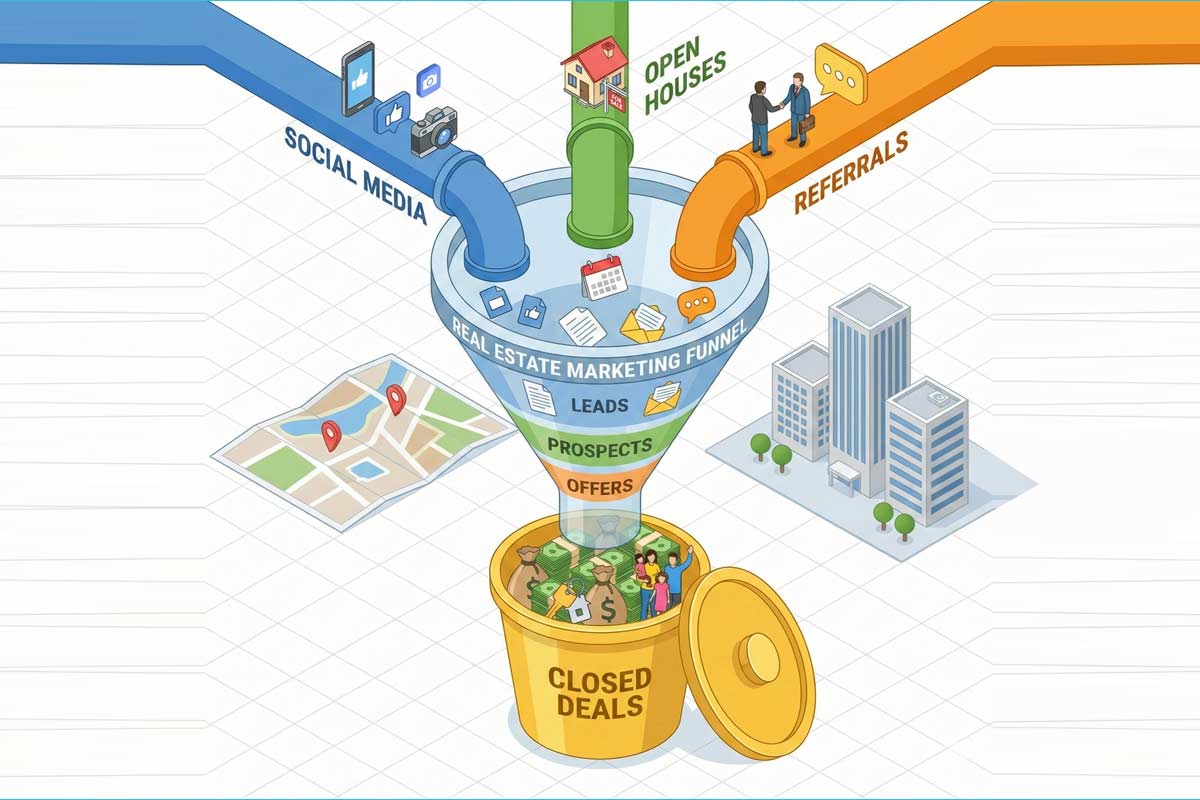
To win, you must view your marketing as a four-stage pipeline:
Attract: Getting someone to stop scrolling or start a conversation.
Pre-qualify: Filtering out the "looky-loos" from the serious buyers/sellers.
Convert: Turning a conversation into a signed listing or buyer representation agreement.
Follow-up: Staying top-of-mind for the 3–12 months it takes a CA lead to actually move.
Marketing is NOT
Spending $500 on a logo before you’ve made a cold call.
Posting "Just Listed" photos of houses that aren't yours without permission.
Buying leads and letting them sit in a CRM without a phone call or other follow up.
The 4-Part Marketing Foundation
Before you spend a dime on ads, you need to stabilize your foundation. These are the basics that compound over time.
1. Positioning
This is "Who you help" and "What you're known for."
If you try to be the "California Expert," you’re the expert of nothing.
Actions: Define your farm (e.g., "The go-to condo specialist in Downtown Los Angeles"). Identify your unique value (e.g., "I help first-time buyers navigate FHA in high-cost counties").
Common Mistake: Being a generalist. To avoid this, read about Personal Branding Mistakes New Agents Make.
2. Proof
In California, skepticism is the default. You need assets that reduce skepticism and prove you can do the job.
Your First 5 Proof Assets (Even with zero closings):
1-page Zip Code Snapshot: Median price, Days on Market (DOM), and inventory trend for your farm area.
Open House Notes One-Pager: What buyers asked, what they ignored, and what moved them emotionally.
“Buyer Mistakes in CA” Mini Guide: A one-page PDF that shows you understand the process—this is marketing because it builds trust before you ever ask for an appointment.
Three Micro-Testimonials: Responsiveness, diligence, and follow-through from anyone you’ve helped (clients, colleagues, vendors).
Broker/Team Credibility Line: A factual, approved credibility line your broker is comfortable with (no hype, no unverifiable claims).
3. Pre-qualify & Convert
Marketing fails when it generates a lead but doesn't know what to do with it. You need a real estate lead follow-up system that includes the right questions.
The 5-Question Script (CA-Safe):
“Are you already speaking with a lender?”
“What’s your timeline if everything goes right?”
“Have you toured homes or open houses in the last 30 days?”
“Do you need to sell a home first?”
“What would make you say ‘let’s move’ within 2 weeks?”
The Appointment-Setters (CTAs):
“Want me to run a 10-minute price reality check for your zip code?”
“Want a 15-minute buyer game plan call so you know what you can win with in this market?”
4. Follow-Up
In California, most deals come from leads that “weren’t ready” the first time. Your follow-up system is your commission protection plan.
Actions: Set up a simple CRM. Create a "Long-Term Nurture" plan.
Common Mistake: Calling a lead once, getting no answer, and deleting them.
Common CA Marketing Mistakes
Avoid these traps that waste months of effort for new agents:
Buying leads before you have a repeatable follow-up cadence.
Posting listings you don’t represent without explicit permission or context.
Trying to be “Luxury” before you are trusted locally or understand the inventory.
No database hygiene: Failing to tag leads, leave notes, or remove duplicates.
Inconsistent schedule: Marketing in random bursts followed by weeks of silence.
Channels That Matter Most for New CA Agents
You cannot be everywhere. To learn how to get real estate clients in California, pick two of these to start:
Your Sphere (Database): This is your highest ROI. These are people who already know, like, and trust you.
Email Newsletters: A weekly touchpoint providing value. Learn How to Create a Real Estate Newsletter that people actually open.
Open Houses as Content Engines: Use an open house marketing plan where you film 3–4 videos while you’re there: a "Market Update," a "Home Feature," and a "Neighborhood Spotlight."
Google Business Profile: Essential for local SEO. If someone Googles "Agent near me," you want your name to appear with reviews. Learn the nuances of Branding Yourself as a California Real Estate Agent to stand out.
The 30-Day Marketing Plan for New California Agents
Stop theorizing. Here is your execution schedule for the next month.
Week
Focus
Key Task
Week 1
The Sphere
Call 10 people a day. Tell them you’re in the business and ask how they are.
Week 2
Local Credibility
Claim your Google Business Profile. Build a “Market Update” template for weekly use.
Week 3
Active Prospecting
Schedule 2 Open Houses. Use your "Open House Notes" one-pager to capture lead info.
Week 4
The Nurture
Send your first "Market Update" email to everyone you’ve talked to this month.
The "Minimum Viable" Daily List:
Add 2 new people to your database.
Send 5 personalized "Thinking of you" texts/DMs.
Post 1 local market data update to your Stories.
Compliance & Professionalism
The California Department of Real Estate (DRE) is vigilant. Your marketing must be as compliant as it is creative.
DRE Disclosures: In California, many advertisements must include your license ID and responsible broker identification—follow your broker’s policy and DRE guidance for each medium (print, digital, social, email, signage).
No "Guarantees": Avoid promising specific results unless you have the legal paperwork and broker approval to back it up.
Branding: Follow your brokerage policy for branding hierarchy and required identification across print, digital, and social.
Master the Skills Stack
Marketing is a powerful engine, but it’s only one part of the vehicle. Marketing is one spoke in the full skill stack—negotiation, contracts, timelines, and client psychology are what convert attention into commissions.
If you want the full “map,” start here: Real Estate Agent Skills California.
Your next move (today):
Pick two channels (sphere + newsletter, or open houses + newsletter).
Run the Week 1 plan.
Don’t change your system for 30 days.
FAQ Section:
Q: How much should a new agent spend on marketing?
A: Focus on "sweat equity" (calls/networking) first. Invest in a CRM and professional headshots before paid ads.
Q: Do I need a website as a new agent?
A: Use your brokerage-provided site and focus on your Google Business Profile for better local search results.
Q: How often should I post on social media?
A: Quality over quantity. 3 times a week with actual market data is better than daily generic "Happy Monday" posts.
Q: Is door knocking still effective in California?
A: Yes, if done with a "Give" (like a market report) rather than a "Take" (asking for a listing immediately).
Q: What is the best way to get reviews?
A: Ask for them immediately after a "win"—even if it's just helping someone understand their home's value.
TL;DR: The California Agent’s Marketing Blueprint
Marketing is a System: It is the repeatable process of Attract → Pre-qualify → Convert → Follow-up.
The CA Reality: High competition and sophisticated buyers mean "pretty" isn't enough; you need proof and persistence.
Focus on Inputs: Stop tracking "likes." Track outgoing calls, sent newsletters, and face-to-face meetings.
The Golden Rule: Choose two channels and master them before expanding.
|