Choosing to start a career in real estate is exciting and full of opportunities. But before jumping in, it makes sense to find out what real estate school is about. Doing your homework helps you know what Read more...
Choosing to start a career in real estate is exciting and full of opportunities. But before jumping in, it makes sense to find out what real estate school is about. Doing your homework helps you know what to expect, making it easier to handle the challenges and succeed.
Real estate school should teach you more than just how to pass an exam; it gives you the skills and knowledge you need for your future job. It's essential to check that the school's courses match what you want from your career and that you're ready for the time and work it requires.
Knowing about our school's setup and what the classes are like helps you prepare better. It also shows you what it means to work in real estate, not just how to get your license.
In short, learning about real estate school before you enroll is a smart move. It helps you go in prepared and confident, ready to take on the challenges and grab the opportunities that come with a career in real estate.
Curriculum Deep Dive: Core Components of Your Real Estate Education
To become a licensed real estate agent in California, three specific courses are required: Real Estate Principles, Real Estate Practice, and one elective. Each course is designed to equip aspiring real estate professionals with the knowledge they need to succeed in the industry. Let's explore what each course covers, their importance, and why ADHI Schools recommends "Legal Aspects of Real Estate" as the elective course.
Real Estate Principles
The Real Estate Principles course lays the foundational knowledge every agent needs. It covers a broad spectrum of topics, including property ownership and land use controls, real estate law, and the nuances of property valuation. Understanding these principles is crucial as it provides the groundwork for making informed decisions in buying, selling, leasing, and managing real property. This course is essential because it teaches the theoretical aspects of real estate that are critical for passing the state licensing exam and effectively serving future clients.
Real Estate Practice
Real Estate Practice focuses on the day-to-day operations in real estate, such as listing, selling, leasing, buying, and managing property. This course provides practical knowledge on conducting real estate transactions, including marketing properties, understanding buyer and seller needs, and completing some contract forms. It also teaches critical skills in negotiation and closing transactions. This vital course bridges the gap between theoretical knowledge and practical application, preparing students for real-world real estate activities.
Elective Course: Legal Aspects of Real Estate
ADHI Schools strongly recommends "Legal Aspects of Real Estate " for the elective. This course dives deeper into the legal intricacies of real estate transactions and property law. It covers topics such as contracts, property rights, the legal implications of real estate finance, and recent changes in real estate law and tax regulations. Understanding these aspects is vital for anyone in the field, as it helps protect agents and their clients from legal pitfalls.
By completing these courses, students are well-prepared to take the California real estate licensing exam and embark on a successful career.
Learning Formats & Study Tips: ADHI's Modern Approach to Real Estate Education
At ADHI Schools, we recognize that real estate education needs to be flexible, accessible, and efficient. That's why we've tailored our course offerings to meet the demands of today's learners and industry standards, emphasizing the advantages of remote learning while addressing the limitations of traditional classroom settings.
Self-Study and Instructor-Led Courses
We offer two primary learning formats: self-study and instructor-led courses. Our self-study options provide the utmost flexibility, allowing students to progress at their own pace and schedule. This is ideal for those who need to balance other commitments, such as work or family, but still want comprehensive access to quality educational content.
Our instructor-led courses are delivered via Zoom for those who thrive under guided instruction. This format combines the convenience of online study with the benefits of live interaction. Students can engage directly with experienced instructors and peers in real time, enjoying a dynamic learning environment without commuting. This saves time, reduces travel costs, and lessens the environmental impact of traditional classroom settings.
The Outdated Model of In-Person Classes
Traditional in-person coursework must be updated for today's fast-paced, digital world. The future of real estate education lies in digital accessibility and interactive learning environments. In-person classes often need more flexibility than many aspiring real estate professionals. They can be a barrier to those who cannot commit to rigid schedules or travel to distant locations.
The Best of Both Worlds
Our Zoom-led instructor courses offer the best of both worlds: the ease of online access with the personalized touch of in-person training. This hybrid model ensures that all students, regardless of location or schedule, can benefit from high-quality real estate education and interactive sessions that foster a more profound understanding and retention of course material.
By choosing ADHI Schools, you're not just enrolling in a real estate school—you're embracing a modern, innovative approach to learning that prepares you for success in the real estate market. Our formats are designed to equip you with the knowledge and skills necessary to excel, utilizing traditional educational principles and cutting-edge technology.
Embarking on a new educational journey in real estate shouldn’t have to mean putting your life on hold. You don't need to be a full-time student to achieve your dreams of becoming a licensed real estate professional.
Prepping for the Real Estate Exam with CrashCourseOnline.com
Once you finish the pre-license courses, the next step is to prepare for the real estate exam. This is where you consolidate all your learning and prepare to succeed. A robust tool in your arsenal should be CrashCourseOnline.com, specifically designed to optimize your exam preparation.
CrashCourseOnline.com offers a comprehensive suite of resources tailored to the real estate license exam's structure and content. Familiarizing yourself with the exam format is essential, and our platform covers multiple-choice questions, simulations, and potential essay components. What sets CrashCourseOnline.com apart is its focus on interactivity and real-world simulation, providing practice exams that mimic the testing environment.
Our iPhone and Android apps make studying flexible and accessible, allowing you to prepare on the go and fit study sessions into your busy schedule. The apps are designed to enhance learning efficiency with features like timed quizzes, answer explanations, and progress tracking.
These tools help you master test-taking strategies such as question analysis, time management, and critical thinking under exam conditions.
Encouragement Every Step of the Way
We believe in encouraging our students through every step of their real estate education. At ADHI Schools, you're not just another student but part of a community that cares about your success. Our instructors are dedicated professionals who are as invested in your achievements as you are. They are readily available to help you navigate your courses and confidently prepare for the real estate exam.
Becoming a real estate agent is a personal and professional growth journey. With ADHI Schools, you have a partner in education who provides the tools and support you need to excel without overwhelming your daily life. Enroll with us, and take the first step towards a successful career in real estate with the flexibility and encouragement you deserve.
Love,
Kartik
|
Selecting a real estate school is the first professional decision you will make in your new career. It is often the difference between getting licensed in six months or being stuck in a cycle of retakes Read more...
Selecting a real estate school is the first professional decision you will make in your new career. It is often the difference between getting licensed in six months or being stuck in a cycle of retakes and frustration two years from now.
Many prospective agents choose a school based solely on the lowest price or the flashiest marketing promise. However, a "cheap" course becomes expensive very quickly if the materials are outdated, the support is non-existent, or the curriculum fails to prepare you for the California Department of Real Estate (DRE) state exam.
Most students who come to us after failing elsewhere don’t lack effort—they lacked access to real instruction. After 20 years of helping students navigate this process, I’ve learned that the "best" school isn't a universal title—it’s the one that prioritizes actual learning over marketing optics.
Quick Take: The 30-Second Summary
Verify Legal Standing: Confirm a valid DRE Sponsor ID before looking at anything else.
Prioritize Support: Access to a human instructor is the primary factor in passing the first time.
Evaluate Exam Prep: Look for depth and rationales, not just a bank of "A, B, C, D" questions.
Scrutinize Policies: Treat "guarantees" as fine-print audits rather than quality indicators.
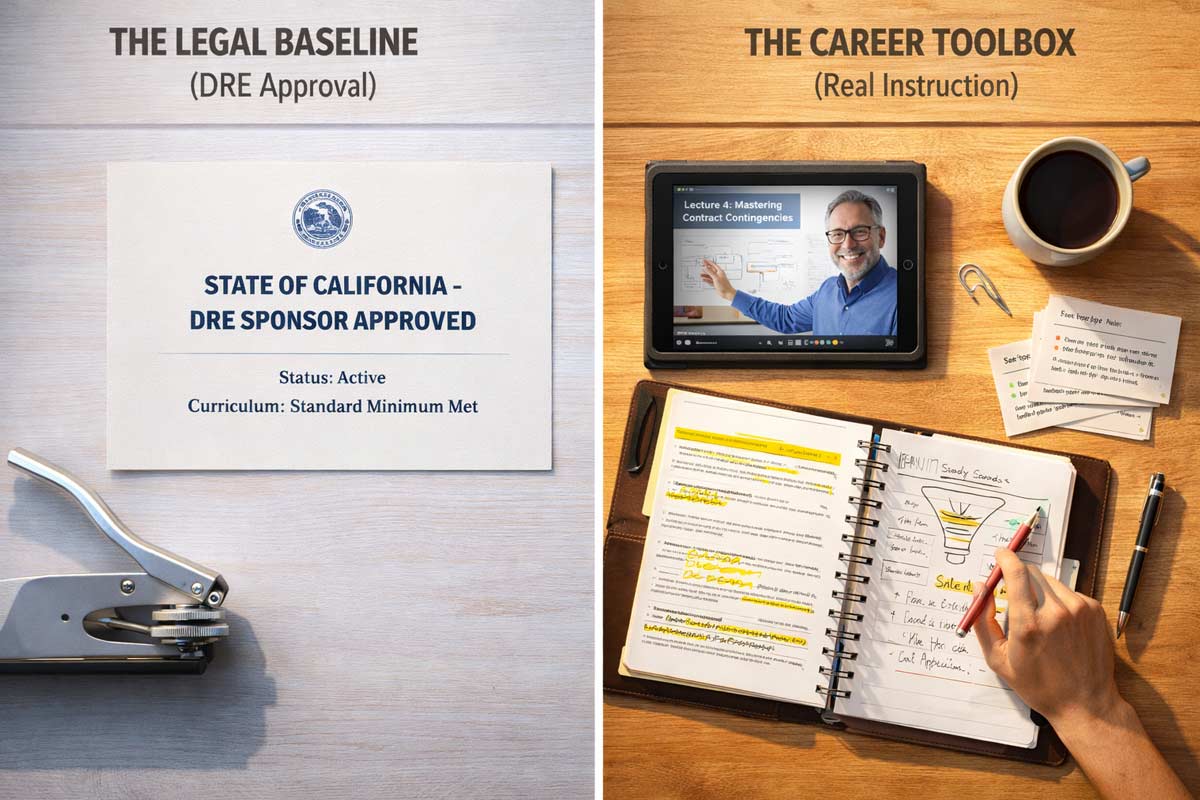
Step 1: Confirm the Legal Baseline (DRE Approval)
In California, you cannot sit for the state exam unless you complete three college-level courses from an approved provider. DRE approval is the absolute minimum legal requirement—it is not a rating of quality. It simply means the school has permission to offer the curriculum.
How to verify in minutes:
Ask the school for their DRE Sponsor ID.
Visit the DRE website to confirm their status is "Approved."
Check if they offer the three mandatory courses: Real Estate Principles, Real Estate Practice, and an elective.
To understand why this approval is just the starting line, read our guide on What Makes a Real Estate School DRE-Approved?
Step 2: Decide What Kind of Student You Are
The format of the school should match your lifestyle, not the other way around. A "self-paced" course is only a value if you have the discipline to finish it without a structured environment.
Learner Profile
Priority
Recommended Feature
The Full-Time Professional
Efficiency
High-quality mobile interface & clear PDF materials.
The Anxious Test-Taker
Stability
Live webinars or in-person coaching components.
The Fast-Tracker
Support
Responsive administrative teams for finishing certificates.
The Career Switcher
Practicality
Instructors who provide context through California examples.
Real-World Scenario: Many students choose a purely digital format because it's cheaper, only to realize months later they’ve stopped making progress because they have no one to ask for clarification.
Step 3: Instructor Access is the Hidden Difference-Maker
Many online schools are essentially "digital bookstores." They sell you the material and leave you to navigate it alone.
If you hit a wall while studying Agency or Valuation, you need a human answer. In high-volume, low-support environments, you might wait days for a canned email response. This delay kills your momentum.
When evaluating a school, ask: “If I don’t understand a concept, can I reach out to an instructor, or am I limited to a help-desk ticket?”
Instructional depth is what prevents failure. You can learn more about this in our guide on The Role of Instructors in CA Real Estate Education.
Step 4: Evaluate Prep Quality (Beyond the "Guarantee")
The goal is to pass the state exam on your first attempt. High-quality exam prep is about feedback loops, not just repetition.
The Baseline: A school that only gives you a score at the end of a quiz.
The Standard: A program that provides a detailed rationale for every answer (explaining why the correct answer is right and the others are wrong).
Scrutinizing the Guarantee:
Many schools market a Pass Guarantee. It is important to view these as administrative policies rather than trust signals. A guarantee is effectively a "post-failure" plan; it does not indicate the quality of the instruction itself. Often, the fine print requires multiple failures or specific prerequisites to qualify. Focus on the quality of the practice rationales—that is what keeps you from needing the guarantee in the first place.
Step 5: Know When a Crash Course Helps (and When It’s a Trap)
A crash course is a "gap-closer," not a foundation. If the primary pre-licensing courses were low-quality, a weekend session cannot replace 135 hours of lost learning.
The Readiness Benchmark: If you are scoring 70–75% on practice exams, a crash course can provide the "test-taking logic" to secure a pass. If you are scoring 50%, you likely need to revisit the core material.
For more on timing your prep, see: Are Crash Courses Worth It in California?
Step 6: Compare Total Cost & Friction
The "sticker price" of a real estate school is rarely the final cost. Look for "friction points" that lead to hidden expenses:
Extension Fees: Charges if you don't finish the course within a strict window.
Retake Fees: Fees for re-taking a course final exam.
Tech Friction: Outdated portals that don't work well on mobile or modern browsers.
Insider Tip: If a school’s support is slow during the enrollment process, it will likely be slower when you are waiting for your course completion certificates.
Step 7: The Simple Decision Checklist
Use this rubric to evaluate providers. Score them based on substance, not marketing.
DRE Approved: Verified Sponsor ID (Non-negotiable).
Direct Instructor Access: Can I get a human on the phone or email?
Feedback Loops: Does the exam prep explain the "why" behind the answers?
Policy Clarity: Are refund and retake policies written in plain English?
Format Fit: Does this match my actual daily schedule?
Frequently Asked Questions
Do I really need an exam pass guarantee?
Guarantees are secondary to instructional quality. A guarantee is relevant only after you have failed. Your priority should be finding a school with active instructor support and robust practice rationales—the tools that help you pass the first time.
Does DRE approval mean the school is "good"?
No. DRE approval only means the school meets the minimum legal curriculum requirements. It is a baseline for entry, not a measure of how well the school prepares you for a career or the state exam.
What should I prioritize if I work full-time?
Prioritize "support responsiveness." When your study time is limited to late nights or weekends, you cannot afford to wait days for a response to a question. You need a school that provides the resources to keep you moving forward.
Take the Next Step
Choosing a real estate school is about finding a partner for your licensure journey. A great school makes guarantees mostly irrelevant because the instruction is designed to help you pass the first time. To see how different programs compare across the state using this objective framework, view our guide to the best real estate schools in California.
|

The real estate industry is built on trust. Clients rely on agents to guide them through complex transactions, often involving significant financial and emotional investment. Maintaining this trust requires Read more...
The real estate industry is built on trust. Clients rely on agents to guide them through complex transactions, often involving significant financial and emotional investment. Maintaining this trust requires a solid commitment to ethical conduct, especially when managing conflicts of interest.
Definition of Conflict of Interest
A conflict of interest arises when an agent's interests or duties to another client interfere with their ability to act in the best interests of their current client. This can involve financial gain, personal relationships, or any situation where the agent's objectivity is compromised.
Imagine you're a real estate agent with two clients interested in the same house. One of the clients is a close family friend. Even though you might naturally want to help your friend more, as a real estate agent, you must treat both clients fairly and equally. This situation could lead to a conflict of interest because your relationship with your friend might influence your professional judgment. You can give your friend inside tips or encourage the seller to accept their offer over the other client's, even if it's not the highest offer. In real estate, agents must always act in the best interest of their clients and maintain professional integrity by avoiding any actions that could benefit them personally or favor one client unfairly over another.
Importance of Addressing Conflicts
Failing to address conflicts of interest can damage client relationships, lead to legal disputes, and tarnish an agent's reputation. Proactively managing these situations is crucial for maintaining professionalism and upholding the integrity of the real estate industry.
Common Scenarios Leading to Conflicts of Interest
Dual Agency: Representing the buyer and seller in a transaction presents a significant conflict. While allowed in some states with informed consent, it can be challenging to ensure both parties receive unbiased advice and negotiation.
Family or Personal Relationships: Transactions involving family members or close friends can create conflicts, even if the agent believes they can remain impartial. Perceived favoritism can undermine trust.
Financial Interests: An agent with a financial stake in a property or related business—like a real estate broker who also owns a mortgage company—can create a conflict if it influences their recommendations to clients.
Ethical Ways to Handle Conflicts of Interest
Full Disclosure: Openly disclose any potential or perceived conflict to all parties involved. This includes the nature of the conflict and how it might affect the transaction.
Obtaining Informed Consent: After full disclosure, obtain written consent from all parties acknowledging the conflict and agreeing to proceed with the agent's representation.
Refusing or Handing Off Representation: In some cases, the best approach is to decline or withdraw from the transaction to avoid compromising ethical obligations. This might involve referring the client to another agent.
Real Estate Board Policies: Navigating Conflicts of Interest
Local and national real estate boards, such as the National Association of REALTORS® (NAR), play a vital role in maintaining ethical standards within the industry. These organizations often establish detailed codes of ethics that serve as a framework for handling potential conflicts of interest and ensuring professional integrity.
For instance, the NAR's Code of Ethics and Standards of Practice outlines clear expectations for REALTORS® to act honestly, transparently, and in the best interests of their clients. Article 1 emphasizes the obligation to protect and promote clients' interests, while Article 2 requires the disclosure of all pertinent facts about a property that may affect its value or desirability. These principles guide agents in avoiding situations where personal or financial interests might conflict with their duty to the client.
Local real estate boards also adopt similar ethical standards tailored to their specific regions. These policies help agents navigate conflicts of interest, such as representing both a buyer and seller in the same transaction (dual agency) or having a financial stake in a property being sold. Boards often require agents to disclose such relationships fully and ensure the client's informed consent.
By adhering to these ethical guidelines, real estate professionals can maintain the trust of their clients and the public while fostering a culture of accountability and fairness within the industry.
The Bad Foundation Example
Imagine an agent representing a buyer discovers that the property they are interested in has significant, undisclosed foundation issues. The seller, eager to close the deal, pressures the agent to minimize the severity of the problem or avoid mentioning it altogether. However, the agent knows their fiduciary duty is to act in their client's best interest, the buyer.
Rather than succumbing to the seller's demands, the agent immediately informs the buyer about the potential foundation issues. They recommend that the buyer hire a licensed professional to conduct a thorough inspection before purchasing. By doing so, the agent ensures the buyer has all the necessary information to make an informed decision, demonstrating integrity and professionalism.
This example highlights the importance of upholding fiduciary duties, even in challenging situations. It underscores the agent's responsibility to prioritize their client's interests over external pressures, ultimately protecting them from potential financial or legal risks.
Best Practices for Real Estate Professionals
Training and Education: Continue education on ethical practices and conflict management to stay informed about best practices and legal requirements.
Consulting Legal Professionals: Consult a real estate attorney or experienced mentor for guidance when facing a complex conflict.
Maintaining Transparency: Prioritize transparency in all client interactions. Proactive communication and clear documentation can help prevent misunderstandings and mitigate potential conflicts.
Navigating conflicts of interest is an essential skill for real estate professionals. Agents can build trust, protect their reputation, adhere to ethical principles, prioritize client interests, maintain transparency, and contribute to a more moral and professional real estate industry.
Conflicts of interest are an inevitable challenge in the real estate industry, but how professionals handle these situations defines their integrity and success. Agents can confidently navigate these complexities by understanding the nature of conflicts, adhering to ethical standards, and leveraging tools like full disclosure and informed consent.
Addressing conflicts of interest is not merely about complying with rules—it's about building and preserving trust, the cornerstone of every client relationship. When agents prioritize their fiduciary duty, maintain transparency, and stay committed to ethical practices, they not only protect their clients but also enhance the professionalism and reputation of the industry.
Managing conflicts ethically is a hallmark of a successful real estate professional. Agents can foster stronger relationships and contribute to a real estate landscape defined by accountability, fairness, and trust by continuing to learn, consult, and apply best practices.
Love,
Kartik
|

Choosing the right real estate license school is a major step for anyone looking to succeed in California’s real estate market. A good real estate school will do more than teach you facts; they lay the Read more...
Choosing the right real estate license school is a major step for anyone looking to succeed in California’s real estate market. A good real estate school will do more than teach you facts; they lay the groundwork for your career. In California, to become a licensed real estate agent, you must pass a state exam that tests your knowledge and readiness to work professionally.
Your school should teach you about real estate laws, how to help clients buy and sell properties, and how to act ethically in your job. The education you get not only helps you pass your exam but also prepares you to face the challenges and grab the opportunities in the real estate world. So, picking the right school is crucial because it shapes your future as a professional agent.
The Importance of Accreditation
Accreditation is another crucial factor to consider when selecting a real estate license school. Accredited schools like ADHI Schools have been reviewed and validated for quality and efficacy by the Department of Real Estate. This isn’t just about meeting minimum standards; accreditation is a seal of quality that ensures the education you receive will be respected and recognized. It also signals to employers and clients that you have been trained under rigorous educational standards, boosting your credibility and professional standing in the competitive real estate industry.
Benefits of Online and Online “Live” Real Estate Courses
Online real estate courses offer several advantages, particularly in terms of flexibility, accessibility, and self-paced learning. These courses are ideal for those who have busy schedules or who live far from traditional classroom locations. They allow students to access materials at any time and from anywhere, making it easier to fit learning into a hectic lifestyle. Standout features of our online courses often include:
Video Tutorials: Engaging video lessons that can be paused and replayed, helping you to understand complex topics at your own speed.
Interactive Modules: Interactive learning experiences that keep you engaged and test your knowledge as you progress.
Mobile-Friendly Platforms: The ability to study on the go with courses optimized for smartphones and tablets, ensuring you can learn even when you’re away from your computer.
Hybrid Learning Options
Hybrid courses combine the best aspects of online and classroom learning. These programs typically involve a mix of online coursework to cover theoretical knowledge and scheduled in-person sessions for more practical, hands-on training. This format can be particularly beneficial as it offers:
Flexibility and Interaction: You can enjoy the flexibility of online learning while still benefiting from the interpersonal and experiential advantages of traditional classroom attendance.
Balanced Structure: The structure of hybrid models provides a balanced approach, catering to different learning preferences and needs.
The Value of Experienced Instructors
The experience and teaching styles of instructors at a real estate license school play a critical role in shaping the quality of education. Experienced instructors bring a wealth of real-world knowledge to their teaching, offering insights that go beyond textbooks and theoretical concepts. They are often well-versed in the latest industry trends and regulatory changes, which can provide students with a more comprehensive understanding of the real estate landscape.
Teaching style also significantly impacts learning outcomes. Instructors who employ interactive and adaptive teaching methods can cater to various learning styles, ensuring that all students grasp complex topics. This versatility is crucial for effectively preparing students for the varied scenarios they will encounter on the real estate exam and in their future careers.
The presence of knowledgeable instructors is particularly important for real estate exam success. These professionals can pinpoint the most important content that is likely to appear on the exam and provide students with strategies to tackle difficult questions. Moreover, their ability to clarify doubts and provide real-time feedback is invaluable in building confidence and competence among students.
CrashCourseOnline.com
CrashCourseOnline.com offers a unique advantage in real estate exam preparation with its comprehensive suite of study tools designed specifically for California real estate licensure. What sets CrashCourseOnline.com apart includes:
Tailored Content: All resources are specifically designed to meet the requirements of the California real estate exam, ensuring that students study the most relevant and up-to-date information.
Interactive Learning Tools: The platform includes interactive features like practice quizzes and real-time feedback, which help reinforce learning and build confidence as students see their progress.
Accessibility and Flexibility: With courses and materials available online, students can prepare on their schedule and at their pace, which is crucial for adult learners who may be balancing other responsibilities.
Expert Guidance: CrashCourseOnline.com provides access to seasoned real estate educators who offer live exam prep sessions. These sessions delve into exam strategies, breakdown challenging areas, and answer student questions in real time, providing a level of personalized preparation that can be hard to find elsewhere.
By using these preparation materials and engaging with platforms like CrashCourseOnline.com, students can greatly enhance their chances of success on the California real estate exam. The comprehensive resources and expert guidance available can give them a competitive edge in a challenging field.
Choosing the right real estate license school is a pivotal decision that can impact your career for years to come. As you make this decision, consider the following key factors:
Accreditation and DRE Approval: Ensure that the school is approved by the California Department of Real Estate and accredited by relevant authorities.
Learning Formats: Reflect on whether online, classroom-based, or hybrid learning environments suit your learning style and schedule best.
Experienced Instructors: Look for schools with knowledgeable and experienced instructors who can provide not only the curriculum but also valuable industry insights.
Support Resources: Evaluate the availability of student support services such as tutoring, forums, and dedicated staff to help you through your studies.
Exam Preparation: Consider the quality and effectiveness of the exam preparation materials offered, such as mock exams, study guides, and live prep courses.
It’s essential to do thorough research and choose a school that aligns with your career goals and educational needs. Take the time to read reviews, talk to alumni, and perhaps attend a few introductory sessions or webinars to get a feel for the school’s environment and offerings.
Ready to take the first step towards a successful career in real estate? Enroll today at ADHI Schools or start your preparation with CrashCourseOnline.com.
Love,
Kartik
|

How Long Does the California Real Estate Exam Take?
If you’re planning to become a real estate agent in California, one of the key steps is passing the California real estate exam. Knowing how long Read more...
How Long Does the California Real Estate Exam Take?
If you’re planning to become a real estate agent in California, one of the key steps is passing the California real estate exam. Knowing how long the exam will take helps in preparing effectively and managing your time on the day of the test. This article will cover everything you need to know about the duration of the exam and how to approach it efficiently.
Total Duration of the Exam
The California real estate exam is designed to test your knowledge in various real estate topics, including property ownership, laws, valuation, financing, and contracts. For the sales license exam, it consists of 150 multiple-choice questions, and you are given up to 3 hours to complete it. This means you have about 1 minute and 11 seconds per question on average. It’s a manageable pace if you're prepared, but rushing or spending too much time on a single question can impact your ability to finish the exam.
For those taking the broker exam, it is longer, consisting of 200 multiple-choice questions with 4 hours allotted to complete the exam.
Breakdown of the Exam:
Sales License Exam:
Number of Questions: 150 multiple-choice questions.
Time Allotted: 3 hours (180 minutes).
Broker Exam:
Number of Questions: 200 multiple-choice questions.
Time Allotted: 4 hours (240 minutes).
Key Considerations
Here are some tips to manage your time during the exam:
Practice Time Management: When practicing for the exam, completing practice tests within the time limit is crucial. This builds comfort with the pacing and prepares you for the actual test day. Our blog on Effective StudyTechniques for the Real Estate Exam offers additional insights and strategies.
Skip and Return to Hard Questions: If you encounter a tough question, it’s often better to move on and come back to it later. This approach ensures you don't waste too much time on any single question and that you cover more ground.
Read Questions Carefully: While keeping an eye on the clock, make sure to read each question thoroughly. Misreading can lead to easy mistakes.
Watch the Clock: Monitoring your time can help adjust your strategy on the fly, ensuring you answer as many questions as possible. Our additional resources provide tactics on maintaining a good pace throughout the test.
What Happens After the Exam?
Once you’ve completed the exam, the next step is to wait for your results. The California Department of Real Estate (DRE) typically provides results at the time the test is concluded, but sometimes it could take a few days.
The California real estate exam is a comprehensive test that requires thorough preparation and good time management. With different durations for the sales license and broker exams, it’s important to practice completing sample exams within the time limits to ensure you’re comfortable with the pacing. By preparing effectively, you’ll increase your chances of passing the exam and moving closer to your goal of becoming a licensed real estate agent.
|

Recent Changes to the California Real Estate License Exam
The California Department of Real Estate (DRE) has recently implemented changes to the real estate license exam, which may impact how Read more...
Recent Changes to the California Real Estate License Exam
The California Department of Real Estate (DRE) has recently implemented changes to the real estate license exam, which may impact how you prepare and take the test. Over the past few months, the DRE has stopped providing calculators and whiteboards during the exam. This shift means that test-takers will need to adjust their strategies to succeed without relying on these tools.
What This Means for You
No Calculators: The removal of calculators means you will have to complete any math-related questions manually. While there are hardly any math problems in the real estate exam, it’s still important to practice solving basic calculations, such as determining commission splits, prorations, or property taxes, without a calculator.
No Whiteboards: Previously, whiteboards were provided for taking notes or working through questions. Without them, you’ll need to rely on mental calculations and keep track of important points without jotting them down. This change highlights the importance of sharpening your memory and mental math skills during preparation.
How to Prepare for the California Real Estate Exam Without Calculators or Whiteboards
To succeed under these new conditions, follow these tips:
Practice Mental Math: Get comfortable doing basic real estate calculations in your head or on scratch paper. You can practice solving simple math problems regularly to ensure you’re prepared for the exam.
Memorize Key Formulas: Memorizing common real estate formulas (such as commission calculations, loan-to-value ratios, and property tax estimations) will help you tackle math questions confidently without needing a calculator.
Focus on Conceptual Understanding: The real estate exam is not just about numbers; it’s also about understanding important concepts such as property law, real estate finance, and contracts. The better you understand these topics, the more you can rely on your knowledge, even in math-related questions.
Take Mock Exams: Practice real estate exams are a great way to prepare under the new conditions. These simulations can help you get used to solving problems without additional tools and will give you a better sense of your readiness for test day.
How to Pass the California Real Estate Exam
Passing the California real estate exam requires more than just adjusting to the new no-calculator and no-whiteboard rules. Here are some key strategies to increase your chances of success:
Thoroughly Review the Course Material: A solid understanding of the topics covered in your real estate courses is crucial. Make sure you go over everything from property management to ethics and legal issues.
Attend Our Crash Course: Consider enrolling in our real estate crash course that focuses on exam preparation. These intensive reviews can sharpen your knowledge and fill any gaps before test day.
Take Multiple Mock Exams: Aim to consistently score above 80% on your practice tests. This will ensure you’re prepared and confident about your understanding of the material.
Stay Calm and Focused: Test anxiety can affect your performance, so be sure to approach the exam with confidence and a clear mind. Practice mindfulness or relaxation techniques leading up to the exam.
The recent changes to the California real estate license exam may seem daunting, but with the right preparation, you can still succeed. Focus on understanding key concepts, practice solving math problems manually, and simulate exam conditions to ensure you're ready.
Remember, passing the exam is just the first step toward a successful real estate career. Stay persistent and dedicated, and you’ll be well on your way to becoming a licensed real estate agent in California.
Love,
Kartik
|

Factors Influencing Real Estate Agent Income
The allure of the real estate profession is undeniable: the potential for financial freedom, flexible work schedules, and the satisfaction of helping clients Read more...
Factors Influencing Real Estate Agent Income
The allure of the real estate profession is undeniable: the potential for financial freedom, flexible work schedules, and the satisfaction of helping clients find their dream homes. Yet, the reality is that income in real estate can vary. While some agents earn well into the six or seven figures, others struggle to make ends meet. So, what factors influence real estate agent income?
Understanding these factors is essential for anyone considering a career in real estate, or for existing agents seeking to increase their earnings.
Location
Geographic location can play a major role in an agent's earning potential. Since most real estate agents earn a percentage of the sales price of a property, practicing in high-cost urban areas can lead to larger commissions. In contrast, agents in lower priced or more rural locations may deal with lower property values and, consequently, lower commissions. However, it's important to note that the cost of living can also vary significantly between locations.
While setting up shop in Beverly Hills might seem tempting, remember that high-priced areas often attract lots of agents because of the big commissions they can earn. In busy areas like Manhattan Beach or Newport Beach, there are so many agents that it becomes really competitive. To stand out, agents need to be great at marketing themselves, negotiating deals, and making connections. They also need to close deals regularly to afford the high cost of living in these areas and maintain their lifestyle.
Market Conditions
Economic factors like interest rates, housing demand, and local market trends can have a profound impact on agent income. When interest rates are low and demand is high, it's a seller's market, and agents can earn more. Conversely, in a buyer's market with high interest rates and low demand, transactions may be slower, impacting agent income. Additionally, seasonal fluctuations can affect real estate activity. Spring and summer tend to be busier seasons, while the market may slow down during the fall and winter months.
Experience and Skills
Experience levels often correlate with income. Seasoned agents have a larger network, better negotiation skills, and in-depth market knowledge. This allows them to close deals more and command higher commissions. Moreover, niche expertise and specialized knowledge in areas like luxury homes, commercial real estate, or investment properties can be lucrative. Continuous learning and professional development are also crucial for staying ahead in a competitive market.
Business Model and Commission Splits
The way commissions are split between a real estate agent and their brokerage can greatly influence their earnings. Common splits can vary widely, but an agent generally keeps more as they gain more experience and close more deals. Some brokerages offer even better terms or a 100% commission model, where agents keep all the commission but pay a monthly or transaction fee to the brokerage.
While these offers might sound good, agents should think carefully about what they might lose in terms of support and resources from traditional brokerages. For instance, brokerages offering lower splits often provide more resources, such as CRM systems or postcard marketing and mailing services. Therefore, while an agent on a higher split might earn more per deal, their overall profit could be lower as they might end up paying for these services out of pocket. Understanding the compensation structure is crucial when picking a brokerage because it directly impacts how much money an agent can make and their overall financial success.
Marketing and Lead Generation
Effective marketing and lead generation strategies are crucial for success in real estate. Agents need to create a strong online presence while utilizing social media. Digital marketing campaigns are a must to attract potential clients. Building a personal brand and establishing oneself as a trusted expert in a specific area can also lead to increased visibility and higher earnings. Lead nurturing and conversion strategies are equally important for turning leads into closed deals.
Client Relations and Reputation
Exceptional customer service and client satisfaction are key to generating repeat business and referrals. Agents who prioritize building strong relationships with their clients and providing a seamless experience are more likely to see long-term success. A positive reputation can lead to organic growth and increased income over time.
Specialization and Niche Markets
Specializing in certain types of properties or catering to specific demographics can be a strategic way to enhance income. By becoming the go-to expert in a niche market, such as eco-friendly homes, senior living communities, or vacation rentals, agents can attract a loyal clientele and potentially command premium commissions.
Real estate offers tremendous opportunities for motivated individuals to achieve financial success and build a rewarding career. However, it's essential to recognize that income is influenced by a multitude of factors.
By understanding these factors and adapting their strategies, agents position themselves for success in this dynamic industry.
When creating your business plan, keep the above factors in mind. You might not be able to immediately change where you practice, and reputation isn't built overnight, but you can always turn up the marketing and keep plugging away. Real estate sales is a career that is built brick-by-brick not overnight.
Love,
Kartik
|

In the competitive and often unpredictable world of real estate, success hinges not just on knowledge, but also on how well you prepare and adapt. I wanted to write an article exploring the critical roles Read more...
In the competitive and often unpredictable world of real estate, success hinges not just on knowledge, but also on how well you prepare and adapt. I wanted to write an article exploring the critical roles of a well-honed strategy and a resilient mindset, and offer practical advice for real estate professionals aiming to excel in their careers and navigate the complexities of the market confidently.
The Importance of Preparation
In real estate, meticulous preparation is key to managing a complex schedule effectively. For agents, staying organized is crucial for handling multiple listings, client meetings, and dynamic market conditions. A structured schedule allows for allocating adequate time to each client, providing personalized service that addresses unique needs and challenges. This readiness not only enhances professionalism but also builds trust and reliability among clients—cornerstones of long-term success in the industry.
Managing Distractions as a Self-Employed Agent
Distractions can undermine even the best-prepared agents. As a self-employed professional, it's vital to manage your time and workspace effectively. Setting a daily schedule mimicking a traditional office environment, creating a dedicated workspace, and using technology wisely can significantly enhance focus and productivity. Prioritizing tasks and taking regular breaks are also essential practices that help maintain efficiency and prevent burnout.
Maintaining focus can be difficult without the structured environment of a traditional office. Distractions are a significant challenge for real estate agents, mainly because many operate as self-employed professionals, which requires a high degree of self-management and discipline. Poor time management and reduced productivity can directly impact an agent’s ability to serve clients effectively. Real estate agents must respond quickly to client needs and market changes; thus, any delay or oversight caused by distractions can result in missed opportunities or diminished service quality.
Real estate can demand a high degree of accuracy in handling transactions and paperwork. Distractions that lead to errors can have serious consequences, potentially harming the agent’s reputation and client relationships. Managing distractions effectively is crucial for maintaining professionalism, ensuring client satisfaction, and upholding the reliability expected in the real estate industry.
Finding Solutions to Common Real Estate Problems
Real estate transactions involve multiple parties and interests, often leading to complex challenges. Whether dealing with property title issues, financing setbacks, or unexpected inspection results, there is always a potential solution. Effective strategies include:
Proactive Communication: Keep all parties informed to prevent misunderstandings and build trust.
Flexibility and Creativity: If initial solutions falter, think outside the box. For instance, if financing falls through, suggest alternative lenders or creative financing options like seller financing.
Leverage Expertise: Consult with seasoned colleagues or specialists, such as real estate attorneys or title agents, to gain new perspectives and solutions.
Stay Updated: Keeping abreast of changes in real estate laws and regulations can preempt and mitigate potential issues.
The Power of Positive Self-Talk
The way we converse with ourselves significantly influences our actions and outlook, especially in high-stakes situations like negotiations or competitive markets. Positive self-talk, such as affirming "I am a skilled negotiator" or "I can handle this challenge," can shift your perspective and boost your confidence, thereby enhancing your performance.
Consistency Leads to Mastery
Success in real estate isn't just about big moves; it’s also about the accumulation of small, consistent actions. Regularly engaging in activities that enhance your skills, like market analysis or client relationship management, builds expertise over time. This principle of consistency is particularly pertinent in real estate, where persistence and resilience often determine long-term success.
Embracing thorough preparation and maintaining an optimistic outlook are indispensable in enhancing your professional performance and managing personal challenges in real estate. By equipping yourself with the tools to find solutions and succeed, you can confidently navigate every aspect of your career. Remember, in the dynamic field of real estate, every problem indeed has a solution—it's up to you to find it.
Love,
Kartik
|

How Long Are California Real Estate Courses Valid?
For those considering becoming a real estate agent in California, several questions come to mind. One of the most common being: "Is a California Read more...
How Long Are California Real Estate Courses Valid?
For those considering becoming a real estate agent in California, several questions come to mind. One of the most common being: "Is a California real estate license worth it?" After all, you have to take some classes, study and pass and exam and obtain the license.
What if you want to dip your toe in the water and sign up for real estate school, but aren’t quite ready to apply for your license?
The good news is that once you complete your real estate courses, they don’t expire. You can take the exam whenever you're ready, as long as the rules don’t change.
Choosing the Right Real Estate School
Selecting a reputable real estate school like ADHI Schools is crucial. We are recognized for meeting the educational standards required by the state, ensuring that you're well-prepared not only for the exam but also for your future career in real estate.
Stay Updated with Legislative Changes
While the real estate courses don't expire, it's still important to keep an eye on changes in the law that might affect the validity of the courses. For example, a new law called Senate Bill 1495 (SB 1495) was introduced and took effect on January 1, 2024. This law added new requirements to the Real Estate Practice course, including topics on implicit bias and fair housing laws. These topics are designed to help you understand the underlying biases affecting housing decisions and learn the laws ensuring housing fairness.
If you plan to take your licensing exam after January 1, 2024, you must have completed a course that includes these new topics. If your previous courses didn't include these, you will have to retake this course.
Why It Matters
Choosing a school that stays updated with the latest legal requirements is essential. We ensure that our curriculum is always aligned with the latest laws, helping you avoid surprises when you decide to take your exam.
While the courses you take are valid indefinitely under current regulations, the requirements for becoming a licensed real estate agent can and sometimes do change. Being proactive and informed about these changes and choosing a reputable school can significantly impact your career.
Even Though the Education Doesn’t Expire - Apply for Your License Promptly
Once you've completed your real estate courses, it's crucial to take the next step and apply for your license without delay. Procrastination can be a significant hurdle. Lots of students, filled with relief and satisfaction after finishing their coursework, might feel tempted to take a break before applying for the license. However, delaying this critical step can lead to unnecessary setbacks.
Applying for your license immediately after completing your courses has several benefits. Firstly, the information you've learned is still fresh in your mind, which can be advantageous when taking the licensing exam. Secondly, beginning your career sooner rather than later allows you to capitalize on the momentum and enthusiasm you've built up during your studies with ADHI Schools.
Moreover, getting licensed quickly enables you to enter the real estate market when your drive is at its peak, potentially leading to a more successful start. Delaying the process might not only diminish your preparedness but could also impact your motivation and the likelihood of pursuing a career in real estate altogether.
In essence, treat the completion of your courses not as the finish line, but as a springboard into your real estate career. By applying for your license promptly, you ensure that you maintain the momentum necessary for a successful transition from student to practicing agent. Remember, in real estate, timing is everything, and the sooner you start, the sooner you can begin shaping your successful career.
In the end, a California real estate license is valuable, especially when you are well-prepared with the right education from the right real estate license school.
TLDR: Courses don’t expire in California, but sometimes the requirements to get a license change.
|

Passing the California real estate exam on your first attempt is a milestone that sets the tone for your entire career. Every day, students ask me some version of the same question:
“What’s the Read more...
Passing the California real estate exam on your first attempt is a milestone that sets the tone for your entire career. Every day, students ask me some version of the same question:
“What’s the fastest, most reliable way to pass the real estate exam the first time?”
The answer isn’t mysterious.
Success comes from preparation, strategy, and understanding how the exam actually works. If you want the big-picture roadmap—everything from application requirements to how scoring works—start with our California Real Estate Exam Guide. It gives you the full context before you dive into the specifics.
With that foundation in place, let’s walk through the proven strategies that help first-time test-takers succeed.
Understanding the Challenge
Many aspiring agents wonder, “Is the California real estate exam hard?”
It can feel challenging — but mostly because the Department of Real Estate (DRE) tests judgment as much as knowledge.
It isn’t enough to memorize definitions. You must understand how to apply California-specific laws, disclosures, ethics, and principles to scenario-based questions.
In fact, relying too heavily on memorization rather than comprehension is one reason why people fail the real estate exam to begin with.
Choose the Right School
Your choice of real estate school determines whether you barely scrape by—or whether you build the depth of understanding required to pass confidently on test day.
The right school provides:
Experienced instructors who understand how the DRE thinks
Comprehensive materials aligned to the DRE’s official exam blueprint
Ongoing support, practice testing, and review tools
A strong instructional foundation improves your odds of passing dramatically.
Why a Crash Course Is Your “Turbo Boost”
A real estate crash course is like activating a turbo boost in a video game — fast, focused, and designed to maximize performance right before the final challenge.
Just as a sprinter trains intensely before a major race, a crash course helps sharpen your recall, solidify your understanding, and tighten your exam-day strategy.
In the ADHI Schools crash course, you get:
Deep coverage of high-value DRE exam topics
Real exam-style practice questions
Insights into how the DRE frames distractor answers
Strategies to eliminate wrong choices under pressure
A Study Strategy Designed for a First-Time Pass
Here’s the blueprint our most successful first-time pass students follow:
1. Study Consistently — Not Sporadically:
Short, regular study sessions beat cram sessions every time.
Build a schedule that rotates through all seven DRE content categories.
2. Use Practice Tests to Build Exam Awareness:
Practice tests help you:
Identify weak spots
Build familiarity with four-option multiple choice
Learn common test traps.
3. Understand Key Concepts Deeply
The DRE expects mastery of critical areas including:
Property ownership forms
Agency law and mandated disclosures
Financing and appraisal
Contracts and transfer of property.
Surface-level memorization isn’t enough.
You need to apply the concepts.
4. Stay Updated on California Law:
Unlike many states, California has no national portion — everything is state-specific.
Rules around:
Agency
Disclosures
Fair housing
Real estate practice
…can evolve. Always use current study materials like those from ADHI Schools
Managing Exam Day With Confidence
Even highly prepared students slip due to nerves.
Here’s how to stay in control:
Arrive early to avoid last-minute stress
Read carefully, especially for trap words like “NOT,” “EXCEPT,” or “ALWAYS”
Manage your time — answer all questions and return to difficult ones later
Knowing that the DRE allows unlimited attempts within your two-year application window often gives students the mental space they need to perform better on attempt #1.
You Can Absolutely Pass on Your First Try
Passing the California real estate exam the first time is completely achievable.
Your results will directly reflect:
Your preparation
Your study strategy
Your ability to use the highest-quality resources
Your mindset on exam day
Approach your journey with intention, structure, and confidence — and you’ll be well on your way to becoming a licensed California real estate professional.
You've got this.
Frequently Asked Questions
1. Is the California real estate exam actually hard? Yes, it is challenging because it tests judgment, not just memorization. The state pass rate hovers around 50%, but with consistent study and a focused crash course, passing on the first attempt is very achievable.
2. What happens if I fail the real estate exam the first time? Don’t panic—you can retake it as many times as you need within your two-year application window. You simply have to pay a re-examination fee and schedule a new date. There is no waiting period enforced by the DRE other than the time it takes to get back on the schedule.
3. How long should I study before scheduling my exam? Most successful students spend 2–4 weeks consistently reviewing material after finishing their college-level courses. We recommend scheduling your exam date first to create a deadline, then working backward with a daily study plan and a crash course right before test day.
4. Can I bring a calculator to the exam? Yes, but it must be a basic, silent, battery-operated, non-programmable calculator that does not have a print-out capability or an alphabetic keyboard. You cannot use the calculator on your phone.
5. How many questions do I need to get right to pass? There are 150 questions on the salesperson exam, and you need a score of 70% to pass. That means you need to answer at least 105 questions correctly. You have 3 hours and 15 minutes to complete the test.
|