Passing the California real estate exam on your first attempt is a milestone that sets the tone for your entire career. Every day, students ask me some version of the same question:
“What’s the Read more...
Passing the California real estate exam on your first attempt is a milestone that sets the tone for your entire career. Every day, students ask me some version of the same question:
“What’s the fastest, most reliable way to pass the real estate exam the first time?”
The answer isn’t mysterious.
Success comes from preparation, strategy, and understanding how the exam actually works. If you want the big-picture roadmap—everything from application requirements to how scoring works—start with our California Real Estate Exam Guide. It gives you the full context before you dive into the specifics.
With that foundation in place, let’s walk through the proven strategies that help first-time test-takers succeed.
Understanding the Challenge
Many aspiring agents wonder, “Is the California real estate exam hard?”
It can feel challenging — but mostly because the Department of Real Estate (DRE) tests judgment as much as knowledge.
It isn’t enough to memorize definitions. You must understand how to apply California-specific laws, disclosures, ethics, and principles to scenario-based questions.
In fact, relying too heavily on memorization rather than comprehension is one reason why people fail the real estate exam to begin with.
Choose the Right School
Your choice of real estate school determines whether you barely scrape by—or whether you build the depth of understanding required to pass confidently on test day.
The right school provides:
Experienced instructors who understand how the DRE thinks
Comprehensive materials aligned to the DRE’s official exam blueprint
Ongoing support, practice testing, and review tools
A strong instructional foundation improves your odds of passing dramatically.
Why a Crash Course Is Your “Turbo Boost”
A real estate crash course is like activating a turbo boost in a video game — fast, focused, and designed to maximize performance right before the final challenge.
Just as a sprinter trains intensely before a major race, a crash course helps sharpen your recall, solidify your understanding, and tighten your exam-day strategy.
In the ADHI Schools crash course, you get:
Deep coverage of high-value DRE exam topics
Real exam-style practice questions
Insights into how the DRE frames distractor answers
Strategies to eliminate wrong choices under pressure
A Study Strategy Designed for a First-Time Pass
Here’s the blueprint our most successful first-time pass students follow:
1. Study Consistently — Not Sporadically:
Short, regular study sessions beat cram sessions every time.
Build a schedule that rotates through all seven DRE content categories.
2. Use Practice Tests to Build Exam Awareness:
Practice tests help you:
Identify weak spots
Build familiarity with four-option multiple choice
Learn common test traps.
3. Understand Key Concepts Deeply
The DRE expects mastery of critical areas including:
Property ownership forms
Agency law and mandated disclosures
Financing and appraisal
Contracts and transfer of property.
Surface-level memorization isn’t enough.
You need to apply the concepts.
4. Stay Updated on California Law:
Unlike many states, California has no national portion — everything is state-specific.
Rules around:
Agency
Disclosures
Fair housing
Real estate practice
…can evolve. Always use current study materials like those from ADHI Schools
Managing Exam Day With Confidence
Even highly prepared students slip due to nerves.
Here’s how to stay in control:
Arrive early to avoid last-minute stress
Read carefully, especially for trap words like “NOT,” “EXCEPT,” or “ALWAYS”
Manage your time — answer all questions and return to difficult ones later
Knowing that the DRE allows unlimited attempts within your two-year application window often gives students the mental space they need to perform better on attempt #1.
You Can Absolutely Pass on Your First Try
Passing the California real estate exam the first time is completely achievable.
Your results will directly reflect:
Your preparation
Your study strategy
Your ability to use the highest-quality resources
Your mindset on exam day
Approach your journey with intention, structure, and confidence — and you’ll be well on your way to becoming a licensed California real estate professional.
You've got this.
Frequently Asked Questions
1. Is the California real estate exam actually hard? Yes, it is challenging because it tests judgment, not just memorization. The state pass rate hovers around 50%, but with consistent study and a focused crash course, passing on the first attempt is very achievable.
2. What happens if I fail the real estate exam the first time? Don’t panic—you can retake it as many times as you need within your two-year application window. You simply have to pay a re-examination fee and schedule a new date. There is no waiting period enforced by the DRE other than the time it takes to get back on the schedule.
3. How long should I study before scheduling my exam? Most successful students spend 2–4 weeks consistently reviewing material after finishing their college-level courses. We recommend scheduling your exam date first to create a deadline, then working backward with a daily study plan and a crash course right before test day.
4. Can I bring a calculator to the exam? Yes, but it must be a basic, silent, battery-operated, non-programmable calculator that does not have a print-out capability or an alphabetic keyboard. You cannot use the calculator on your phone.
5. How many questions do I need to get right to pass? There are 150 questions on the salesperson exam, and you need a score of 70% to pass. That means you need to answer at least 105 questions correctly. You have 3 hours and 15 minutes to complete the test.
|

What is the Hardest Part of the Real Estate Exam?
Becoming a licensed real estate professional in California is a significant achievement that opens many doors in the industry. However, obtaining your Read more...
What is the Hardest Part of the Real Estate Exam?
Becoming a licensed real estate professional in California is a significant achievement that opens many doors in the industry. However, obtaining your license, specifically passing the California real estate exam, can be daunting. At ADHI Schools, we understand the complexities and challenges of this crucial test.
After all, we have been training and licensing students in California for over 20 years.
The Challenge of Focus and Stamina - The hardest part of the real estate exam process
Based on all the students we have spoken to over the years, the most challenging part of preparing for the California real estate exam isn't necessarily the content itself but the ability to maintain concentration and stamina throughout the exam. The salesperson exam lasts up to 3 hours, while the broker exam lasts 4 hours. This requires a sustained focus that can be challenging for many candidates. Preparing to stay mentally alert for such a lengthy period is crucial and often determines one's success on the exam day.
Cell phones have changed the way we focus. They constantly send us notifications and alerts from social media, emails, and news apps, which can be distracting. Every time we get a notification, it interrupts whatever we're doing. This can make it hard to stay focused on any one thing for a long time. Plus, because everything on our phones happens so fast, we always expect quick answers and results. This can make us less patient and less likely to stick with tasks requiring more effort.
This can cause a problem not just on exam day, but also in the process of studying and preparing for the test.
Practice of Real Estate and Mandated Disclosures - A Big Deal
The "Practice of Real Estate and Mandated Disclosures" section, makes up approximately 25% of the real estate license exam in California, is often regarded as the hardest part of the real estate test. This significant portion challenges candidates attending any real estate school in California due to its comprehensive nature and the depth of understanding required.
Trust Account Management and Record Keeping Requirements demand strict adherence to financial and documentation standards, which are critical for legal compliance in real estate practice. Mastery of these topics is crucial, as any misstep can lead to severe consequences, illustrating how hard the real estate exam can be.
Fair Housing Laws, Truth in Advertising, and General Ethics cover essential ethical and legal standards designed to ensure fairness and honesty in real estate transactions. These areas not only require memorizing specific regulations but also a profound understanding of their ethical implications across various scenarios, making them some of the most complex topics for students.
Agency Supervision and Permitted Activities of Unlicensed Sales Assistants involve precise knowledge of the legal responsibilities within a real estate agency, including understanding the tasks that can legally be delegated, which is vital for maintaining operational legality.
DRE Jurisdiction and Disciplinary Actions, Licensing, and Continuing Education Requirements and Procedures, along with the California Real Estate Recovery Fund, cover lots of regulatory details. These segments are often challenging to grasp without a solid understanding of the legal framework, contributing to discussions around how hard the real estate exam is.
Technology and Property Management require both practical application and theoretical knowledge, from utilizing real estate software to managing properties effectively, demanding both technical skills and strategic insight.
Lastly, critical disclosures such as the Transfer Disclosure Statement, Natural Hazard Disclosure Statements, and Disclosure of Material Facts Affecting Property Value emphasize the importance of transparency. Understanding the intricacies of what must be disclosed and the procedures for inspections and verifications reflects the detailed and complex nature of the hardest part of the real estate test.
This extensive coverage in the exam underlines why attending a well-structured real estate school in California is crucial for candidates, as it equips them with the necessary knowledge and skills to navigate these challenging topics effectively.
Exam Content Overview
The California real estate exams cover various topics to assess candidates' understanding of real estate principles, practices, and laws relevant to their future careers. The Salesperson Exam Content and Broker Exam Content provided by the California Department of Real Estate (DRE) give detailed outlines of the subjects tested.
The real estate license exam in California tests your knowledge and understanding of real estate principles, practices, and laws. The sales license exam consists of multiple-choice questions; you are given up to 3 hours to complete it. The total number of questions is 150, covering various topics relevant to California's real estate transactions and regulations.
To pass the exam, you need to score at least 70%. This means you must answer at least 105 questions correctly.
The broker exam has 200 questions, and you have up to 4 hours to complete it. The passing score is 75%.
The format of the exam is straightforward, with each question providing four options to choose from. It's essential to prepare thoroughly, as the exam covers a wide range of material, and passing it is a critical step towards becoming a licensed real estate professional in California.
Minimal Mathematical Calculations
A common misconception about the California real estate exam is the emphasis on math. In reality, there is very little math involved. The exam focuses more on legal aspects, ethical practices, real estate principles, and problem-solving through scenario-based questions.
Strategic Exam Preparation Tips
Structured Study Schedule: Dedicate specific hours each day to studying the different topics outlined in the DRE's content specifications. This systematic approach helps you cover all necessary material without overwhelming yourself.
Practice Tests: Regularly taking practice exams can help you understand the exam format and identify weaker areas. At ADHI Schools, we provide extensive practice materials tailored to the California real estate exam structure.
Rest and Nutrition: Do not underestimate the power of good rest and proper nutrition before your exam. A well-rested mind is more efficient, and a nourished body can maintain energy levels throughout the exam.
Focus on Weak Areas: Spend additional time reinforcing your understanding of the topics you find most challenging on our real estate crash course system. This targeted study can transform weaknesses into strengths.
Relaxation Techniques: Learn and practice relaxation techniques to manage exam stress. Techniques such as deep breathing or visualization can help maintain calm and focus during the test.
So to answer the question of “How Hard is the California Real Estate Exam” - In California, the pass rate for the real estate license exam typically hovers around 50%, a statistic that remains consistent regardless of the exam period. This notably low success rate is primarily attributed to inadequate preparation by candidates. Folks tend to underestimate the required breadth and depth of knowledge and need to spend more time studying the necessary material.
Thorough preparation is crucial to increasing your chances of passing. A resource like crashcourseonline.com can be highly beneficial. Our site offers comprehensive study materials tailored to the specifics of the California real estate exam. Using the "Training" mode on the website is advisable, ensuring that you go through all the questions at least twice.
Additionally, scoring consistently at 90% or better on mock exams provided by the site can give you a reliable indication of your readiness for the test. This level of preparation can significantly boost your confidence and competence, improving your odds of passing the exam on your first attempt.
At our California real estate school, we are committed to providing the highest-quality education to future real estate professionals. Whether you are preparing for your salesperson or broker exam, we offer a variety of resources and courses to ensure you are fully prepared to pass it and excel in your career.
Remember, the key to conquering the California real estate exam is not just understanding the material but mastering the art of test-taking. Equip yourself with the right tools and mindset with ADHI Schools, your partner in real estate education.
Love,
Kartik
|

How Many Times Can You Fail the California Real Estate Exam?
Failing any exam can be a disheartening experience, but it's crucial to remember that persistence is vital when it comes to the California Read more...
How Many Times Can You Fail the California Real Estate Exam?
Failing any exam can be a disheartening experience, but it's crucial to remember that persistence is vital when it comes to the California real estate license exam. If you're wondering, "How hard is the California real estate exam?" you're not alone. It's a common question among aspiring agents and brokers, reflecting the challenging nature of the exam.
Unlimited Opportunities to Succeed
In California, salespersons and brokers can retake the real estate licensing exam as often as they want until they pass or give up.
The state does not limit the number of attempts, allowing candidates to continue striving for success until they pass.
While the opportunity to retake the California real estate exam as often as needed might seem super generous, it's essential to recognize the potential financial implications. The state collects fees each time you schedule an exam, whether it's your first attempt or a subsequent retake.
These fees serve as a steady revenue stream for the state, incentivizing them not to discourage frequent retakes.
Financial Considerations of Multiple Exam Attempts
Here is closer look at how the fees break down and the potential cost implications if you find yourself needing multiple attempts:
Original Examination Fee: $100 for salespersons, $150 for brokers
Re-Examination Fee: $100 for salespersons, $150 for brokers
First Rescheduled Exam Fee: $40 for salespersons, $45 for brokers
Subsequent Rescheduled Exam Fee: $40 for salespersons, $45 for brokers
While the state allows unlimited retakes, each attempt incurs a cost. These costs can accumulate, turning what seems like a flexible system into a financial burden. For example, if a candidate fails the exam twice and schedules two more retakes, the total cost can escalate quickly. This doesn't even include the cost of additional study materials or courses necessary to prepare for further attempts.
These fees allow candidates to approach the exam with less pressure, knowing that they can try again if they do not succeed on the first try. However, the costs can add up, emphasizing the importance of thorough preparation.
The Strategic Advantage of Comprehensive Preparation
This financial model underscores the importance of being well-prepared for your first exam attempt. Investing in a reputable real estate school like ADHI Schools isn't just about passing the exam; it's also about minimizing financial costs and reducing the time it takes to start your career in real estate.
The Role of a Quality Real Estate School
While the state allows unlimited retakes, the goal should always be to pass the exam on your first attempt. This is where the value of a reputable real estate school comes into play. Enrolling in a recognized school like ADHI Schools, a leading real estate school in California, can significantly increase your chances of passing the exam.
A dedicated real estate education provider, such as ADHI Schools, offers comprehensive courses that cover all the necessary material you need to know to pass your exam. More than just helping you memorize facts, these courses aim to provide a deep understanding of the industry and the day-to-day tasks of a real estate professional.
Why Choose ADHI Schools?
Choosing the right education provider is crucial. Here you should consider enrolling with ADHI Schools:
Expert Instructors: Learn from experienced professionals who know precisely what it takes to succeed in the industry.
Comprehensive Material: Access up-to-date, detailed course materials covering every California real estate exam aspect.
Supportive Environment: Enjoy a learning environment geared towards helping you succeed, with support available whenever needed.
Failing the California real estate exam can happen, but it doesn't have to be a recurring challenge. With the proper preparation and support from a top-tier real estate school like ADHI Schools, you can make your next attempt your last.
Love,
Kartik
|
Is the California Real Estate Exam Multiple Choice?
If you're considering a career in real estate in California, attending a California real estate school will prepare you for an important milestone: Read more...
Is the California Real Estate Exam Multiple Choice?
If you're considering a career in real estate in California, attending a California real estate school will prepare you for an important milestone: the California real estate exam. Many aspiring agents ask: "Is the California real estate exam multiple choice?" This is often asked alongside the question of “How hard is the California real estate exam?”
Let's examine the exam's structure and discuss the advantages and disadvantages of being a multiple-choice test.
Structure of the California Real Estate Exam
The California real estate exam is indeed a multiple-choice test. This format assesses your knowledge and understanding of California real estate principles and laws. When you enroll in a real estate school in California like ADHI Schools, you'll be trained to tackle this exam, which is crucial for obtaining your real estate license.
The sales license exam consists of 150 questions (the broker test in California has 50 more); you are given three hours to complete it (four hours for the broker exam). The questions cover a wide range of topics, including property ownership, land use controls and regulations, valuation and market analysis, property disclosures, contracts, financing, and much more. This comprehensive test requires a solid understanding of all these areas, which is why attending a reputable real estate school like ADHI Schools is beneficial.
Pros of Multiple Choice Exams
Straightforward and Fast to Answer: Multiple-choice questions allow for quick answers. You select the option that best fits the question. This can make the testing process faster and less subjective than essay-type questions.
Objective Grading: One of the most significant advantages of multiple-choice tests is their objectivity in grading. Since the answers are fixed, there is no room for bias, and scoring is clear-cut.
Covers Broad Material: Multiple-choice exams can cover a more comprehensive range of topics than other exams, ensuring a thorough assessment of a candidate's knowledge.
Cons of Multiple Choice Exams
Guesswork: One downside is the possibility of guessing. Test-takers might select the correct answer by chance without truly understanding the material.
Test-Taking Strategies Over Knowledge: Sometimes, students focus more on mastering
test-taking strategies than on the actual content. This can lead to a lack of deep understanding of real estate principles.
Limited Depth of Knowledge Testing: Multiple-choice questions often test recognition of facts rather than a deep understanding. This can be a drawback for subjects that require complex problem-solving skills.
Exam Format: Multiple Choice Only
A significant feature of the California real estate exam is its exclusive use of multiple-choice questions. Unlike many other exams you might encounter during your educational or professional career, this test does not include true/false questions, essays, or short-answer questions.
Here's what this means for you as a test-taker:
No True/False Questions: True/false questions can sometimes be tricky, requiring absolute certainty. The California real estate exam avoids this format, so you won't have to worry about oversimplifications or the nuances that often make true/false questions challenging.
No Essays: Without essay questions, you won't need to formulate complex arguments or write lengthy responses during the exam. While this can be seen as a relief to those less confident in their writing skills, it also means that the exam focuses on assessing your quick recall and recognition of fundamental concepts rather than your ability to elaborate on or argue a point in depth.
No Short Answer Questions: The exam avoids testing your ability to recall and concisely explain specific details without short answer questions. This format removes the stress of remembering exact terminology or definitions without the cue of multiple-choice options.
Focused Preparation: Knowing that the exam consists solely of multiple-choice questions allows you to tailor your study strategy. Focus on understanding key concepts thoroughly enough to recognize the correct answer among the options provided. This involves more than memorization; it's about understanding relationships, processes, and principles in real estate practice.
Strategic Answering: In a multiple-choice format, you can use strategies like the process of elimination to work towards the correct answer, even if you're initially unsure. This can be particularly helpful in a comprehensive test like this, where your breadth of knowledge is as crucial as your depth.
Time Management: Without essays or short answers to slow you down, you can manage your time more effectively during the exam. Allocate enough time to read each question carefully and consider all the options before selecting.
The structure of the California real estate exam as a multiple-choice-only test influences both the preparation approach and the testing experience. While it eliminates the challenges associated with other question types, it emphasizes a solid understanding of various topics. Adequate preparation at a California real estate school can equip you with the necessary knowledge and test-taking strategies to excel, ensuring you're not just choosing answers at random but making informed decisions throughout the exam.
This focused approach to the format and implications of the exam's structure should help bolster your preparation efforts and increase your confidence as you prepare to take the California real estate license examination.
TLDR: Both the sales and broker exams in California are multiple choice.
Love,
Kartik
|

Mastering Self-Representation in Real Estate Transactions
As a licensed real estate professional, you face a critical decision: should you hire an agent or handle your property transactions independently? Read more...
Mastering Self-Representation in Real Estate Transactions
As a licensed real estate professional, you face a critical decision: should you hire an agent or handle your property transactions independently? For those contemplating self-representation, this choice blends challenges with rewards. This article explores the nuances of representing oneself in real estate deals and offers a strategic approach for agents considering this path.
Legal Viability of Self-Representation
Yes, as a licensed real estate agent in California under the employ of a broker, you are fully capable of representing yourself in property transactions. However, this autonomy necessitates clear upfront disclosure of your dual role as both agent and party in the transaction.
Brokerage Affiliation: A Crucial Step
Before venturing into self-representation, it is essential to secure affiliation with a reputable brokerage. This relationship often involves sharing a portion of your commission in exchange for their support and services. The process includes choosing a brokerage that aligns with your professional values, undergoing interviews, and formally associating your license with them.
Advantages of Self-Representation
The financial benefits of self-representation are notable. Typically, a buyer’s agent splits a commission with the seller’s agent. By acting as your own agent, you could retain the entire commission, potentially saving thousands. Additionally, having direct control over negotiations, listings, and transaction coordination enhances efficiency and minimizes reliance on third parties, which is particularly beneficial for seasoned agents with strong market knowledge and negotiation skills.
Risks and Considerations
Despite its advantages, self-representation carries risks, especially for less experienced agents. The complexities of transaction processes, legal requirements, and market dynamics require extensive knowledge and experience. Mishandling paperwork, disclosures, or legal compliance can lead to significant financial and legal repercussions.
For Novice Agents: Consider Collaboration
If you are a new licensee or unfamiliar with local market dynamics, collaborating with an experienced agent could be advantageous. This partnership allows you to learn while still earning through shared commissions—an effective strategy to build experience and confidence before undertaking transactions independently.
Benefits of a Local Expert
Partnering with an agent knowledgeable about your target area can be invaluable. Their expertise can aid in accurately assessing property values, understanding neighborhood trends, and making informed decisions that maximize investment returns.
Experienced Agents: Less Risk, More Reward
For seasoned professionals, self-representation offers a pathway to maximize earnings and transaction volumes. However, it’s crucial to adhere to state regulations and coordinate with your brokerage to ensure all practices are compliant.
Emotional Considerations in Transactions
Even the most experienced agents find real estate transactions emotionally charged. Working with another agent can provide a buffer against emotional decisions that might negatively impact the transaction. A home is more than a building; it’s a repository of memories and aspirations, making any transaction feel personal and emotionally intense.
Here's how another agent can help: they act as a neutral party, unattached to the house or its memories, allowing them to view the deal more objectively. They can provide advice based on market data and facts, ensuring decisions are made with clarity and professionalism, not swayed by emotions.
Is a Real Estate License Worth It for Self-Representation?
Obtaining a real estate license for self-representation offers more than commission savings. It also provides networking opportunities and a potential new career trajectory. However, consider the ongoing costs of maintaining a license and the commitment required to stay active and informed in the industry.
Representing yourself in real estate transactions offers financial benefits and greater control over the process, but it requires careful consideration, preparation, and adherence to legal standards. With the right experience and strategic approach, self-representation can be a rewarding endeavor, enriching both your professional capabilities and financial portfolio.
Love,
Kartik
|

Should I Become a Realtor?
Deciding a new career path can be exciting and daunting, especially when considering potentially lucrative fields like real estate. I wanted to write an article to guide Read more...
Should I Become a Realtor?
Deciding a new career path can be exciting and daunting, especially when considering potentially lucrative fields like real estate. I wanted to write an article to guide you through the considerations of becoming a Realtor. Interest in obtaining a real estate license has grown due to flexible work hours, the potential for high earnings, and the personal satisfaction of helping people find their dream homes. As more people get interested in real estate, it’s important to know what you need to do well in this tough field.
Let’s explore the profession's benefits and challenges, helping you make an informed decision about whether this is the right path for you. Join us and uncover the realities and rewards of pursuing a career as a Realtor.
How Should I Make This Decision?
Becoming a Realtor is not merely a career choice; it's a lifestyle decision that requires careful consideration of your motivations and long-term career goals. Understanding why you want to enter the real estate field is crucial. Are you drawn to being your boss, or do you find the potential financial rewards appealing? Are you motivated by the prospect of helping others achieve the dream of homeownership? Each of these motivations carries its own set of expectations and realities.
Evaluating your skills and interests is equally important. Real estate is fundamentally about sales, negotiation, and customer service. Ask yourself: Do you enjoy interacting with different people every day? Are you comfortable with the art of negotiation and persuasion? Can you handle the emotional ups and downs of clients? Your answers to these questions will help determine how well you fit into the real estate industry.
Finally, consider your financial position. As a Realtor, your income would be commission-based, which can lead to significant fluctuations in your earnings, especially as you build your business. Financial stability and having a buffer to manage periods of uncertainty are critical as you build your clientele and reputation. If consistent and immediate income is crucial for your financial security; you should carefully consider jumping into real estate until you're more financially prepared.
Even if you don't plan to start as a full-time Realtor, obtaining a real estate license is a wise choice because it is both easy and inexpensive to acquire. A real estate license provides flexibility, allowing you to engage in transactions whenever you're financially ready. This approach can be particularly beneficial while you're building a financial buffer to handle the natural fluctuations in earnings that come with commission-based work, without the pressure of relying on it as your sole income source.
By carefully weighing these aspects, you can make a more informed decision about whether becoming a Realtor aligns with your personal and professional aspirations.
What Are Some Good Reasons to Become a Real Estate Agent?
Becoming a real estate agent offers a unique blend of benefits that can appeal to those with an entrepreneurial spirit and a desire to help others. Here are some compelling reasons to consider this career path:
Flexibility: One of the most attractive aspects of a real estate career is its flexibility. Unlike typical 9-to-5 jobs, real estate agents can set their schedules. This flexibility allows you to attend family events, pursue hobbies, or manage other commitments alongside your career. You can schedule client meetings, showings, and open houses around your personal life, giving you control over your daily activities.
Potential for High Earnings: There is no cap on how much you can earn as a real estate agent; your earnings are directly tied to your ability to close deals and sell properties. The more effort you put into your career, the higher the financial rewards. This performance-based income structure is perfect for self-motivated individuals driven to excel and increase their earnings through hard work and successful sales.
Entrepreneurial Freedom: Real estate agents essentially run their own business. You can decide how to market your services, manage your time, and grow your client base. This entrepreneurial aspect encourages creativity and innovation, allowing you to build a personal brand and tailor your business strategies to suit your market and clientele.
Helping Others: Few careers offer the personal satisfaction of helping others achieve their dreams. As a real estate agent, you guide clients through one of their life's most significant decisions: buying a first home or selling a cherished family property. The gratitude and happiness of clients who find their perfect home or sell their property can be immensely fulfilling.
Market Knowledge and Investment Opportunities: Working in real estate provides deep insights into the housing market, which can be an invaluable asset. This knowledge helps you serve your clients better and opens up personal investment opportunities. Understanding market trends and property values can lead to profitable investments, making real estate a wise career choice for those interested in building personal wealth through real estate investments. Each of these reasons highlights the unique advantages of a career as a real estate agent, combining flexibility, potential wealth, entrepreneurial control, personal satisfaction, and investment opportunities into one dynamic profession.
There Are Some Responsibilities
While the benefits of becoming a real estate agent are compelling, it's also essential to understand the role's responsibilities. Here's what you need to know about the duties and obligations of a real estate professional:
Licensing Requirements: You must obtain a real estate license before practicing as a real estate agent. In California, for example, this process involves completing 135 hours in real estate education from a real estate school like ADHI Schools, followed by passing the real estate examination.
Renewing Your California License Every 4 Years: Real estate licenses must be renewed every four years in California. To renew your real estate license, you must complete 45 hours of continuing education every four years. These courses help you stay updated on real estate laws, regulations, and best practices, ensuring that your knowledge remains current and you continue providing the best service to your clients.
Financial Commitments: Pursuing a career in real estate involves various financial commitments. These include paying for your initial and continuing education, state licensing, and examination fees. Once licensed, you'll likely pay annual dues to the local real estate board and the Multiple Listing Service (MLS). Additionally, as you establish and grow your business, you will likely incur marketing, client meetings, and travel expenses. These costs are necessary investments in your professional growth and success.
Professional Standards: Real estate agents must adhere to ethical and professional standards. This includes maintaining honesty in all transactions, protecting client interests, and conducting business with integrity. The National Association of Realtors (NAR) enforces a strict code of ethics that all members must follow. Adhering to these standards is crucial for legal compliance and building trust and a strong reputation in the industry.
Ultimately, becoming a real estate agent offers a unique blend of independence, potential financial rewards, and the satisfaction of helping others achieve their property dreams. Throughout this post, I wanted to go over the flexibility of setting your schedule, the limitless earnings potential based on your drive and sales success, and the entrepreneurial freedom to run your own business. Additionally, there’s a profound joy in assisting clients with significant life moments and the strategic advantage of gaining comprehensive market knowledge.
However, this career does come with responsibilities, such as passing the real estate exam and maintaining a real estate license, fulfilling continuing education requirements, managing financial commitments, and upholding high professional and ethical standards. These responsibilities ensure that you are well-equipped to serve your clients with the utmost integrity and expertise as a Realtor.
If this blend of opportunities and responsibilities aligns with your personal and professional aspirations, a career in real estate might be the perfect path for you. To take the next step, contact us to learn more about the licensing process.
The journey to becoming a real estate agent is filled with potential and promises a rewarding professional life for those who are committed and passionate.
Love,
Kartik
|

Are Classes Required for a California Real Estate License?
There's a myth that anyone can take the California real estate licensing exam and obtain a real estate license without taking any formal Read more...
Are Classes Required for a California Real Estate License?
There's a myth that anyone can take the California real estate licensing exam and obtain a real estate license without taking any formal education. While there's a grain of truth to this for members of the California bar, most aspiring real estate agents need to complete mandatory pre-licensing coursework before they can even sit for the exam. Let's clear up the confusion with accurate information and guidance.
Overview of California Real Estate Licensing Requirements
To become a licensed real estate agent in California, you must meet several key requirements set by the California Department of Real Estate (DRE). These include:
Age: Be at least 18 years old.
Honesty: Have an acceptable criminal record, as criminal convictions may lead to license denial.
Education: Complete 135 hours of approved pre-licensing education consisting of 45 hours of Real Estate Principles, 45 hours of Real Estate Practice and 45 hours of one elective course.
Mandatory Pre-Licensing Education
Pre-licensing education is crucial for several reasons:
Foundational Knowledge: It covers essential principles of real estate law, practice, finance, and ethics.
Exam Preparation: The courses directly prepare you for the content and format of the state exam.
Career Success: A solid educational foundation sets you up for a smoother transition into the real estate profession.
Student Testimonial:
Joe Buck:
"The courses at Adhi Real Estate School not only prepared me for the exam but also gave me the confidence to start my career. The Real Estate Practice course was particularly impactful,"
The Lawyer Exemption
Due to their extensive legal training, lawyers licensed to practice in California are exempt from the pre-licensing education requirement. However, they still must pass the state licensing exam. You can read more about this exemption here.
How to Enroll in Pre-Licensing Classes
If you're not a lawyer, your next step is enrolling in pre-licensing classes. Choose an accredited real estate school like ADHI Schools. We offer comprehensive courses to prepare you for the exam and career.
To succeed in your coursework:
Attend Classes Regularly: Active participation enhances learning.
Ask Questions: Don't hesitate to seek clarification.
Study Diligently: Review materials outside of class.
Utilize School Resources: We offer additional study guides and practice exams.
Understanding the pre-licensing requirements is essential for anyone pursuing a real estate career in California. While lawyers have a unique exemption, most aspiring agents must complete mandatory coursework. This investment in education is a stepping stone to a rewarding career.
Ready to start your real estate journey? Contact Adhi Real Estate School today to learn more about our pre-licensing courses and expert guidance. We're committed to your success and look forward to helping you achieve your career goals!
|

Can a Foreigner Become a Real Estate Agent in California?
California's thriving real estate market attracts investors, professionals, and those from around the globe. The allure of diverse cities like Read more...
Can a Foreigner Become a Real Estate Agent in California?
California's thriving real estate market attracts investors, professionals, and those from around the globe. The allure of diverse cities like Los Angeles, San Francisco, and San Diego makes the state a hotspot for real estate activity, prompting many to consider a career in our dynamic field.
For foreigners, the path to becoming a real estate agent in California holds unique prospects and challenges. This article explores the feasibility of non-U.S. citizens' earning a real estate license in the Golden State. Specifically, I wanted to delve into what it takes to meet the requirements set forth by the Department of Real Estate in California.
Whether you're looking to start a new career or expand your existing real estate portfolio internationally, understanding the licensing process is the first step toward success in California's lucrative market.
Understanding Real Estate Licensing in California
To work as a real estate agent in California, you must obtain a salesperson license through the California Department of Real Estate (DRE) after taking real estate courses through an approved real estate school like ADHI Schools. Here's an overview of the requirements and the general steps you'll need to take:
Basic Requirements
Age: Be at least 18 years of age.
Background: Clear a background check While past convictions may not automatically disqualify you, they must be disclosed to the DRE for review.
Education: Complete 135 hours of approved pre-licensing education. This includes three core courses:
Real Estate Principles
Real Estate Practice
An elective course
Language Considerations: While some online courses might be offered in languages other than English, confirm this with the school before enrolling. However, note that the California real estate exam is only administered in English.
Steps to Obtain Your License
Complete Pre-Licensing Courses: Enroll in the required coursework at an approved real estate school like ADHI Schools.
Pass the California Real Estate Exam: Successfully pass the state licensing exam administered by the DRE.
Apply for the License: Submit a formal application to the DRE, including fingerprinting and background check information.
Secure a Sponsoring Broker: In California, you must work under the supervision of a licensed broker in order to practice real estate legally.
Eligibility Criteria for Foreigners
Residency Requirements
Contrary to what many might assume, California does not require real estate agents to be U.S. citizens or permanent residents. However, all applicants must be legally authorized to work in the United States and clear criminal background.
Social Security Number or ITIN Requirements
To apply for a real estate license in California, every candidate must provide a Social Security Number (SSN) or an Individual Taxpayer Identification Number (ITIN). For those who do not have an SSN, obtaining an ITIN is a crucial step. The ITIN serves as a tax processing number issued by the Internal Revenue Service (IRS) to individuals who are required to have a U.S. taxpayer identification number but who do not have, and are not eligible to obtain, an SSN.
Specific Conditions or Exceptions for Non-US Citizens
Foreign nationals must be particularly diligent in complying with all regulatory requirements. This includes the employment mentioned above, tax identification prerequisites, and completing the exact educational and examination requirements as U.S. citizens. It's important to note that certain visas may restrict the ability to conduct business, so consulting with an immigration lawyer can provide personalized guidance.
Challenges and Considerations for Foreigners
While the California real estate market presents exciting opportunities, foreigners seeking to become licensed agents may face some specific challenges:
Language Barriers: Fluency in English is essential for understanding contracts, communicating with clients, and navigating legal terminology. A solid conversational level might need to improve when dealing with complex real estate documents.
Legal Hurdles: Visa requirements, work permits, and tax implications for non-U.S. residents can add complexity. Consulting with an immigration attorney or a tax professional specializing in international clients is advisable.
Cultural Differences: Understanding local real estate practices, negotiating styles, and client expectations within the California market can take time and experience.
Tips for Overcoming Challenges
Improve English Proficiency: If English isn't your first language, invest in language courses or tutors focusing on business and real estate terminology.
Seek Legal Guidance: Consult professionals to ensure you understand all the legal requirements and restrictions regarding your specific visa or residency status.
Build a Network: Connect with other foreign-born real estate agents or join professional associations catering to diverse communities. Their experience and mentorship can be invaluable.
Leverage Your Background: Your language skills and cultural understanding may be significant in serving specific clientele, especially in California's diverse real estate landscape.
Patience and Persistence: Adapting to a new market and overcoming challenges takes time. Stay focused on your goals and be willing to learn and adapt.
Resources and Support
Navigating the path to becoming a real estate agent in California can feel less daunting when you have the right resources and a supportive network. Here are some places foreigners can look for help:
California Department of Real Estate (DRE): The DRE website is your primary source for official information, licensing requirements, and approved education providers.
Real Estate Schools: Many real estate schools cater to diverse populations and may offer language support or additional resources for international students.
Multicultural Real Estate Associations: Organizations like the National Association of Hispanic Real Estate Professionals (NAHREP) or the Asian Real Estate Association of America (AREAA) have local chapters that can provide mentorship and networking opportunities.
Online Forums and Communities: Join online groups or forums dedicated to real estate professionals in California. Seek out those who welcome and support international members.
Remember, you are not alone! Others have successfully achieved their real estate goals in California despite coming from abroad. Proactively seeking out these resources will make your journey smoother.
Entering the California real estate market presents a significant opportunity for growth and success, particularly given the state's dynamic and diverse property landscape. However, foreigners wishing to participate in this vibrant market must navigate challenges and requirements unique to their status.
Despite these hurdles, California's real estate market opportunities are substantial. The state's economy is one of the largest and most diverse in the world, encompassing booming tech sectors, luxurious residential communities, and expansive agricultural lands. This diversity offers a wide range of niches and specializations for real estate professionals.
To those considering this journey, it is essential to approach it with determination and motivation. The process may seem daunting, but the rewards can be equally significant. By meeting the standards the California Department of Real Estate set forth, you demonstrate your commitment and professionalism, which are highly valued qualities in our competitive market.
Love,
Kartik
|

California's bustling real estate market shines for anyone aiming to make their mark in the real estate world. Starting a career in California real estate can unlock endless possibilities and the chance Read more...
California's bustling real estate market shines for anyone aiming to make their mark in the real estate world. Starting a career in California real estate can unlock endless possibilities and the chance for significant financial rewards. It's easy to see why people are drawn to the real estate business. Not only does our industry offer the flexibility to craft a personal brand and business, but it also provides the chance to significantly impact individuals' and families' lives by helping them find their dream homes. For those ready to dive into this thriving market, enrolling in a California real estate license school is the first step toward achieving your goals.
This article focuses specifically on the costs of obtaining a real estate license in California With a comprehensive breakdown of all associated costs, from educational fees to licensing and examination expenses, I want to offer a clear and detailed understanding of what to expect on your journey. Whether considering a career change or looking to enter the workforce with a bang, understanding the costs associated with an accredited California real estate license school is crucial Let's delve into the financial investment required to successfully start a career in California real estate.
Pre-Licensing Education Costs: Finding the Right Fit for Your Budget and Learning Style ADHI Schools' cost: $150-$499
California offers some flexibility when fulfilling your mandatory 135 hours of pre-licensing education. Consider these options to find a program that aligns with your needs and resources:
Online California Real Estate License Schools: Online programs often provide the most affordable and convenient way to complete your coursework. Look for "affordable California real estate license school" options, with ADHI Schools' prices starting at $150. Be sure to consider whether the school offers other resources that could save you money in the long run.
Instructor-led California Real Estate License Schools: ADHI Schools offers instructor-led options that may better suit some learners. While our program is slightly more expensive (ranging from $399 to $499), it provides the benefit of direct interaction with instructors and peers.
Factors Influencing Cost:
School Reputation: Well-established schools with a proven track record, like ADHI, may charge slightly more.
Features and Resources: Programs with comprehensive exam preparation tools, live instructor support, or additional resources may cost slightly more.
Course Format: Self-paced online courses are more budget-friendly than live online or with set schedules.
Remember: Researching the best online California real estate license schools or reputable in-person programs in your area is critical to finding the perfect balance of quality and affordability.
.tble-cls{
color: gray !important;
font-size: 17px !important;
text-align: justify;
border: 2px solid gray;
width: 100%;
}
tr {
border-bottom: 2px solid gray;
}
td {
border-right: 2px solid gray;
padding-left: 5px;
font-weight: normal;
}
Taking the Exam and Getting A License: Costs Revealed
$100 for the sales license exam $150 for the broker exam
$350 for the sales license issuance fee and $450 for the broker license fee
Becoming a licensed real estate agent in California includes a pivotal step: passing the California real estate license examination. This process is meticulously designed to assess an applicant's knowledge and understanding of real estate laws, practices, and principles crucial for a successful career in our industry. As part of the preparation for this journey, it's essential to be aware of the examination fees, which are a mandatory aspect of the licensing process.
As of the most recent guidelines, the California real estate salesperson examination fee is $100 and the broker exam is $150. This fee is payable at the time of application and is required for each attempt at the examination. To reiterate, the state charges every time you take and fail the exam, which is why enrolling with a reputable California real estate license school like ADHI Schools is important. It's also important to remember that this fee is subject to change, so applicants should verify the current costs with the California Department of Real Estate (DRE) at the time of their application.
In addition to the examination fee, candidates who pass the exam must also pay a license issuance fee. The current fee for issuing a salesperson license is $350 and $450 for the broker license. This brings the total cost for examination and initial licensing to $450 for the sales exam and $600 for the broker - not including any preparatory course fees or additional materials that may be needed for study purposes.
Examination Fees
Salesperson
Broker
Original Examination
$100
$150
Re-Examination
$100
$150
First Rescheduled Exam
$40
$45
Subsequent Rescheduled Exam
$40
$45
Combination Examination and License Application
For those applicants who want to file their examination and license application at the same time. For more information, salesperson applicants may review Salesperson Exam/License Application (RE 435) and broker applicants may review the Broker Exam/License Application (RE 436) .
Salesperson
Examination Fee
$100
License Fee
$350
Fingerprint Fee
*
Total Due to DRE with RE 435
$450
Broker
Examination Fee
$150
License Fee
$450
Fingerprint Fee
*
Total Due to DRE with RE 436
$600
Price Comparison
One of the initial steps in your journey to becoming a licensed real estate agent in California should be to shop around for California real estate license school providers carefully. The market offers many educational institutions offering pre-licensing courses, each with its unique pricing structure. Feel free to request detailed information on what each course package includes, such as textbooks, additional resources, and exam prep tools. Comparing prices and course offerings can significantly impact your overall budget, allowing you to find a program that fits your financial constraints and meets your learning needs.
Of course, I recommend ADHI Schools.
Budget Breakdown
Creating a realistic budget plan is critical for managing your licensing costs effectively. Start by listing all potential expenses, including pre-licensing education, examination fees, license issuance fees, and any additional study materials or resources you might need. Once you have a comprehensive list, allocate a specific amount towards each cost, considering your current financial situation.
Beyond the Initial Investment: Ongoing Costs for a Thriving Career
Getting your California real estate license is a significant accomplishment, but it's only the first step on your journey. To build a successful and sustainable real estate career, it's essential to factor in these ongoing expenses:
Marketing and Business Expenses: Think of marketing as fueling your growth. You'll need to invest in advertising, building your online presence, networking with potential clients, and acquiring essential business tools. These costs are crucial to attracting leads and growing your client base.
Continuing Education: California mandates that real estate professionals complete continuing education courses to maintain an active license. Renewal fees and the cost of these courses are an ongoing investment in your professional development and allow you to stay up-to-date on industry changes.
Pro Tip: Budgeting for these recurring costs from the outset ensures you will know the situation later. Consider them part of your overall business plan for long-term success in real estate. Achieving a real estate license in California is a pivotal step towards a career with significant personal and financial growth potential. As you stand at the threshold of this dynamic profession, equipped with knowledge of the necessary financial investments to initiate your journey, it's essential to look ahead and understand that the pathway to success in real estate extends beyond the initial licensure process. The foundation of a prosperous real estate career is built on obtaining your license and your commitment to continuous growth, learning, and adaptation.
The real estate industry, particularly in a market as competitive and vibrant as California's, demands ongoing investments in marketing, business development, and education. These are not mere expenditures but vital investments in your future. Effective marketing and business operations are crucial for expanding your client base and establishing a robust network. At the same time, continuous education ensures you remain at the forefront of industry developments and legal requirements.
As you venture into this promising career, remember that the costs of obtaining your license are just the beginning. Embracing the ongoing expenses of marketing, business development, and education is essential for nurturing a thriving career. These investments contribute to your professional growth, enabling you to provide exceptional service to your clients, stay ahead in the market, and, ultimately, achieve your career aspirations in California real estate.
Love,
Kartik
|

Picture this: you've just passed your real estate exam, your license is now in hand, and your heart races with anticipation and nerves. You're ready to conquer the world, but the path seems uncertain. Read more...
Picture this: you've just passed your real estate exam, your license is now in hand, and your heart races with anticipation and nerves. You're ready to conquer the world, but the path seems uncertain. Don't worry, you're not alone. New real estate agents often walk a familiar road and by learning from your own missteps and those of others, you'll gain the knowledge and resilience to thrive in this dynamic field.
After over 20 years in the real estate industry, I’ve put together a list of common mistakes that newer real estate agents make after completing real estate license school and some potential solutions to these problems.
Mistake 1: Not Understanding Real Estate is a Direct Sales Job
Description: Some people new to selling houses don't realize that their job is really about direct sales, like selling a product directly to customers. This misunderstanding can make them less successful because they're not prepared for what the job actually involves. Real estate agents don't just sell houses; they're selling their own skills and trustworthiness to help people through the big deal of buying or selling a home. If they fail to recognize their job as centered on sales, they may avoid seeking new clients or improving their sales skills, both of which are crucial for success in their role.
Solution: Embrace the sales nature of real estate by developing strong sales and negotiation skills. This includes learning how to effectively communicate your value proposition, understanding the needs and wants of your clients, and mastering the arts of prospecting and closing. Building a strong personal brand and marketing yourself effectively are also key components of successful sales strategies in real estate. Networking, both online and in-person, is essential for generating leads and getting referrals. Understanding that real estate is fundamentally a direct sales job is the first step towards aligning your efforts with the demands of the industry and setting the stage for a thriving career.
Mistake 2: Failing to Set a Business Plan
Description: One of the most common pitfalls for new realtors is the need for a concrete business plan. Diving into the real estate industry without a clear strategy is like having a sailboat with no sail - the ship goes adrift. A well-thought-out business plan sets a clear direction for your real estate career and helps you establish achievable goals and strategies for reaching them. It should outline your market analysis, target audience, marketing strategies, financial planning, and growth objectives, providing a roadmap to success and a mechanism to measure progress.
Solution: Creating a robust business plan is your first step towards a successful career in real estate. Begin by defining your mission statement and unique value proposition—what sets you apart from the competition. Next, conduct a thorough market analysis to understand your local real estate market's needs, trends, and gaps. Set SMART (Specific, Measurable, Achievable, Relevant, Time-bound) goals to give your efforts direction and focus. Outline your marketing strategies: how do you plan to reach your target audience? Is this through digital marketing, networking events, or other channels? Lastly, draft a financial plan that includes your budget, expected income, and expenditure. This plan will guide you through the ups and downs of your real estate journey, enabling you to make informed decisions and adjust your strategies as the market evolves. The broker you work with should help chart this out.
Mistake 3: Neglecting Networking Opportunities
Problem: New real estate agents can easily get caught up in the immediate tasks of listing properties and chasing leads. However, overlooking the power of networking is a significant missed opportunity. Building relationships with other real estate professionals, industry professionals, and potential clients is crucial for generating referrals and expanding your knowledge base. Consider out-of-area networking also as you are less likely to get a referral from another agent in your area.
Solution:
Attend Industry Events: Make an effort to attend local real estate association meetings, open houses hosted by other agents, and community events related to homeownership. These provide platforms to meet new people and introduce yourself.
Join Online Communities: Leverage social media groups and online real estate forums to engage with other professionals, ask questions, share insights, and build a network of connections that extends beyond your geographical area. Referral fees are common in the real estate industry and the bigger your network is, the more money you can expect to make.
Focus on Relationship Building: Networking isn't just about collecting business cards. Prioritize genuine connections, offer help without expecting immediate returns, and position yourself as a valuable resource within the community.
Mistake 4: Not Fully Understanding the Local Market
Description: A deep understanding of the local real estate market is crucial for any real estate agent, yet it's an area where many newer licensees find themselves playing catch-up. Without a thorough understanding of the local marketplace you're essentially operating in the dark, unable to provide accurate advice to clients or make informed pricing, marketing, and negotiation decisions. This lack of insight can lead to overpriced listings that languish on the market or missed opportunities in emerging neighborhoods.
Solution: To avoid this pitfall, commit to becoming an expert in your local market. Start by analyzing your area's current listings, recent sales, and historical trends. Attend local real estate meetings, seminars, and workshops to network with other professionals and stay abreast of new developments. Utilize tools and platforms that provide real-time data and analytics on your market. Regularly reviewing the Multiple Listing Service can provide insights into property values. Most importantly, engage with your community. The more you understand the people and the unique characteristics of different neighborhoods, the better equipped you'll be to serve your client's needs and become a trusted local expert.
Mistake 5: Overlooking the Power of Online Marketing
Problem: A solid online presence is essential for Realtors in today's digital landscape. Failing to utilize online marketing tools effectively means missing out on countless leads and severely limiting your visibility as an agent. Potential clients almost always begin their home search online and if you're not there, you're invisible.
Solution:
Build a Professional Website: Your website should be your digital storefront. It should highlight your expertise, listings, and client testimonials and provide easy ways for potential clients to contact you.
Embrace Social Media: Actively engage on platforms where your target audience spends time (e.g., Facebook, Instagram). Share listings, provide market insights, and showcase your personality to build a loyal following.
Invest in SEO (Search Engine Optimization): Optimizing your website and content will help you rank higher in search results, driving more organic traffic and leads your way.
Mistake 6: Ignoring the Need for Continuing Education
Description: The real estate industry constantly moves with new laws, evolving market trends, changing marketing strategies, and technological advancements. Failing to keep up with these changes can lead to stagnation. New real estate agents must pay attention to ongoing training even after passing their initial licensing exams. Failure to do so will put them at a significant disadvantage in an increasingly competitive market. Continuous learning is not merely about fulfilling licensing requirements—it's about staying competitive, informed, and at the forefront of the industry.
Solution:
1.Adopt a philosophy of lifelong learning to ensure you remain relevant and practical in your profession.
Pursue additional qualifications, certifications, and courses that cover a wide range of topics, from digital marketing to real estate law.
Participate in workshops, attend conferences, and join webinars to get acquainted with industry trends and practices.
Check your local Association of Realtors and see what training they have available in addition to company provided training.
Mistake 7: Poor Time Management
Description: The flexible nature of a real estate career can be a double-edged sword. A lack of effective time management can lead to missed appointments, neglected leads, and a constant feeling of being overwhelmed. As a result, promising opportunities slip away, and your business growth suffers.
Solution:
Time Blocking: Dedicate specific blocks of time to different tasks - lead generation, client meetings, administrative work, etc. This helps prevent reactive work patterns and maintains focus. Your schedule is your boss in real estate.
Prioritize High-Value Activities: Analyze and prioritize which tasks generate the most income. Delegate or outsource other tasks when feasible.
Embrace Technology: Use a CRM (Customer Relationship Management) system to track client interactions, set reminders, and automate follow-ups, streamlining your workflow.
Schedule Breaks and Recharge: Real estate can be demanding. Intentionally schedule breaks and time for self-care to prevent burnout and maintain productivity.
Mistake 8: Not Setting Aside Savings for Slow Periods
Description: Real estate is an industry characterized by its cyclical nature, with highs and lows that can significantly impact income. A common oversight is failing to prepare for inevitable fluctuations. This lack of financial preparation can lead to stress and instability during slower periods when sales are fewer and far between. Understanding and planning for these fluctuations is essential for maintaining financial stability and ensuring longevity in the industry.
Solution: An essential strategy for managing this aspect of your real estate career is diligent financial planning, which includes setting aside a portion of your earnings during busier times to cover expenses during slower periods. A general recommendation is to save at least 20-30% of each commission check. Additionally, diversifying your income sources, such as rental income or other investments, can provide a steadier cash flow. Creating a detailed budget that accounts for personal and professional expenses will help you understand your financial needs and better prepare for the future.
Additional Tips:
Find a Mentor: A seasoned agent as a mentor can provide invaluable guidance, share their experiences, and accelerate your learning curve.
Embrace Technology: Stay ahead by incorporating the latest technologies and tools to optimize your processes and reach a greater audience.
Never Stop Learning: The real estate industry is constantly evolving. Commit to continuing education to stay informed and remain a trusted advisor for your clients.
With the right approach, the challenges of starting your real estate career can become your most significant growth opportunities!
Love,
Kartik
|
How Fast Can I Get My Real Estate License in California?
After being in real estate education for over 20 years, I can confirm that embarking on a career in real estate in California is an exciting Read more...
How Fast Can I Get My Real Estate License in California?
After being in real estate education for over 20 years, I can confirm that embarking on a career in real estate in California is an exciting journey that opens up a world of opportunities. The first step towards this venture is obtaining your real estate license. This process involves meeting specific requirements, each with its timeline. In this article, I’ll break down these requirements, the time it typically takes to complete each one, and the overall process to give you a clear picture of how quickly you can start your new career in real estate.
What are the Licensing Requirements?
To qualify for a real estate license in California, candidates must complete a handful of key steps:
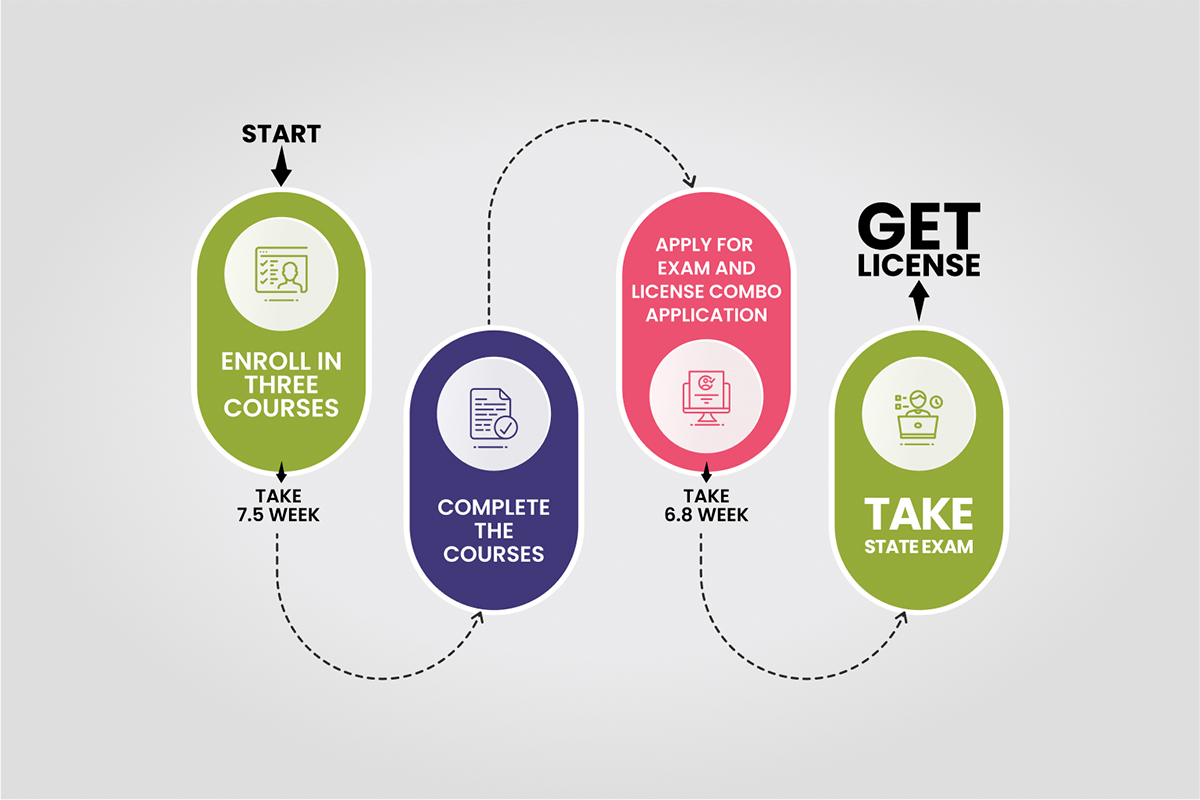
Education: Aspiring real estate agents must complete 135 hours of Pre-Licensing education. This includes three courses: Real Estate Principles, Real Estate Practice, and one elective course with courses approved by the Department of Real Estate in California. [This can be finished in as fast as 54 calendar days]
Examination and License Application: After completing the educational requirements, you must apply to take the California real estate license exam. You can apply for the exam and license simultaneously, but it’s important to bear in mind that this step can’t be completed without first completing the pre-license courses. [This processing typically runs 6-8 weeks.]
Background Check: A fingerprinting process through Livescan is required for a background check. These fingerprints should be completed before applying for the real estate exam but after completing the three pre-license courses.
State Examination: Pass the California real estate license exam and apply for your license. Just as a heads up, the real estate license exam is given in a computerized format.
How Soon Can I Do Each One?
Education: The 135 hours of Pre-Licensing education can be completed at your own pace through ADHI Schools We have online courses for flexibility, so you can potentially complete this step in as little as 54 days. However, you have up to one year to complete the program. We want to give you more time, but the DRE in California says that all courses must be completed within one year of enrollment.
Exam and License Application: Once you complete the three open-book exams on our website, the next step is to apply for the state exam. You can apply online through a California Department of Real Estate eLicensing system. Processing times for the application to take the state exam can vary, but planning is critical. Currently, the processing time is typically between 6-8 weeks. This period can vary, so checking the DRE website for the most current timeframes is advisable.
Background Check: The fingerprinting process can be completed relatively quickly, often within a week, but scheduling might vary based on location and availability.
Where Do I Take My Real Estate License Test?
The California real estate license exam is administered at several DRE locations throughout the state. Candidates can choose the most convenient location when scheduling their exam. The DRE website lists the locations and provides addresses and contact information for planning your exam day.
The five locations where exams can be taken are Fresno, Oakland, Sacramento, San Diego, and La Palma. (La Palma is considered the "Los Angeles area" location for the state exam.)
To summarize, completing the pre-license courses can take up to 2 months, followed by an additional 1.5 to 2 months for the state to process the application. This means the entire process will take approximately 3.5 to 4 months in total.
Obtaining your real estate license in California requires dedication and planning. By understanding the steps involved and the time each takes, you can efficiently navigate the journey toward becoming a licensed real estate agent.
Remember, the time it takes to get licensed varies based on individual circumstances. Still, with a clear plan and a commitment to your goal, you can achieve your real estate aspirations in California. ADHI Schools would love to be a part of your journey!
TLDR: Ideally the whole process should take around 4 months if you hustle!
Love,
Kartik
|

Embarking on a real estate career can be exciting and daunting, especially when meeting the qualifications for obtaining a license. One question that arises among aspiring real estate professionals in Read more...
Embarking on a real estate career can be exciting and daunting, especially when meeting the qualifications for obtaining a license. One question that arises among aspiring real estate professionals in California is: "Can you take the real estate exam in California without any classes?" This question is crucial for those eager to dive into the industry but must decide on the required educational commitments. I wanted to address this question head-on while incorporating insights from related topics pertinent to launching a successful career in real estate.
California, known for its dynamic real estate market, sets forth specific requirements for individuals aiming to become licensed real estate agents. The California Department of Real Estate (DRE) mandates that applicants complete some coursework before sitting for the state licensing exam. Specifically, you must complete three college-level courses in real estate principles, practice, and one elective course from a list from an approved California real estate license school However, exceptions exist for individuals if they are a lawyer who wants a real estate license in California. Lawyers who are members of the State Bar of California are exempt from the college-level course prerequisites, allowing them to proceed directly to the licensing exam. This exemption acknowledges the extensive legal education that lawyers undergo, which overlaps significantly with real estate law and practices. However, California attorneys still must take and pass the real estate license exam.
For those not exempted by a legal career, the educational requirement is more than just a bureaucratic hoop to jump through. It is designed to equip you with a foundation to navigate the complexities of real estate transactions. These courses cover various topics, from property rights and contracts to finance and ethics, ensuring that you are well-prepared to serve your clients effectively.
Preparing for the California real estate exam is a rigorous process that demands a comprehensive understanding of various subjects. Our real estate exam prep guide offers a valuable resource for those studying for the exam, providing structured guidance and strategies to tackle the exam confidently. The guide includes practice questions, outlines of key topics, and test-taking tips to enhance your chances of passing on your first attempt.
Passing the California real estate exam is a notable achievement, but it's just the beginning of your journey. A Guide to Your First 30 Days as a Real Estate Agent outlines essential steps for newly licensed agents, from joining a brokerage to developing a marketing plan and building your client base. This critical period can set the tone for your career, emphasizing the importance of a strong start.
Once licensed, continuous learning and adaptation are key to longevity and success in the real estate profession. California requires real estate agents to complete continuing education courses to renew their licenses. This requirement ensures that agents stay updated on the latest laws, regulations, and market trends, reinforcing the value of lifelong learning in this dynamic field.
In addition to formal education and licensing requirements, building a successful real estate career involves mastering practical skills and leveraging personal networks. Referrals 101: How to Ask Your Friends and Family for Referrals highlights the significance of referrals in generating business. Cultivating a solid referral network can be instrumental in establishing and growing your real estate practice, underscoring the industry's relational nature.
Understanding the financial aspects of real estate, such as understanding off-the-top fees as a Realtor is also crucial. This knowledge helps agents manage their finances effectively, from navigating commission structures to budgeting for business expenses. Financial understanding is essential for maximizing earnings and ensuring the sustainability of your real estate career.
While it may seem appealing to bypass educational requirements and jump straight into taking the California real estate exam, the state mandates these courses for good reason. They provide a solid foundation of knowledge and skills essential for success in the real estate industry. For lawyers, exemptions offer a streamlined path to licensure, yet the principles of thorough preparation and continuous learning apply universally across the profession. By embracing these educational opportunities and leveraging resources like exam prep guides and practical advice for new agents, aspiring real estate professionals in California can set themselves up for a rewarding and prosperous career.
TLDR: For the most part, classes are required. Lawyers in California are exempt from the classes, but nobody is exempt from the licensing exam.
Love,
Kartik
|
What are the Pros and Cons of Becoming a Real Estate Agent?
Imagine a career where each day brings a new adventure, your income mirrors your ambitions, and you have the power to shape your destiny. Read more...
What are the Pros and Cons of Becoming a Real Estate Agent?
Imagine a career where each day brings a new adventure, your income mirrors your ambitions, and you have the power to shape your destiny. This is the world of real estate — a profession that's not just a job but a lifestyle. Real estate offers an exciting and rewarding path for those drawn to a career that combines flexibility, potential, and personal fulfillment. However, like any dynamic career, it comes with its challenges.
At our real estate school we are regularly counseling students on the benefits of obtaining a real estate license As such, I wanted to write an article exploring the multifaceted nature of a real estate career, examining the advantages and hurdles to give you a clear perspective on what it truly means to pass the real estate exam and become a real estate agent. Whether you're seeking a change, chasing a dream, or contemplating your next career move, understanding the pros and cons of real estate is an essential step toward making an informed decision.
Pros of Becoming a Real Estate Agent:
Unlimited income potential:
Forget the paycheck treadmill: Ditch the predictable, the capped, the "just enough" mentality. In real estate, you're the CEO of your career and the captain of your financial ship. Every transaction is a voyage, every negotiation a thrilling adventure, every closed deal a treasure chest overflowing with rewards.
A single high-value deal can catapult you to financial heights you never dreamed of. Imagine exceeding expectations, not just meeting them. Imagine exceeding your wildest goals, shattering personal records, and rewriting your definition of "possible."
Remember, the only limit in real estate is the one you set for yourself. So, grab your ambition, unleash your hustle, and get ready to conquer the world, one deal at a time. The open sky awaits!
Flexible Schedule:
Say goodbye to the clock punch and hello to a workday woven into the fabric of your life. Becoming a real estate agent isn't just about houses; it's about reclaiming your time and crafting a schedule that dances to your tune. Imagine this: No more rigid 8-to-5s cramping your dreams. No more morning commutes stealing precious moments with loved ones. As a real estate agent, your calendar becomes a blank canvas, ready to be splashed with vibrant hues of work, family, and personal pursuits. Early bird or night owl? Introvert or social butterfly? The answer doesn't matter here. You schedule the open houses around your yoga class, the client meetings around your kid's soccer game, and the paperwork blitz around your quiet writing hour. This is your symphony, and you get to conduct the tempo.
Need a midday break for a spontaneous hike? Go for it! The market doesn't close with the lunch bell. Just schedule that afternoon showing around your newfound sense of rejuvenation. Your well-being isn't an afterthought; it's fuel for your hustle. Flexibility doesn't just mean freedom, it means opportunity. Imagine catching a weekday morning showing for a client before their work starts, securing the deal before anyone knows the property is available. Or you are closing a late-night negotiation over cocktails, sealing the deal with a flourish while others are tucked in their beds.
This isn't just about escaping the cubicle: It's about embracing a life where work flows seamlessly with your passions, where every day feels like a dance between ambition and fulfillment. You're not just selling houses; you're selling control over your precious time and the freedom to design a life that truly resonates with your soul. Remember, in real estate, time is yours to bend, mold, and sculpt into the masterpiece of your life. What will you create?
Career Satisfaction:
Imagine this: unlocking the door to a family's first home, their eyes sparkling with excitement as they step onto the freshly cut lawn. Picture yourself handing keys to a young couple, their faces radiating gratitude after months of searching. Feel the warmth of a retiree's smile as they hand you the keys to their longtime home, ready for their next adventure. These aren't just transactions; they're life-changing moments.
If you decide to focus on residential real estate you're not just selling houses; you're orchestrating dreamscapes, crafting havens of happiness, and weaving the threads of hope into the very fabric of your community. The gratitude you receive isn't just a pat on the back; it's fuel for your soul. Every satisfied client is a testament to your impact, a living reminder of the difference you make in their lives. It's a validation that your hustle, expertise, and dedication matter. But it goes beyond the tangible. You become a trusted confidante, a shoulder to lean on, a cheerleader for their aspirations.
You witness the most vulnerable moments – the nervous excitement of first-time buyers, the bittersweet nostalgia of downsizing seniors, the quiet anxieties of those facing life transitions. In these moments, you're more than an agent; you're a human touchpoint. You offer empathy, understanding, and a reassuring hand to guide them through the emotional rollercoaster of buying or selling a home. You become a part of their story, a thread in the tapestry of their lives. This isn't just a career, it's a privilege.
Variety and Excitement:
For those of us in real estate, each day is a blank canvas, ready to be splattered with vibrant hues of new experiences, unexpected challenges, and the thrill of the unknown. Imagine this: One morning you're touring a sprawling mansion with a celebrity client, discussing million-dollar deals and marble countertops. The next, you're knee-deep in negotiations with a young couple, helping them navigate the labyrinth of first-time homeownership. By lunchtime, you're meeting an appraiser on one of your listings.
No two clients are the same, no two properties are identical. You'll encounter quirky retirees looking for a cozy retirement haven, savvy investors hunting for profitable flips, and growing families yearning for their perfect suburban nest. Every interaction is a mini-mystery, a puzzle to be solved, a story waiting to unfold. The market is a living, breathing entity, pulsing with change and unexpected turns. Every economic update, every shifting trend, every neighborhood hot spot creates a new wave of excitement, a new challenge to conquer.
Networking Opportunities:
Forget business cards, think handshake highways! Becoming a real estate agent isn't only about keys and contracts, it's about unlocking a vast network that can catapult your career and expand your horizons. Imagine a web of opportunity woven from every conversation, every client you meet. Your daily life becomes a networking event in disguise. Open houses are cocktail parties where you mingle with potential clients, lenders, and fellow agents. Every neighborhood walk becomes a chance to connect with homeowners, business owners, and community leaders. Your social media becomes a vibrant marketplace of professional interactions and referrals. But it's not just about numbers, it's about relationships. You become the trusted advisor, the one who knows a guy (or gal) for everything. Think of yourself as a spider at the center of a bustling web.
This network isn't just for business, it's for life. You'll find mentors who guide your path, friends who share your hustle, and collaborators who fuel your creativity. So, step out of your comfort zone and into the bustling marketplace of possibilities. Shake hands, share stories, offer help, and watch your network become your launchpad. Remember, in real estate, connections aren't just built; they're cultivated, cherished, and leveraged to unlock a world of success beyond your wildest dreams. Who will you connect with today?
Personal Growth:
Forget the gym, embrace the real estate hustle! This isn't just a career; it's a training ground for personal growth where you'll sculpt yourself into a more robust and resilient version of yourself. Imagine this: Every client interaction is a language lesson, honing your communication skills from a whisper to a roar. You'll learn to negotiate like a ninja, read people like open books, and navigate complex situations with the grace of a seasoned diplomat. Challenges won't break you, they'll build you. Every hiccup in a deal, every tough negotiation, every unexpected hurdle becomes a stepping stone, teaching you resilience, resourcefulness, and the art of thinking on your feet. You'll learn to trust your instincts, embrace your unique approach, and become the best version of yourself, brick by brick.
As a new real estate agent, think of yourself as a diamond in the rough, waiting to be polished. Real estate is the polishing cloth, the pressure, the heat that brings out your inner sparkle. You'll emerge not just a successful agent but a confident individual, a skilled communicator, a fearless problem-solver, and a leader in your own right. This isn't just a career, it's a personal odyssey. It's about pushing your boundaries, conquering your fears, and discovering the depths of your potential. So, roll up your sleeves, embrace the challenges, and get ready to be amazed by the person you'll become in the vibrant world of real estate. Remember, growth isn't found in comfort zones, it's found in the heat of the hustle. What will you discover about yourself today?
Community Impact:
Imagine this: You're the key that unlocks the door to a young family's first home, the foundation on which they'll build their memories. You're the guide who shepherds retirees into their perfect downsized haven, a cozy nest for their golden years. You're the matchmaker who connects vibrant businesses with the ideal location, injecting life and prosperity into the local tapestry.
You might also become the local professional who spearheads the annual charity bake sale and organizes the neighborhood clean-up day. Your success fuels your desire to give back, see your community thrive, and leave a legacy beyond commission checks.
So, step into the role of community champion. Embrace the opportunity to leave your mark, not just on a balance sheet, but on the very soul of your neighborhood. Make a difference: one client, block, and smile at a time. Remember, in real estate, you're not just building houses; you're building a legacy of community. What will yours be?
Cons of Becoming a Real Estate Agent:
Income Inconsistency: The fluctuating nature of the real estate market means that income can be inconsistent. This variability requires agents to be financially savvy and prepared for periods of lower earnings.
Competitive Market: The real estate industry is highly competitive, requiring agents to work hard to differentiate themselves and build a thriving client base.
Extended Hours and Stress: Success in real estate often means working outside traditional hours, including evenings and weekends. The job can also be stressful, dealing with various client demands and market fluctuations.
A career in real estate offers a unique blend of challenges and rewards. It's a profession that demands dedication, hard work, and a willingness to navigate its complexities. Real estate can provide a fulfilling and lucrative career path for passionate and committed people. When entering this field, prospective agents should consider their personal goals, strengths, and lifestyle preferences. Despite its challenges, real estate offers a rewarding journey with professional and personal growth opportunities for the right individual.
Love,
Kartik
|

The path to becoming a real estate professional in California is often perceived as a straightforward journey. However, the reality is quite different. The California real estate exam is a non-negotiable Read more...
The path to becoming a real estate professional in California is often perceived as a straightforward journey. However, the reality is quite different. The California real estate exam is a non-negotiable step in this journey, posing a challenge to lots of folks who want to enter our industry.
Before diving into the specific statistics of who passes and who fails, it is helpful to understand the big picture. If you are looking for a complete roadmap of the entire licensing process—from requirements to application—check out our Ultimate Guide to the California Real Estate Exam.
Qualifying to Take the Exam: The First Hurdle
In order to take the real estate license exam in California, you must successfully complete three college-level courses. These courses are "Real Estate Principles," "Real Estate Practice," and one elective course.
Once certificates of completion are obtained for each of these three required courses, the candidate may then sit for the state license exam. If a real estate broker license is desired, the candidate must complete the above three courses as well as five additional college-level courses and have a couple of years of experience.
Scheduling vs. Taking the Exam: The Second Hurdle
A surprising phenomenon in the California real estate exam process is the discrepancy between the number of individuals who schedule their exams and those who actually show up and take it.
In July 2025, 259 broker examinees scheduled their exam, but only 223 actually took the test. Similarly, out of 2,662 salespersons who planned to take the exam, only 2,328 followed through and actually took the test.
That’s over 300 people who scheduled their salesperson exam but never took the test! This gap suggests a range of factors—from last-minute jitters to personal circumstances—that prevent candidates from even attempting the exam.
Passing the Exam: A Steeper Challenge
For those who actually do take the exam, success is not guaranteed. The failure rate is a stark reminder of the exam's difficulty and the level of preparation required. A recent examination of the pass rates might be super surprising.
Broker Exam: 223 people took the broker exam in a recent month and only 107 of those passed.
Salesperson Exam: The salesperson exam is only slightly better. In the same month, 2,328 people took the sales license exam and only 1,280 of those passed.
Unpacking the Low Pass Rates
The real estate license exams in California have yielded intriguing results, with notably low pass rates that might raise eyebrows among novices and experts alike. You might be looking at these numbers and asking yourself, Is the California Real Estate Exam Hard?
The Factors Contributing to Failure
The Factors Contributing to Failure Let's delve into the factors that contribute to such challenging scenarios to really understand why people fail the real estate exam.
Exam Difficulty & Scope: The exams encompass a broad spectrum of topics, from intricate laws and regulations to real estate principles and practices. This extensive range demands a high level of understanding.
Preparation Level: Often, examinees may find themselves inadequately prepared due to limited study time or a simple underestimation of the exam's difficulty.
Test Anxiety: Many candidates grapple with test anxiety or lack effective test-taking strategies.
If you fall into the statistical group that doesn't pass on the first try, don't panic. It is a common setback. It is important to know your options regarding your options on retaking the real estate exam.
How to Be in the Passing Group
The pass rates for California's real estate license exams are indicative of a demanding professional standard. They underscore the necessity for thorough, well-rounded preparation.
To ensure you are part of the 46% who pass rather than the majority who fail, you need a strategy. We have compiled a list of specific strategies to help you navigate these challenges so you can pass the real estate exam on the first try.
Next Steps
For those embarking on this journey, understanding and addressing these factors can pave the way to success in this challenging yet rewarding field.
If you need help passing the real estate license exam, visit www.crashcourseonline.com for the most up-to-date and comprehensive test prep available.
FAQ
Q: Is getting a real estate license in California as easy as people think?
A: No. While often perceived as a straightforward journey, the reality is much harder. The exam is a major hurdle that blocks many from entering the industry.
Q: What do I have to do before I can even sit for the exam?
A: You must complete three college-level courses: Real Estate Principles, Real Estate Practice, and one elective. (Aspiring Brokers need to finish these three plus five additional courses).
Q: Does everyone who schedules the test actually show up?
A: Surprisingly, no. In July 2025, over 300 salesperson candidates scheduled the exam but never took it, likely due to last-minute jitters or personal circumstances.
Q: What are the actual pass rates?
A: They are steep. In a recent month:
Brokers: Only 107 passed out of 223.
Salespersons: Only 1,280 passed out of 2,328.
Q: Why is the failure rate so high?
A: It usually comes down to three factors:
Scope: The exam covers a massive range of topics, including intricate laws.
Preparation: Candidates often underestimate the difficulty and don't study enough.
Anxiety: Poor test-taking strategies and nerves cause many to freeze up.
Q: What if I fail on the first try?
A: Don't panic—it is a very common setback. You have options to retake the exam.
Q: How do I ensure I’m in the group that passes?
A: You need a strategy. To be part of the ~46% who pass, you must move beyond basic studying and utilize comprehensive test prep.
|

Are you gearing up to carve out your niche in the competitive world of California real estate? Before you start showcasing homes and closing deals, there's one crucial hurdle to cross: the California Real Read more...
Are you gearing up to carve out your niche in the competitive world of California real estate? Before you start showcasing homes and closing deals, there's one crucial hurdle to cross: the California Real Estate License Exam Now, you might wonder, "Is the examination digital, or do I have to tackle it the old-fashioned way, with paper and pencil?" Let's dive into the evolution of the exam process, transitioning from paper to computer, and what that change means for aspiring real estate moguls like you.
The Evolution of the California Real Estate Exam
Years ago, the California Real Estate Exam was a paper-based test format many of us remember from school. Picture it: a room full of anxious individuals, the sound of pages turning, and the scratching of pencils against paper. This method, while traditional, presented various logistical issues, like scheduling constraints, potential for error in grading, and delays in scoring of the real estate exam.
However, as technology advanced, so did the examination methods. Over ten years ago (2011), the state recognized the need for a more streamlined, efficient process through computer-based testing (CBT). Today, the California Real Estate Exam is administered electronically, a transformation that has modernized the examination process. This change means quicker results, enhanced security, easier accommodations for those who need them, and a more flexible exam schedule.
But what does taking the exam on a computer entail for you? Let's unpack that.
Real Estate Exam Locations: Know Before You Go
The California Department of Real Estate (DRE) offers several convenient locations to take your computerized exam. These sites are strategically located to cover the widest possible area, ensuring candidates can find a testing center without traveling extreme distances.
Testing locations are in Fresno, Sacramento, La Palma (Los Angeles area location), San Diego, and Oakland.
What's important is selecting a location that suits your needs. Consider factors such as distance, ease of travel, and availability of dates. You'll want to register for your exam beforehand using eLicensing eLicensing and remember that slots fill up quickly, especially in busy seasons.
A pro tip? Be flexible with your dates, and monitor any slot openings due to cancellations.
Mastering the Digital Arena: Requirements to Pass the Real Estate License Exam
Switching to a computerized format doesn't change the essence of the exam; it's the medium, not the content, that's different. You will still be tested on your knowledge of real estate laws, principles, and practices. The exam consists of multiple-choice questions, requiring a keen understanding of various topics and the ability to apply that knowledge in scenario-based questions.
So, how do you conquer this digital giant? Preparation is key. Invest in up-to-date study materials take practice exams, and consider enrolling in reputable real estate exam prep courses Since the exam is on the computer, try simulating the test environment by taking online practice tests. This approach will familiarize you with the content and digital format, reducing any test-day jitters related to navigating the computer interface.
Now, let's talk scores. To pass, you need to correct a specific number of questions, reflecting a thorough understanding of the material. The DRE doesn’t require perfection but demands a passing score. After submitting your test, one of the beauties of computer testing is that you won't have to wait weeks to receive your score. Instead, you'll know soon whether you've cleared the hurdle or need to jump again.
License Type
Broker
Salesperson
Number of questions
200
150
Number of exam
4 hours
3 hours
Passing score
75%
70%
Test Day Essentials: Remember the Parking!
You've studied and are ready to excel in the digital test-taking environment, but your test-day preparations continue beyond there. Picture this nightmare: You arrive at the testing center and are already nervous. Your heart sinks as you realize there's no parking, or worse, you need to have a permit you didn't know about. Now you're racing against the clock, with the added pressure of finding parking.
To avoid this added stress, plan your visit. Check out the testing location, noting the parking situation, whether you need to pay, where you can park, or if you need a permit. Some test centers may need more parking, especially during busy times. Others might share a parking lot with other businesses, and specific restrictions may apply. Check with the DRE for parking information or scope the location before your exam.
Knowing the parking logistics will spare you unnecessary test-day tension. Consider doing a trial run, especially if you are unfamiliar with the area. Knowing exactly where you're going will provide peace of mind, letting you focus on what's truly important: passing that exam.
Embracing the Future of Real Estate Examinations
Ultimately, the shift from paper to computer for the California Real Estate License Exam reflects our broader societal shift towards digitalization. It's about efficiency, security, and accessibility. For test-takers, computer-based testing represents convenience and quicker results, allowing you to embark on your real estate career sooner.
Remember, while the testing method has changed, the key to success remains unchanged. So, embrace the change, plan your test day down to the parking details, and you'll navigate this digital challenge like a pro, setting the stage for many successful transactions in your promising real estate career.
TLDR: Exams are given at DRE testing centers electronically.
Love
Kartik
|

Oh, the allure of the real estate world! It's like a giant magnet for folks with big dreams of ditching the 9-to-5, being their own boss, and really taking control of their money. And why not, right? The Read more...
Oh, the allure of the real estate world! It's like a giant magnet for folks with big dreams of ditching the 9-to-5, being their own boss, and really taking control of their money. And why not, right? The beauty of diving into real estate is that you are the captain of your own ship. Your business grows as much as you hustle, and who doesn't love the sound of that?
Here's a little inside scoop: there's this magic number that everyone pencils at the top of their dream board - a cool $100,000. Cracking six figures isn't just about brimming bank accounts (although that's a sweet perk). It's more like a golden ticket that gets your foot in the door and your name on the leaderboard. It's a confidence booster, a sign you're playing in the big leagues, and can give you the confidence to climb even higher. So, for anyone breaking into the biz, crossing off that $100K target isn't just a flashy ambition; it's the first major pit stop on a thrilling ride to the top!
This number also strikes a balance between ambition and attainability. New agents, while enthusiastic, are aware of the realities of starting in real estate: the unpredictability of the market, the initial period where commissions might be sparse, and the competitive nature of the industry. Setting a goal too high might lead to early burnout from chasing unattainable targets, while too low a goal might not provide enough motivation. $100,000 is an accepted “middle ground” that provides a realistic target while offering enough challenge for motivation without being discouragingly unattainable.
But this requires a game plan.
And let's be real: a goal without a plan is just a wish. Without a target, how will you measure how far you've come? Or know what’s hot and what’s not? You need it to backtrack, tweak your strategies, and keep yourself honest. It’s your own personal reality check, stopping you from floating off into space.
So once you've aced your real estate exam your education truly begins. Now, instead of theory, you're analyzing the local real estate market in the real world.
So, what does the blueprint for achieving this goal entail?
To start, understanding the average sales price of homes in your market is a fundamental data point, as it correlates to potential commissions.
Suppose the median sales price in your area is $850,000. This will be your guiding figure, keeping in mind that actual property prices will be around this point.
The standard commission for real estate transactions hovers between 2-3% of the property's selling price. Using the average sales price gleaned from your market research, a 2.5% commission on an $850,000 property equates to $21,250.
So to reach your $100,000 goal you will need to close escrow on around five properties. However, remember that some deals will inevitably fall through due to various factors outside of your control.
Working with your broker or manager, you might come to realize that in order to close five transactions, you might need to open escrow on eight to ultimately close the five deals required to meet your income target.
Keep in mind that brokerage commission splits are a reality that will affect your take-home pay. If your brokerage claims a 30% share of your commission, your net earnings from each deal decrease, demanding another adjustment in your sales strategy to meet income objectives.
Develop a business plan that accounts for your brokerage's commission structure, the average property price in your area, and the realities of deal attrition. Regularly assess your progress and adjust your strategies as you learn more about market dynamics. The first step in doing this is to devise a schedule you need to open the eight escrows needed to achieve your income goal.
Remember there are only two ways to make more money in real estate:
Increase your average sales price
Close more deals
Whichever of these you choose, there are three crucial skills that new agents should develop to hit this lucrative target.
Prospect/Market
Lead Follow Up
Make Presentations
Prospecting and Marketing
Prospecting, the active process of searching for potential customers or buyers, is crucial in real estate sales. This proactive approach involves identifying individuals or entities in the market to purchase, sell, or invest in property. It is often what sets successful real estate professionals apart from their peers. In an industry where opportunities and competition coexist intensely, prospecting acts as a lifeline, ensuring a consistent flow of business opportunities and helping professionals keep their pipeline of potential sales active. Without effective prospecting, a real estate agent's business becomes highly susceptible to the peaks and troughs of market conditions, impacting sustainability and growth.
Moreover, prospecting allows real estate agents to establish and maintain relationships with a network of potential clients, which is essential in an industry driven by trust and personal connections. Agents build a reputation and a sense of authority among potential and future clients through regular communication initiated by prospecting efforts, such as calls, meetings, or community engagements. This continuous cycle of outreach and relationship management often leads to referrals, repeat business, and a robust client base, fostering long-term success. Prospecting is not just about seeking immediate opportunities; it's about nurturing an ecosystem of future opportunities, creating a solid foundation for a resilient and thriving real estate business.
Lead Follow Up
Securing a lead is just the beginning; following up is where the real work lies. The real estate industry thrives on relationships and trust, aspects developed through consistent communication. New agents should establish a systematic approach to lead follow-up, ensuring potential clients stay caught up.
This strategy might include personalized emails, regular check-in calls, or informative newsletters. A CRM (Customer Relationship Management) system can be invaluable here, helping manage your contacts and set follow-up reminders. Responding promptly and thoughtfully to inquiries is crucial, showing potential clients your commitment and setting the stage for successful transactions.
Remember - the money is in the lead follow up
Improving Your Presentation Skills
An often under-emphasized real estate license education skill is the ability to present effectively. Whether you're pitching to a prospective client, showcasing a property, or negotiating deals, your presentation skills are constantly under the spotlight.
New agents should invest time in improving these skills — practicing property showings, role-playing negotiation scenarios, or even taking a public speaking course. A compelling presentation can sway decisions in your favor and is often the key to converting leads into sales. As you gain confidence, you'll also build a reputation for professionalism and competence, factors clients seriously consider when choosing an agent.
Earning $100,000 a year in real estate is not a feat achieved by sitting back and waiting for opportunities to knock. It results from proactive effort in prospecting, meticulousness in lead follow-up, and continual refinement of presentation skills. These activities and the foundational benefits of getting a real estate license create a pathway to reach and exceed your income goals.
Embrace these tasks with the understanding that real estate isn't just about selling properties; it's about forging relationships, providing top-notch service, and asserting your value in a competitive marketplace. Each satisfied client, successful deal, and learned lesson propels you closer to that six-figure milestone.
If you are interested in learning more about getting your real estate license, reach out at www.adhischools.com or call us at 888-768-5285.
Love,
Kartik
|

Top 5 Mistakes New Real Estate Agents Make After Getting Licensed (And How to Avoid Them)
Starting a career in real estate is exciting and has many opportunities. However, like any job, it has Read more...
Top 5 Mistakes New Real Estate Agents Make After Getting Licensed (And How to Avoid Them)
Starting a career in real estate is exciting and has many opportunities. However, like any job, it has its challenges. New agents might initially find it complicated, even after completing real estate school and getting their licenses. While getting a license is an important step, it's just the beginning. Challenges arise when handling property sales, building client relationships, and understanding market changes. I wanted to write an article to highlight common mistakes made by new agents and give advice on how to avoid them for a more rewarding real estate career.
Mistake 1: Not Building a Marketing Strategy
One of the most common pitfalls for newer real estate agents is the belief that clientele will magically gravitate toward them with little proactive outreach. This misconception can be detrimental to an agent's budding career. Today's real estate market is saturated, and standing out requires more than obtaining a license and setting up a desk in an office. Successful agents understand that a consistent and well-thought-out marketing strategy is at the heart of their business.
A robust marketing strategy is a combination of both online and offline efforts. In the digital age, online methods such as social media campaigns, targeted ads, email newsletters, and a professional website are indispensable. These tools increase an agent's visibility and help build credibility and trust among potential clients. On the other hand, offline methods like networking events, open houses, and local advertising play a vital role in community engagement and personal brand building. Together, these strategies form a comprehensive approach to reaching and attracting clients. For a new real estate agent, investing time and resources into a marketing strategy from the outset can make all the difference between a thriving career and one that never quite takes off.
Mistake 2: Neglecting Continuous Learning
Starting a real estate career usually begins with training, like what ADHI Schools offers. We prepare students for the licensing exam and give our students a basic understanding of the industry. But this initial knowledge is just the beginning. The real estate world constantly changes—new market trends, shifting property values, and updated regulations exist. So, while the foundation from schools like ADHI is important, agents shouldn't stop there.
To succeed, agents must keep learning. Regular training, workshops, and staying updated on the market are crucial. This continuous education helps agents stay ahead and better serve their clients. Simply put, the most successful agents know their learning never stops, even after formal schooling.
Mistake 3: Undervaluing Networking
The Power of Networking in the Real Estate Industry
For many newer real estate agents, passing the real estate exam marks a significant milestone in their budding careers. It's an achievement that opens the door to the vast world of property sales, acquisitions, and negotiations. However, a crucial aspect that can sometimes be overlooked in the initial stages is the immense value of networking.
While acing the real estate exam is a testament to one's foundational knowledge, the journey ahead requires more than just theoretical understanding; it demands connections, collaborations, and mentorships.
Failing to build a robust professional network can leave agents isolated in an industry where relationships often drive success. Engaging with local real estate groups, for instance, not only offers insights into regional market trends but also provides opportunities for collaborations and referrals. Likewise, attending industry events can introduce agents to seasoned professionals, potential clients, and even future mentors. These interactions often lead to partnerships, joint ventures, and other collaborative efforts that can bolster an agent's market presence and portfolio.
Furthermore, seeking mentorships can be a game-changer. A mentor can provide guidance, share experiences, and offer valuable advice on navigating the industry's complexities. They can be instrumental in avoiding common pitfalls and capitalizing on hidden opportunities.
So while passing the real estate exam is essential to establishing oneself in the industry,
the relationships built afterward often dictate the trajectory of success. Undervaluing networking can be a significant oversight, but with proactive effort, newer agents can weave a network that supports and propels their career forward.
Mistake 4: Not Setting Clear Goals and Milestones
In the bustling world of real estate, momentum and direction are paramount. One of the pitfalls that newer agents can sometimes fall into is navigating the industry without clear goals and milestones. Just as a ship without a compass can drift aimlessly, a real estate agent without set objectives may find themselves working hard but not necessarily smart. A lack of direction can significantly hamper growth, leading to missed opportunities and inefficient use of time and resources.
Setting both short-term and long-term goals is essential for charting a clear path forward. Short-term goals offer immediate targets, ensuring agents remain focused and motivated in their daily endeavors. These can range from acquiring a set number of new clients in a month to closing specific property deals. On the other hand, long-term goals provide a broader vision, guiding agents towards larger aspirations like becoming a top agent in their region or expanding into luxury or other high-end markets.
Other examples of short-term goals can be to tour several homes for sale in your target area each week to understand pricing and features. Another example might be to familiarize yourself with local market trends, neighborhood specifics, and school zones by a certain date.
Long-term goals as a real estate agent include achieving a specific income or commission amount by the end of 12 months or becoming one of the top agents in your office or area based on sales volume or closed deals. Other areas of long term growth might be to grow your team by hiring an assistant, a buyer's agent, or other supporting roles.
However, setting goals is only half the battle. Regular reviews are vital to assess progress and ensure alignment with these objectives. The real estate market is dynamic, and strategies that work today might need tweaking tomorrow. Agents can adjust their strategies by periodically evaluating their progress, ensuring they remain on the path to success.
In essence, while the real estate landscape offers vast opportunities, the agents with clear goals and the diligence to review and adapt find themselves at the forefront of success.
Mistake 5: Poor Time Management
The Pitfalls of Mismanaging Time in Real Estate
In the bustling world of real estate, time is of the essence. New agents are quickly introduced to a whirlwind of tasks, from back-to-back client meetings to endless property showings and the necessary (albeit boring) set of administrative duties. With effective time management, they can avoid drowning in these responsibilities, missing golden opportunities, and feeling unnecessary stress. Moreover, the work-life balance—vital for mental well-being and long-term productivity—crumbles when business tasks consume every waking moment.
The key to taming the time management beast is leveraging the right tools. Thankfully, today's technology offers many solutions tailored for real estate professionals. Whether it's an online calendar that nudges with timely reminders or a comprehensive CRM system that optimizes client interactions, there's a tool for every need. By incorporating these into their daily routines, agents can ensure they're not just busy, but productive. A structured schedule also earmarks moments for relaxation and personal time—because a burnt-out agent benefits no one.
The unpredictability of real estate demands discipline in time management. For new agents, knowing these challenges and being ready for them can lead to real success in the long run. Everyone makes mistakes, but being prepared and knowing how to handle common problems can help a lot. If new agents focus on good marketing, keep learning, build strong connections, set clear goals, and manage their time well, they can avoid many common mistakes.
Love,
Kartik
|

Scheduling for Real Estate Agents: A Must-Have for Success
Being self-employed in the real estate industry presents unique challenges, especially when maintaining a consistent schedule. This is true Read more...
Scheduling for Real Estate Agents: A Must-Have for Success
Being self-employed in the real estate industry presents unique challenges, especially when maintaining a consistent schedule. This is true for both newcomers fresh from our real estate license school as well as seasoned agents. A well-organized timetable is essential. It ensures efficient time management, helps prioritize tasks, and ultimately aids in achieving career goals. Scheduling can also help achieve work-life balance, avoid burnout, and encourage balance.
Despite the benefits, scheduling can be challenging for real estate agents for a number of reasons:
The unpredictable nature of the job: Real estate agents often have to deal with unexpected events, such as last-minute client requests or property viewings. This can make it difficult to stick to a schedule.
Client-centric demands: Real estate agents need to be flexible and accommodating to their clients' needs. This may mean having to adjust their schedule on a regular basis.
The absence of a 9-to-5 structure: Real estate agents (especially in the residential sector) do not have fixed working hours, which can make it difficult to establish and maintain a routine.
With all this said, I wanted to suggest a sample schedule for the real estate professional to consider that is sustainable and ensures productivity. I’ve explained more about each of these below the schedule itself.
7.30am -10.00am Prospecting
10.30am – 12.00pm Lead Follow Up
1.30pm – 3.00pm Administrative Time
3.30pm – 4.30pm Preview Property/Market Analysis (MLS/CoStar Time)
5.00pm – 7.00pm Appointments or go home
Prospecting
Prospecting and lead generation are key tactics real estate agents use to get new clients. Lead generation is about attracting people by providing useful content online, like property listings, and using ads on social media, while also using traditional methods like direct mail real estate campaigns and open houses. On the other hand, prospecting is more active and involves agents directly reaching out to people, like making cold calls or asking previous clients for referrals. It's important for agents to effectively use both strategies: drawing people in with lead generation and then actively engaging with them through lead follow up to guide them through the buying or selling process in the competitive world of real estate.
Lead Follow-Up
In real estate, quickly and helpfully responding to potential customers, or "lead follow-up," is super important. This isn’t just being polite; it’s about showing you're reliable and trustworthy in a world where people are making big money decisions. Even in real estate school, there’s a big focus on this, teaching students that prompt and informative responses are key to turning interested people into actual clients. This has become especially crucial in our digital age, where potential clients can easily find another agent online if they don’t get quick answers. Therefore, learning about online communication and using tools to manage customer relationships is vital. In a nutshell, the careful and timely follow-up with leads often makes the difference in landing a deal in the real estate business.
Studying the Market
In real estate, knowledge about the market and continuous learning is vital. Market analysis involves studying current conditions and future possibilities in your local market, including pricing trends, demand, economic factors, and comparing similar properties. Like a doctor needs to stay updated with medical research, real estate agents must regularly analyze the market to provide accurate advice and spot trends or opportunities. Continuous learning, from seminars to online real estate courses, helps agents understand the many factors affecting the market. Agents must schedule time for these activities to stay informed, provide insightful advice, and gain a competitive edge in the fast-moving real estate world.
Preview property
Previewing properties is a crucial step for real estate agents, involving personally inspecting a property before showing it to potential buyers. This practice helps agents to know the property's features and any issues, enhancing client trust by providing accurate information and using their time wisely with suitable properties. For listing agents, previewing property also helps identify selling points and guide marketing strategies. This activity also assists in managing risks by identifying potential issues, facilitates professional development by keeping agents updated on trends, and ensures time efficiency by focusing on relevant properties.
Previewing property is invaluable for newer real estate agents as it offers firsthand experience and insights into the housing market. By personally visiting and inspecting properties, new agents become familiar with diverse property features, current market trends, and potential selling points, enabling them to answer client queries confidently.
This hands-on approach not only boosts their knowledge and credibility but also aids in building trust with potential clients, ensuring they offer relevant and informed property choices to match their clients' needs.
Showing properties and making presentations or go home
In the active world of real estate, two essential activities are showing properties and making presentations, both pivotal in aiding the transaction process.
Showing Properties: Real estate agents should allocate specific times in their calendars to show properties to qualified buyers. By having these slots pre-booked, agents can effectively structure their day and ensure they also have dedicated time for other essential tasks related to their real estate business.
Making Presentations: In real estate, listing presentations are crucial. Aiming to fit as many of these into your week as possible is beneficial. If you aren't engaged in showing a property or delivering a buyer or listing presentation, it's a sign you've concluded your essential tasks for the day. Adhering to a diligent schedule means you've put in solid work, and while heading home is an option, always remember that maximizing client interaction is always beneficial for success.
Scheduling Implications
Given the significance of these activities, real estate agents must make them central in their schedules:
Prioritization: Dedicating specific time slots for property showings and presentations ensures that agents remain undistracted during these crucial moments, providing undivided attention to clients.
Preparation: Scheduled times allow agents to prepare effectively — be it researching the nuances of a property, tailoring a presentation to a specific audience, or gathering additional resources to support their narrative.
Efficiency: Structured schedules optimize an agent’s time, ensuring a balance between personal client interactions and back-end research and administrative tasks.
By prioritizing property showings and crafting compelling presentations, agents bridge this gap. And in making deliberate time for these activities in their schedules, they amplify their efficacy, ensuring that every client interaction is informed, personalized, and impactful.
Don’t forget to incorporate regular intervals for short breaks that can ensure consistent productivity levels throughout the day.
Set Boundaries: Agents need to demarcate clear boundaries between work and personal time, ensuring neither encroaches upon the other.
Flexibility: While structure is vital, agents should allow spontaneous breaks or personal time, especially during taxing days.
Holistic Approach: Emphasizing the need for breaks and personal time signifies an agent's understanding of success as a holistic concept, encompassing both professional achievements and personal well-being.
While the hustle and bustle of real estate are inescapable, the importance of personal well-being remains paramount. By integrating breaks and personal time into their schedules, real estate agents do not merely enhance their productivity but also enrich their overall quality of life. After all, in a profession built upon relationships and personal connections, an agent's well-being is not just a personal asset but a professional one as well.
Love,
Kartik
|

The Changing Landscape of the Real Estate Industry
The world is now at our fingertips, and the real estate industry is no exception. Buyers can browse properties from the comfort of their own homes, Read more...
The Changing Landscape of the Real Estate Industry
The world is now at our fingertips, and the real estate industry is no exception. Buyers can browse properties from the comfort of their own homes, and agents can reach a global audience for their listings. This connectivity has created new opportunities for both buyers and sellers, and has also made the real estate market more competitive. The real estate industry is constantly changing, and it is important for agents and consumers alike to stay ahead of the curve. New technologies are emerging all the time, and agents who are able to embrace these technologies will be well-positioned to succeed in the future. In short, the real estate industry is in a new era, and it is an exciting time to be involved. The digital revolution has transformed the industry, and there are new opportunities for everyone.
Online listings, virtual tours, and digital marketing strategies have become the new norm, altering how real estate transactions are conducted and the expectations of both buyers and sellers.
Take a step back to the 1980s and early 1990s when the Multiple Listing Service materialized in hefty "phone book" styled catalogs. These pages showcased properties through single black-and-white photographs accompanied by brief, often vague descriptions that barely scratched the surface of what each home had to offer.
Today, dozens of full-color and high-resolution photos accompany each listing, with a lengthy description of each property that anyone with an internet connection can read. High-definition video tours abound with interactive components, allowing buyers to experience the property without leaving their homes.
Information is now readily accessible, effortless to obtain, and available everywhere.
How Has The Real Estate Licensing Process Changed Over The Years?
As of the date of this writing, the requirements to get a real estate license are three required statutory courses. These courses are Real Estate Principles, Real Estate Practice, and one elective course the candidate can choose from a list. Then the candidate will have to prepare for and pass the real estate exam.
However, these requirements have changed over time. Before October 1, 2007, only the Real Estate Principles course was a required to obtain a real estate license. Once completed, the candidate could get their real estate license, albeit a "conditional" one. Then, within 18 months, the new licensee could complete two other statutorily required courses and remove the "conditional" aspect of the real estate license.
The Department of Real Estate is again changing the real estate licensing requirements effective January 1, 2024. Applicants for a real estate license on or after that date must complete Real Estate Principles, Real Estate Practice with an "implicit bias" component, and one elective course. As the population becomes more diverse, real estate agents need to be able to understand and address the unique needs of all clients. The licensing process can play a role in preparing agents to be more inclusive and culturally competent.
Ultimately, the aim is to ensure that new agents are prepared to provide their clients with the highest level of service and professionalism. As the industry evolves, the licensing process will continue to adapt to meet the market's changing needs and protect consumers.
This change shows that the real estate licensing process adapts over time, hoping that new agents are knowledgeable, fair, and understanding when dealing with different kinds of people. These ongoing changes in the real estate licensing process show the industry's dedication to preparing new agents for the modern challenges of the real estate market.
The Future for Homebuyers
Home Buyers
In today's digital age, home buyers find themselves in a more empowered position than ever before when it comes to navigating the real estate market. Here's how:
Better Informed
Gone are the days when buyers had to rely solely on agents to get information about properties. Now, a wealth of information is just a click away. Various online platforms provide detailed information about the properties on the market, including asking prices, floor plans, amenities, and neighborhood statistics. The consequence is a breed of well-informed buyers who can make decisions based on data available at their fingertips, leading to more satisfying and confident purchases.
Convenience
The surge in digital platforms has notably streamlined hunting for a new home. Potential buyers can virtually tour numerous properties from the comfort of their homes at any time that suits them. This saves a significant amount of time and makes it easier to compare different options without the pressure of travel and appointments. Additionally, online tools like mortgage calculators and neighborhood insights assist buyers in making informed decisions quickly. The result is a smoother, more pleasant home-buying process where prospects can easily shortlist their preferred properties before visiting in person, making the entire journey less cumbersome and more aligned with individual preferences and needs.
Through these advancements, the real estate industry has reshaped the home buying process into a more buyer-friendly experience, bridging gaps and fostering a more transparent and efficient transaction environment.
The Future For Home Sellers
Home Sellers
Home sellers stand to gain immensely as the real estate industry embraces the digital revolution. From expansive outreach to enhancing the visual allure of listings, here's how the modernization of the industry is benefiting home sellers:
Wider Reach
In the era preceding the Internet, sellers largely depended on local agents and word-of-mouth to find potential buyers. But now, digital platforms have obliterated geographical barriers, offering an opportunity for listings to be viewed by a national, even global audience. Websites, apps, and social media platforms have become powerful tools in a seller's arsenal, enabling them to reach a vastly expanded pool of potential buyers. This increases the likelihood of finding the right buyer more quickly and fosters a competitive environment, driving the property price upward. Through online listings and virtual tours, sellers can ensure their property is visible to a much larger audience, enhancing their chances of a successful sale.
Visual Appeal
The ability to showcase properties through high-resolution images and videos has revolutionized the real estate listing process. Sellers can now work with professionals to create visually stunning virtual tours, aerial views captured by drones, and 3D home tours, allowing prospective buyers to explore every nook and cranny of a property without leaving their homes. This enhanced visual presentation attracts more viewers and enables the property to be presented in its best light, highlighting its strengths and downplaying its weaknesses. Consequently, a listing becomes more appealing and stands out in the crowded marketplace, potentially attracting more inquiries and visits and resulting in a quicker sale at a better price.
Digital tools have given sellers powerful ways to showcase their homes to a wider and more diverse audience, making the selling process more efficient and profitable.
Overall, I am optimistic about the future of the real estate industry and the licensing process. The changes we see are necessary to ensure that the industry remains competitive and that consumers are protected.
As Robin Sharma has said “Change is hard at first, messy in the middle and gorgeous at the end.” The real estate industry is no exception.
Love,
Kartik
|

Navigating the Landscape of Trust: Interpersonal Skills in Real Estate
Interpersonal Skills: The Essential Ingredient for Real Estate Success
As a real estate expert, I am often asked what the most Read more...
Navigating the Landscape of Trust: Interpersonal Skills in Real Estate
Interpersonal Skills: The Essential Ingredient for Real Estate Success
As a real estate expert, I am often asked what the most important quality is that a new agent needs to succeed. Without a doubt “interpersonal skills” is at or near the top of that list.
Interpersonal skills are the ability to communicate and interact with others effectively. These skills are essential for success in any profession, but they are especially important in real estate. Real estate agents need to be able to build relationships with clients, understand their needs, and negotiate on their behalf.
Here are a few of the most important interpersonal skills for real estate agents:
Communication: Agents need to communicate effectively with their clients verbally and in writing. They need to be able to explain what are sometimes complex concepts clearly and concisely. They also need to be able to listen attentively to their client's concerns.
Empathy: Agents need to be able to put themselves in their client’s shoes and understand their perspectives. This helps them understand their client's needs better and provide the best possible service.
Negotiation: Agents need to be able to negotiate effectively on behalf of their clients. This involves being able to understand both sides of the talk, to develop persuasive arguments, and to compromise when necessary.
Problem-solving: Agents need to be able to solve problems that arise during the buying or selling process. This requires creativity, flexibility, and a willingness to go the extra mile.
Real estate agents with strong interpersonal skills are more likely to build long-term client relationships. These relationships are essential for repeat business and referrals.
Building rapport with clients is not just a strategy but a way to create opportunities for growth for both the agent and the client. Understanding their needs and preferences is not just about following a checklist but actually finding solutions that meet their goals and budget. Through this process, the real estate agent becomes a trusted advisor, helping clients navigate the complex real estate market with empathy, foresight, and dedication.
Effective communication is essential for real estate agents to build trust, establish credibility, and close deals. It allows agents to understand their client's wants and to keep them informed and engaged throughout the buying or selling process.
Open Dialogue
Building rapport with clients is one of the most important aspects of effective communication. This means creating a safe and supportive environment where clients feel comfortable expressing their concerns and expectations. Agents can do this by being friendly, approachable, and empathetic. They should also listen attentively to their clients and ask clarifying questions. When clients feel comfortable communicating with their agent, they are more likely to be open and honest about their requirements. This allows the agent to understand the client better and to provide them with the best possible service.
Feedback Loop
Another important aspect of effective communication is creating a feedback loop with clients. This means keeping clients informed about every step of the process and getting their feedback regularly. This allows the agent to ensure the client is pleased with the process and to make adjustments as needed.
Agents can create this feedback loop by communicating with their clients regularly via phone, email, or text. They should also schedule regular in-person meetings to discuss the client's progress and answer any questions. In our real estate license school program, we often talk about the importance of regular check-ins with the client to ensure that communication is done with regularity and is predictable. This is essential for building trust, establishing credibility, and closing deals. You don’t have to wait to pass the real estate exam to start practicing these skills.
Here are some additional tips for effective communication in real estate:
Be clear and concise in your communications. Avoid using jargon or technical terms that your clients may not understand.
Be respectful and professional in all of your interactions with clients.
Be responsive to your client’s concerns.
Be honest and transparent in your dealings with clients.
Follow up with your clients regularly.
Long-Term Relationships
Building long-term relationships with clients is essential for real estate agents. Satisfied clients are more likely to return for future transactions and to refer their friends, family, and colleagues.
Repeat Business
When clients have a good rapport with their agents, they are more likely to trust and feel comfortable working with them again. This can lead to repeat business, as clients return to their agent when they are ready to buy or sell another property.
Referrals
Clients with a positive experience with their agent are likely to refer them to their friends, family, and colleagues. This is one of the most valuable sources of new business for real estate agents.
There are several things that real estate agents can do to build long-term relationships with their clients. Here are a few tips:
Provide excellent customer service. This means being responsive, helpful, and going the extra mile for your clients.
Keep your clients informed. Please regularly communicate with your clients throughout the buying or selling process and update them on your progress.
Be honest and transparent. Be truthful with your clients about the market conditions and their chances of success.
Be a good listener. Take the time to listen to your client's concerns and show them that you understand.
Stay in touch. Keep in touch with your clients after the transaction is closed. Send them holiday cards, birthday cards, or market updates.
By following these tips, real estate agents can build strong relationships with their clients that will last years.
Here are some additional benefits of building long-term relationships with clients:
Increased income: Long-term clients are more likely to purchase or sell multiple properties with you over time, which can lead to increased income.
Reduced marketing costs: Referrals from satisfied clients are one of the most cost-effective ways to generate new leads.
Improved reputation: A positive reputation is essential for success in real estate. When you have a long track record of satisfied clients, other potential clients are more likely to trust you and want to work with you.
Investing in your client relationships can build a successful and sustainable real estate business.
The role of a real estate agent extends beyond merely facilitating the purchase or sale of a piece of real estate. It involves building and nurturing solid relationships with clients. The bedrock of a successful real estate career lies in understanding and aligning with the client's preferences, and goals. This fosters trust and respect and can pave the way for repeat business and valuable referrals.
Effective communication forms the cornerstone of this relationship-building process. By maintaining an open dialogue and a continuous feedback loop, agents can ensure that clients are informed and engaged throughout the buying or selling journey. Furthermore, this approach enables agents to adapt and respond effectively to the client's evolving needs and preferences. Additionally, cultivating long-term relationships should be at the forefront of an agent's strategy. This involves providing excellent customer service, staying transparent in dealings, and keeping in touch even after completing transactions. In doing so, agents can build a positive reputation and a stable, successful career in the real estate sector.
By honing these interpersonal skills, real estate agents can set themselves up for a fulfilling and prosperous career marked by satisfied clients and a strong network of referrals.
Love,
Kartik
|