

Disclaimer
This article is for educational purposes only and does not constitute legal advice. California real estate practices are governed by state law, evolving MLS rules, and specific brokerage policies. Always follow the direction of your broker, counsel or manager, before advising clients, submitting files, or sending notices.
Your offer was just accepted. Within minutes, your inbox is flooded with a dozen PDFs, a timeline from escrow, and a frantic text from your client.
Welcome to the Escrow Avalanche.
For a new agent, the volume of paperwork in a real estate transaction can feel like a mountain of red tape. However, these documents are your protective gear. As I often remind our students:
“Amateurs see forms; professionals see a timeline of protection.”
To survive your first two years, you don't need to memorize every form in the library—you need to understand the "usual suspects" and the proof they provide.
The Residential Purchase Agreement (RPA) is the master blueprint. It defines the price, the Close of Escrow (COE), and the contingency periods.
Rookie Pain: If you don't master this, a single missed checkbox could cost your client their deposit or result in your file being kicked back by compliance. Start here: Purchase Agreement Basics (CAR RPA Explained).
The Transfer Disclosure Statement (TDS) is the seller’s statutory disclosure document. The Seller Property Questionnaire (SPQ) is a widely used C.A.R. disclosure supplement that often adds detail beyond the TDS.
The AVID: This form documents your visual inspection and what you observed. It doesn’t replace other legal duties—but it can become critical evidence of your standard of care.
Rookie Pain: If you saw something obvious (stains, cracks, water marks) and your file has no documentation, you and your broker become easy targets later when someone claims “the agent must have known.”
There are two overlapping requirements—MLS rules (post-settlement) and California law.
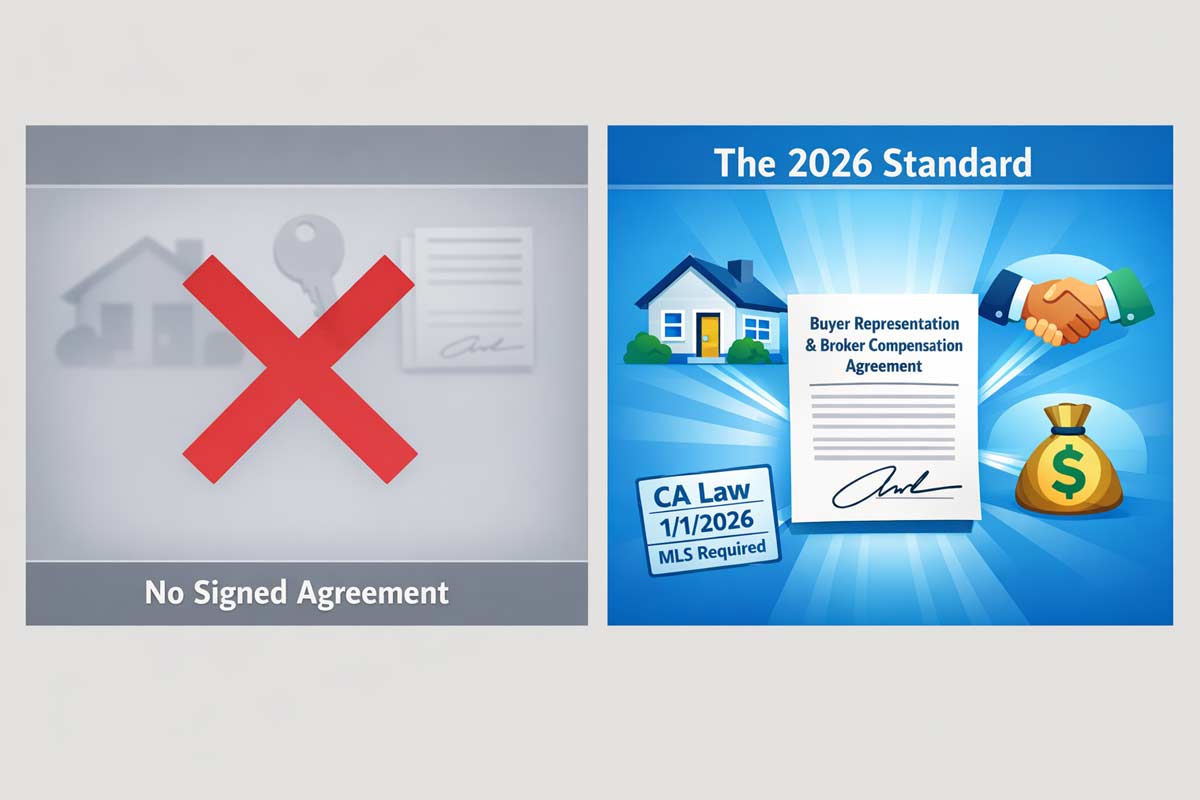
MLS rule (post-settlement, effective Aug 17, 2024): If you are an MLS Participant “working with” a buyer, you must have a written buyer agreement BEFORE you “tour” a home with them (in-person or live virtual).
California law (AB 2992 / Civ. Code §1670.50, effective Jan 1, 2025): A buyer-broker representation agreement must be executed as soon as practicable, but no later than the buyer’s execution of an offer to purchase.
Rule of thumb: Treat “before touring” as your default deadline unless your broker requires something even earlier. Also note: AB 2992 limits initial term length (commonly 90 days) and restricts renewals—so don’t use open-ended buyer agreements.
While often 17 days, never assume—always read the negotiated timeline in your specific contract.
If a client misses a deadline or a party wishes to exit, you must understand Cancellation Rights in California Transactions to protect the deposit. Always confirm the correct notice with your broker or TC before sending.
[ROOKIE MISTAKE] Don't rely on verbal agreements for repair credits. If a credit isn't documented on an Amendment or Seller Response, it is extremely difficult to enforce and creates a dispute magnet for your broker.
If you can control your delivery and your deadlines, you can control your risk.
We recommend you save this checklist, build a "Proof" folder template in your email, and run your first few files past your broker. For a deeper dive into the regulations shaping your career in 2025, visit our California Real Estate Laws & Compliance Guide.
Per MLS policies tied to the 2024 settlement, MLS participants are generally required to have a written agreement before "touring" a home (including in-person and live virtual tours). This typically does not apply to visitors walking into an open house. California law (AB 2992) also requires a signed agreement as soon as practicable, but no later than the execution of a buyer’s offer.
In residential property in California, contingencies do not typically expire automatically. If a deadline is missed, a seller typically delivers a Notice to Buyer to Perform (NBP), giving the buyer a short cure period (governed by the terms of the notice) to perform before the seller gains the right to cancel.
C.A.R. updates forms on a regular release cycle (commonly mid-year and year-end), and additional revisions can occur when industry rules change. Best practice: always pull forms from the current library in zipForm®/Glide and confirm your brokerage is using the latest release notes.

Founder, Adhi Schools
Kartik Subramaniam is the Founder and CEO of ADHI Real Estate Schools, a leader in real estate education throughout California. Holding a degree from Cal Poly University, Subramaniam brings a wealth of experience in real estate sales, property management, and investment transactions. He is the author of nine books on real estate and countless real estate articles. With a track record of successfully completing hundreds of real estate transactions, he has equipped countless professionals to thrive in the industry.

"Hey guys,
I took the exam today and passed!!!!
It only took me one try which was one of my goals. I took the online
classes and follow your suggestions so I took the crash course,
used the crash course app a lot, took 7 mock tests and went
confident to present the exam. Thank you for the great job you are
doing, you guys are awesome!!!! May God continue to bless you!"
Willie V.