
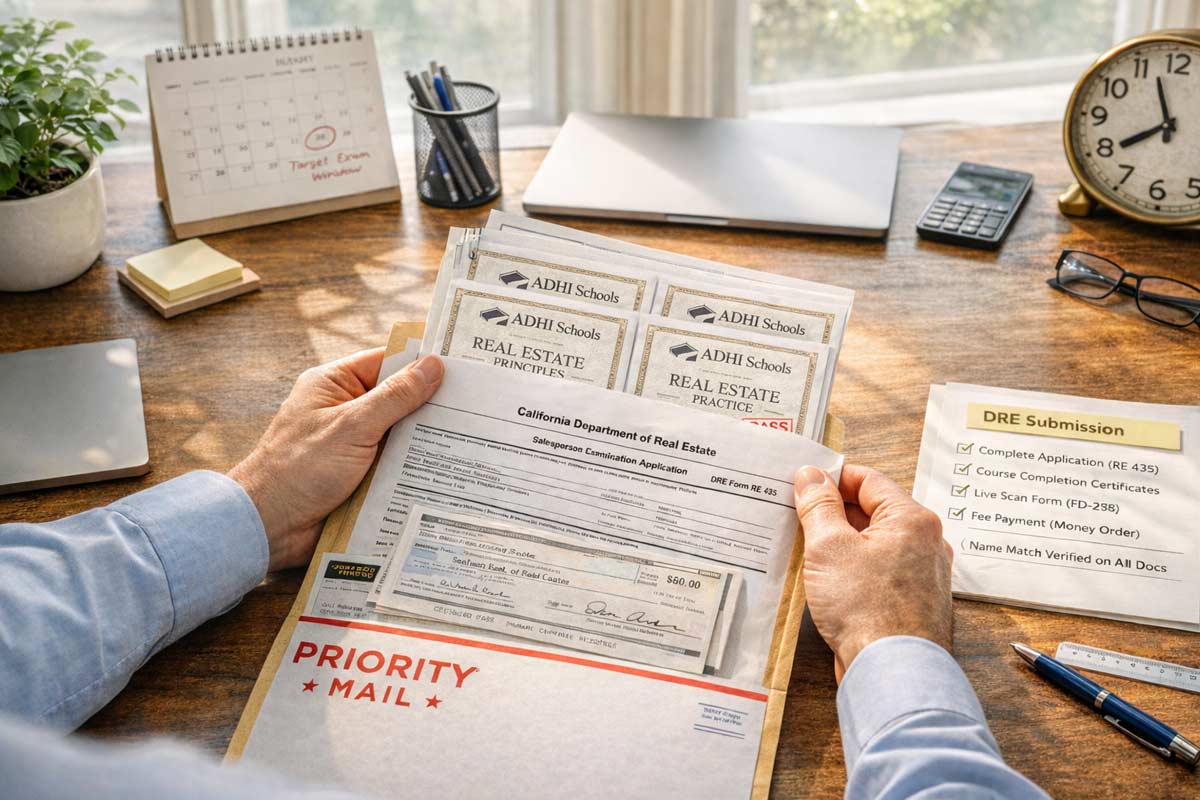
TL;DR: The Bottom Line
Most confusion comes from mixing up applying to the DRE with scheduling an exam date—scheduling your state exam can only happen after DRE approval.
| Action | Possible before 135 hours? | Outcome / Practical Advice |
|---|---|---|
| Submit DRE application | Yes (don’t) | Triggers a deficiency notice and adds weeks of delay. |
| Get Authorization to Schedule | No | The DRE won’t issue an exam invite until your file is 100% complete. |
| Choose an exam date | No | You can’t access the eLicensing calendar until you’re approved. |
| Study & exam prep | Yes | Recommended — this is the only “shortcut” that actually works. |
In my 20-plus years of training thousands of agents at ADHI Schools, I’ve seen one mistake repeat more than any other: the Speed Trap.
It usually starts with a highly motivated candidate who is halfway through their third course. They look at the DRE’s current processing times—which fluctuate—and think they’ve found a loophole. They decide to mail their exam application today, assuming that by the time a DRE processor actually opens their envelope, they will have finished the course and can just "send in the final certificate later."
This is a high-stakes gamble that almost nobody wins. The DRE does not "hold" your spot in line while you finish your homework. If a processor opens your application and the course completion certificate is missing, the process doesn’t pause—it breaks. You won’t just lose time; you’ll lose your momentum and you'll be waiting for a deficiency notice and a new review cycle before you can fix it.
The DRE’s system is built to verify eligibility first — clean files move faster than hopeful ones. In practice, the fastest candidates aren’t the ones who rush—they’re the ones who submit a file with nothing for the DRE to question.
To qualify for the California real estate salesperson exam, state law requires the completion of three DRE-approved pre-licensing courses, totaling 135 hours:
Enrollment in these courses is subject to California’s minimum time-in-course rules (usually enforced as a minimum number of days per course). You cannot "crash" these courses in a weekend; the regulatory framework is designed to ensure a minimum level of exposure to the material before you are given the ability to test out.
The DRE only considers a course "complete" when you have checked these three boxes:
Until you have all three certificates in your possession, you are not an eligible candidate for the state exam.
Let’s break down the specific scenarios candidates use to try and bypass the timeline.
Can I schedule the exam before finishing 135 hours?
No. In California, you don’t simply call a testing center and pick a date like you would for a haircut. You must first apply to the DRE. They review your education proof, and only then do they issue an Authorization to Schedule (also known as an Exam Invite). Until you’re approved, you’re not “in line” for an exam seat.
Can I take the state exam before finishing 135 hours?
No. There is no "provisional" testing. The education is a statutory prerequisite. Without the 135 hours, you aren't a candidate; you're just someone with an incomplete application.
What if I’m 90% done with my last course?
No. The DRE does not recognize partial credit. Whether you have 0 hours or 134 hours, the result is the same: Ineligible. You must wait until the final certificate is issued before mailing your application packet.
What if my course is done, but I’m waiting for my certificate?
No. Do not mail your application with a note saying "Certificate coming soon."
What if I finished courses years ago?
Only If. In many cases, older course completion records can still be usable, but the safest move is to verify your course titles and the provider's approval status to make sure you're applying under current DRE rules. If you are unsure if your older classes still count, check our California Real Estate License Guide to ensure your education aligns with today’s standards.
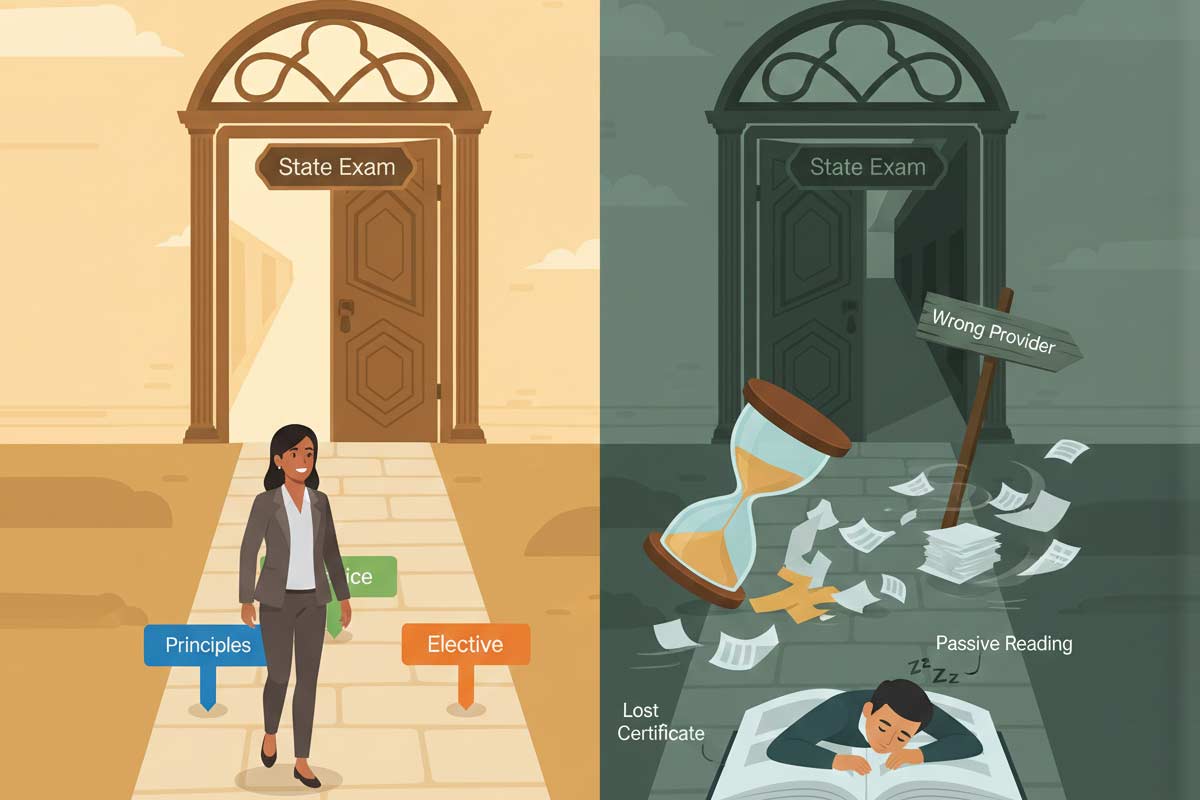
If you want to get licensed as quickly as possible, stop looking for shortcuts and follow this proven sequence. This is the timeline we see work most efficiently for our students.
Pro-Tip: If you want the full, granular step-by-step from choosing your courses to passing the state exam, start with our California Real Estate License Guide.
The period between mailing your application and receiving your Authorization to Schedule is not "dead time." If you just sit and wait, you are actually slowing yourself down. Use this window to handle the "back-office" of your new career:
As discussed, mailing your application while still enrolled in a course is a guaranteed delay. The DRE is a high-volume government agency; they do not have the resources to "match" a late certificate to an existing file easily. Your file will be set aside, a DRE deficiency notice will be generated, and you will likely have to start the waiting clock all over again.
Candidates often use the "Exam Only" form (RE 400) because it's shorter. However, this means after you pass the exam, you have to submit another application for the license itself. This can add significant time to the total process. Always use the combined exam and license application to bypass that second wait.
I've seen students finish their 135 hours, wait for an exam date, and then fail the exam because they thought the state test would be as easy as the course quizzes. If you fail, you have to reschedule and pay the fee again. This is one of the Top Reasons People Fail to Get Licensed in California.
Can I apply to the DRE before finishing classes?
Technically, you can mail the form, but it will be treated as a deficient file and you’ll receive a deficiency notice. The DRE requires all three course completion certificates to be included in the initial packet to prove eligibility.
What is an "Authorization to Schedule"?
This is the document the DRE sends you once they have approved your 135 hours and your application. It grants you access to the eLicensing system where you can finally pick your date, time, and location for the exam.
How long are the course certificates valid?
Currently, there is no expiration date on pre-licensing course completions in California.
Is there any way to skip the 135 hours?
Only if you are a member of the California State Bar.
What happens if I pass the exam but haven't picked a broker?
Your license will be issued in "Inactive" status. You won't be able to perform any acts requiring a license or earn commissions until you officially "hang your license" with a broker. See What Happens After You Get Your California Real Estate License? for the next steps.
In the world of California real estate, "slow is smooth, and smooth is fast." The desire to rush the process is understandable—this is a career that offers incredible freedom and income potential. But trying to take the California real estate exam before completing 135 hours is a tactical error that almost always backfires.
True efficiency is found in the "clean-file" sequence: complete your courses, gather your proof, and submit a perfect application. By doing the work correctly the first time, you ensure that once you pass the exam, you are ready to hit the ground running.

Founder, Adhi Schools
Kartik Subramaniam is the Founder and CEO of ADHI Real Estate Schools, a leader in real estate education throughout California. Holding a degree from Cal Poly University, Subramaniam brings a wealth of experience in real estate sales, property management, and investment transactions. He is the author of nine books on real estate and countless real estate articles. With a track record of successfully completing hundreds of real estate transactions, he has equipped countless professionals to thrive in the industry.

"Hey guys,
I took the exam today and passed!!!!
It only took me one try which was one of my goals. I took the online
classes and follow your suggestions so I took the crash course,
used the crash course app a lot, took 7 mock tests and went
confident to present the exam. Thank you for the great job you are
doing, you guys are awesome!!!! May God continue to bless you!"
Willie V.