
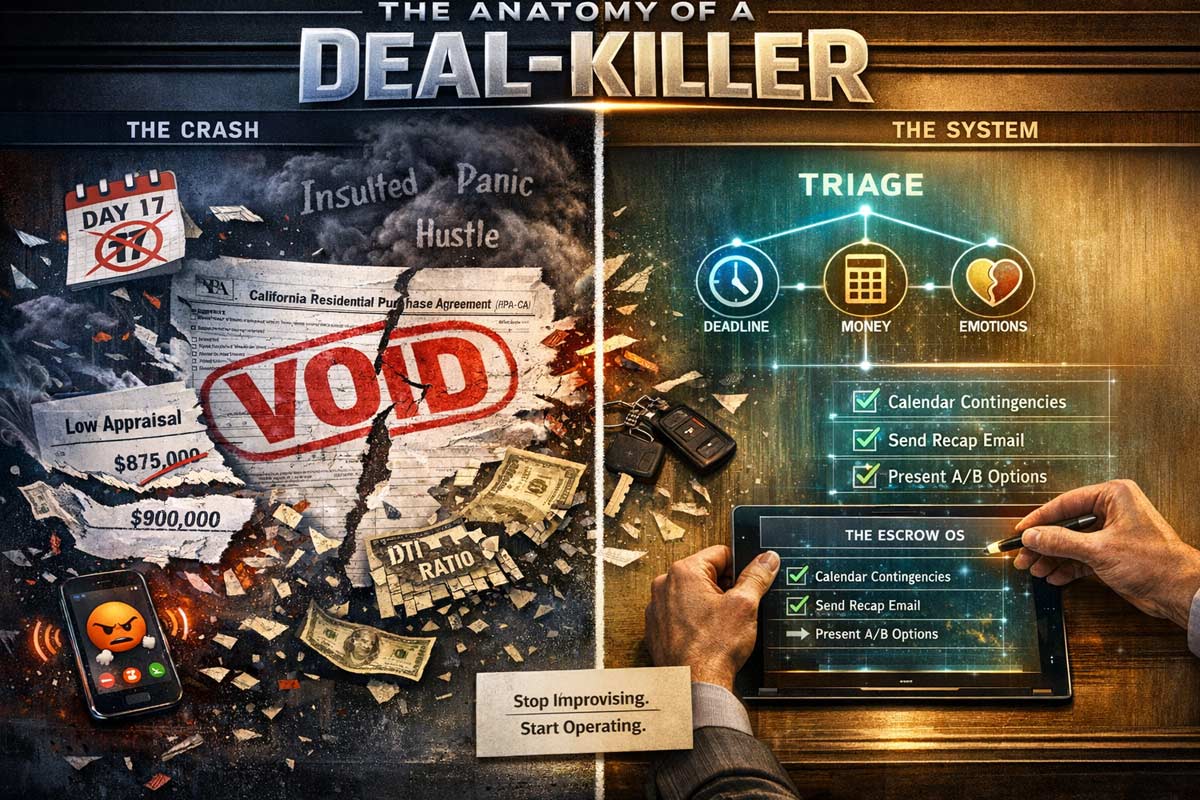
Imagine it’s Friday at 4:00 PM. You’re 14 days into a transaction in Irvine with a 21-day timeline.
The lender just called: the buyer’s debt-to-income ratio is blown because of a new car lease. Simultaneously, the appraisal came in $25,000 short, and the seller is refusing the Request for Repair because they feel "insulted."
In California’s deadline-driven, high-liability market, this is where most agents panic. They start "hustling"—calling everyone, venting, and hoping for a miracle.
But hope is not a strategy. After 20+ years of coaching California agents, I can tell you that a deal-killing mistake usually isn’t one big error—it’s a sequence of small misses: unclear expectations, missed deadlines, and sloppy communication.
To survive, you don't need more hustle; you need an operating system. California’s escrow structure—strict contingencies, statutory disclosures, and form-driven enforcement—leaves very little margin for improvisation. Mastering these Real Estate Agent Skills California is the difference between a top producer and a former agent.
In the California real estate ecosystem, a "deal-killer" is any process failure that leads to an unnecessary cancellation, a legal impasse, or a lender denial.
California contracts are uniquely deadline-driven. Whether you are using the standard C.A.R. 17-day contingency period or a shortened timeline, there is no room for "handling it later." My experience has shown that the fastest way to lose control of a deal is to negotiate by phone without a written recap email. When you lose the paper trail, you lose the deal.
Real Life: Assuming the "17-day period" is a suggestion and forgetting to deliver a Notice to Perform (NTP).
The Mechanism: It creates a "zombie escrow" where no one is committed, leading to a sudden, emotional cancellation on day 25.
Deep Dive: Learn how to explain contract terms to clients clearly to avoid these timeline traps.
Real Life: Telling a buyer "don’t worry, the seller will fix everything" before the inspection occurs.
The Mechanism: You’ve created a "fantasy" deal. When reality hits, the buyer feels betrayed.
Real Life: Delivering a messy, incomplete TDS (Transfer Disclosure Statement) late in the game.
The Mechanism: Late disclosures can re-open questions and trigger new review periods, giving the buyer a clean psychological "exit ramp" exactly when they are feeling most nervous.
Real Life: Turning a Request for Repair into a personal conflict over cosmetic items.
The Mechanism: You lose the "Big Picture." The deal dies over a $500 water heater because the parties stopped looking at the math.
Refine your approach: Review these negotiation tactics every California agent should know.
Real Life: The appraisal comes in $30k low, and you start complaining about the appraiser instead of the data.
The Mechanism: Blame creates paralysis. Without a data-driven plan, the buyer walks.
Strategy Guide: See our guide on how to handle appraisal gaps in California.
Real Life: Picking the highest price—which happens to have the weakest financing and a 10-day close.
The Mechanism: The "highest price" often has the highest risk of "Buyer's Remorse."
Win the Bid: Master how to present and win multiple-offer situations.
Real Life: Having a "great talk" with the other agent on the phone but never sending a follow-up email.
The Mechanism: "He said/She said" becomes the narrative when the deal gets tough.
Real Life: Letting the other side "drift" past deadlines without using professional forms.
The Mechanism: You lose the ability to control the narrative. If you don't use your forms, you are negotiating from "vibes," not the contract.
Real Life: Telling a buyer they can "definitely" build a pool or move a wall without checking local zoning or easements.
The Mechanism: Misrepresenting material facts leads to lawsuits and cancellations during the due diligence period.
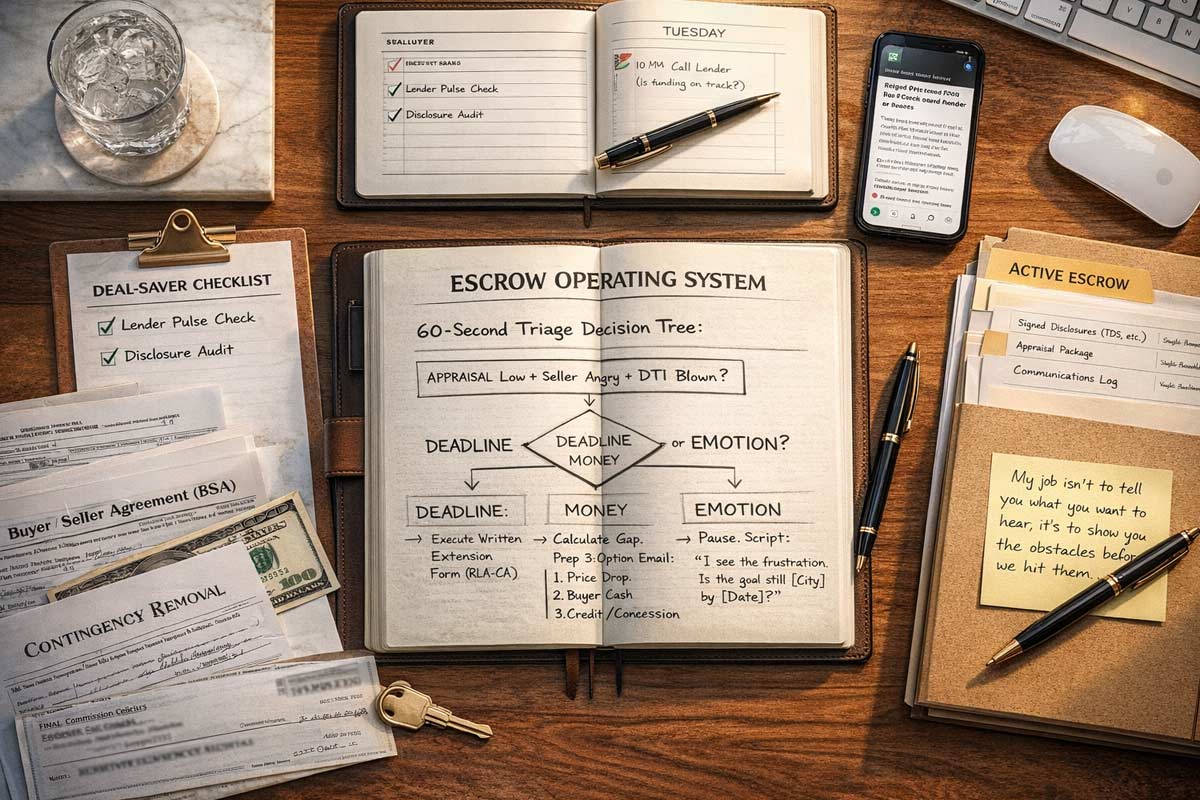
When a problem hits, stop. Don't react. Use this triage:
Success in escrow is a repeatable cadence.
| Phase | Action Item |
|---|---|
| Kickoff | Send a "Milestone Email" to all parties. Schedule an "Expectations Call." |
| Every Tuesday | Call the lender. Ask: "Is there any reason we won't fund on time?" |
| 48 Hours Pre-Deadline | Confirm the inspection is scheduled or the appraisal is ordered. |
| Problem Hits | Identify issue → Draft Options A & B → Present recommendation. |
What are the most common reasons deals fall apart in California?
Beyond the "Big Three" (Appraisal, Inspection, Loan), most deals die because of "buyer's remorse" triggered by an agent who failed to manage the psychological timeline of the escrow.
What if the buyer’s lender changes the terms mid-escrow?
Immediately request a "Loan Commitment Letter" and have your backup local lender review the file. If the terms change significantly, it may trigger a new disclosure period.
How do I keep a deal together when the seller is emotional?
Stop talking about the house and start talking about their "Next Step." Remind them why they are moving. Emotions live in the present; logic lives in the future goal.
Most agents don’t lose deals because they’re lazy—they lose deals because they’re running escrow on improvisation. In California, that is a recipe for a $0 commission check. If you want to move from "surviving escrow" to "mastering the market," you need the full professional skill stack.
Build Your Professional Operating System: Real Estate Agent Skills California
Founder, Adhi Schools
Kartik Subramaniam is the Founder and CEO of ADHI Real Estate Schools, a leader in real estate education throughout California. Holding a degree from Cal Poly University, Subramaniam brings a wealth of experience in real estate sales, property management, and investment transactions. He is the author of nine books on real estate and countless real estate articles. With a track record of successfully completing hundreds of real estate transactions, he has equipped countless professionals to thrive in the industry.

"Hey guys,
I took the exam today and passed!!!!
It only took me one try which was one of my goals. I took the online
classes and follow your suggestions so I took the crash course,
used the crash course app a lot, took 7 mock tests and went
confident to present the exam. Thank you for the great job you are
doing, you guys are awesome!!!! May God continue to bless you!"
Willie V.