
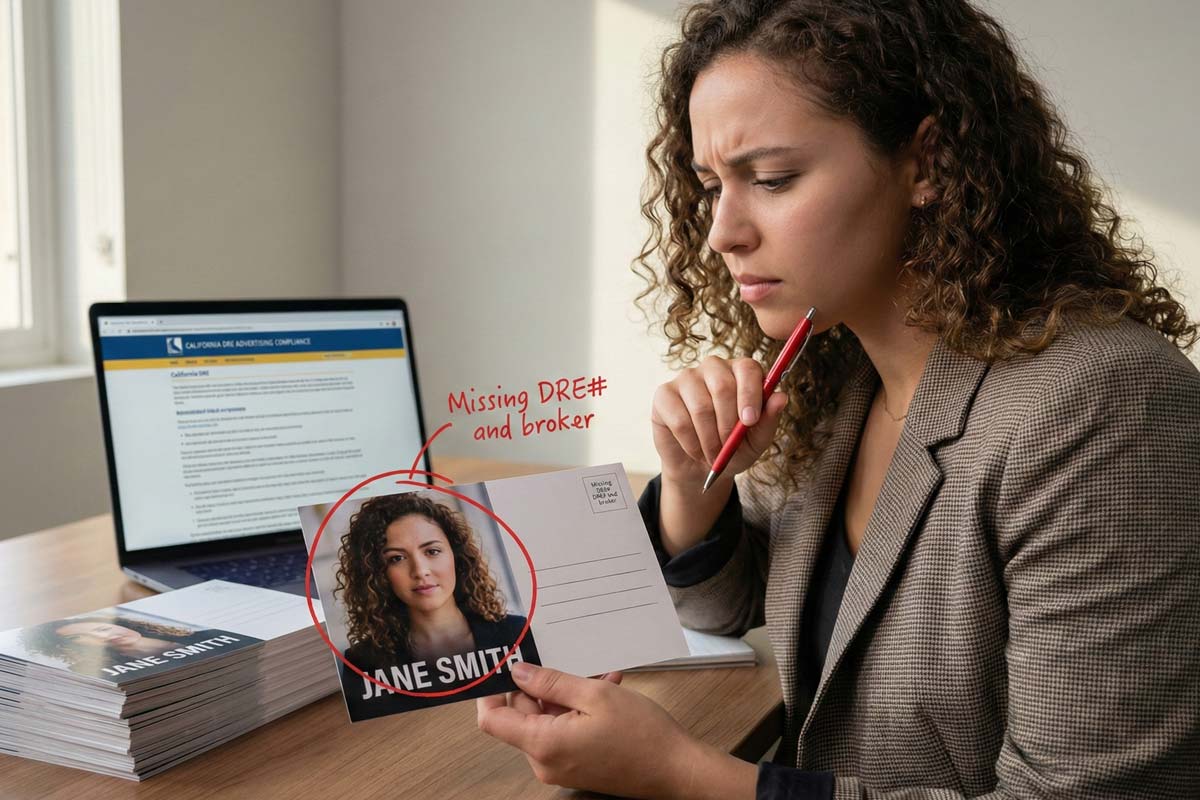
You’ve passed your exam, you’ve hung your license with a broker, and you are ready to take over your local real estate market. You want to blast your face and name everywhere—billboards, Instagram, business cards, and flyers.
But before you order 5,000 glossy postcards, hit the brakes.
In my 20+ years of training agents, I’ve learned a hard truth: Most new agents don’t get in trouble for stealing money—they get in trouble because they violated DRE rules in their marketing and they might not have even known it.
You do not want your first letter from the Department of Real Estate to be an accusation. The DRE does audit websites, postcards, and social profiles—especially when a complaint comes in—so assume your advertising will be reviewed at some point.
The DRE is incredibly strict about how licensees present themselves. If you don’t follow the specific DRE advertising rules, you aren't just looking at a warning; you could be facing citations, fines, and a permanent mark on your record.
Here is your plain-English guide to marketing yourself aggressively without getting flagged.
The most fundamental concept in California real estate advertising is the "First Point of Contact."
This is the moment a consumer first encounters you professionally. Because the public relies on these materials to verify your identity, the DRE mandates strict transparency here. Think of your license status as the very first disclosure you make to a client. (For more on what you must reveal later in the transaction, see our California Disclosure Laws (Complete Breakdown)).
The DRE defines this broadly. If you use it to get business, it counts. In the regulations, these are called "solicitation materials"—anything you use to solicit business from the public. These include:
For any of the materials listed above, you must include three specific items:
The internet moves fast, but the law keeps up. Under Commissioner's Regulation 2770, electronic and online advertising is treated just like traditional solicitation—your license status must still be clear.
Here is how to stay compliant on different platforms:
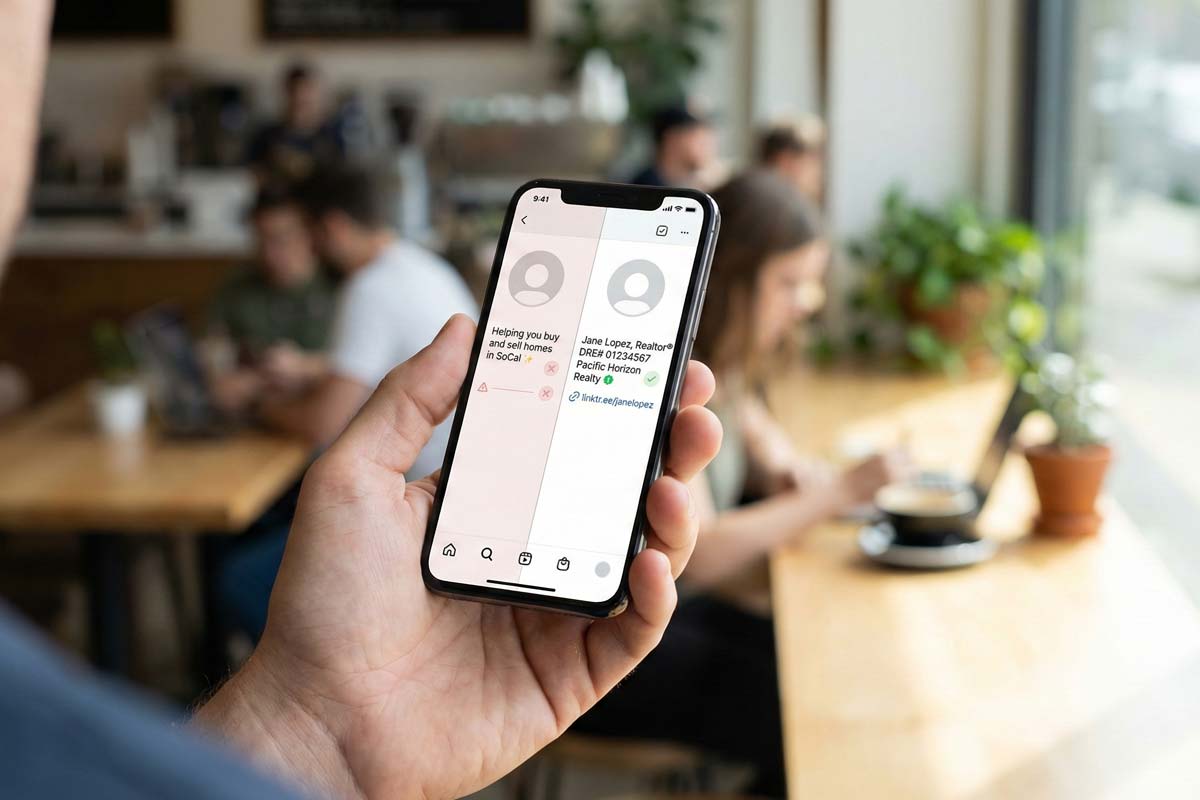
Your bio is your digital business card. It must include:
Warning: Do not bury this information deep inside a Linktree. If a consumer clicks your link, and then has to click again to find your license info, you are technically "two clicks" away. That is a violation. Put the DRE# directly in your bio text.
Does your license number need to be in the caption of every single Instagram story or Tweet? Generally, no—provided you follow the "One-Click Rule."
You are compliant if your individual posts clearly relate back to a main profile (your bio) where the mandatory information is displayed. As long as the consumer can find your license status with one single click from the post, you are safe.
Websites are different. You cannot rely on the "one-click" rule here. Your license number and broker identity should appear on the homepage or, ideally, globally in the footer of every page. If a consumer lands on a blog post or a listing page, they should not have to hunt to see who you are.
This is where I see the most citations for established agents. Everyone wants a flashy team name like "The Luxury Living Group," but the DRE sees "Teams" as a potential source of consumer confusion.
If you follow these real estate team advertising rules California sets out, your signs and online branding will stay out of trouble:
A team name must include the surname (last name) of at least one licensee on the team.
Your team name must include a term like "Group," "Team," or "Associates." You cannot use words that imply you are a standalone brokerage, such as "Real Estate," "Brokerage," or "Company."
This is a technicality that leads to fines. When you advertise a team name, the Responsible Broker’s identity must be displayed as prominently as the team name.
This ties directly to agency relationships. As we explain in California Agency Law Explained for New Agents, you represent the broker, and the broker represents the client. Your ads must reflect that legal hierarchy.
Advertising rules aren't just about font sizes; they are about civil rights. When writing listing copy, you must avoid language that suggests a preference or limitation based on a protected class.
In California, that includes: race, color, religion, sex, gender, gender identity, sexual orientation, marital status, national origin, ancestry, familial status, disability, and source of income.
For a full list of words that can trouble you, read our guide: California Fair Housing Laws Agents Must Know.
Honesty is the baseline. Under the Business and Professions Code, making any substantial misrepresentation is grounds for license suspension.
"Puffery" is an opinion that isn't expected to be taken as literal fact (e.g., "The most beautiful view in the city!").
This is allowed.
Fraud is retouching a photo to remove power lines or claiming a home is 3,000 sq. ft. when tax records say 2,200.
A Blind Ad is any advertisement that hides the fact that you are a licensed real estate agent or fails to identify your broker.
Just like commingling is the top financial violation, improper advertising is the top administrative violation. (See: What Is “Commingling” in California Real Estate?).
Before you hit "publish" or "print," run your materials through this checklist.
Advertising is just one piece of your legal footprint. Your license is your livelihood—don’t risk it for a cute slogan or minimalist design.
For a complete breakdown of the rules that govern your career—from trust funds to agency disclosures—bookmark and study our California Real Estate Laws & Compliance Guide. That is your roadmap to staying safe, compliant, and in business for the long term.
Q: What must be included on a California real estate business card?
A: Under DRE "First Point of Contact" rules, your business card must include three mandatory items: your name exactly as it appears on your license, your DRE license identification number, and the identity of your responsible broker. Omitting the broker’s name is a common violation.
Q: Do I need to put my DRE license number on every Instagram post or Story?
A: Generally, no. Under the "One-Click Rule" (Commissioner's Regulation 2770), you do not need your license number on every individual post if that post links directly to a profile (like your Bio) where your name, license number, and broker affiliation are clearly displayed.
Q: Can I put my real estate license number in my Linktree or bio link?
A: No, this is risky. The DRE requires your license status to be accessible within "one click." If a consumer clicks your bio link and then has to click again inside a menu (like Linktree) to find your license number, you are technically two clicks away, which can be considered a violation. Place your DRE# directly in your Instagram or TikTok bio text.
Q: What are the rules for real estate team names in California?
A: A team name must include the surname (last name) of at least one licensee on the team and a term like "Group," "Team," or "Associates." You cannot use terms that imply you are a separate brokerage, such as "Real Estate," "Company," or "Corp."
Q: Does my broker’s name have to be the same size as my team name on signs?
A: Yes. The DRE requires that the responsible broker’s identity be displayed as prominently as the team name. If your team name is in a large font, your broker’s name cannot be a tiny footnote; it must be reasonably equivalent in size to prevent consumer confusion.
Q: What is a "blind ad" in real estate?
A: A blind ad is any solicitation material that fails to identify the advertiser as a licensed real estate agent or fails to identify their responsible broker. For example, a Craigslist ad saying "I buy homes for cash" without a license number or broker name is a prohibited blind ad.

Founder, Adhi Schools
Kartik Subramaniam is the Founder and CEO of ADHI Real Estate Schools, a leader in real estate education throughout California. Holding a degree from Cal Poly University, Subramaniam brings a wealth of experience in real estate sales, property management, and investment transactions. He is the author of nine books on real estate and countless real estate articles. With a track record of successfully completing hundreds of real estate transactions, he has equipped countless professionals to thrive in the industry.

"Hey guys,
I took the exam today and passed!!!!
It only took me one try which was one of my goals. I took the online
classes and follow your suggestions so I took the crash course,
used the crash course app a lot, took 7 mock tests and went
confident to present the exam. Thank you for the great job you are
doing, you guys are awesome!!!! May God continue to bless you!"
Willie V.