Every real estate school in California shares one thing: they must be approved by the Department of Real Estate (DRE) and will have a 4-digit sponsor ID number. Because the curriculum is regulated, many Read more...
Every real estate school in California shares one thing: they must be approved by the Department of Real Estate (DRE) and will have a 4-digit sponsor ID number. Because the curriculum is regulated, many students make the mistake of assuming the schools themselves are identical. They treat the pre-license course like a commodity, shopping strictly on price or the "fastest" promise.
However, after 20 years of coaching students through the licensing process, I can tell you that while the certificate at the end looks the same, the experience of getting it varies wildly. The "commodity" is the credit; the differentiator is the path to passing the real estate exam.
How to use this article: Use the TL;DR to shortlist schools, then use the verification questions at the end of each section to confirm reality before you buy.
Key Takeaways
Approval is the floor, not the ceiling: Every school is DRE-approved, but "approval" doesn't guarantee the content is modern or easy to navigate.
Friction kills momentum: Technical glitches and poor support are the leading reasons students drop out before finishing.
The "Final" isn't the end: The school's final exam is a hurdle; the California State Exam is the finish line. Choose a school that builds a bridge between the two.
Quick TL;DR: The 10 Differences at a Glance
/* Mobile-only scroll */
@media (max-width: 768px) {
.responsive-scroll {
overflow-x: auto !important;
-webkit-overflow-scrolling: touch !important;
}
}
Difference
What to Look For (The Check)
Impact
1. Course Format
True self-paced vs. scheduled sessions.
Flexibility vs. Accountability.
2. Tech & UX
Mobile-responsive + progress auto-saves.
Reduces study friction.
3. Student Support
Published hours + phone availability.
Faster resolution of DRE hurdles.
4. Instructor Access
Direct paths to clarify complex concepts.
Better grasp of legal nuances.
5. Exam Prep Tools
Timed simulated exams + "why" explanations.
Higher first-time pass odds.
6. Content Quality
Updated for current California law changes.
Prevents learning "stale" info.
7. Compliance Ease
Automated tracking of mandatory hours and enrolled time.
Prevents DRE rejection of hours.
8. Price Transparency
All-in pricing vs. hidden retake/book fees.
Protects your total budget.
9. Speed to Cert
Streamlined reporting to the DRE.
Gets you to the state exam faster.
10. Career Bridge
Post-course coaching and guidance.
Smooths transition to a brokerage.
1. Course Format & Time Flexibility
What it is: The delivery method—ranging from independent reading to live-streamed webinars.
Why it matters: California’s pre-licensing courses are time-regulated. Most providers enforce a minimum time window per 45-hour course (commonly 18 days), which creates a realistic floor for your timeline. If a school’s format doesn’t match your life, you will fall behind.
How to verify: Check if the "online" component is just a static PDF or an interactive platform.
Verification Question: "If I miss a scheduled session, what is the specific process and cost to make it up?"
2. Technology & User Experience (UX)
What it is: The stability and intuitiveness of the learning management system.
Why it matters: I’ve seen students lose hours of progress because a platform didn't save their quiz scores. If the tech is frustrating, you won't study.
How to verify: Ensure the platform works in modern browsers (Chrome/Safari) and auto-saves progress. Evaluate course format, student support, and pass rates carefully before committing.
Verification Question: "Does your platform allow me to switch between my laptop and my phone without losing my place in the chapter?"
3. Student Support Quality
What it is: The ability to get a human on the phone when you have a DRE paperwork question.
Why it matters: The DRE application process is notoriously bureaucratic. A school with poor support leaves you to figure out background checks and transcripts alone.
How to verify: Call the school before you buy. If you can’t get a human during sales, you likely won't during support.
Verification Question: "What is your average response time for student support emails during business days?"
4. Instructor Access & Clarification Path
What it is: A direct line to an expert who can explain complex fiduciary duties or legal concepts.
Why it matters: Some concepts in California real estate are counter-intuitive. Without an instructor to clarify, you'll end up memorizing answers without understanding them, which leads to surprises on the state exam.
How to verify: Ask specifically who answers content-related questions—a licensed instructor or a general clerk?
Verification Question: "If I don't understand a concept in Chapter 4, is there a licensed instructor I can speak with or email directly?"
5. Exam Readiness Tools
What it is: Tools beyond the basic quizzes, such as simulated state exams and performance analytics.
Why it matters: Passing the state exam is where many candidates get surprised—the questions are scenario-based, time-pressured, and unforgiving if you’re only memorizing. You need tools that target your weak areas.
How to verify: Look for "simulated exams" that mimic the DRE’s phrasing and provide "why" explanations for every answer.
Verification Question: "Does your exam prep software track my 'weak areas' across different categories like Agency or Contracts?"
6. Content Quality & Updates
What it is: Whether the material reflects current California law and disclosure practices.
Why it matters: Real estate law changes. If your school is using a curriculum from several years ago, you're learning outdated information that won't match how questions are framed today.
How to verify: Low price sometimes correlates with older platforms or less frequent updates—verify the revision date before buying.
Verification Question: "What major legislative or forms updates were incorporated into your curriculum in the last 12 months?"
7. Completion Tracking & Compliance Friction
What it is: How the school tracks your mandatory hours and issues the certificate.
Why it matters: If the school’s tracking isn't DRE-compliant, your application could be rejected weeks after you think you’ve finished.
How to verify: Check what matters most when choosing a real estate school regarding their reporting reputation.
Verification Question: "Is my completion certificate issued automatically the moment I complete the course requirements and meet the pacing/time requirements?"
8. Pricing Structure & Hidden Fees
What it is: The "all-in" cost versus the "teaser" price.
Why it matters: These fees don't just raise cost—they slow you down when you’re trying to finish. Some schools lure you with a low price but charge for certificate reprints, final exam retakes, and course extensions.
How to verify: Read the refund and extension policy before clicking "Buy."
Verification Question: "Are there any additional fees for retaking a school final exam or extending my access if I don't finish in six months?"
9. Speed to Certificate
What it is: The actual time it takes from payment to being eligible for the state exam.
Why it matters: Even if you’re highly motivated, there’s a built-in pacing floor for completing three 45-hour courses, so any ‘finish instantly’ marketing should trigger verification.
How to verify: Use a step-by-step guide on how to compare California real estate schools to map out your realistic timeline.
Verification Question: "How long after I pass my third exam will it take for me to receive the transcripts I need for the DRE?"
10. Career Bridge After the Certificate
What it is: What the school does for you once you have your certificate but before you have your license.
Why it matters: The "gap" between finishing the course and taking the state exam can be months. A good school provides resources to keep your knowledge fresh during that wait.
How to verify: Ask if they offer post-completion study groups or crash courses.
Verification Question: "Do I still have access to the practice exams and instructors after I receive my completion certificates?"
Decision Framework: Match the School to the Student
Not every student needs the same features. When researching the Best Real Estate Schools in California, prioritize based on your profile:
The Full-Time Professional: Prioritize Tech & UX and Mobile Flexibility. You need to be able to study during a commute or lunch break without a clunky interface slowing you down.
The Procrastinator: Prioritize Instructor Access and Live Components. You likely need to weigh the Online vs. In-Person Real Estate Schools in CA: Pros & Cons to see if you need the structure of a classroom.
The "Bad" Test Taker: Prioritize Exam Readiness Tools. You need a school that provides detailed explanations for why an answer is wrong, mimicking the state exam's style.
The Fast Tracker: Prioritize Compliance Ease and Support Speed. You want a school that ensures you hit the "pacing floor" accurately so your DRE application isn't delayed.
The Budget-Conscious Strategist: Prioritize Price Transparency. Cheapest isn't actually cheapest if you have to pay $100 for a course extension because life got in the way.
FAQ
Are all DRE-approved schools basically the same?
No. While they teach the same legal requirements, the delivery, technology, and level of student support vary significantly. A school is a service, not just a textbook.
Does online vs. in-person affect passing?
It depends on the student. Online offers convenience, but in-person offers immediate clarification. The best schools often offer a hybrid approach to provide both.
Do pass-rate claims matter?
The DRE does not officially publish pass rates for individual schools. Any school claiming a "99% pass rate" should be viewed with healthy skepticism—ask them how they verify that data.
How long does it take to finish?
Most providers enforce a minimum time window of 18 days per course. For the three required courses, this creates a realistic floor of about 54 days, though most students finish in 3 to 4 months.
What should I compare before buying?
Look at the "hidden" costs (retakes/extensions), the age of the technology, and whether you can actually communicate with a human when you have a question.
Choosing Your Path
Selecting a school is the first professional decision you make in your real estate career. It sets the tone for your licensing journey—either one of constant technical frustration or one of focused, supported growth.
Use Best Real Estate Schools in California to compare these factors side-by-side. Your goal isn't just to get the certificates; it’s to walk into the state exam with the confidence that you actually know the material.
|

In California real estate, "busy" is sometimes viewed a badge of honor. But after 20 years of coaching and operating in this industry, I can tell you the truth: Busy isn't the goal. Profit and freedom Read more...
In California real estate, "busy" is sometimes viewed a badge of honor. But after 20 years of coaching and operating in this industry, I can tell you the truth: Busy isn't the goal. Profit and freedom are.
This guide provides a practical, operator-level time management system for California real estate agents designed to move you from a reactive state to a systems-first mindset. If you don't control your calendar, your clients, escrow officers, and the 405 freeway will control it for you.
To master the essential Real Estate Agent Skills California requires a shift from chasing the day to owning it.
TL;DR: The California Operator System
The 3-Bucket Filter: If it creates revenue, it’s Pipeline. If it saves a deal, it’s Operations. If it builds the future, it’s Visibility.
The Morning Power: 8:00 AM – 10:00 AM is for non-negotiable follow-up. No email allowed.
The "One Window" Rule: Batch all escrow and admin tasks into a single 90-minute block.
The Guardrail: If it isn't on the calendar, it doesn't exist.
Reactive Calendar vs. Revenue Calendar
Most agents operate on a Reactive Calendar. You wake up, check your email, respond to a frustrated buyer, get lost in a DM rabbit hole, and suddenly it’s 2:00 PM. You’ve done "work," but you haven't generated a single dollar of future revenue.
A Revenue Calendar is designed to protect income-producing activities first.
Diagnostic: 5 Signs You Are Operating Reactively
You start your day by answering emails instead of making outbound calls.
You don't have a recurring "Follow-Up" block in your digital calendar.
An inspection or appraisal request can derail your entire afternoon.
You find yourself scrolling Instagram under the guise of "content research."
Your "lead generation" only happens when you realize you have no active escrows.
The 3-Bucket Decision Rule
To manage your time, you must categorize your tasks instantly. Stop treating an escrow signature with the same urgency as a cold lead follow-up. Use these filters:
Pipeline (Revenue): Does this create or advance a commission check today or tomorrow? (Follow-up, appointments, negotiations)
Operations (Delivery): Does this protect a deal currently in motion? (Disclosures, inspections, TC coordination)
Visibility (Future): Does this build my pipeline for 6 months from now? (Content creation, networking, database building)
The secret to consistency is ensuring all three buckets have a "home" in your week. This balance is one of the daily habits of top-producing agents that separates the earners from the hobbyists.
The California Agent Weekly Template
California real estate has a specific rhythm. Traffic is a factor, and weekend "work" is mandatory. Use this table as your base real estate agent schedule:
Time Block
Focus
Purpose
8am – 10am
Revenue (Pipeline)
Calls, texts, and CRM follow-up.
10am – 11:30am
Delivery (Operations)
Escrow Command Center / Admin.
12pm – 1pm
Recharge
Lunch / Personal time (No pings).
1pm – 5pm
Appointments / Field
Showings, listing presentations, previews.
5pm – 6pm
Future (Visibility)
Social media content / Networking.
The "New Agent" vs. "Busy Agent" Flex
New Agents: Spend 4+ hours daily in the Pipeline bucket. You need reps more than you need "systems" right now.
Busy Agents: Spend more time in Operations but must protect the 8 AM – 10 AM window at all costs to avoid the "income roller coaster."
Effective time management begins by knowing how to set goals as a new real estate agent—once your goals are clear, the calendar follows.
Win the Morning: The Follow-Up Operating System
The first two hours of your day dictate your commission check three months from now. Time management for California real estate agents lives or dies in the CRM.
The Daily Priority Stack:
New Leads: Contact within 5 minutes (or first thing in your 8 AM block).
Hot Nurtures: Clients likely to transact in the next 30–60 days.
Active Clients: Brief status updates (even if the update is "no news").
Past Clients: Staying top-of-mind for referrals.
To make this work, you need a system. Learning how to build a real estate CRM that actually works is the only way to automate your reminders so you don't spend hours "organizing" instead of "doing."
Escrow and Transaction Control
In California’s fast-paced escrow environment, a single inspection report can trigger 20 phone calls. If you handle these as they come in, you will never have a productive day.
The Escrow Command Center Rule: Schedule one "Operations Window" (e.g., 10:00 AM – 11:30 AM). Batch all your emails to escrow officers, lenders, and TCs during this time.
Kartik’s Tip: When a lender calls at 2:00 PM while you're at a showing, let it go to voicemail. Listen, then reply during your next designated admin block. Most "emergencies" are simply other people’s poor planning.
Open Houses & Traffic Realities
California traffic is a variable you must account for. If you have a showing in Irvine at 4:00 PM, you aren't "working" from 3:30 PM to 6:00 PM—you are commuting and showing.
The 20% Buffer: Always add 20% more time to travel than GPS suggests.
Weekend Recovery: If you work 6 hours on Saturday and Sunday, you must protect Monday morning as "Off" time to prevent the burnout cycle.
Pre-Prep: Don't print flyers on Sunday morning. Do all "Visibility" prep on Thursday so your weekend is focused on the people in front of you.
Burnout Guardrails (Energy Management)
"Always on" is a recipe for a short career. Sustainable time management requires energy management.
The Hard Stop: Pick a time (e.g., 7:00 PM) where the phone goes in the drawer.
The One True Day Off: One day a week, you are not an agent. You are a human being.
Boundary Scripts: "I’m headed into an appointment, but I will check this first thing at 8:00 AM tomorrow."
Effective burnout prevention for real estate professionals is built into the calendar, not added as an afterthought.
FAQ: Real Estate Time Management
How many hours should a real estate agent work?
A: Successful full-time agents typically work 40–50 hours per week, but the composition of those hours matters more than the total. 15 hours of focused lead generation is more valuable than 60 hours of "random busywork."
What’s a good daily schedule for real estate agents?
A: A high-production schedule starts with 2 hours of follow-up (8–10 AM), 90 minutes of admin/escrow (10–11:30 AM), and afternoons dedicated to appointments and field work.
How do I handle "looky-loo" buyers who waste my time?
A: Use a mandatory buyer consultation. If they won't meet for 20 minutes to discuss their needs and financing, they aren't worth a 2-hour drive.
What if a client gets mad because I didn't answer at 9:00 PM?
A: Set expectations early. Tell them: "I am fully focused on my clients from 8:00 AM to 7:00 PM. If you text after that, I'll have an answer for you first thing in the morning."
Implementation Challenge: The 14-Day Reset
Commit to this for the next 14 days before you customize:
Block 8:00 AM – 10:00 AM for lead follow-up only. No email. No social media.
Batch your "Operations" into one 90-minute window.
Identify 3 "Stop-Doing" items: Activities that resulted in zero revenue last week.
Time management isn't about doing more; it's about doing what matters. Master these systems, and you’ll find that a successful California real estate career doesn't have to cost you your sanity.
Ready to level up your entire business? Visit our Real Estate Agent Skills California hub to learn more about building a sustainable, high-performance career with ADHI Schools.
|
TL;DR: The System Summary
A successful real estate CRM is a daily follow-up machine, not a contact list.
To make it work, you need:
Minimalist Data: Only track what helps you make the Read more...
TL;DR: The System Summary
A successful real estate CRM is a daily follow-up machine, not a contact list.
To make it work, you need:
Minimalist Data: Only track what helps you make the next call.
Strict Pipeline Stages: Define exactly where a lead sits in the journey.
The Golden Rule: Every contact must have a Next Step and a Next Date.
Daily Discipline: A 10-minute "CRM Block" to clear your tasks.
The CRM Graveyard: Why Most Systems Fail
Let’s be honest: Most California real estate agents have a "CRM graveyard." It’s a software subscription you pay for every month, filled with names you haven't called in 90 days and "leads" from an open house three years ago that were never categorized.
I’ve spent over 20 years coaching and operating in the California real estate education space, and I see the same mistake everywhere. Agents try to build a "database" when they should be building a real estate lead follow-up system.
If your CRM isn’t telling you exactly who to contact by 9:00 AM today, it’s not a CRM—it’s a hobby. In a market where you’re fighting 101 freeway traffic and juggling multiple escrows, speed-to-lead is the only metric that matters. If you aren't contacting an inbound lead within minutes, you are often competing with 3–5 other agents. Your CRM is what allows you to win that race.
CRM Setup in 30 Minutes (Beginner-Proof)
Don't spend weeks "researching" software. Pick a tool and follow this 30-minute sprint:
Create your 7 stages: (Use the framework in the table below).
Set your required fields: Source, Lead Type, Stage, Next Follow-Up Date, Tags.
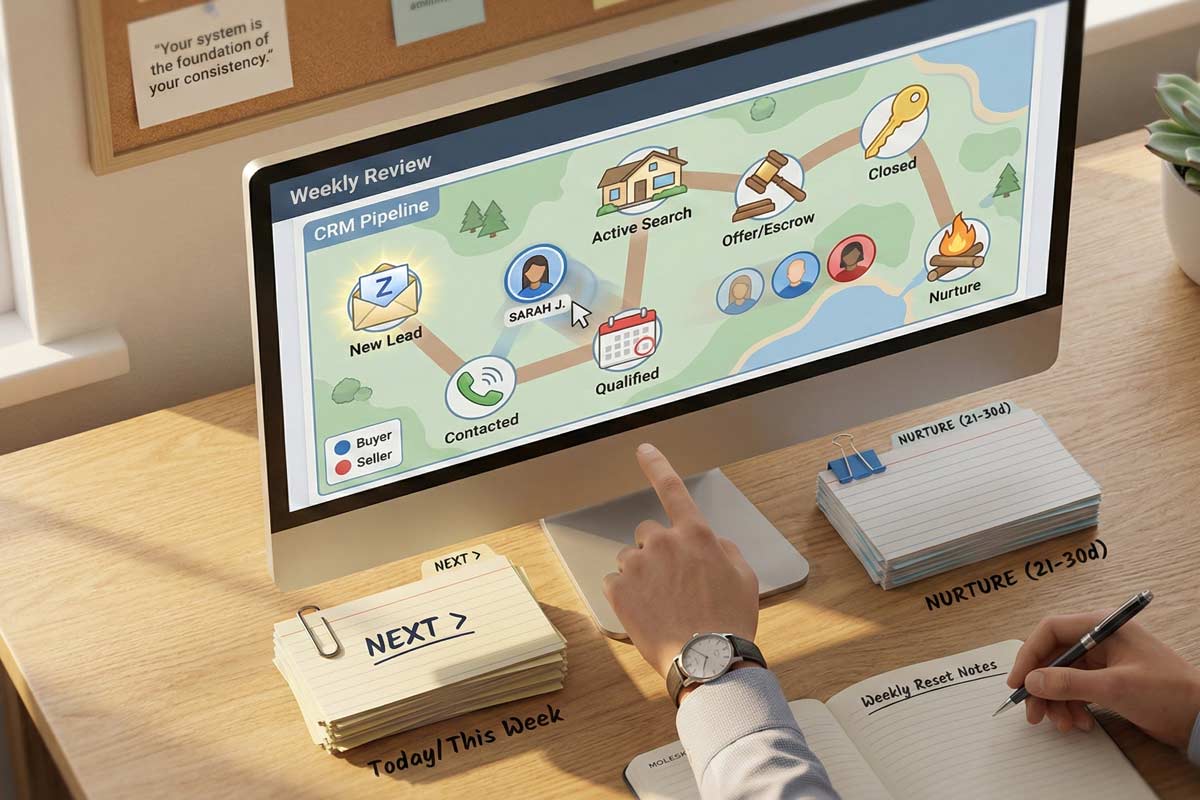
Configure 3 saved views: Today, This Week, Nurture.
Import 10 contacts: Start with your phone’s "recent" list or warm sphere.
Assign a "Next Step + Next Date": Do this for every single one.
Calendar it: Put a recurring 10-minute CRM Block on your calendar for every weekday morning.
The CRM Build: Your Minimum Viable System
To build a real estate CRM that sticks, you need to strip away the "tech-bro" features most CRM for real estate agents are bloated with and focus on the core structure.
1.The Only Fields You Actually Need
Stop trying to fill out 50 fields of data. You’ll burn out. Stick to these:
Name & Contact Info: (Phone/Email)
Source: (Zillow, Open House, Sphere, Referral)
Lead Type: (Buyer, Seller, Investor, Renter)
Pipeline Stage: (Where are they in the process?)
Next Follow-Up Date: (The most important field in your business)
Tags: FHA-Buyer, Inland-Empire-Retail, Probate, Past-Client, Hot-Lead.
Common Mistake
Don't create a "custom field" for every little detail. Use the "Notes" section for the story; use "Tags" for the category. Over-complicating fields is the fastest way to stop using the system.
2. Your Pipeline Stages (Entry/Exit Criteria)
Your pipeline stages real estate logic must be tight. If you don't know why someone is in a specific stage, the system breaks.
Stage
What it means
Move forward when...
New Lead
Inbound or added, not contacted
You’ve attempted contact + set Next Date
Contacted
Two-way exchange happened
You have timeline + motivation basics
Qualified
Budget + timeline + reason confirmed
You scheduled consult/showing/listing appt
Active Search
You’re actively working inventory
They’re ready to offer or pause
Offer / Escrow
Under contract
You close or deal dies (then re-stage)
Closed / Past
Transaction complete
You set post-close follow-up + nurture
Nurture
6+ months out
They re-engage (then re-qualify)
The Follow-Up Engine (The Real Product)
Your real estate CRM workflow is only as good as your persistence. Most agents stop after two attempts. Top operators go further.
The “No-Response” Ladder
Use this framework when a lead goes quiet:
Touch 1 (Day 1): Call + short text: “Hey [Name], it’s Kartik—saw your inquiry about [area]. Quick question: are you looking to move in the next 30–90 days or just researching?”
Touch 2 (Day 2–3): Value text: “If you tell me your target city + price range, I’ll send 3 options that match your criteria today.”
Touch 3 (Day 5–7): Close-the-loop: “I don’t want to spam you—should I stop reaching out, or is there a better time next week?”
If no response occurs after Touch 3, move them to the Nurture stage and set a Next Date for 21–30 days out.
Workflow: The Daily Execution
A CRM is only as good as your Daily Habits. To stay organized, stop looking at "All Contacts." Instead, use these three saved views:
Today: Shows only leads where the Next Date = Today or is Overdue.
This Week: Shows leads with a Next Date within the next 7 days (for planning).
Nurture: Shows leads with a Next Date 21–30 days out.
The Daily & Weekly Rhythm
Success requires a Time Management for California Real Estate Agents strategy that protects your "system time."
Daily (10 Mins): Clear your "Today" view every morning. Log outcomes in one sentence. Set the next date.
Weekly Reset (15 Mins): Every Friday at 4:30 PM, review your pipeline. Drag leads back to the correct stages and ensure no one is missing a Next Date.
Automation vs. Human Touch
Automation should support you, not replace you.
Do Automate: Immediate "Thanks for reaching out" texts; Appointment reminders.
Don't Automate: Deep relationship building. If an automation can’t be answered with a human reply, it probably shouldn’t be sent.
Common Failure Points and Fixes
"I don't have time to update it."
Fix: Make the update process smaller. Log the outcome immediately after the call, not at the end of the day.
"I'm burning out on follow-up."
Fix: Read our guide on Burnout Prevention for Real Estate Professionals. Usually, burnout comes from the anxiety of forgetting someone, not the act of calling them.
"I'm in escrow chaos all week."
Fix: Use your CRM to set "reminders" for your active leads so you don't ignore your future income while processing current checks.
The Bigger Picture: Your CRM Is One Skill in the Stack
A CRM that works is revenue insurance—but it only performs when it’s paired with daily execution, clear targets, and protected time. As you Set Goals as a New Real Estate Agent, remember that your system is the foundation of your consistency.
If you want the complete operator framework behind follow-up, pipeline control, and professional consistency, start here: Real Estate Agent Skills California.
FAQ: Building Your Real Estate CRM
1. What should I put in the ‘Notes’ vs. ‘Tags’?
Tags are for categories you want to filter (e.g., "Buyer," "Past Client"). Notes are for the "story" and specific details from your last conversation (e.g., "Daughter is moving to San Diego in August").
2. What’s the best follow-up schedule for Zillow or open house leads?
High intensity for the first 10 days (5–7 touches), then transition to a 21-day "Nurture" cycle. Speed is everything in the first 48 hours.
3. How do I use a CRM when I’m in escrow all week?
The CRM is what protects your next paycheck while you’re busy earning the current one. Treat your escrow tasks like lead tasks. Use the CRM to remind you of contingency removals, but don't let your "Today" view of new leads go uncleared. Spend 5 minutes on leads, then 55 minutes on your escrow.
4. How many stages should my real estate pipeline have?
Keep it between 5 and 8 stages. Any more and you will spend more time organizing the list than calling the people on it.
|
Choosing a real estate school in California often feels like looking at a dozen identical houses. On the surface, every provider promises the same outcome: a certificate that allows you to take the state Read more...
Choosing a real estate school in California often feels like looking at a dozen identical houses. On the surface, every provider promises the same outcome: a certificate that allows you to take the state exam.
However, once you sign up, the differences in technology, support, and actual "readiness" become glaringly apparent. Choosing the wrong provider doesn't just cost you money; it costs you weeks of momentum.
You are in the right place if:
You are confused by "guaranteed pass" claims.
You aren’t sure if a cheap online course is enough to actually pass the state exam.
You need a framework to filter out schools that don't align with your learning style.
This guide provides an operator-level system to compare schools objectively so you can move forward with confidence.
Quick Take:
All California real estate schools teach the same required subjects—but they do not teach them the same way. The difference between passing smoothly and stalling out usually comes down to support, platform quality, and hidden policies—not price.
The 9-Step Comparison Framework
Use these steps to audit any school you are considering. Do not rely on the marketing copy on their homepage; look for these specific indicators of quality.
Step 1: Confirm DRE Approval
Every school must be approved by the Department of Real Estate (DRE). If they aren't, your completion certificates are worthless.
Why it matters: The DRE sets the curriculum. Any DRE-approved real estate course must meet the 135-hour requirement (three 45-hour courses).
How to verify: Don't just look for a logo. Navigate to the official DRE website to search the DRE’s approved provider list.
Step 2: Match the Format to Your Life
Are you a self-starter, or do you need a coach? California allows for purely elective online study, but that doesn't work for everyone
Why it matters: Some students thrive in a self-paced environment, while others need the accountability of a live instructor.
How to verify: Look at the Online vs. In-Person Real Estate Schools in CA: Pros & Cons to see which environment fits your current schedule and focus level.
Step 3: Evaluate Student Support
When you have a question about "joint tenancy", who answers?
Why it matters: Many budget schools provide the materials but zero access to human experts.
How to verify: Email the school a technical question before you buy. If it takes them three days to respond to a sales lead, imagine how long they’ll take to help a student. This is a key factor when you evaluate evaluate real estate school quality in California.
Step 4: Check Course UX and Materials
The platform you use shouldn't be a relic from 2005. It should work on your phone, tablet, and laptop.
Why it matters: If the interface is clunky, you will find excuses to avoid studying.
How to verify: Ask for a demo or a "look inside" video. Check if the quizzes are interactive or just static PDFs.
Step 5: Understand Pass-Rate Claims
Be wary of schools claiming "100% pass rates." The DRE does not officially track or publish pass rates for individual schools in a way that is easily verifiable for marketing.
Why it matters: Statistics can be manipulated (e.g., only counting students who pass a "pre-test" first).
How to verify: Look for transparency. A reputable school will tell you that the state exam is difficult and requires significant effort. When asking what matters most when choosing a real estate school, look for schools that emphasize preparation over "shortcuts."
Step 6: Compare Total Cost
The "sticker price" is rarely the final price.
Why it matters: Some schools charge extra for physical textbooks, retaking final exams, or extending your course access if life gets in the way.
How to verify: Read the "Terms and Conditions" specifically for "re-enrollment fees" or "extension fees."
Step 7: Compare Completion Speed & Flexibility
In California, generally there is a legal minimum time frame of 18 days per course. You cannot finish the entire program in a weekend.
Why it matters: Some schools have rigid schedules; others allow you to pause for months if needed.
How to verify: Check the expiration date of your enrollment. A good California real estate license course should give you at least 6–12 months of access.
Step 8: Verify Reputation Signals
Look past the five-star reviews on the school's own website.
Why it matters: Public platforms (Google, Yelp, Reddit) provide a more honest look at the student experience.
How to verify: Look for patterns. Are people complaining about the tech? The differences between real estate schools in California often come down to how they handle student frustrations.
Step 9: Make the Final Decision
Use the scoring rubric below to weigh your options. Don't choose based on price alone—choose based on the path that ensures you actually get your license.
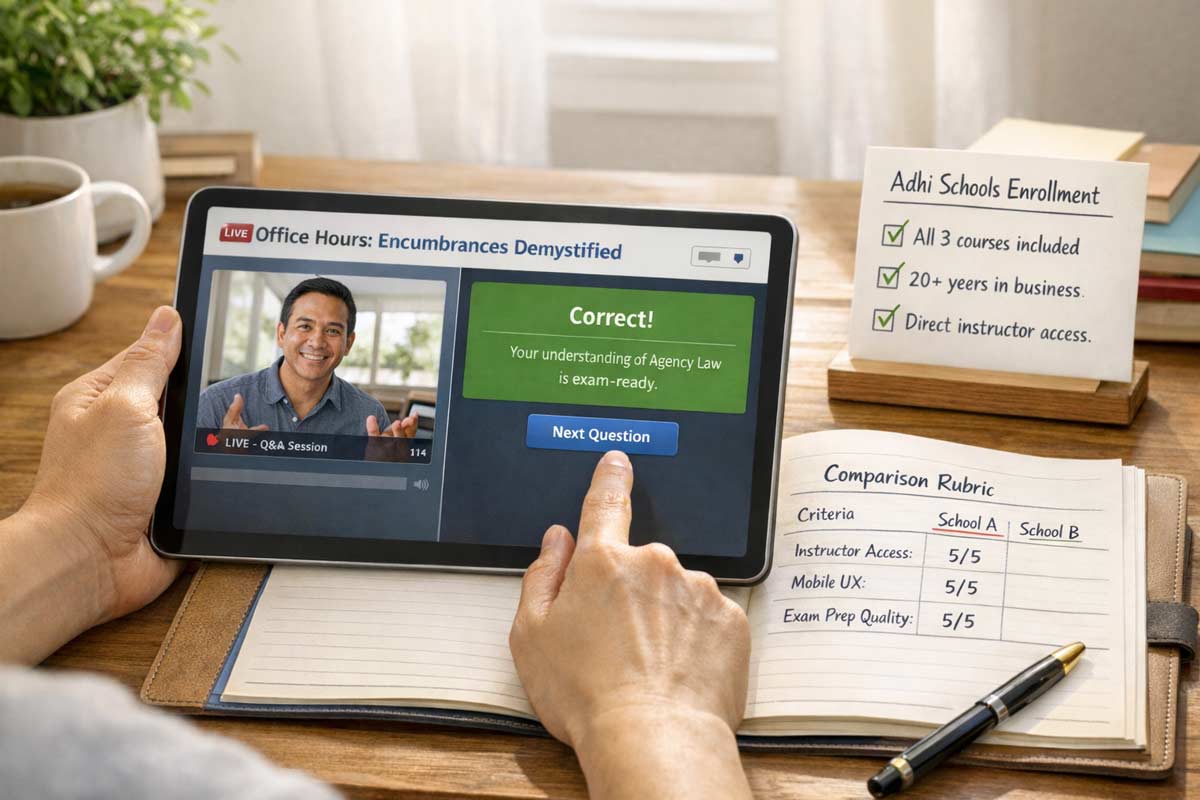
Comparison Rubric: How to Grade a School
Criteria
Weight
School A
School B
School C
DRE Approval
Essential
Instructor Access
High
Mobile UX
Medium
Total Price (Fees included)
Medium
Reputation/Reviews
High
Exam Prep Quality
High
Real-World Scenarios: Which Profile Are You?
In my 20+ years of coaching California students, I’ve seen that the "best" school is the one that matches your lifestyle.
1. The Full-Time Worker
The Need: Maximum flexibility and mobile access.
The Advice: Look for an online real estate school in California that offers "on-demand" video or high-quality reading material that you can digest in 20-minute windows. Avoid schools with rigid "live session" requirements if your work schedule is unpredictable.
2. The Fast-Tracker
The Need: Efficiency and clear milestones.
The Advice: You need a system that tracks your 18-day windows automatically and alerts you the moment you are eligible to take your next final.
3. The High-Support Learner
The Need: Accountability and the ability to ask "Why?"
The Advice: Don't buy a budget, text-only course. You will likely get stuck on complex topics like "encumbrances" or "agency relationships." Invest in a school that offers live Q&A sessions or direct instructor access.
Common Mistake to Avoid: Buying a course based on a "coupon" only to find out the school charges $50 every time you need to ask a question or $100 to renew after 3 months. Screenshot the "Terms" page before you buy.
The Ultimate Comparison Checklist
Before you enter your credit card info, check these boxes:
Is the school listed on the DRE website?
Does the price include all three required 45-hour courses?
Are the textbooks digital, physical, or both? (Is there an extra fee?)
Is there a dedicated "Exam Prep" component available?
Can I access the materials on my phone without a headache?
What is the "hidden fee" for retaking a final exam if I fail?
How do I contact an instructor if I'm confused?
Red Flags to Watch For:
No physical office or phone number listed.
"Guaranteed" pass rates (nobody can guarantee what you'll do in the state exam room).
Outdated websites that look like they haven't been updated since the 90s.
Lack of clarity on how long you have to finish the course.
Comparing schools shouldn't be a guessing game. By focusing on support, transparency, and format, you move from being a "lead" to being an informed student.
If you want a broader look at the landscape of providers, visit our comprehensive guide on the Best Real Estate Schools in California, where we break down providers using the same criteria above. This comparison framework is just one part of choosing the right path toward your California real estate license.
Frequently Asked Questions
1. Are all California real estate schools the same since the curriculum is the same?
No. While the topics are mandated by the DRE, the delivery (video vs. text), the quality of exam prep, and the level of instructor support vary wildly between providers.
2. How much should I expect to pay for a good school?
In California, prices typically range from $150 to $600. Be cautious of "bottom-dollar" schools; they often make up the difference with hidden fees for books or support.
3. Is an online real estate school in California better than in-person?
It depends on your discipline. Online is more convenient, but in-person (or "live stream") offers better networking and immediate answers to your questions.
4. How do I know if a school’s pass rate is real?
You don't. Since there is no independent, third-party audit of school pass rates required by the DRE, treat extreme claims as a red flag. Look for schools that offer extensive practice exams instead.
5. Can I switch schools if I don't like the one I chose?
Yes, but you usually cannot transfer "partial" credit. If you finished one 45-hour course, you can take the remaining two elsewhere.
6. What happens if my course access expires?
Most schools allow you to pay a "re-enrollment" or "extension" fee. Always check this cost before signing up, as it can be as much as 50% of the original tuition.
|
TL;DR: The 90-Minute Monthly Newsletter System (Beginner-Proof)
Pick a lane: Market Translator, Homeowner Value, or Buyer/Relocation.
Use one template: Stick to the same structure every Read more...
TL;DR: The 90-Minute Monthly Newsletter System (Beginner-Proof)
Pick a lane: Market Translator, Homeowner Value, or Buyer/Relocation.
Use one template: Stick to the same structure every month so you actually ship it.
Send monthly for 90 days: Focus on consistency first, then optionally move to bi-weekly once the habit is locked in.
Measure the right thing: Prioritize replies and booked conversations over "pretty design."
The Newsletter Mindset Shift: From Spam to Service
You have 250 contacts in your phone. Every time you think about emailing them, you panic. What do I say? Will they think I’m annoying?
Most agents treat a newsletter like a digital billboard. They blast out "Just Listed" photos and generic "Happy Spring" graphics. That isn't a newsletter; that’s noise. Your newsletter is a regular, valuable touchpoint that makes you the obvious choice when a real estate need arises.
In 20+ years as a California operator, I’ve rarely seen a consistent, value-first newsletter not produce replies—because it compounds familiarity. Every email is a trust deposit. This is the core of Real Estate Marketing Basics—the foundational system that shows California agents how marketing actually converts attention into conversations.
"Is this relevant enough that my ideal client might reply or forward it to a friend?"
Step 1: Choose Your "California Lane"
To avoid the Personal Branding Mistakes New Agents Make, you must pick a specific lane for the next 90 days. Your newsletter works best when it reinforces a clear positioning—something we break down further in Branding Yourself as a California Real Estate Agent.
Lane 1: The Local Market Translator: Explain what median price shifts in San Diego or DOM (Days on Market) in the Inland Empire actually mean for a homeowner's equity.
Lane 2: The Homeowner Value Engineer: Focus on Prop 19 benefits, ADU potential, and smart renovations. You help them manage their largest asset. Always frame these topics as educational and encourage homeowners to confirm details with a CPA, attorney, or their local jurisdiction.
Lane 3: The Buyer/Relocate Guide: Demystify the California buying process, neighborhood vibes, and school district nuances for newcomers.
Step 2: Set Up the Boring Stuff (So You Don’t Get Burned)
Before you write a single word, set these once to ensure you stay professional and compliant:
Sender name: “Kartik @ [Brokerage]” (Use your name; never use “No-Reply”).
Reply-to: Your real email address. Your goal is to start a dialogue.
Footer: Your full name, brokerage name, and DRE #. This is non-negotiable in California.
Unsubscribe link: Mandatory for every send.
One list only: Start with your sphere and warm contacts. Never buy a list.
Mobile check: Send a test to yourself and read it on your phone first.
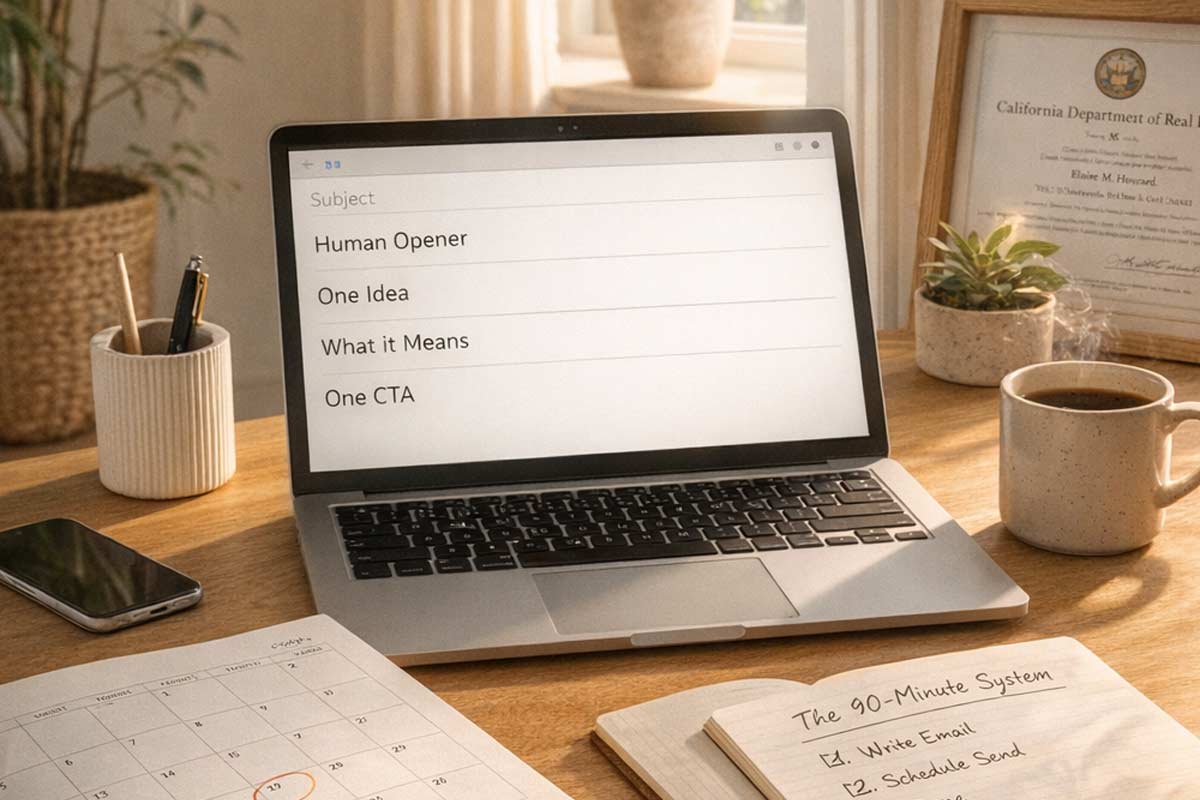
Step 3: The “Same Every Time” Newsletter Template
Your newsletter should feel like a familiar TV show: same format, new episode. This builds the consistency required for branding yourself.
Subject (Benefit + Place): “What today’s OC inventory shift means for you.”
Human Opener (2 sentences): Local and relevant. Example: "The line at Porto’s was wrapped around the block today—reminded me how fast things move in Buena Park."
One Idea: One chart, one story, or one principle (e.g., why interest rates shouldn't stop a move-up buyer).
What it Means for You: Translate the idea into a decision. Example: “If you’ve been waiting for a 6% rate, you might be missing the best equity window in five years.”
One CTA: One action only. (See the Keyword System below).
Signature & Compliance Footer: Name, Brokerage, and DRE #.
The CTA That Actually Works: “Reply With One Word”
People often won’t click a link, but they will reply if it’s easy. Pick one of these for your newsletter:
Reply Keyword
What They Get
VALUE
I’ll send a quick home value range for your specific neighborhood.
ADU
I’ll send the California ADU feasibility checklist.
BUY
I’ll send my “first 30 days” buyer game plan.
SELL
I’ll send my pricing and prep checklist for your specific zip code.
Tip: When someone replies, respond within 24 hours—even if it’s just to acknowledge and schedule a follow-up. Speed compounds trust.
Step 4: The California-Ready Content Menu
Pick one idea for your next edition.
Note: Always include a disclaimer that you are not providing tax or legal advice.
Market Intelligence: California Association of REALTORS® (C.A.R.) monthly data decoded for your city.
Homeowner Wealth: How Prop 19 might affect your parents' ability to downsize.
Transaction Truths: Why the "Appraisal Gap" is the most important term in a CA contract right now.
Hyperlocal Spotlight: The best coffee shop in your neighborhood for a morning meeting.
Step 5: Frequency (What You Can Sustain Wins)
If you’re new, start monthly. One newsletter sent 12 times a year beats two newsletters sent twice.
Months 1–2: Monthly (Build the habit).
Month 3+: Optional bi-weekly if you are consistently getting replies.
Your First Newsletter Should Be an Intro (Copy/Paste)
Subject: Quick note — I’ll send one helpful real estate email each month
Body:
“Hey — quick note. I’m starting a simple monthly email where I share one California real estate insight (prices, inventory, and practical homeowner tips). No spam, no daily blasts.
If you ever want out, you can unsubscribe at the bottom. If you want something specific, reply with what city or zip code you care about and I’ll tailor future emails for you.”
California Compliance: Stay Professional
Broker Review: Have your broker-of-record glance at your template.
Accuracy: Be meticulous about sourcing your data (C.A.R., MLS, etc.).
Reply Goal: Treat open rates as noisy; prioritize replies and booked conversations. If you get 1–3 replies per 100 sends, you are winning.
The System is the Secret
Mastering your newsletter is just one part of the Real Estate Agent Skills California ecosystem. This hub explores the full range of technical and interpersonal skills required to thrive in the Golden State.
Your first newsletter is the hardest.
Send it anyway.
Then send 11 more.
That’s when the system starts working for you.
FAQ: Real Estate Newsletters
How often should a real estate agent send a newsletter?
Start monthly. Once you can produce a monthly email in under 90 minutes without stress, you can consider moving to a bi-weekly cadence.
What should I avoid putting in my newsletter?
Avoid politics, "listing-only" blasts, and generic national news that doesn't explain the impact on a local California homeowner.
Do I need permission to email people?
Start with people who know you (sphere, clients, and opted-in leads). Use honest subject lines, include your business info and an unsubscribe link, stay CAN-SPAM compliant and never email people who have asked you to stop. When in doubt, consult your office's specific policy.
What is the best email platform for agents?
Mailchimp and ConvertKit are excellent for beginners. If you use a CRM like Chime or LionDesk, ensure the templates are easily readable on mobile.
How do I measure if it's working?
The only metric that matters is the "Reply." If people are asking you questions or thanking you for the data, the system is working.
|

When you decide to get your California real estate license, you are immediately flooded with ads. Some schools scream about being the cheapest; others promise "100% pass rates."
But after 20 years in Read more...
When you decide to get your California real estate license, you are immediately flooded with ads. Some schools scream about being the cheapest; others promise "100% pass rates."
But after 20 years in this industry, I can tell you that most of those metrics are noise. If you choose a school based on the wrong criteria, you might end up with certificates of completion but zero confidence when you sit down for the actual real estate exam.
Here is what actually determines your success.
Quick Take:
Your goal isn't just to "finish the hours"—it's also to pass the state exam on the first try. To do that, you need a school that prioritizes support, exam-readiness, and policy transparency over just being the lowest bidder.
Quality of Student Support (The "Ghosting" Factor)
In California, you have to complete 135 hours of education. At some point, you will get confused by a concept like "negative amortization" or "easements by prescription."
The Problem: Budget schools often automate everything. If you have a question, you might wait 48–72 hours for an emailed response from someone who isn't even an instructor.
What Matters: Can you get in touch with a human? Is there a live Q&A session? Access to experienced instructors is one of the 10 biggest differences between California real estate schools.
Exam Prep vs. Course Completion
Completing the required DRE-approved real estate courses in California is just Step 1. Passing the final for those courses is "open book." The state exam is not.
The Problem: Many schools give you the 135 hours but very little "Crash Course" or "Exam Prep" material.
What Matters: Look for a school that includes a robust state exam simulator. You need to practice with the same wording, timing, and difficulty level you’ll face at the DRE testing center. This is a vital part of how you evaluate course format, student support, and pass rates.
Hidden Costs and Enrollment Length
In California, you cannot legally finish all three courses in less than 54 days. Life often gets in the way of that perfect timeline.
The Problem: Some schools give you only 3 or 6 months of access. If you don't finish, they charge you a "re-enrollment fee" that can cost as much as the original course.
What Matters: Transparency. Look for a one-year enrollment period and clear policies on retaking final exams (it should be free or very low cost).
Platform Usability (The "UX" Factor)
If the website looks like it was built in 1998, your learning experience will likely suffer.
The Problem: Clunky interfaces make it harder to track your progress or study on your mobile device.
What Matters: A modern online real estate school in California should allow you to jump between your phone and laptop seamlessly. If the technology is a hurdle, you won't finish the course.
Decision Checklist: The "Big 5" Questions
Before you enroll, ask these five questions to ensure the school is a fit:
Who is the instructor? (Are they a practicing broker or just a paid actor?)
How long do I have to finish? (Is the timeline 6 months or a full year?)
Does the school offer exam prep? (Passing the state exam is critical.)
How do I get help? (Is there a community or a help desk?)
What is the "Total" price? (Does it include books, shipping, and exam prep.)
The Reality of Pass Rates
Any school can claim a high pass rate. But since the DRE doesn't publish these figures for private schools, you have to look for reputation signals:
Check independent reviews (Google/Yelp).
Ask local brokers which school their most successful new agents attended.
Check if the school offers an "open door" policy to try a class before you buy.
If you are still stuck between two schools, you should learn how to compare California real estate schools using a side-by-side rubric.
The "best" school isn't the one with the biggest discount code. It’s the one that respects your time and provides the tools to ensure you only have to take the state exam once.
For a final ranking of the top options in the state based on these criteria, see our master guide: Best Real Estate Schools in California.
FAQ
What is the most important factor in choosing a real estate school?
Instructor access and the quality of state exam prep software. Passing the 135 hours is easy; passing the state exam is the real hurdle.
Can I switch from an online course to an instructor-led one later?
It depends on the school. Some allow a "hybrid" approach, but it's easier to decide your format upfront. See our guide on Online vs. In-Person Real Estate Schools in CA for more.
Does a more expensive school mean I’m more likely to pass?
Not necessarily, but "too cheap" often can indicate a lack of human support and outdated materials. Aim for the mid-to-high range for the best balance of value and quality.
|

I have spent over 20 years as a broker in California, training and supervising thousands of new licensees. In that time, I’ve developed a sixth sense for the “Quiet Quit.”
It starts with a subtle Read more...
I have spent over 20 years as a broker in California, training and supervising thousands of new licensees. In that time, I’ve developed a sixth sense for the “Quiet Quit.”
It starts with a subtle avoidance. An agent might stop showing up for the Tuesday sales meetings because they don’t have any "wins" to report. They tell their family that “it’s just a slow season” while watching their credit card balance climb to cover local association dues.
Often there isn’t a dramatic resignation; they simply fade out of the industry, seeing that the new career touted on LinkedIn six months ago never actually materialized.
This isn’t just the loss of a job; it’s the identity built in front of everyone that withers.
In California, the first-year dropout rate is high because the industry sells a dream while the reality requires surgical discipline. Most agents don't quit because they lack talent—they quit because they were never told how to survive this compounding decline.
1. No Business Plan (Productive Procrastination)
The biggest mistake I see is "productive procrastination." This is when an agent spends four days color-coding a CRM that contains zero leads or obsessing over the font on a business card.
This is where most agents fool themselves into thinking they are "building a business" when they are actually just maintaining an expensive hobby. If you don't have a daily lead-generation block—actual conversations with prospects, not administrative setup work—you are a tourist, not an agent yet. To stop the bleed, you must learn How to Create a Real Estate Business Plan (New Agents).
2. No Personal Brand (The Invisible Decline)
Invisibility is a death sentence in California's competitive markets. Many new agents hide behind their big-box brokerage’s logo, thinking the name on the building will do the heavy lifting. It won't.
The danger here is the lag factor. The damage of a weak brand isn’t felt today; it’s felt six months from now when the pipeline is bone-dry. The consequence is a phone that stays silent even when inventory shifts or interest rates drop. Essentially becoming a "secret agent," and secrets don't get paid. Overcoming this requires Branding Tips for New California Agents that force the agent into the public eye before the silence becomes entrenched.
3. Cash-Flow Shock (The Panic Check)
Let's talk about the moment the "dream" hits the bank account. Between DRE fees, REALTOR® association dues, and marketing costs, you are likely thousands of dollars in before the first escrow even opens.
In California, a standard escrow is 30 to 45 days. If it takes you four months to find a client, you are six months away from a check. Most agents quit when they hit the "Panic Check"—the moment they realize they have to retreat to their old 9-to-5 and explain to their peers why they couldn't make it. Cash-flow shock is a public retreat that most egos can't survive.
The Hard Truth: You were given a license, but you weren't given a survival manual. Quitting is a rational response to a lack of systems. If you find yourself avoiding your broker or lying to your spouse about how "busy" you are, it’s not a character flaw—it’s a systemic failure.
4. Social Media Confusion (Digital Noise vs. Value)
I see new agents posting photos of their lunch or generic "Happy Monday" graphics and wondering why their DMs are empty. This random posting is actually worse than silence because it creates a false sense of accomplishment.
In the current market cycle, the public is too sophisticated for "guru" posturing. If your digital presence doesn't provide data or inventory insights, you are just adding to the noise. You need a strategy for How New Agents Should Use Social Media in 2026 that builds authority rather than just seeking "likes."
5. Isolation & The Shame of "Looking Stupid"
Real estate can be a lonely business. When a deal falls apart, the isolation leads to a rapid collapse in motivation.
But the real killer is shame. New agents often stop asking questions because they don't want to "look stupid" in front of the high-producers in the office. They isolate themselves to hide their lack of progress, which only accelerates the Quiet Quit. Breaking this cycle requires a specific strategy on How to Stay Motivated as a New Agent that acknowledges the psychological toll of the first year.
6. The "Licensing Lie"
The California Department of Real Estate (DRE) exam ensures you know the basics of real estate law; passing does not guarantee you will make money. The industry’s onboarding narrative often suggests that "getting your license" is the hard part.
That is the Licensing Lie. Your license is merely a "permit to learn." The reality is that the first year is 10% real estate and 90% grueling lead acquisition. Lead acquisition isn't a chore you do to get to the real estate; lead acquisition is the real estate business.
The Survivor Mindset: Boring Consistency
The agents I’ve seen survive and thrive over the last two decades don't have "hustle" posters on their walls. They have boring consistency.
Survivors rely on observable behaviors:
The Calendar: Guarding lead-generation blocks like a doctor guards surgery time.
The CRM: Documenting every interaction, no matter how small or unlikely.
The Follow-Up: Calling when you said you would, even when there is no "news" to report.
The Decision Window
If you are currently feeling the weight of the Quiet Quit, you are at a fork in the road. You can continue to fade out, or you can admit that your current "plan" isn't working and reset your systems.
The first year is an exercise in attrition. Survival depends on your willingness to stop "playing house" and start operating a business. To move past the danger zone and build something that lasts, you need to understand the full career arc. It’s time to stop guessing and learn how to properly Start a Real Estate Career in California with your eyes wide open.
|
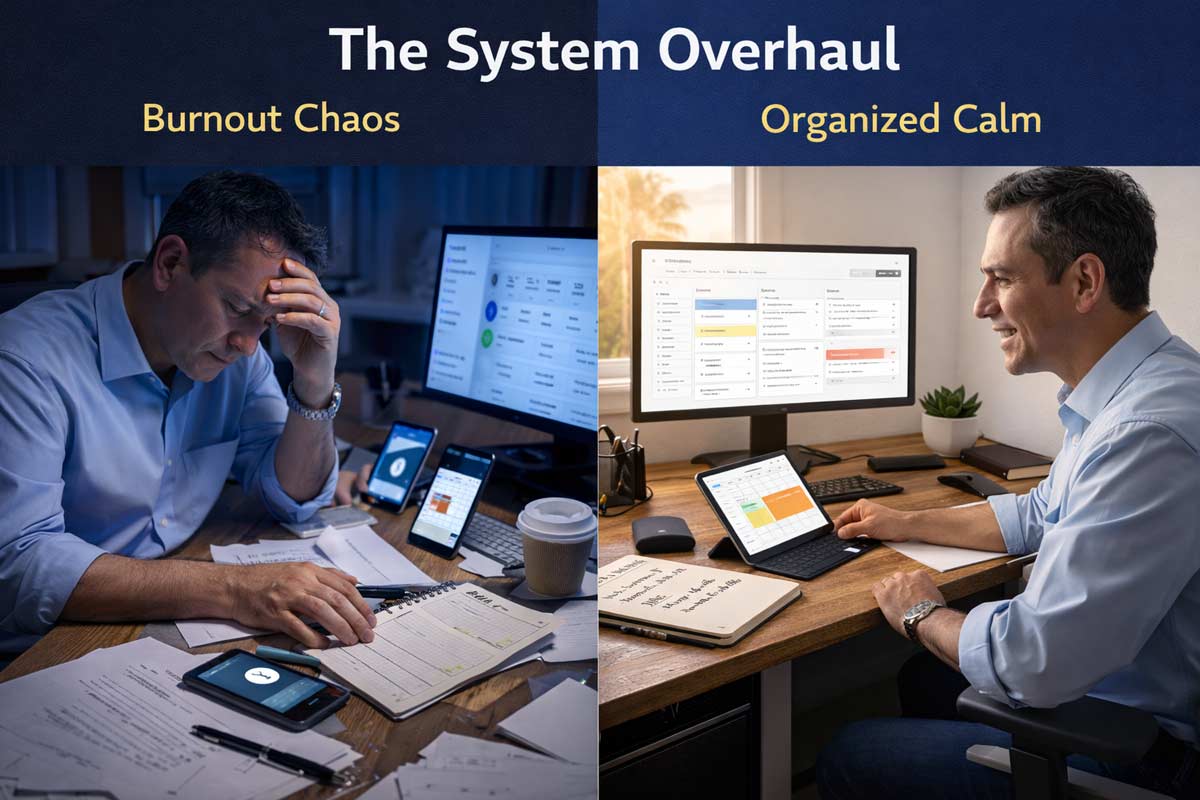
Disclaimer: This article provides operational and professional strategies for performance management. It is not a substitute for professional medical or psychological advice. If you are experiencing severe Read more...
Disclaimer: This article provides operational and professional strategies for performance management. It is not a substitute for professional medical or psychological advice. If you are experiencing severe mental health distress, please consult a licensed professional.
It’s 7:45 PM on a Tuesday. You’re finally sitting down to dinner when your phone buzzes. It’s a "quick question" from a buyer about an escrow contingency. Against your better judgment, you reply.
That one text turns into a 45-minute email chain with the lender and the listing agent. By 9:00 PM, you’re staring at the ceiling, mentally rehearsing tomorrow’s showings while your adrenaline spikes.
If this sounds familiar, you aren’t "working hard"—you’re redlining. At ADHI Schools, I’ve spent over 20 years coaching California agents through every market cycle, and I can tell you that burnout prevention for real estate professionals is not a luxury; it is a fundamental requirement for production. You don’t need a vacation; you need a sustainable operating cadence.
This guide is the operator’s plan to reduce your mental load, protect your commission, and build the real estate agent skill stack pillar that the top 1% use to stay at the top.
The Death Spiral: From "Busy" to Burnout
In a commission-based business, it is easy to mistake "constant access" for "high performance." However, ignoring the early warning signs of real estate agent burnout creates a dangerous downstream effect on your bank account.
The Symptoms To Consequences Bridge
If you ignore the symptoms, the professional consequences are inevitable:
Symptom: You dread opening your CRM or email.Consequence: Your follow-up slips and your pipeline dries up causing your panic level to increase.
Symptom: You have a "short fuse" with clients or TCs.Consequence: Your reputation takes a hit and your referrals drop causing you to work twice as hard to find new business.
Symptom: You are "always busy" but nothing moves.Consequence: You enter a cycle of "random activity" and your decision fatigue sets in causing you stop doing the high-ROI tasks that actually close deals.
Operational Strategies for Burnout Prevention for Real Estate Professionals
To survive the California market, you must stop being a "responder" and start being an "operator." This requires moving away from a reactive calendar and toward a structured system.
1. The "Two Windows Rule" (Communication Framework)
The primary cause of mental fry is constant context switching. Stop answering texts the second they arrive. Instead, implement the Two Windows Rule:
Window 1 (11:30 AM): Process all morning inquiries, lender updates, and escrow fires.
Window 2 (4:30 PM): Wrap up the day’s communication and set expectations for the following morning.
The Result: You train your clients that you are a professional with a schedule, not a 24-hour concierge. This single shift is the cornerstone of time management for California real estate agents.
2. One Source of Truth (The CRM)
Your brain is for processing information, not storing it. Trying to remember which buyer needs a disclosure sent and which listing needs a sign-post update is the fastest path to exhaustion. Learning how to build a real estate CRM that actually works is the only way to offload that mental weight. If it’s in the CRM, your brain can let it go.
3. Minimum Viable Habits
Don't try to overhaul your life. Pick three non-negotiables that keep your energy stable. For most top producers, this includes a set wake-up time, 60 minutes of proactive lead generation, and a "shutdown ritual." Mastering the daily habits of top-producing agents creates a performance floor that protects you even when the market gets volatile.
Practical Playbooks for the Fried Agent
The 2-Hour Daily Stabilizer
Before you open email or social media, spend the first two hours of your workday on Pipeline Defense.
0–30 mins: Review your CRM tasks.
30–90 mins: Proactive reach-out (calls/texts/notes).
90–120 mins: Appointment setting.
Why? If you spend the rest of the day fighting escrow fires or stuck in California traffic, you’ve already secured your future income.
The Boundary Scripts
The Late Night Text: "Hi [Name], I’m currently away from my desk for the evening, but I’ve prioritized this for my 8:30 AM updates. I’ll have an answer for you then!"
The "Urgent" Non-Urgent Item: "I want to ensure I give this the proper review. Let’s discuss this during my next update window at 4:30 PM."
The Operator’s Comparison
Feature
The Burnout Path (Reactive)
The Sustainable Path (Systematic)
Morning Routine
Checking emails in bed
CRM task review & proactive calls
Client Access
24/7 "on-call"
The Two Windows Rule
Goal Tracking
"I hope I close something"
Using how to set goals as a new real estate agent to track daily inputs
Recovery
Crashing from exhaustion
Scheduled "Hard Stops" and 24-hour disconnects
The 7-Day Reset Mini-Plan
If you're currently redlining, follow this sequence to regain control:
Day 1: Audit your phone. Turn off all non-human notifications (social, news, retail).
Day 2: Clean the CRM. Move every "reminder" out of your head and into the system.
Day 3: Set a "Hard Stop" time (e.g., 7:00 PM). The phone goes in a drawer.
Day 4: Schedule one 3-hour "Deep Work" block. No phone, no distractions.
Day 5: Proactive Triage. Update every active client before they ask you for a status report.
Day 6: Design your "Ideal Week" on paper, including gym time and family meals.
Day 7: Total disconnect. No real estate for 24 hours.
The Bottom Line on Sustainable Production
In the California market, burnout prevention for real estate professionals is an operational skill. If you operate without a system, the business will eventually consume your personal life and your health. If you operate with a system, you can handle higher volume with lower stress.
To build a career that lasts decades rather than months, you must master the fundamental Real Estate Agent Skills California requires. Stop reacting to the chaos and start engineering your success.
Burnout Prevention Checklist
One Source of Truth: Is every lead and task documented in your CRM?
The Two Windows Rule: Have you set specific times for client updates?
Pipeline First: Have you completed your 90-minute lead-gen block today?
Hard Stop: Is there a time tonight when you will officially "log off"?
Weekly Recovery: Is there a 24-hour block in your calendar for total disconnect?
Next Step: Build your foundation by exploring the full Real Estate Agent Skills California pillar to see how systems-first agents dominate the market.
|

Most students don’t fail the California real estate exam because the material is "too hard." They fail because they pick a learning format that doesn’t match their actual life.
You might be tempted Read more...
Most students don’t fail the California real estate exam because the material is "too hard." They fail because they pick a learning format that doesn’t match their actual life.
You might be tempted to choose the cheapest online real estate school in California versus an instructor-led real estate school closest to your house, but without a framework, you risk losing weeks of momentum to procrastination or burnout.
This guide provides an objective look at the trade-offs between formats, helping you choose the best format for California real estate license course success.
Quick Take:
All California real estate schools teach the same required subjects—but they do not teach them the same way. The difference between passing smoothly and stalling out usually comes down to support, platform quality, and hidden policies—not price. Our full breakdown of providers is covered in the Best Real Estate Schools in California guide.
Quick Answer: Which One Should You Choose?
If you need a fast decision, match your profile below:
Choose Online if: You are a disciplined self-starter with a full-time job, have strong tech comfort, and need to fit studying into "pockets" of time.
Choose Instructor-Led if: You struggle with self-motivation, learn best through discussion, and need a "destination" to focus.
Online is risky when: You have zero student support and a "buy it and forget it" mentality.
In-person is inefficient when: The commute takes longer than the class or the fixed schedule forces you to miss critical business opportunities.
The Deciding Factor: It isn't just about the screen vs. the classroom; it’s about accountability + support + schedule reality.
If you want to go deeper into how support, accountability, and policies impact outcomes, see our breakdown on What Matters Most When Choosing a Real Estate School.
Defining the Formats For This Article
Before comparing, it’s important to understand what these terms actually mean under Department of Real Estate (DRE) regulations:
Self-Paced Online: You log in and read text or watch videos. You move as fast or slow as you want (within the 18-day-per-course legal minimum).
Livestream (The Hybrid): Classes are held over Zoom at specific times. You get the classroom feel without the commute.
Physical Classroom: Traditional in-person instruction at a physical campus.
Regardless of format, ensure you are taking DRE-approved real estate courses in California. The curriculum is standardized, but the experience—and your results—will vary based on the school's platform and instructor quality.
Online Real Estate Schools in California — Pros & Cons
The self-paced online real estate course in California has become the most popular option for a reason: flexibility.
The Pros
Total Flexibility: Study at 2 AM or during your lunch break.
Cost Efficiency: Generally 30–50% cheaper than instructor-led equivalents.
Pacing Control: Breeze through topics you know and spend more time on complex concepts like Trust Fund Handling.
Repeatability: You can re-watch videos or re-read chapters as many times as needed.
The Cons
Procrastination: Without a "teacher" waiting for you, it’s easy to push studying to "tomorrow."
Isolation: You don’t have a cohort of peers to "bump brains" with.
Tech Friction: If the school's platform is outdated, the user experience can be frustrating.
Best for: Erratic schedules, full-time employees, and those with a high degree of self-discipline.
Watch-outs: Look for hidden fees for "extensions" and check the quality of their real estate school student support in California.
In-Person Real Estate Schools in California — Pros & Cons
For some, the "four walls" of a classroom are the only way to ensure the work gets done.
The Pros
Built-in Accountability: If you show up to the building, you’re going to study for those hours.
Real-Time Q&A: You can stop an instructor and ask for a real-world example the moment you’re confused.
Community: You meet people who will eventually be your colleagues and potential referral partners.
The Cons
Rigid Schedule: If you miss a class, you might have to wait weeks for that topic to cycle back.
Time Cost: A two-hour class plus an LA commute can equal four hours of your day.
Lack of Review: Once the lecture is over, you can’t "rewind" a live instructor.
The Decision Framework: Your Scoring Checklist
Be honest—this isn’t about what sounds good, it’s about what you’ll actually do. Rank each category from 0–5 (5 being highest importance).
Category
Score (0–5)
Schedule Control: I need to study at random times.
Self-Discipline: I can sit down and work without being told to.
Need for Live Instruction: I need to ask "Why?" to understand.
Tech Comfort: I am comfortable navigating web platforms.
Timeline Urgency: I need to finish as fast as legally possible.
How to Interpret:
Higher on Schedule/Discipline/Speed: Go Online.
Higher on Live Instruction/Accountability: Go In-Person or Livestream
If you are still torn, you should learn how to compare California real estate schools by looking at the specific student support levels each offers.
Format Myths vs. Reality
Myth 1: "In-person students have higher pass rates."
Reality: Success is tied to study behavior. An online student using a high-quality simulator often outperforms an in-person student who only listens passively. You must evaluate course format, student support, and pass rates as a total package.
Myth 2: "Online is easier."
Reality: The 135-hour curriculum is the same. In many ways, online is harder because it requires more mental stamina to stay engaged with a screen than a human.
Format alone doesn’t explain why students have wildly different experiences. Many of the real differences come down to policies, platforms, and support structures—which we break down in The 10 Biggest Differences Between California Real Estate Schools.
Choose the Format You’ll Actually Finish
The "best" school is the one you will actually finish on time while staying exam-ready. Don't let a $50 price difference or a "prestige" label distract you from your own learning habits.
If you’re ready to see how the top providers in the state stack up, check out our master guide: Best Real Estate Schools in California. This comparison framework is just one part of choosing the right path toward your California real estate license.
FAQ
Is livestream or Zoom real estate school considered online in California?
Yes. Livestream or Zoom-based courses are considered an approved delivery method as long as the provider is DRE-approved and properly tracks completion. These hybrid formats often combine live accountability with the convenience of remote access.
How long does an online California real estate course take compared to in-person?
It usually takes the same total time—but online might feel faster because you control the pace. California has an 18-day minimum per course, so you can’t legally finish instantly. The real difference is efficiency: online lets disciplined students stack study blocks daily and finish near the minimum, while in-person schedules can stretch the timeline if classes meet only certain days or if you miss a session.
What should I look for in student support if I choose an online school?
Look for support that prevents “stall-outs,” not generic customer service.
Specifically:
Fast response times (same-day or next business day)
Clear extension and refund policies (no surprise fees)
Real exam-prep tools (practice exams/simulators + explanations)
Progress tracking + reminders (anything that adds accountability)
If the school can’t clearly explain how they keep students moving, it’s a red flag.
|

You passed the real estate exam, joined a brokerage, and ordered business cards. Week one feels like an adrenaline rush of “limitless potential.” By week four, the anxiety sets in. You’re staring Read more...
You passed the real estate exam, joined a brokerage, and ordered business cards. Week one feels like an adrenaline rush of “limitless potential.” By week four, the anxiety sets in. You’re staring at an empty CRM, your inbox is full of industry noise, and you haven’t had a “real” real estate conversation in days.
Most new agents fail here because they set outcome goals (like “I want to make $100k”) without building the machine required to produce them. In my 20+ years coaching California agents, I’ve seen the pattern: goals don’t fail because of a lack of hustle. They fail because they aren’t connected to a weekly scorecard and a daily plan.
If you want to survive year one, stop acting like an enthusiast and start acting like an operator.
The Operator Goal Stack Framework
To succeed, stop obsessing over the commission check and start obsessing over the architecture of your day.
Use the Operator Goal Stack:
Outcome Goals (The “What”): Lagging indicators like closings, GCI, or listings taken. You can’t control these directly—you can only influence them.
Input Goals (The “How”): Leading indicators: conversations, appointments set, and follow-ups completed.
System Goals (The “Machine”): Your infrastructure: protected time blocks, a weekly review, and a CRM that prevents leads from dying of neglect—starting with How to Build a Real Estate CRM That Actually Works.
Start With One 12-Week Sprint
Annual goals are too far away to create urgency. For a new agent, a year is an eternity of “I’ll start tomorrow.” Instead, operate in 12-week sprints. You get four “New Years” per year—and fast feedback loops.
Example goal sets for your first sprint:
The “Zero Database” Agent: Add 10 new contacts to your database per week through open houses, local networking, and community events.
The “Warm Network” Agent: Conduct 15 coffee chats or catch-up calls per week to re-announce your career and create referrals the right way.
Choose 3 Numbers That Matter (The Scorecard)
Stop tracking “busyness.” Remember that merely checking email does not equal work. Similarly, designing a flyer does not equal real work. For new agents, only three numbers reliably move the needle.
Metric
Weekly Target (Average)
Definition
New Conversations
40–50
Two-way conversations about real estate (sphere or new leads).
Appointments Set
1–2
A scheduled meeting (Zoom/in-person) to discuss a move timeline.
Follow-ups Completed
100+
Logged touches (call/text/email/DM) that advance a next step.
Pro Tip: These numbers are averages—not quotas. Some weeks will exceed them, others won’t. Consistency over 12 weeks is what creates results. If you aren’t hitting these averages, the problem usually isn’t the market—it’s your calendar. The Daily Habits of Top-Producing Agents are consistent because they protect the morning for these activities.
Translate Goals Into a Daily Plan
Your goals are fantasy until they’re time-blocked. An operator structures the day so input goals happen before the day’s chaos takes over.
Option 1: Standard New-Agent Schedule
8:00–10:00 AM: Pipeline Block (Non-Negotiable) — Outbound calls, follow-ups, open house nurture. No email. No scrolling. If it doesn’t directly create a conversation or an appointment, it doesn’t belong in this block.
10:00–11:00 AM: Admin/Ops Window — Email, paperwork, CRM updates.
1:00–2:00 PM: Visibility Block — Content creation, networking, event outreach.
3:00–5:00 PM: Appointments & Field Work — Showings, buyer consults, listing meetings.
Option 2: Aggressive Pipeline Schedule
Extend the Pipeline Block to 8:00–11:00 AM if you are in full "build mode" and need to generate immediate momentum.
If you want to keep your day from being hijacked, study Time Management for California Real Estate Agents—because if you don’t have an appointment, your job is to go create one.
5 Common Goal-Setting Mistakes
Setting income goals with no activity plan: “I want $200k” is a wish. “I will have 10 conversations/day” is a plan.
Copying a top producer’s goals: A veteran runs on referrals. Newer agents need to do more hunting and direct engagement. Don’t copy “maintenance” goals when you need growth goals.
The “Ghost Week”: Going hard for four days and disappearing for three kills momentum—and fuels the feast-or-famine cycle and contributes to Burnout for Real Estate Professionals.
Tracking too much: You don’t need 27 metrics. Track the three numbers in the scorecard above. Everything else is noise.
Letting escrow kill production: One deal in escrow isn’t a business. Keep prospecting or you’ll close and then go starve for the next two months.
Goal Templates (Copy/Paste)
Activity Goal: “For the next 12 weeks, I will have [Number] real estate conversations per week by [Prospecting Method] daily from [Start Time] to [End Time].”
Conversion Goal: “I will set [Number] appointments/week by following up with [Number] people from my CRM each morning.”
Structure Goal: “I will protect my calendar by batching admin/ops from [Start Time] to [End Time] and never allowing it into my morning pipeline block.”
Build the Full Skill Set
Goal-setting is step one—but it’s only one part of becoming a professional operator. To thrive in a competitive market, you need the full toolkit outlined in Real Estate Agent Skills California — from pipeline habits to systems, communication, and execution.
At ADHI Schools, we don’t just help you get licensed. We help you stay in business.
|