

It’s 4:00 PM on a Friday. A repair request just came back with a $15,000 credit demand, the appraisal gap is widening, and the other agent is screaming into their speakerphone.
"This is an ethics violation!" they yell.
"I’m reporting you to the DRE! You’ll never sell a house in California again!"
If you’re like most agents, your stomach just did a somersault. You start mentally cataloging every email, every disclosure, and every text message, wondering if a single mistake is about to end your career.
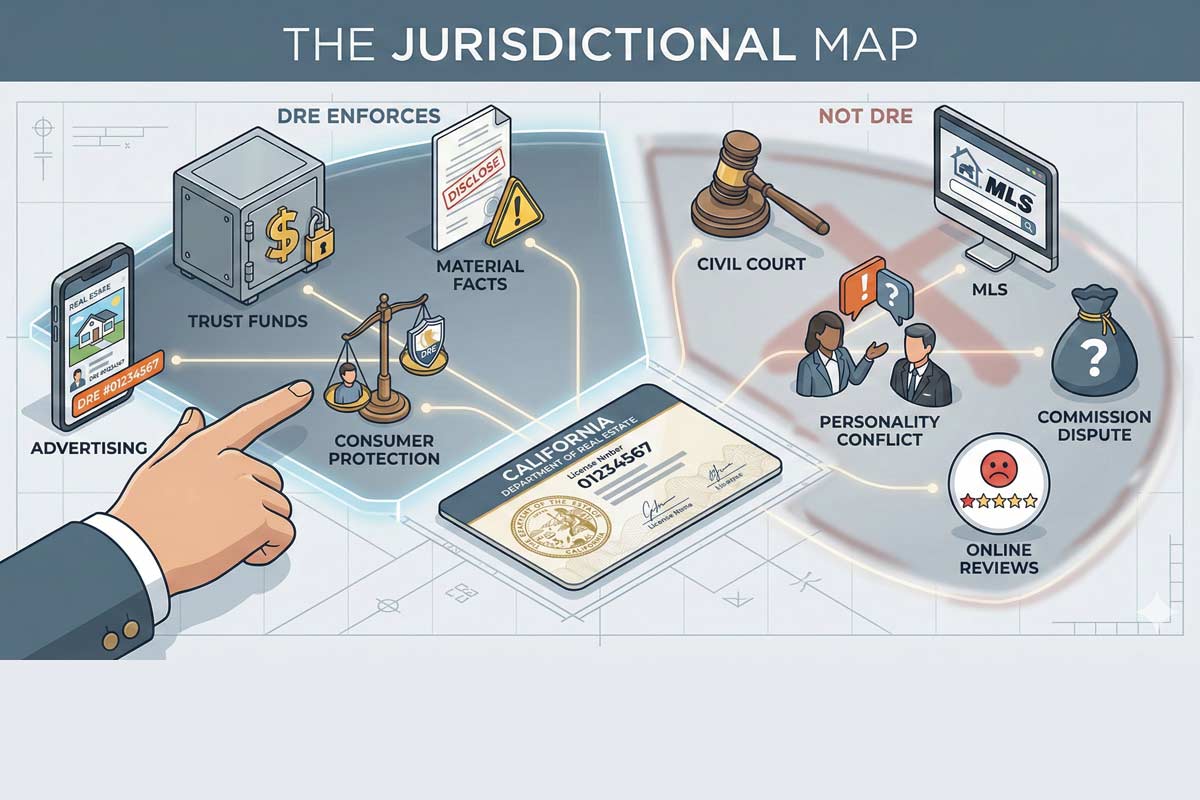
The reality is this: The California Department of Real Estate (DRE) is not an "everything cop." They are the License Cop. Their jurisdiction is specific, and their mission is consumer protection—not settling playground disputes between agents.
The DRE in Plain English: License Cop, Not Everything Cop
The DRE exists to protect the public from those who hold a real estate license. Think of the DRE like the DMV for your professional life. If you drive 100 mph in a school zone, the DMV (via the police) cares. If you forget to wave at your neighbor or argue over who pays for gas, the DMV does not have jurisdiction.
The DRE typically enforces license law—conduct tied to your license that impacts consumers, such as truthfulness, disclosures, money handling, and advertising. They generally do not enforce the REALTOR® Code of Ethics (that’s the Association’s job). They do not enforce the "spirit of cooperation" (conflicts here are typically handled internally by your broker). And they certainly do not care if another agent thinks you were "rude" during a negotiation. For the full compliance map, start with our California Real Estate Laws & Compliance Guide.
Where the DRE Shows Up: The Real Discipline Triggers
When the DRE does step in, it’s because a licensee has crossed a line into territory that can trigger discipline. The "Short List" of enforcement usually falls into these buckets:
-
Trust fund mishandling: One of the fastest ways to invite serious discipline is mishandling other people’s money—especially commingling (mixing funds) or conversion (misusing funds). When in doubt, escalate to your broker. If you’re unclear on the mechanics, read Trust Fund Handling Rules for California Agents.
-
Material misrepresentation / nondisclosure: This typically involves failing to disclose a material fact—like a neighbor’s unpermitted boundary wall or a known soil subsidence issue—to a buyer.
Micro-scenario: An agent fails to disclose a known, recurring roof leak because "the seller said it was fixed." The buyer moves in, the ceiling stains again during the next storm, and the buyer's attorney finds an old repair estimate in the file history during the dispute. This creates a documented trail that can support a complaint. Check our guide on Common DRE Violations and How to Avoid Them.
-
Advertising violations: Because it’s public and easy to document, advertising is often the first place investigators look.
Micro-scenario: An agent runs Instagram ads with “Top OC Realtor Team” but omits the broker ID in the caption and leaves the license number off the graphic. Nobody complains for months—until a transaction goes sideways and the client screenshots the posts. That’s a documentable issue investigators can verify quickly. Start with Real Estate Advertising With Your License Number and Team Name & DBA Rules for California Agents.
-
Criminal convictions: Certain convictions or conduct "substantially related" to the license can trigger DRE action because they raise questions about honesty or fitness. If this applies, consult your broker and legal counsel early.
-
Failure to supervise: Your broker is generally responsible for supervising your activities. If a team or office has no documented supervision and review procedures, the DRE can discipline the employing broker alongside the agent.
-
Unlicensed activity: This includes "scope creep" where unlicensed assistants perform tasks like advising on contract terms or negotiating repairs during an open house.
Where the DRE Usually Doesn’t Show Up (And Who Does)
Most "threats" you hear in the field have nothing to do with the DRE. While the DRE may get involved indirectly if facts allege misrepresentation or fraud, use this table to triage typical conflicts:
| Complaint About... |
Typically Handled By... |
DRE Involvement? |
What to Do |
| Commission split disputes |
Your broker / mandatory arbitration or mediation |
Unlikely |
Escalate to your broker |
| "Stolen" MLS photos or remarks |
Local MLS committee |
Unlikely |
File a violation report with your MLS |
| A "rude" or "unprofessional" tone |
Nowhere (Business conflict) |
Usually none |
De-escalate, document, move on |
| REALTOR® ethics violation |
Local Association of REALTORS® |
Usually none |
File an ethics complaint with the Association |
| Breach of contract (Buyer vs. Seller) |
Civil court / mediation |
Indirect (if fraud is alleged) |
Loop in your broker; consult counsel if needed |
| Fair Housing discrimination |
CRD / HUD (and can overlap with DRE) |
Can overlap |
Consult broker/attorney immediately |
Reality Check
A bad Yelp review or an angry email does not automatically become a DRE case. The DRE typically looks for an allegation tied to license law. If the complaint is “they were rude” or “they negotiated badly,” it often ends at intake triage because it isn’t a licensing enforcement issue.
The Investigation Pathway: From Complaint to Closure
If you want to understand what the DRE investigates, look at the process. It is clinical and evidence-driven. If you receive a letter, don't improvise—provide factual records and loop in your broker immediately.
-
Intake & triage: They screen for jurisdiction—meaning, is this a license-law issue or just a dispute?
-
Request for response: If it’s in-scope, you and your broker may be asked to respond and provide documentation.
-
Investigation: They may review transaction files, ads, and interview parties.
-
Possible outcomes:
- Closed / no action: No violation found.
- Citation / administrative resolution: Often for fixable compliance items like advertising errors.
- Formal accusation / disciplinary process: For more serious allegations.
Checklist: If You Want to Stay Compliant, Do This:
-
Treat trust funds like evidence: Follow broker policy, use compliant trust procedures, and adhere to the Trust Fund Handling Rules for California Agents.
-
When in doubt: Disclose, document, and escalate to your broker.
-
Quarterly Marketing Audit: Review your signs, business cards, social media bios, and landing pages against the Real Estate Advertising With Your License Number requirements.
-
Keep a clean file: The DRE values a well-documented, organized file that tells a clear story of the transaction.
-
Involve your broker early: Your broker is your first line of defense and is legally required to supervise your conduct.
Your 3-Part Compliance Shield
You don't need to live in fear if you have a system. Treat your business with surgical competence:
-
Document Like a Defensive Pro: Every material conversation needs an email follow-up."Per our conversation..." is a strong phrase in your vocabulary to avoid Common DRE Violations.
-
Audit Your Advertising: Ensure your license number and broker's identity are conspicuous. Use our guide on Real Estate Advertising With Your License Number to help stay compliant.
-
Marketing & Team Hygiene: Ensure your team names and DBAs are registered properly. Refer to our guide on Team Name & DBA Rules for California Agents to ensure your branding isn't a liability.
The next time someone threatens you with a DRE report over a personality clash, take a breath. Look at your jurisdictional map. If you are operating with transparency and following license law, their threat is often empty noise. The DRE isn’t your shadow—your paperwork is.
To master the nuances of license law and protect your career, bookmark our master California Real Estate Laws & Compliance Guide.