When you begin the journey toward a California real estate license, the fear of choosing the "wrong" school is often the first hurdle. For most applicants, the natural instinct is to search for the most Read more...
When you begin the journey toward a California real estate license, the fear of choosing the "wrong" school is often the first hurdle. For most applicants, the natural instinct is to search for the most popular real estate schools in California.
I guess the logic is simple: if thousands of other students are using a specific program, it must be the “safest path” to passing the state exam.
However, in my 20+ years of helping students navigate the DRE’s 135-hour requirement, I’ve seen that popularity is often a reflection of marketing scale rather than individual student success. While high-volume schools offer certain advantages, "popular" does not always mean "best fit" for your specific learning needs or timeline.
How can I identify the most popular real estate schools?
Since the California DRE does not publicly rank schools by enrollment or pass rates, popularity is best identified through visibility signals like high search volume, large numbers of reviews on third-party platforms, and established partnerships with major brokerage firms. To find the Best Real Estate Schools in California, look past the volume and verify the school's specific support channels, course expiration policies, and the depth of their California-specific exam prep.
What Popularity Actually Signals (and What It Doesn't)
Before you enroll based on a brand name, it is important to distinguish between a school’s size and its effectiveness for your learning style.
What Popularity Signals
What Popularity Does NOT Signal
Broad Accessibility: The school likely has a highly stable online platform and mobile app.
Individual Support: High volume can sometimes lead to automated "support tickets" rather than live instructor access.
Social Proof: You can find thousands of reviews to gauge the general user experience.
High Pass Rates: A large enrollment base does not guarantee a higher percentage of students pass the DRE exam.
Familiarity: Seeing lots of content on Instagram or Reddit might make the school “feel familiar”.
Curriculum Depth: Large national schools may use generic content that doesn't always capture the nuances of California agency law.
How to Observe Popularity Signals Without a Brand List
Since enrollment data isn't public, you can verify a school’s "popular" status by looking for these three indicators:
Search Visibility: Are they consistently at the top of search results (be careful to look for "Sponsored" labels vs. organic rankings)?
Review Density: Do they have thousands of reviews on platforms like Trustpilot or Google, rather than just a few dozen?
Broker Mentions: Ask a local office manager which school they see most often on incoming certificates.
The "Fit Framework": An Operator’s Due Diligence Checklist
Instead of choosing the "biggest" school, use this checklist to verify the artifacts of a quality education. This is the same framework we use to evaluate the Best Real Estate Schools in California.
1. The Support Infrastructure
Don't just look for a "Help" button. Identify the channel :
The Test: Send an email or call the school on a Tuesday morning. Do you get a live human or a chatbot?
Instructor Access: Is there a designated time for live Q&A, or are you limited to searching a knowledge base?
2. Policy-Driven Costs (The "Expiration Trap")
Many popular, low-cost programs have rigid policies that can lead to unexpected fees:
Expiration Windows: Does the course expire in 6 months or 12?
Extension Fees: If you get busy and need another 30 days, is it a $50 fee or do you have to repurchase the entire course?
Retake Policies: If you fail a final school exam, is there a waiting period or an additional charge to retake it?
3. Seat-Time and Access Rules
Module Locking: Does the school force a specific "timer" on every page, or can you move at your own natural reading pace?
Content Freshness: Look for California-specific references. Does the material mention current CA-specific nuances?
Why Students Search for Popular Options
The 135-hour pre-licensing grind is a significant time investment. Students often gravitate toward online real estate schools in California that have high volume because they want to avoid "making a mistake."
This is especially true for those looking for the fastest way to get a real estate license in California. The logic is: "If it's popular, the system must be efficient." While often true for the tech platform, speed without comprehension can lead to multiple failed attempts at the state exam.
Two Paths: Real-World Scenarios
I’ve observed that the "popular" choice works differently depending on the student's background:
The Autonomous Learner: A student with a high degree of self-discipline chooses a high-volume online program. They don't need help, they never call the school, and they move through the material flawlessly. For them, popularity was a great signal for a stable platform.
The Momentum-Seeker: Another student chooses the same program but hits a point of confusion regarding Trust Fund Handling. They submit a support ticket but don't hear back for 48 hours. That delay causes them to lose momentum, and they eventually miss their 6-month completion window, resulting in a "re-enrollment fee" that makes the cheapest real estate school in California much more expensive in the long run.
Which Path Matches Your Learning Style?
"I need structure and peer interaction": Popularity in the online world doesn't replace the accountability of in-person real estate classes in California.
"I'm tech-focused and self-driven": You may find that the best online real estate schools in California offer the best mobile apps and user interfaces.
"I want the lowest entry price": You can often find the cheapest real estate schools in California among high-volume providers, provided you are confident you won't need extensions.
Common Mistakes When Choosing by Volume
1. Confusing "Top of Search" with "Top of Class": Heavy advertising is a sign of a healthy marketing budget, not necessarily a superior educational outcome.
2. Overlooking "Generic" Content: Some national brands use "multi-state" materials. Always verify the content focuses on California-specific law and practice.
3. Assuming a "Popular" Prep is Enough: Many high-volume schools are excellent at the 135-hour requirement but provide only basic "practice questions" for the state exam. Real exam prep should include simulated exams and a targeted study plan.
Frequently Asked Questions
How do I know if a popular school is DRE-approved?
You can verify any school by searching the California DRE's searchable database of approved providers. Never enroll until you've confirmed their license status.
Are big national schools better than local California schools?
For this purpose, not really. Local California schools have more direct access to instructors who understand the specific nuances of the state exam and the licensing process in California that is unlike any other state.
Does a "popular" school have better pass rates?
There is no publicly available data to prove this. Pass rates are generally a reflection of the student's dedication and the quality of the school's specific "Exam Prep" product, not the size of the school.
What happens if I start with a popular school and want to switch?
You can usually switch, but your progress doesn’t transfer. You will likely have to restart the specific 45-hour course you were in and pay a new enrollment fee.
Making an Informed Choice
Popularity is a helpful data point, but it shouldn't be your only decision rule. Your goal isn't just to enroll—it's to get licensed.
If you’re ready to see how the top programs in the state stack up based on actual quality, support, and student outcomes, visit our main decision hub: Best Real Estate Schools in California.
|
Choosing a real estate school can feel like a high-stakes decision because in some ways it is. You are investing your time, money, and career aspirations into a regulated process.
Naturally, most Read more...
Choosing a real estate school can feel like a high-stakes decision because in some ways it is. You are investing your time, money, and career aspirations into a regulated process.
Naturally, most students turn to the digital "safety net": online reviews.
Reviews feel like certainty in an uncertain process. However, in professional licensing, a high star rating doesn't always translate to a smooth path to a license. Understanding how to weigh student feedback against regulatory facts is the difference between starting your career on time or getting stuck in a cycle of hidden fees and technical hurdles.
How important are reviews when choosing a real estate school?
Online reviews are a valuable secondary tool for evaluating student support and platform usability, but they should never be your primary filter. Reviews help you predict the student experience; DRE legitimacy predicts whether your effort produces a certificate accepted by the state. Always verify a school’s DRE approval and specific provider policies before relying on a star rating.
The Right Way to Use Reviews: "Triangulation"
In over 20 years of helping California students, I’ve seen a recurring pattern: students choose a school based on a high star rating, only to realize the "support" mentioned in ratings doesn't exist when they actually need help.
Instead of looking at reviews first, use a triangulation method:
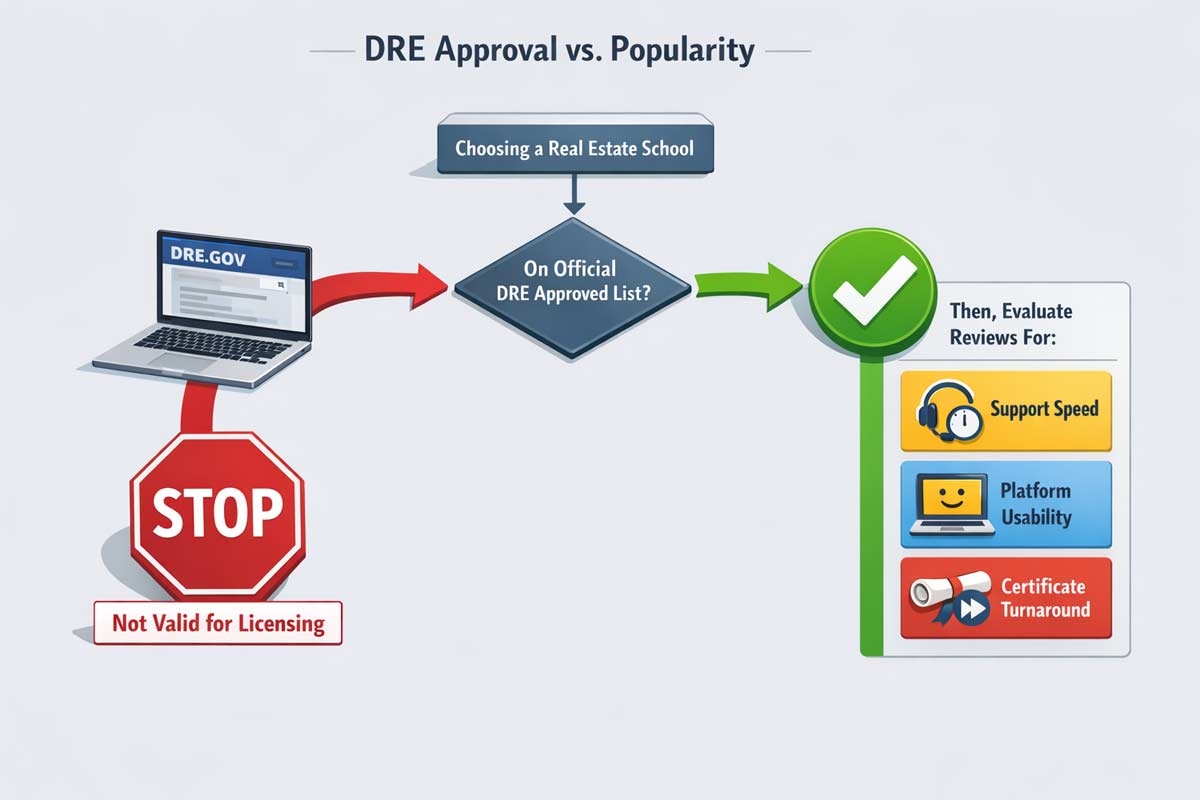
Legitimacy First: Verify the school is currently on the DRE’s approved provider list. (Always verify directly on the DRE website, not from a third-party review profile.)
Fit Second: Ensure the format (live vs. online) matches your learning style.
Verification Third: Check the school’s specific terms regarding refunds, extensions, and certificate delivery—ask about typical turnaround times for certificates.
Reviews Last: Use student feedback to look for patterns that confirm or contradict the first three steps.
Before you trust a star rating, it is essential to understand how to know if a real estate school is legit in California.
High-Signal Categories: What to Actually Look For
When scanning student feedback, look for "Signal" reviews that mention specific operational details:
Support Responsiveness
Look for mentions of problem resolution, not just friendliness. Does the reviewer mention how long it took to get a response? You will have questions about certificates or exam applications; you need a school that provides more than just automated "ticket loops."
Provider Pacing Restrictions
Provider pacing restrictions are platform rules that limit how quickly you can progress—even if you are ready—such as cooldown periods, minimum intervals between module exams, or capped progress. Look for reviews that mention being "stuck" or unable to progress at a natural speed due to these platform-imposed caps.
Certificate Issuance and Turnaround
You cannot apply for the state exam without your completion certificates. Feedback mentioning delays in certificate processing is a high-signal warning of administrative friction that could delay your career by weeks.
Platform Reliability and Content Freshness
Look for mentions of whether the material feels current. This is one of the red flags when choosing a real estate school that impacts your actual learning.
Where Reviews Mislead: The "Expectation Gap"
Online feedback often contains "noise" that can lead you toward a poor decision.
The Exam Prep Mismatch: A student might hit a school with a negative review because they struggled with the state exam. It is vital to remember that pre-licensing education is not necessarily the same as exam readiness. A pre-licensing course fulfills legal education requirements; exam readiness depends on how you study and retain information under timed conditions.
The "Price Emotion" Trap: Low-cost providers often have high review volumes because people feel they "got a deal." However, "cheap" often comes with hidden costs like $50 extension fees or non-existent support.
The Campaign Effect: If you notice a sudden burst of reviews, treat it as a data point to investigate rather than assuming manipulation. Bursts can happen for innocent reasons—such as a new platform launch or a graduation cycle—so look for specifics in those ratings to see if they align with your needs.
The "3 Filters" for Evaluating Student Feedback
To find the truth in the comments section, apply these three filters:
Specificity: Does the review mention a specific process (e.g., "The refund took 3 days" or "The instructor answered my question about Disclosure laws")?
Recency: Is the feedback from the last 90–180 days? Real estate platforms and support teams change frequently.
Repetition: Is the same issue—such as a specific technical bug or a delay in certificates—mentioned by multiple unrelated reviewers?
Using these filters helps you avoid fake or unaccredited CA real estate schools that may use volume to mask poor service.
The Hierarchy: DRE Approval Outranks Popularity
In California, you are buying a certificate of completion that the DRE must accept. If a school has 10,000 five-star reviews but their provider identity is unclear or they aren't on the DRE’s current list, those reviews are irrelevant to your licensing outcome.
This is why DRE accreditation matters more than online reviews. You are managing "license risk"—the risk that your time and money won't result in a license. A legitimate school will always prioritize DRE compliance over appearing popular. For a deeper dive, see our guide on why DRE accreditation matters more than online reviews.
Checklist: How to Read Reviews Fast
Sort by "Most Recent": Is the platform and support currently functional?
Search Within Reviews: Use "Find" to search for keywords like refund, extension, support, phone, and certificate.
Verify the Provider: Ensure the school name on the review site matches the name on the DRE’s approved provider list.
Identify Throttles: Do students complain about being unable to finish the course due to "forced wait times" or pacing caps?
Check for CA Relevance: Ensure the reviewers are taking the California-specific curriculum.
Frequently Asked Questions
Are online reviews reliable for choosing a real estate school in California?
Reviews are reliable for gauging student support and platform usability, but they do not guarantee a school's legitimacy. Always use them as secondary evidence alongside a DRE approval check.
What matters more: online reviews or DRE approval?
DRE approval is non-negotiable. Without it, your certificates are not valid for licensing. Reviews only tell you how pleasant (or difficult) the process of obtaining those certificates might be.
How can I spot “provider pacing restrictions” in reviews?
Look for complaints about "wait times," "cooldowns," or being "locked out" of the next chapter. These reviews indicate the school has platform-imposed limits on how quickly you can study.
Do negative reviews mean a real estate school is bad?
Not necessarily. Many negative reviews stem from an "expectation gap" where students confuse pre-license education with state exam prep. Focus on reviews that mention technical failures or poor support.
Making a Grounded Decision
Reviews are a tool, but they aren't the blueprint. Your goal is to find a school that is transparent about its policies, responsive to your needs, and strictly compliant with California law.
Want a step-by-step framework to choose your school confidently?
Use the full evaluation system here: Best Real Estate Schools in California
|

You’ve passed the real estate exam, joined a brokerage, and ordered your business cards. Now comes the most pressing question every new California agent faces:
"Where do I get my first lead?"
The Read more...
You’ve passed the real estate exam, joined a brokerage, and ordered your business cards. Now comes the most pressing question every new California agent faces:
"Where do I get my first lead?"
The industry is flooded with marketing noise and subscription platforms promising instant closings. But after 20 years in the California real estate business, I’ve seen thousands of agents burn through their savings chasing the wrong leads. The truth is that lead sources are far less important than your lead-to-relationship conversion and your consistency.
A lead isn't a commission check; it’s an introduction. California markets are fragmented—what works in Riverside won't always work in West LA. To start a real estate career in California that actually lasts, you need a system, not just a tactic.
Key Takeaways
Trust over Tech: Your Sphere of Influence (SOI) remains the highest-converting lead source.
Sweat Equity: Open houses are the fastest way to meet "now" buyers without an upfront budget.
Speed Wins: The agent who follows up same-day—often within minutes—usually wins the client. This is often called “speed-to-lead”.
Local Authority: Consistency in a small "micro-farm" beats sporadic efforts across a whole city.
Best Lead Sources by Situation
Fastest results: Open houses + tight follow-up
No budget: SOI + community networking
If you hate cold outreach: Database + partner referrals
Long-term dominance: Micro-farm + simple local content
Commercial-lite path: Small lease deals + local owner conversations
Ranked: The Best Lead Sources for New Agents
Note: "Skill Level" refers to your conversion and communication skill, not your personality type.
Lead Source
Cost
Time-to-Result
Skill Level
Best For...
Sphere of Influence (SOI)
Free
Days/Weeks
Low
Immediate trust & referrals
Open Houses
Free/Low
Days/Weeks
Medium
Meeting unrepresented buyers fast
Open House Follow-Up
Free
Days/Weeks
Medium
Turning “tourists” into clients
Database + CRM Follow-Up
Free/Low
Weeks
Medium
Staying top-of-mind consistently
Local Partner Referrals
Low
Weeks/Months
Medium
Warm intros from lenders/escrow
Agent-to-Agent Referrals
Low
Weeks/Months
Medium
Relocation + overflow clients
Community Networking
Low
Weeks/Months
Medium
Trust-building (schools, chambers)
Micro-Farming (100–300 homes)
Medium
Months
High
Long-term local dominance
Rentals / Landlords
Low
Weeks/Months
Medium
Leads that become buyers later
FSBO / Expireds
Low
Weeks
High
High-volume conversations
Online Inbound Basics
Low/Medium
Months
Medium
Compounding flow (reviews)
Paid Leads (Optional)
High
Days/Weeks
High
Agents with a break-even mindset
The Core Strategy: Where to Start
1. Your Sphere of Influence (SOI)
Your SOI includes friends, family, and past coworkers. These are people who already want you to succeed.
Why it works: Trust is pre-built. You aren't "selling"; you're informing.
Scenario: Instead of a sales pitch, try: "I'm not calling to sell you anything—I just wanted to let you know I'm officially with [Brokerage]. If you ever have a quick question about what's happening in our neighborhood, I'm happy to be your resource."
Do this this week: Call 5 people a day. Update their contact info in your CRM.
2. Open Houses as a Lead Engine
Don't just "sit" in a house. Use it as a platform. Learning how new agents should hold open houses effectively can transform a boring Saturday into three new buyer representation agreements.
Why it works: You meet active buyers in a specific zip code.
Scenario: When a visitor walks in: "Thanks for coming by. Most people I meet here are either neighbors or looking to move in the next 90 days—which one are you?"
Do this this week: Ask a top producer in your office to host their listing open this weekend.
3. Building Your Database
Every person you meet belongs in a CRM. You must build a real estate database from scratch to automate your "top of mind" awareness.
A Simple Follow-Up Cadence
Day 0: Quick text + “What stood out to you at the house?”
Day 1: Phone call (short, human).
Day 3: Value add (neighborhood note or listing link).
Day 7: Call + clarify timeline.
Month 2+: Monthly market update + personal check-in.
Expanding Your Reach
Local Partner & Agent Referrals
Lenders, escrow officers, and out-of-area agents are massive referral sources.
Why it works: These are professional, warm introductions.
#1 Rookie Mistake: Asking for leads before offering any value.
Do this this week: Invite a local lender to coffee to learn about their specific programs.
Community Networking & Micro-Farming
Become the "Digital Mayor" of a small area. Focus on 100–300 homes (a micro-farm) or your local PTA/Chamber.
Why it works: It builds "omnipresence" in a small, manageable pond.
Do this this week: Draft a simple, one-page market update for your specific neighborhood.
Online Inbound & Rentals
Claim your Google Business Profile and gather reviews immediately. Additionally, don't ignore renters; in California, today’s tenant is often next year’s first-time buyer.
FSBO / Expireds
Why it works: These are people with high "intent to sell."
Compliance Reminder: Strictly follow the National Do Not Call (DNC) Registry, respect all opt-outs, and follow your brokerage’s specific outreach policies.
What to Avoid: The "New Agent Traps"
Paid Leads: The "High Tuition" Trap
Paid leads aren't evil—they're just expensive if you aren't ready. If you can't respond in under 5 minutes and don't have a conversion system, paid leads are just a donation to a tech company.
Small Commercial (The "Lite" Path)
You don’t need to be a commercial specialist on day one. Start commercial-lite: small retail/office leases and local owner conversations. Partner with a senior agent when complexity rises. Done right, it builds a professional reputation that feeds your residential business.
The 30-Day Lead Generation Operating System
Success requires strict new agent time management strategies.
Week 1: Set up CRM. Call everyone in your phone. Schedule two open houses.
Week 2: Execute follow-up cadence (Day 0–7). Meet one local partner.
Week 3: Start your 100-home micro-farm. Drop off a market report.
Week 4: Evaluate metrics. How many conversations did you actually have?
Weekly Scorecard
Contacts added to CRM: ________
Real estate conversations: ________
Speed-to-lead (Avg minutes): ________
Follow-up attempts: ________
Appointments set: ________
FAQ
What is the best lead source for new California real estate agents?
Your sphere of influence (SOI) is the highest-converting starting point because trust is built-in. Pair it with open houses for faster “now buyer” conversations.
Are open houses a good way to get clients in California?
Yes—they are one of the fastest ways to meet unrepresented buyers. The key is capturing contact info and running a same-day follow-up plan.
How quickly should I follow up with a new lead?
Same day—ideally within minutes. In California’s fast-paced market, the first agent to provide value and set the next step usually wins the client.
Can I get real estate leads for free?
Yes. SOI outreach, open houses, and partner relationships produce leads with $0 in ad spend; your main cost is time and consistency.
How many follow-ups does it take to convert a lead?
Many leads convert after 5–12 touches over weeks or months. Most new agents fail by stopping after the second attempt.
Are paid leads worth it?
Only if you have a proven conversion system and understand break-even math. Without these, they are "expensive tuition."
Is cold calling illegal in California?
It is not automatically illegal, but it is heavily regulated. You must follow the National DNC Registry, honor opt-outs, and follow brokerage policy.
Should I focus on buyers or sellers first?
Buyers are often easier to find early through open houses. Sellers usually require the trust and proof you build through consistent activity.
Can new agents get commercial leads?
Yes, via "commercial-lite" paths like small leases. Keep expectations realistic and how to find your first 3 clients as a new agent often involves starting with these accessible opportunities.
Build Your Career Foundation
Lead generation is the heartbeat of your business, but it only works if you have the competence to back it up. Focus on building a career system rather than chasing the tactic of the month. Remain consistent, lead with value, and treat every contact like a long-term relationship.
|
Submitting your renewal in eLicensing feels like the finish line—and emotionally, it is. But operationally, the next 48 hours are where most avoidable problems happen. Between payment clearing lags, Read more...
Submitting your renewal in eLicensing feels like the finish line—and emotionally, it is. But operationally, the next 48 hours are where most avoidable problems happen. Between payment clearing lags, public lookup delays, and administrative roster updates, the transition from one license cycle to the next requires a few specific "operator" moves.
I have spent 20+ years helping California agents navigate licensing and compliance, and have seen the same pattern repeatedly: the biggest renewal headaches don’t happen during renewal—they happen when agents don’t document and verify what they just submitted.
The “I Just Renewed” Quick Checklist (10–20 Minutes)
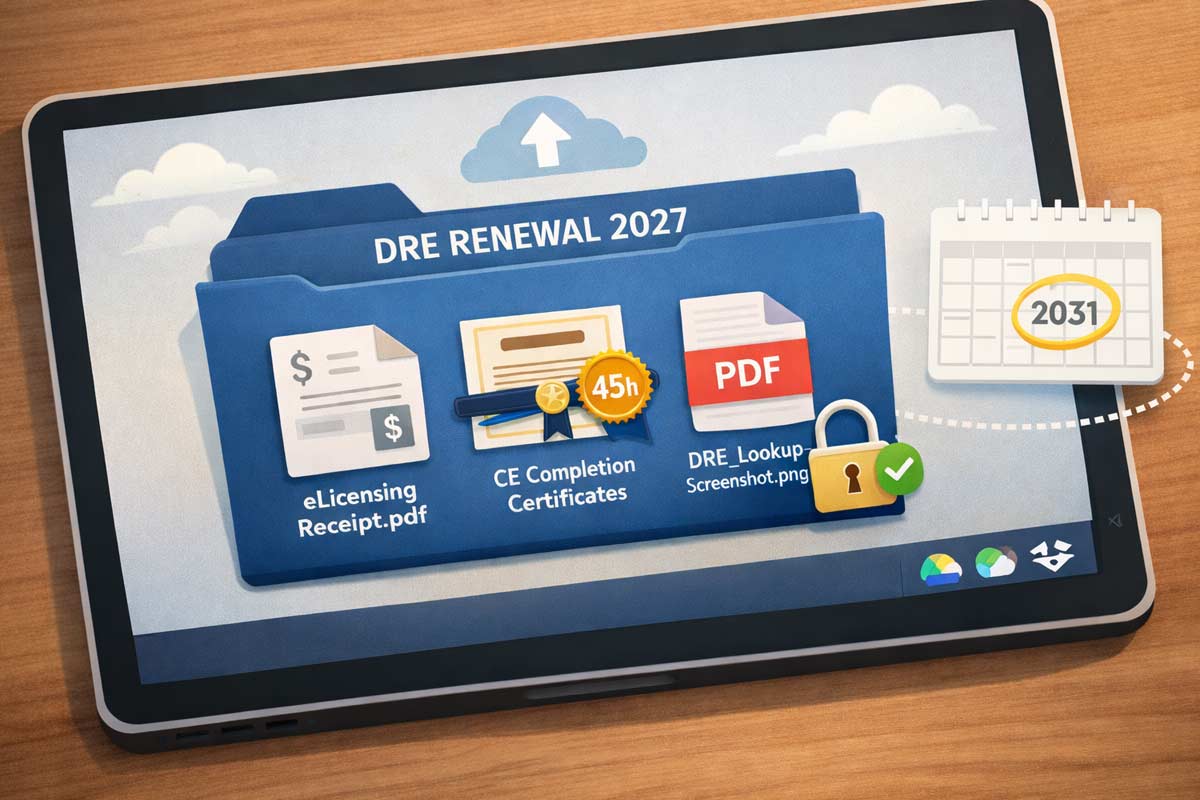
Verify status + new expiration date in the DRE Public License Lookup.
Download/save your eLicensing receipt or transaction summary.
Store all 45-hour CE completion certificates in one “Audit Folder.”
Provide updated proof to your broker/office admin (if your brokerage requires it).
Add renewal reminders to your calendar for the next cycle (set for 3 years, 9 months out).
Quick compliance sweep: Audit your email signature and key marketing touchpoints for DRE # placement (common best practice).
How to Verify Your California Real Estate License Renewal Status
Don’t assume the final confirmation screen means everything is fully complete. Occasionally, payment issues, data-entry mistakes, or processing delays can leave your renewal in a “pending” state longer than expected.
What to check in the DRE Public License Lookup:
Expiration Date: This is the most important indicator. Has it officially advanced to the new four-year cycle?
Status: Does it show "Active" (or the correct current status for your situation)?
Accuracy: Confirm name and license number details look correct.
Real-World Scenario:You renew over the weekend. Monday morning, your office admin says your status hasn’t updated yet. This doesn't necessarily mean something is wrong, but you should monitor the portal until the expiration date officially moves forward.
Step 2: Build Your “Renewal Proof” File (DRE Audit Ready)
The DRE can request CE documentation after renewal. If you can’t produce proof when asked, it can create a serious compliance issue regarding a task you already completed.
CA DRE > Renewals > 2026 Renewal (CE + Receipt)
We recommend keeping these records for at least five years. In practice, you should assume you are the primary record-keeper; the DRE will not "call your school" to reconstruct your file during an inquiry.
Notify Your Broker and Update Compliance Records
Many brokerages maintain internal compliance files and may ask for proof your renewal is complete. This is essential risk reduction. You don't want a lender, title company, or office compliance officer flagging your license status as "Expired" or "Pending" in the middle of an active escrow.
Make sure your license status in internal systems aligns with the public record. For more context on why CE and documentation matter long-term, see How CE Helps Agents Stay Out of DRE Trouble.
Resetting the 4-Year Clock: Planning Your Next Renewal
The best time to plan your next renewal is the day after you complete this one.
Calendar it: Set a reminder for 3 years and 9 months from now so you’re never scrambling at the 11th hour.
Plan smarter: Requirements and options often differ between first vs. subsequent renewals. Don’t guess—use the California Real Estate License Renewal Guide as your reference point for the next cycle.
Step 5: Turn Renewal Into Momentum
Renewal clears mental bandwidth—use it to restart your pipeline with a simple relaunch.
Two-week relaunch sprint:
Database touches: Reach out to 30–50 past clients or warm contacts. Use the "new license cycle" as a subtle reason to confirm your contact info is current in their records.
Marketing sweep: Spend 15 minutes ensuring your DRE license number is present on all "first point of contact" materials, as this is a common compliance expectation.
Red-Flag Mistakes to Avoid
Losing certificates: Assuming "the system has them." You should always maintain your own copies.
Losing the receipt: This is your only proof of payment and submission if a technical error occurs.
Ignoring the date: Not verifying that the expiration date actually moved forward in the public lookup.
Address/Email changes: Forgetting to update your profile in eLicensing if you moved during the renewal period.
Frequently Asked Questions
How long does it take for my renewal to show up in the public lookup?
It often updates quickly, but allow 24–48 hours for processing. If it hasn’t updated within that window, use your receipt as proof of submission and contact the DRE licensing department.
What if I entered a course number incorrectly?
Handle it early. Keep your receipt and contact DRE licensing support to correct the record rather than waiting for an inquiry later.
Do I need to mail certificates to the DRE?
Typically no—renewals are handled through eLicensing—but you must keep digital copies of certificates in case documentation is requested during an audit.
Can I work if my status says “Pending”?
If you are uncertain about what “pending” means for your ability to perform licensed activity, coordinate with your broker or office compliance department immediately.
I lost my certificates—what now?
Contact your CE provider. Reputable schools (like ADHI Schools) usually retain course completion records for a specific period and can reissue proof upon request.
Your Post-Renewal Action Plan (Do This Today)
Verify your status and expiration date in the DRE public lookup.
Archive your receipt and CE certificates into one permanent cloud folder.
Check the California Real Estate License Renewal Guide to ensure you're set for the next cycle.
|

As a real estate professional in California, you’ve likely seen "SB 9 Potential" popping up in MLS remarks. With 20+ years helping California agents and students navigate compliance at ADHI Schools, Read more...
As a real estate professional in California, you’ve likely seen "SB 9 Potential" popping up in MLS remarks. With 20+ years helping California agents and students navigate compliance at ADHI Schools, I have seen how new laws create both massive opportunity and significant professional landmines.
The danger?
Marketing SB 9 as a "guaranteed" four-unit build. If a buyer closes based on your marketing, only to find the city rejects the permit due to local objective standards or utility constraints, you—and your broker—could be in the crosshairs.
Legal Disclaimer:This guide is for informational purposes only and does not constitute legal or land-use advice. SB 9 implementation varies significantly by local jurisdiction. Always advise clients to verify feasibility in writing with the local planning department and qualified land-use counsel.
FAST ANSWER: What is SB 9?
Senate Bill 9 (SB 9) provides a ministerial pathway for homeowners to subdivide a single-family lot (Urban Lot Split) or build up to two primary units on one lot. While it limits local discretionary review, projects must still meet "objective standards" and specific eligibility criteria.
Agent Note: Never guarantee approval; always verify site-specific feasibility in writing with the city.
SB 9 Eligibility: The Quick Screen
Before you spend hours on a property, run these four checks. If any of these "Red Flags" appear, the project may be ineligible under state or local rules.
Zoning: Is it a single-family residential zoning designation (e.g., R-1, RS, etc.)?
Location: Is it in an "Urbanized Area" or "Urban Cluster"? Verify this on the local agency’s SB 9 eligibility map.
Tenancy History: Hard-stop restrictions apply if the property was occupied by a tenant in the last 3 years. Generally, SB 9 cannot be used to alter or demolish tenant-occupied housing. Refer to Rent Control Laws in California (Agent Guide) to evaluate displacement risks.
Ineligible Sites: Sites in very high fire hazard severity zones, floodways, or earthquake fault zones often trigger ineligibility. Treat these as red flags requiring written confirmation from the city. See Environmental Regulations California Agents Should Know for more on these overlays.
What SB 9 Actually Does (Agent Translation)
To advise clients safely, you must distinguish between the two separate pathways provided by the law.
1. Urban Lot Split (Gov. Code § 66411.7)
The "40/60" Rule: Per state statute, the split must result in two lots where the smaller lot is at least 40% of the original lot's size. Both newly created parcels must be at least 1,200 square feet, unless a local ordinance allows smaller.
Owner-Occupancy: State law requires an applicant to sign an affidavit stating they intend to occupy one of the units as a principal residence for at least three years. Exception: This requirement does not apply to "community land trusts" or "qualified nonprofit corporations."
2. Two-Unit Development (Gov. Code § 65852.21)
The "800 Sq. Ft." Rule: Local objective standards generally cannot be applied in a way that would physically preclude the construction of at least two units that are at least 800 square feet each. This is a "backstop" against restrictive local standards, not a guarantee that every lot can accommodate this size.
The Unit Cap: In practice, many jurisdictions treat the total unit count (including ADUs and JADUs) as capped at four across the original lot footprint. If a lot already has an ADU, your client’s SB 9 potential may be limited—verify local implementation.
SB 9 vs. ADU: Why Clients Get Confused
Agents risk misrepresentation claims when they conflate these two very different permit paths.
Primary vs. Accessory: SB 9 units are "primary" dwellings; ADUs are "accessory."
Separate Sale: SB 9 units can potentially be sold separately if a lot split is recorded and ownership is structured appropriately—verify with counsel. ADUs generally cannot be sold separately. (Learn more: California ADU Laws Explained).
Parking: While state law limits parking requirements to 1 space per unit, multiple local waivers apply—verify the city’s specific SB 9 standards.
Setbacks: State law generally allows a local agency to require up to 4-foot side and rear setbacks (Gov. Code § 65852.21), but no setback is required for existing structures rebuilt in the same footprint.
Marketing & Liability: How to Talk About "Potential" Safely
The "Do vs. Don't" Table
Don’t Say (High Risk)
Do Say (Compliance First)
"Approved SB 9 Lot Split"
"May qualify for SB 9; Buyer to verify with city."
"Guaranteed 4-Unit Build"
"Check local unit-count caps for SB 9 + ADU."
"Split Ready / No Restrictions"
"Subject to local objective standards & affidavits."
Pro-Tip: Do not use the words approved, guaranteed, by-right, or split-ready unless you have a written planning confirmation or city-stamped approval in your hand.
Verification Artifacts (The "Agent File" Checklist)
Written email confirmation from the Planning Department regarding the specific APN.
Preliminary Title Report highlighting any private CC&Rs (SB 9 does not automatically override private restrictions).
"Will-Serve" notes from utility providers (water/sewer/power).
A Seller-signed tenant history declaration.
Real-World Scenarios
The Unrecorded Access: A listing marketed "SB 9 split potential." The buyer discovered the "back lot" had no legal frontage and the neighbor refused an easement.
Agent Fix: Check for Water Rights & Easements in California Real Estate and ensure legal access is recorded on title. Document in file: Preliminary Title Report.
The Utility Capacity Halt: An investor bought a lot for a duplex build. The water district denied new meters due to infrastructure limits.
Agent Fix: Always include "will-serve" verification in your buyer's due diligence. Document in file: Water District written response.
The Tenant Surprise: A seller failed to disclose a roommate who paid rent. The city denied the permit because the property wasn't "tenant-free" for the required 3-year lookback.
Agent Fix: Document in file: Signed seller declaration regarding tenancy.
Frequently Asked Questions
Can I list "SB 9 potential" if there are HOAs?
SB 9 does not explicitly override private CC&Rs. Treat HOA/CC&Rs as a major red flag requiring attorney review before you market the project as feasible.
What kills SB 9 feasibility most often?
High-fire hazard zones, unrecorded easements, and the 3-year tenant occupancy rule are the most common "deal killers."
Is owner-occupancy always required?
For an Urban Lot Split, yes—a 3-year affidavit is required (Gov. Code § 66411.7(g)(1)), unless the applicant is a community land trust or qualified nonprofit. For a Two-Unit Development (no split), many cities do not require it.
Your Compliance Playbook
Navigating California land use requires more than just reading a headline. This article is part of our California Real Estate Laws & Compliance Guide, designed to be your professional compliance playbook.
|

Choosing a real estate school in California is the first major "business decision" you will make. It’s also the first time you’ll encounter the noise of the internet in the real estate world. If you Read more...
Choosing a real estate school in California is the first major "business decision" you will make. It’s also the first time you’ll encounter the noise of the internet in the real estate world. If you spend five minutes looking for student reviews of online real estate schools in California, you will find two extremes: glowing 5-star testimonials that sound like marketing copy, and 1-star "rage reviews" from students who felt abandoned by a computer screen.
In over 20 years of helping thousands of Californians through this process, I’ve noticed a consistent pattern: a school’s 'user experience' and its 'educational results' aren't always the same thing.
The truth?
Reviews are a tool, but only if you know how to read between the lines. Here is how to filter the noise and find a school that actually gets you licensed.
Quick Take: The 2026 Review Filter
Look for Outcomes, Not Ease: A "fast and easy" course often leads to a "difficult and repeated" state exam.
Check the Date: California DRE regulations and exam topics shift; reviews older than 12-18 months are less relevant.
Identify the Support Model: "Great support" should mean access to human experts, not just a technical help desk.
The Goal is the License: Prioritize reviews that mention "passing the state exam" over those that only mention "finishing the hours."
What Students Most Commonly Praise (and what it actually indicates)
When you see a 5-star review, you need to determine if the student is praising the convenience or the effectiveness.
“The platform was so simple and fast.”
In 2026, user experience matters, but "simple" can be a double-edged sword. If a platform is too simple, it may be because it lacks the depth required to pass a high-stakes exam. Students often praise a school for letting them click through quickly, but this rarely translates to retention. This is why many online real estate school reviews in California overemphasize convenience while underreporting exam outcomes. How long students should expect real estate school to take depends on the quality of the material, not just the speed of the software.
“Great support whenever I had a question.”
You must define what "support" means in these reviews. Does it mean a live person answered a question about contract law, or does it mean someone helped them reset their password? Real support—the kind that actually gets you licensed—is about how you learn, not just how the website works. Look for reviews that mention instructors who clarify complex topics like encumbrances or agency disclosure.
“The practice questions were just like the exam.”
This is the gold standard of praise. If multiple reviewers mention that the school's preparation tools mirrored the actual California State Exam environment, that is a high-value signal. It suggests the school prioritizes exam readiness over course completion.
While the exact exam questions are never public, a great program prepares you for the logic behind them. This ensures that no matter how a question is framed, you have the knowledge to answer it correctly.
What Students Most Commonly Complain About
Negative reviews are often more revealing than positive ones, but they require a "root cause" analysis.
“No one would help me / I felt like a number.”
The Root Cause: Many online schools are "set it and forget it" models. They provide the PDFs but no bridge to a human being.
How to Verify: Before enrolling, call the school. If you can’t get a human on the phone during business hours now, you won't get one when you’re stuck on Chapter 7 later.
“The materials felt outdated.”
The Root Cause: The California real estate market and laws change. A school using a curriculum from ten years ago is doing you a disservice.
How to Verify: Check if the school mentions 2026 updates or current DRE standards.
Do online real estate classes actually prepare you?
Only if the content reflects the current exam pool.
“I fell behind and lost my motivation.”
The Root Cause: Purely self-paced courses require 100% of the discipline to come from the student. Repeated complaints like this point to a system problem, not a character flaw.
The Reality: This isn't always the school's "fault," but it indicates a lack of an accountability framework. If you see this often, it means the school provides the "what" but not the "how" of staying engaged.
The Review Pattern Test: Your 3-Minute Audit
Don't read every review. Apply this framework to the top 20 reviews you find for any California real estate school.
Rule
What to Look For
The Specificity Rule
Does the reviewer mention a specific chapter, instructor, or "lightbulb moment"? (High Value)
The Recency Rule
Is the review from 2025 or 2026? Tech and DRE rules move fast. (High Value)
The Outcome Rule
Does it say "I passed the state exam"? That is the only metric that matters. (Highest Value)
The Support Signal Rule
Do multiple reviews mention access to instructors or real humans beyond tech support? (Trust Signal)
The 1-Star Filter
Is the reviewer mad about a refund policy they didn't read, or a fundamental lack of teaching? (Context is Key)
Student Checklist for Review Auditing:
Did the reviewer pass on the first or second attempt?
Does the school offer physical textbooks (often a sign of a more serious program)?
Are there mentions of "live" components or webinars?
Does the "clunkiness" mentioned in reviews affect the learning or just the aesthetics?
What Reviews Can’t Tell You (The "Hidden" Factors)
Even the best online real estate school reviews in California have blind spots. There are things you must verify directly with the school:
DRE Compliance: Is the school currently approved for the specific courses you need? Check the DRE website directly.
Repetition Logic: Does the system force you to review what you got wrong, or does it just let you move on?
Your Study Environment: A 5-star school won't help you if you’re studying on a phone in a noisy coffee shop. The optimal study setup for real estate school is as important as the curriculum itself.
Holding Periods: California law requires a minimum of 18 days per course. This is one reason timelines in reviews often conflict with reality. Some reviews complain about "delays" that are actually legal requirements the student didn't understand.
Decision Matrix: Which School Type Fits You?
Based on common student feedback, here is how to choose your path:
The "Busy Professional": Look for reviews mentioning mobile-friendly formats but high-quality physical books for weekend deep-dives.
The "Anxious Test-Taker": Prioritize schools with "heavy" practice question banks and live exam-prep crash courses.
The "Discipline Challenged": Avoid "pure" self-paced schools. Look for reviews that mention how to stay motivated during real estate school through instructor check-ins or structured schedules.
Reviews are Input, Not the Decision
In my experience, the students who succeed are those who treat their education like a job interview. They don't just look for the cheapest or "easiest" option. They look for a partner that provides the structure they lack and the expertise they need.
Reviews tell you about the experiences of others, but they don't guarantee your outcome. Your success depends on your ability to find a school that balances modern convenience with old-fashioned academic rigor.
To see how we categorize the different types of programs available today, view our complete guide on the Best Real Estate Schools in California.
|
Imagine you’re the listing agent for a 1970s fourplex in Los Angeles. The seller tells you the rents are "well below market" and the buyer can easily raise them by 20% to stabilize the asset. You include Read more...
Imagine you’re the listing agent for a 1970s fourplex in Los Angeles. The seller tells you the rents are "well below market" and the buyer can easily raise them by 20% to stabilize the asset. You include this in your MLS marketing.
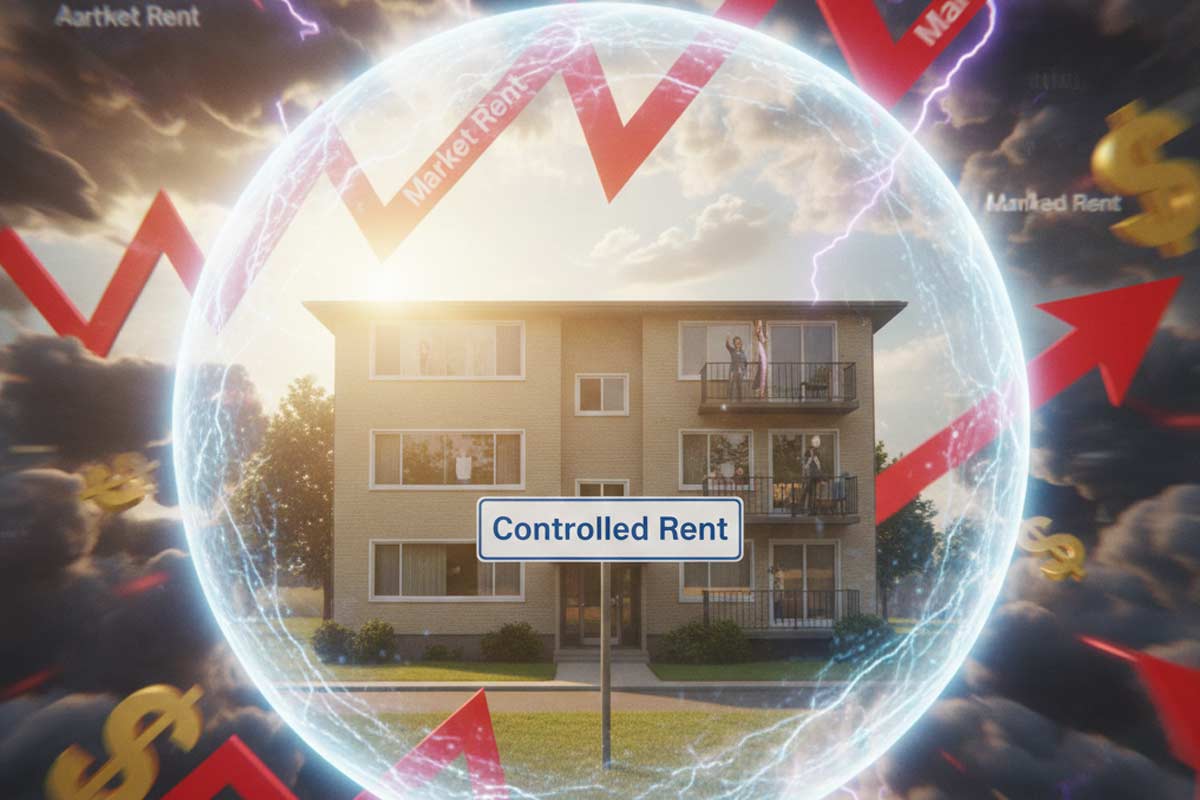
The buyer closes, attempts the increase, and is immediately hit with a wrongful rent increase lawsuit and a city enforcement action. It turns out that because the property is in the City of L.A., it is subject to a local 3% cap for the current cycle (specifically the period through June 30, 2027)—not the statewide 10% maximum.
As an agent, you don’t need to be a lawyer, but you must be a high-level "compliance operator." In California’s 2026 regulatory environment, a single misstatement about "market rent potential" can lead to a professional liability nightmare.
Compliance Disclaimer: This is educational and not legal advice; agents should verify current rules as of the publish date. Local rules are frequently stricter than state law; always consult qualified counsel or local housing departments for jurisdiction-specific guidance.
The Two-Layer System: Statewide vs. Local
To keep your clients safe, use this mental model for every residential transaction:
The State Baseline (AB 1482): This applies to most multi-family housing and corporate-owned rentals statewide.
The Local Card: Cities like Los Angeles, San Francisco, and San Jose have local Rent Stabilization Ordinances (RSOs). If the local rule is more restrictive, the local rule prevails.
Field Scenario: You are showing a property in a city you aren't familiar with. Before discussing rent upside, your first move should be advising the buyer to check the city’s website for a "Rent Stabilization" or "Housing Department" page.
What Agents Must Know About Statewide Rent Caps (AB 1482)
Under the Tenant Protection Act, annual rent increases are capped at 5% plus the local Consumer Price Index (CPI), or 10% total, whichever is lower.
Common Exemptions (Verify for Every Deal)
Properties that are sometimes exempt from the state cap include:
Rolling 15-Year Rule: Residential property issued a certificate of occupancy within the last 15 years (verify the specific date on the CO).
Qualifying SFHs & Condos: Generally exempt only if the owner is not a REIT, a corporation, or an LLC with a corporate member.
Owner-Occupied Duplexes: If the owner occupied one of the units at the start of the tenancy and still lives there.
Agent Pitfall: A single-family home is not automatically exempt. For the exemption to hold, the landlord must have provided the tenant with specific statutory disclosure language in the lease. If that notice is missing, the property may remain "covered" by the rent cap.
“Just Cause” and Tenant Protections in a Sale
The "Just Cause" framework means a landlord cannot terminate a month-to-month lease without a valid legal reason once a tenant has been in place for 12 months.
Vacancy Assumptions: Never promise a buyer the property will be "delivered vacant." If the tenant is protected by "Just Cause," vacancy usually requires a "no-fault" reason like an owner move-in or a substantial remodel.
Relocation Assistance: "No-fault" evictions typically require the landlord to pay the tenant relocation assistance (often equal to one month’s rent, though local laws may require more).
Renovation Requirements: For a "substantial remodel" to be valid, the work must require permits (which must be provided with the notice) and must render the unit unsafe for occupancy for at least 30 consecutive days.
The Agent’s Rent-Control Workflow
Use this checklist during your due diligence period. This is the same logic we outline in our California Real Estate Laws & Compliance Guide.
Rent Control Compliance Checklist
Verify Age: Check the original Certificate of Occupancy date (do not rely solely on assessor data).
Audit Ownership: Confirm if the owner is a person, a trust, or a corporation.
Confirm Local Rules: Check the city/county for local RSO or unincorporated area protections.
Lease Review: Scan (also advise the buyer to) the current lease for AB 1482 "Notice of Exemption" or "Notice of Coverage" language.
Verify Rent History: Request the last 24 months of rent ledgers to ensure previous increases were lawful.
Confirm CPI Basis: Use the 2026 CPI figures for that specific metropolitan area (typically based on April data for increases after August 1).
Marketing Audit: Remove any "guaranteed" income or "easy eviction" claims from the MLS.
Advertising & Pricing Claims: What Not to Say
Risky Statement
Safer Alternative
“Can raise rent to market immediately.”
“Buyer to verify rent control applicability and allowable increases.”
“Guaranteed vacancy at close.”
“Subject to tenant rights; buyer to verify vacancy procedures with qualified professionals.”
“Property is exempt from rent control.”
“Owner-reported exemption to be verified by buyer during due diligence.”
Common Deal Killers (And How to Prevent Them)
Underwriting Mismatch: Lenders often use conservative rent growth assumptions if they see the property is subject to an RSO.
SB 9 & ADU Complications: Adding a unit can sometimes trigger different regulatory layers. See California ADU Laws Explained and SB 9 Explained for Real Estate Agents.
Missing Environmental Disclosures: Rent control isn't the only risk. See Environmental Regulations California Agents Should Know.
Water Rights Issues: Especially in rural properties, see Water Rights & Easements in California Real Estate.
FAQ
How do I know if a city has stricter rent control?
Search the city name + "Rent Stabilization Ordinance." If the city has its own cap (like the L.A. 3% limit), that number overrides the state floor.
Can rent be increased after a property sells?
A change in ownership does not reset the rent cap. The new owner is bound by the same annual limits as the previous owner for any existing tenants.
What is "Vacancy Decontrol"?
This is the concept that once a tenant moves out voluntarily, a landlord can usually reset the rent to market rate. However, once the new tenant moves in, the cap usually applies again.
Do local ordinances apply in unincorporated county areas?
Yes. For example, L.A. County has a dedicated Rent Stabilization and Tenant Protections Ordinance that covers unincorporated areas.
What documents should I request during due diligence?
Always request the original lease, all addendums, the Certificate of Occupancy, and a certified rent roll for the last 2 years.
Does AB 1482 apply to duplexes or triplexes?
Yes, unless they meet specific exemptions such as the "owner-occupied duplex" rule where the owner lived there before the tenancy began.
|
One of the most common questions we hear sounds like: “I upgraded to a broker license—do I have extra CE hours now?” or “Do I have to take different classes than when I had my sales license?”
The Read more...
One of the most common questions we hear sounds like: “I upgraded to a broker license—do I have extra CE hours now?” or “Do I have to take different classes than when I had my sales license?”
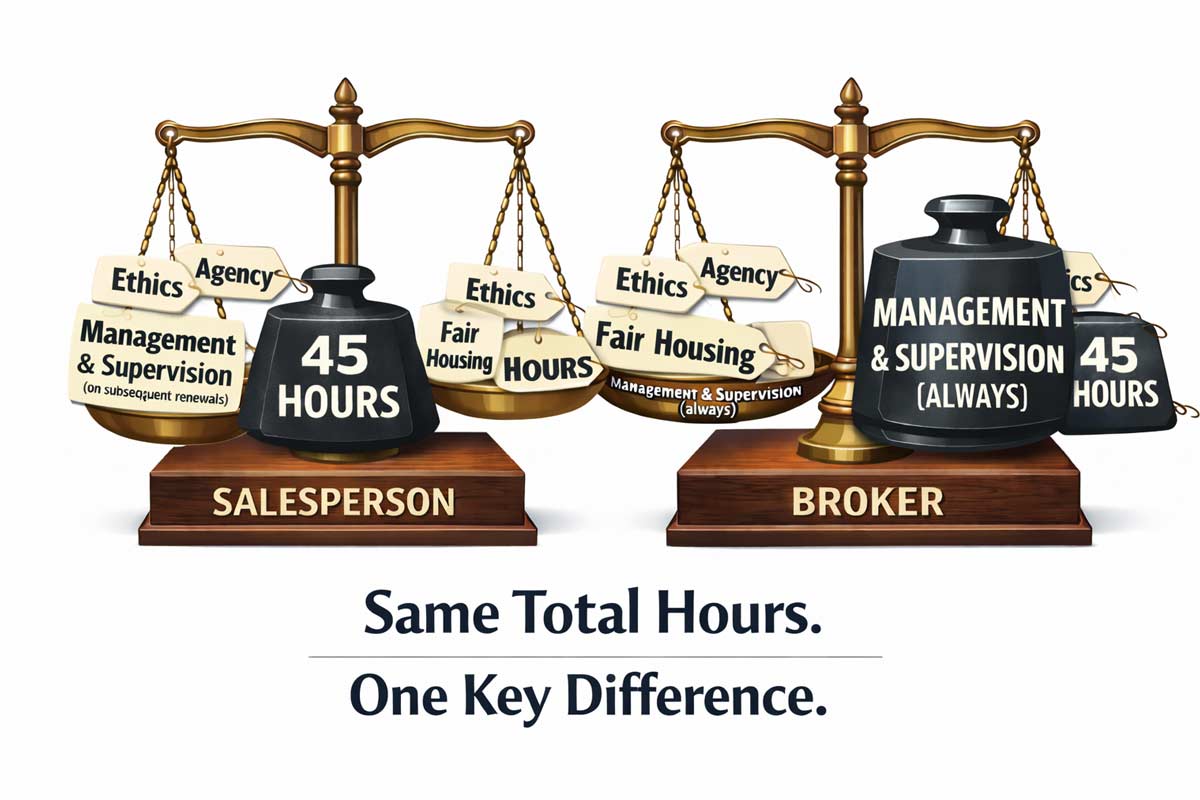
The confusion is understandable. In California, brokers carry a higher level of legal responsibility—so it feels like the DRE should require more education. The reality is simpler: the total hours are the same, but the required subject mix is where brokers can get tripped up.
Key Takeaways
Total Hours: Brokers and salespersons both complete 45 hours of DRE-approved CE each 4-year renewal cycle.
The Content Mix: Brokers must include Management and Supervision as a mandatory topic (salespersons don’t on their first renewal).
The 9-Hour Survey: For second and subsequent renewals (for licenses expiring on/after Jan 1, 2023), a 9-hour survey can cover all mandatory topics in one course.
Interactive Requirement: For licenses expiring on/after Jan 1, 2023, Fair Housing must include an interactive, participatory component.
Quick Answer: Broker vs. Salesperson CE
In California, brokers and salespersons both need 45 hours of continuing education to renew. The difference is what’s inside the 45 hours: brokers must ensure they complete Management and Supervision as part of their mandatory topic mix. While the total hour count is identical, the DRE requires brokers to undergo specific training related to their role as a potential supervisor.
Comparison Table: Salesperson vs. Broker Renewal
Feature
Salesperson (First Renewal)
Broker (First Renewal)
Second+ Renewals (Both)*
Total Hours
45 hours
45 hours
45 hours
Mandatory Core Courses
4 Subjects (3-hrs each)
5 Subjects (3-hrs each)
Included in 9-hour survey
Fair Housing
3-hr + Interactive Implicit Bias
3-hr + Interactive Implicit Bias
Included in 9-hour survey
Implicit Bias
2-hr Required
2-hr Required
Included in 9-hour survey
Mgmt. & Supervision
Not Required
Required
Included in 9-hour survey
*Applies to licenses expiring on/after Jan 1, 2023, and late renewals filed after that date.
What’s the Same for Everyone?
Regardless of license type, the DRE’s CE structure is built around consumer protection—so the baseline framework stays consistent. That’s why the California Real Estate License Renewal Requirements don’t "punish" brokers with extra hours.
The 4-year renewal cycle applies to everyone.
The total is always 45 hours—no "broker bonus hours."
Mandatory topics + consumer protection hours are the backbone of every renewal package.
What’s Different for Brokers?
If the hours are the same, why does broker CE feel different? Accountability.
A broker isn’t just responsible for their own files—they’re responsible for the supervision standard in the office: policies, advertising compliance, trust fund handling, and risk reduction. That’s why Management and Supervision is explicitly part of the broker requirement - even on the first renewal.
Operator Scenarios: Where Brokers Actually Get Exposed
The Supervision Trap: A broker assumes "supervision" just means reviewing contracts. In reality, brokers can be on the hook for agent advertising and compliance breakdowns across the entire team.
Trust Fund Risk: Most salespersons never touch trust fund handling—brokers live inside it. Small process errors can turn into big consequences during a DRE audit.
First Renewal vs. Subsequent Renewals
This is where people accidentally choose the wrong package. Your path depends on your renewal "generation."
1) First Renewal
First renewal requires the mandatory subjects as individual courses, plus the required Fair Housing and Implicit Bias components.
Salespersons: 4 separate 3-hour courses (Ethics, Agency, Trust Funds, Risk Management) + 3-hour interactive Fair Housing + 2-hour Implicit Bias.
Brokers: All of the above PLUS a 3-hour Management and Supervision course.
To avoid confusion, view the full roadmap here: California Real Estate License Renewal Guide
2) Second and Future Renewals
For licenses expiring on/after Jan 1, 2023, the DRE allows a 9-hour survey course that covers all mandatory topics (including Management and Supervision) in a single module. You then complete the remaining hours with electives—ideally from clearly qualified Courses That Count Toward CE in California.
7 Common Mistakes That Trigger Delays
REALTOR® Ethics vs. DRE Ethics: Assuming NAR training counts (it usually doesn’t unless the provider specifically issued a DRE-approved CE certificate).
Non-Interactive Fair Housing: Taking an old-style text course for Fair Housing when your license expires after Jan 1, 2023.
Missing Implicit Bias: Failing to ensure the 2-hour standalone course is in your package. See: Does California Require Implicit Bias Training for Renewal?
Overbuying Hours: Thinking brokers need more than 45. Confirm your California CE hour requirements before paying.
Unverified Providers: Using a "national" school that lacks a California DRE Sponsor Number.
Waiting Until the Final 24 Hours: Because of the 15-hour exam limit (see below), you literally cannot finish 45 hours in one day.
Wrong Package Type: A broker taking a salesperson package and missing the Management and Supervision credit.
Step-by-Step: Choosing the Right CE Package
Verify Sponsor Details: Ensure the school is DRE-approved.
Check Fair Housing: Confirm it includes the "interactive participatory component."
Respect the 24-Hour Rule: The DRE limits licensees to completing final examinations for a maximum of 15 credit hours per 24-hour period. If you have 45 hours of testing to do, you need at least three separate 24-hour windows to complete your exams.
FAQ
Do brokers need more CE hours than salespersons in California?
No. Both license types require 45 hours every four years.
Is Management and Supervision required for brokers?
Yes. It is mandatory for all broker renewals (first and subsequent).
What is the 9-hour survey course?
It's a condensed course covering all seven mandatory subjects, available only for second and subsequent renewals.
Does Fair Housing have to be interactive?
For licenses expiring on or after Jan 1, 2023, yes. This includes late renewals filed after that date.
How early can I renew?
You can submit your renewal via eLicensing up to 90 days before your expiration date.
Broker renewal shouldn’t create uncertainty or cause you to buy the wrong package. The goal is simple: meet the DRE requirements cleanly, protect your license, and keep your business.
|

You’ve passed the real estate exam, your license is hanging at a brokerage, and the initial celebration has subsided. Now, you’re staring at a blank calendar and a quiet phone. It’s what I call the Read more...
You’ve passed the real estate exam, your license is hanging at a brokerage, and the initial celebration has subsided. Now, you’re staring at a blank calendar and a quiet phone. It’s what I call the “post-license cliff”. This moment is particularly acute in California, where high competition meets complex markets, and the pressure to “figure it out fast” can lead new agents toward expensive, ineffective shortcuts.
If you’re a new real estate agent in California wondering how to get your first clients without buying leads, this article is your playbook. Securing your first three clients isn't just about income—it’s about proof of concept. In my 20+ years of working in the California real estate market, I’ve noticed the agents who survive the first year are those who replace "hustle" with systems and processes.
What Success Looks Like in 30 Days
Before we dive in, let’s define a "win." Success in your first month isn't measured by closed escrows—it’s measured by inputs. These inputs work because they maximize trust-building touches, not impressions. If you follow this operating system, your 30-day scoreboard should look like this:
100+ Real Conversations (5 per business day)
40+ Contacts added to your database
4 Open Houses hosted
1–2 Buyer Consultations booked
Practice Over Profit: The First 3 Principle
This is the phase where most new real estate agents in California either build momentum—or quietly stall. Your first three clients are your learning labs. You are building the muscle memory of a professional. Success here comes from
Practice + Proximity + Follow-up
not expensive marketing.
Before You Prospect: Two Things You Must Set Up This Week
Before you pick up the phone, you need a professional foundation. California’s disclosure-heavy environment means your first clients are as much about the learning process as closing deals.
Broker Expectations: Sit down with your broker or team lead. Ask for (a) upcoming open house opportunities, (b) "floor time" for walk-ins (if this is still a thing in your area), and (c) their preferred CRM.
Compliance Guardrails: This is California—disclosures matter. Don’t wing it. Don't promise specific financial outcomes, keep all communications professional, and stay within your brokerage’s legal policies.
Pathway 1: The "Inner Circle" Strategy (The Database)
The Reality: Your first client is almost always someone you already know, or someone they know. People do business with people they trust.
The Action Plan: Stop "announcing" your career and start consulting. Use these micro-scripts to offer value:
The Call: "I’ve officially launched my real estate practice. I’m not calling for business—I just want to be your resource. If you ever need a quick valuation or want to know what’s moving in the neighborhood, I'm here."
The Text: "Hey! Just wrapped up my licensing. If you ever have a random real estate question or need a vendor recommendation, feel free to reach out!"
Micro-Credibility Boost:
Avoid: “I just got licensed and I’m looking for clients.”
Use: “I’m building my practice and want you to have a real resource.”
The 14-Day Follow-Up Cadence:
Day 0: Initial outreach (Call/Text).
Day 7: Value Touch (Send a quick, one-page market snapshot of their specific zip code).
Day 14: The Soft Ask: "I’m helping a few people find homes this month. Do you know anyone else thinking about a move this year?"
The Deeper Resource:
A "system" is simply: Name + Source + Last Contact + Next Action. In week one, a spreadsheet is fine. To move toward a sustainable pipeline, you need to build a real estate database from scratch.
Pathway 2: The Open House Capture & Conversion
The Reality: Open houses are one of the few places consumers actually expect to talk to an agent. It is a high leverage use of your time.
The Action Plan (The 3-Step Flow):
The Welcome: "Welcome! Are you from the neighborhood or just starting your search?"
The Qualification: "Have you seen anything else in this price point, or are you still getting a feel for the local inventory?"
The Close for the Next Step: "I have a list of three similar homes nearby that aren't on everyone's radar yet. Would you like me to send those over?"
A productive open house for a new agent isn’t measured by attendance—it’s measured by 2–3 follow-up conversations scheduled within 48 hours.
The Deeper Resource:
To turn a handshake into a contract, you need a specific follow-up method. Learn the full process in our guide: How New Agents Should Hold Open Houses in California.
Pathway 3: Leverage Office Inventory & Stale Leads
The Reality: While most agents chase "perfect" leads, you can find your first three clients by looking where others don't.
High-volume agents often ignore these opportunities because they require follow-up instead of marketing scale.
The Action Plan:
Support High-Volume Listings: Call top listing agents in your office. Offer to host their "stale" listings or prospect the surrounding neighborhood for them.
Renters-to-Buyers: Many people attending open houses are currently renting. Position yourself as the guide who helps them transition.
The Guardrails: Always follow "Do Not Call" rules and brokerage policy. Your job is service, not pressure. Once you've mastered these manual methods, you can explore broader lead sources for new California agents to scale.
The Two Moments That Start Real Careers
Moment #1: Someone trusts you enough to ask a "small" question (e.g., "What's my neighbor's house listed for?").
Moment #2: You followed up when the "rockstar" agent in your office forgot to.
Neither moment looks dramatic—but both are how real careers actually start.
Practical Pitfalls
Most new agents quit because they confuse activity with income-producing actions. This is how agents stay ‘busy’ for six months and exit the industry silently.
The below activities do NOT count as prospecting:
Perfecting your logo or business cards.
Scrolling Instagram for "content ideas."
Endlessly "tinkering" with CRM tags.
Watching "motivational" YouTube videos.
Re-designing your email signature.
The only 3 activities that count:
Real conversations
Intentional follow-up
Studying local inventory.
Managing this focus is the difference between a hobby and a career. Implement these New Agent Time Management Strategies to stay on track.
Your 30-Day Plan (Simple Version)
Week
Primary Focus
Daily Minimum
Week 1
Database Outreach + 1 Open House
5 Conversations
Week 2
Follow-ups + 1 Open House
5 Conversations
Week 3
Repeat + Book 1 Buyer Consult
5 Conversations
Week 4
Tighten Pipeline + Ask for Referrals
5 Conversations
Note: Five conversations means real two-way dialogue—not texts sent or DMs unanswered.
The Path Forward
Finding your first three clients is the hardest part of this business because it requires the most faith. But once you close that third deal, the "imposter syndrome" fades.
Mastering these first three clients is how you build a durable practice, not just a fleeting side hustle. For the complete framework on launching correctly—from mindset to long-term planning—your next step is our foundational guide: Start Your Real Estate Career in California.
|

For a brand-new California real estate agent, the first few months can feel like a race against an empty pipeline. You have a real estate license and ambition, but you don't yet have the clients.
This Read more...
For a brand-new California real estate agent, the first few months can feel like a race against an empty pipeline. You have a real estate license and ambition, but you don't yet have the clients.
This is why the open house remains an undisputed "fast track" to success. It provides the high-volume conversation reps you need and the immediate lead capture required to build a business from zero.
Who This Article Is For:
New Licensees: (0–12 months) looking for a repeatable system.
The Systems-Minded: Agents who want to move from "hosting" to "converting."
In California, an open house is more than a public showing—it’s a high-intent prospecting event. When run correctly, it becomes one of the best repeatable lead sources available to a new agent (especially when paired with other proven lead sources for new California agents).
Fair warning - if you don’t capture usable contact info from guests, you can’t follow up—and the open house becomes a branding event instead of a pipeline event. To win, you need to transition from "showing a house" to "running an operating system."
The Open House Kit (What to Bring)
Your goal is to look calm and prepared—because prospects pair “prepared” with “competent.” Pack this like a pilot packs a flight bag:
Signage: 10–15 directionals + 1 main “Open House” sign.
Lead Capture: QR placard + tablet sign-in + paper backup.
Property Materials: Feature sheets + disclosure packet access + MLS remarks.
Script Support: 1 small note card with your greeting + 3 discovery questions.
Ops Essentials: Pens, tape, small stapler, portable charger, water.
Safety Basics: Fully charged phone, keep keys on you, clear exit path.
California Note: Sign placement rules and HOA sensitivity vary by city—always confirm your brokerage standards and be respectful about placement to avoid fines.
The 90-Minute Open House Timeline (New Agent Checklist)
Follow this timestamped sequence to ensure you never look "scrambled":
45 minutes prior: Arrive at the property. Open all blinds, turn on every light, and do a quick "sanity sweep."
35 minutes prior: Signs placed + QR code placard at the entry.
25 minutes prior: Set up your "command center" (usually the kitchen island) with sign-in sheets and flyers.
15 minutes prior: Walk the "tour path" one last time. Rehearse your greeting.
Start: Greet guests warmly, but let them tour at their own pace.
During: Ask 2–3 discovery questions max. Jot down notes in between visitors.
End: Final lap, lock up, and retrieve signs.
30 minutes after: Enter all new leads into your CRM and tag them with specific notes.
Same Day: Send the first follow-up text to every "hot" prospect.
The Conversation System: Scripts That Convert
The biggest mistake new agents make is being too aggressive or too passive. Use these "Operator" scripts to gather data without the "salesy" vibe.
The Neighbor Line (The Listing Goldmine):
"Are you here because you’re curious about the value of your own place, or do you know someone thinking of moving into the neighborhood?"
The "We Already Have an Agent" Pivot:
"Perfect—then you’re in good hands. Are you already touring homes this weekend, or still narrowing neighborhoods?"
If Someone Refuses to Sign In:
"Totally fine—please take a look around. If you decide you want a feature sheet, or updates on similar homes in this school district, the QR code on the table makes it easy for me to send those over."
The Follow-Up Operating System
Every open house is a database-building event—log your leads the same day to avoid "lead decay."
To make this automatic, block time for it. The easiest way is to treat every open house like a scheduled workflow: 30 minutes after lock-up for CRM entry and 20 minutes that evening for follow-ups.
If you don’t protect that time, the week fills up and your leads decay—this is exactly why new agent time management strategies matter early in your career.
Email Template (Day 1)
Subject: Oak Street open house — quick follow-up
Body:
“Hi [Name] — great meeting you today at the Oak Street open house. Based on what you mentioned regarding your [Timeline] and [Specific Feature], I pulled 3 similar options currently on the market: [Links].
If you want, reply with your 'must-haves' and I’ll tailor a search for you. — [Your Name]”
California Compliance & Professionalism
As I have observed over 20+ years of training agents, professionalism in California is defined by how you handle the "gray areas."
Do
Don’t
Ask about timeline, financing readiness, and search criteria.
Ask about family status, religion, or national origin.
Offer disclosures and encourage professional inspections.
Speculate on protected-class suitability or schools.
Maintain a clear exit path and stay between guests and the door.
Follow people into small rooms or turn your back to a crowd.
Building Your System
Open houses work best when they’re part of a weekly prospecting cadence—so you’re not relying on luck, you’re running a pipeline. By using this system, you ensure that every weekend moves you closer to finding your first 3 clients as a new agent.
If you're ready to move beyond the "hosting" phase and start operating like a pro, it's time to Start a Real Estate Career in California with the right education and strategy.
FAQ: Open Houses for New Agents in California
Do I need to make everyone sign in at an open house?
No—but you do need a professional way to capture contact info if you want follow-up to be possible. Use a QR placard + soft language: “If you’d like a feature sheet, or updates on similar homes, the QR makes it easy for me to send them.” Some brokerages prefer a hard sign-in policy, others don’t—confirm your office standard.
What if the open house is dead and nobody shows up?
A slow open house still has value if you treat it like a pipeline block, not a social event. Use the time to:
Tighten your tour path + talking points,
Practice your script out loud,
Message neighbors and past visitors,
and review your follow-up workflow so you execute it automatically next time.
If your traffic is consistently low, pair open houses with other lead sources for new California agents so your week doesn’t depend on Saturday luck.
How many open house signs should a new agent use?
A good baseline is 10–15 directionals plus one main sign, placed at key turns that funnel traffic to the home. Keep them clean, consistent, and easy to read. Placement rules and HOA sensitivity vary by city—use good judgment and follow your brokerage policy.
What should I say when someone asks, “Is the seller desperate?”
Stay professional and stay factual. A clean response is: “I can’t speculate on motivation, but I can share what’s publicly available—price history, disclosures, and recent comparable sales.”
How do I follow up after an open house without sounding salesy?
Follow-up feels “salesy” when it’s vague. Make it helpful and specific:
“Here are 3 similar homes based on what you said.”
“Want disclosures/inspection reports sent over?”
“Do you want alerts for homes with [feature] in [area]?”
Then keep your cadence consistent—this is why new agent time management strategies matter early.
How soon should I follow up after an open house?
Same day is ideal—while the conversation is fresh. A simple standard:
Same day: quick text if opted-in
Day 2: “one helpful thing” (disclosures, comps, lender intro)
Day 7: soft next step
Log everyone into your CRM the same day so the open house becomes a true database-building event.
Should I sit or stand during an open house?
Stand if possible. Sitting signals “hosting.” Standing signals “present and available.” You don’t need to hover—just stay positioned so you can greet people without blocking the entry and maintain a clear safety posture.
How do I get clients from open houses if I’m not the listing agent?
By treating the home as the stage and the visitors as the opportunity. Your job is to:
Greet + create comfort,
Ask 2–3 discovery questions,
Capture contact info via value (disclosures, feature sheet, comps),
Follow up the same day.
|