Older homes whisper stories of the past, offering a unique sense of history and character that many find irresistible. The charm of original hardwood floors, intricate crown moldings, built-in cabinetry, Read more...
Older homes whisper stories of the past, offering a unique sense of history and character that many find irresistible. The charm of original hardwood floors, intricate crown moldings, built-in cabinetry, and stained glass windows are just a few examples of the architectural details that contribute to this character. However, the reality of owning an older home can present unexpected challenges. While those creaky floorboards might add to the charm, they could also signal underlying structural issues.
While there is no substitute for a physical inspection by a competent professional, I wanted to write an article on how to navigate some of the complexities of buying an older home to ensure your dream home becomes something other than a money pit. Because lots of our real estate school students dream of selling unique and historic homes it's important to keep in mind that it’s not just about the charm, it's also about being cautious and prepared.
Structural Integrity
Foundations: A solid foundation is crucial. Look for telltale signs like cracks, shifting, or evidence of water damage. Uneven floors, doors that stick, and cracks in the walls, particularly above windows and doors, can all point to foundation problems.
Cracks: Imagine the foundation as the base of a LEGO structure. If that base cracks or shifts, the LEGO bricks above will no longer fit together neatly. Cracks in walls, especially diagonal ones spreading from corners of windows or doors, show that the house's frame is being pulled out of shape by movement in the foundation below.
Uneven Floors: A sinking or uneven foundation can cause the floor joists above to sag or become misaligned. This leads to sloping or bouncy floors. Think of it like a table with uneven legs – it wobbles.
Sticking Doors: When a foundation shifts, it can distort the door frames. This makes doors difficult to open or close because they no longer fit squarely within the frame. It's like trying to fit a puzzle piece into the wrong spot.
Checklist:
Are the floors level?
Do doors and windows open and close smoothly?
Are there any visible cracks in the foundation walls?
Is there any evidence of water damage in the basement or crawlspace?
Roof: The roof is your first defense against the elements.
Checklist:
What is the age of the roof? (And what is the typical lifespan for that roofing material? - e.g., asphalt shingles typically last 20-30 years)
Are there any missing, damaged, or curled shingles?
Are there any signs of sagging or unevenness in the roofline?
Are there any signs of moss or algae growth? (This can indicate moisture problems.)
Are the gutters and downspouts in good condition? (Proper drainage is essential.)
Is there any evidence of water damage in the attic? (Look for stains, mold, or rot.)
Walls and Ceilings: Inspect walls and ceilings for cracks, water stains, or bowing. These imperfections could indicate structural issues, water damage, or poor maintenance.
Plumbing and Electrical Systems
Common Plumbing Problems in Older Homes
Plumbing: Older homes may have outdated plumbing systems, such as galvanized pipes, and be prone to corrosion and leaks. Inquire about the age of the plumbing and look for signs of leaks, low water pressure, or discolored water.
Checklist:
What type of plumbing pipes are used in the home?
What is the age of the plumbing system?
Are there any visible leaks or signs of water damage?
Is the water pressure adequate in all fixtures?
Electrical Safety Concerns
Electrical: An outdated electrical panel can be a safety hazard. Evaluate the panel for its capacity and age. Look for obsolete wiring (like knob-and-tube wiring), insufficient outlets, and any signs of electrical problems, such as flickering lights or frequent circuit breaker trips.
Knob and tube wiring is an old type of electrical wiring that was commonly used in homes from the late 1800s to the early 1900s. You can recognize it by its white ceramic knobs and tubes, which help hold and protect the wires.
The knobs are used to keep the wires attached to the wooden beams in the house, while the tubes are used when the wires need to pass through those beams. The system doesn't have a ground wire, which is used in modern wiring to help protect against electrical shocks and fires.
Because it's so old, knob and tube wiring doesn't meet today's safety standards and can't handle the amount of electricity we use now with all of our gadgets and appliances. That's why it's usually replaced if found in homes today, to make sure everything is safe and works well with modern electricity needs.
Checklist:
What is the age of the electrical panel?
What is the amperage of the electrical service?
Are there any signs of outdated wiring?
Are there enough outlets and circuits to meet your needs?
Hazardous Materials
Asbestos: Asbestos was commonly used in insulation, flooring, and siding in older homes. If you suspect asbestos-containing materials, hire a qualified professional for testing and abatement. Recent regulations have focused on safer removal methods to minimize health risks.
Lead Paint: Homes built before 1978 may contain lead-based Paint, which can be hazardous, especially for children. Lead paint testing and proper reduction are crucial. Modern encapsulation methods offer compelling alternatives to complete removal in some cases.
Heating, Ventilation, and Air Conditioning (HVAC)
System Age: HVAC systems have a limited lifespan, typically 15-20 years. Determine the age of the system and consider its remaining years of service. Older systems are less efficient and more prone to breakdowns.
Efficiency: Pay attention to signs of inefficient operation, such as uneven heating or cooling, drafts, and high energy bills. Consider upgrading to a modern, high-efficiency system to save money and reduce environmental impact. Look for systems with high SEER (Seasonal Energy Efficiency Ratio) and AFUE (Annual Fuel Utilization Efficiency) ratings.
Insulation and Energy Efficiency
Insulation Quality:
Inspect the attic, walls, and basement for adequate insulation.
Look for sufficient insulation depth (e.g., at least 12 inches in the attic) and check for any signs of moisture or pests.
Consider the type of insulation (e.g., fiberglass batts, blown-in cellulose) and its R-value, which indicates its thermal resistance. The higher the R-value, the more effective the insulation.
Poor insulation leads to higher energy bills and uncomfortable living conditions.
Windows and Doors: Check for drafts around windows and doors. Single-pane windows are notorious for heat loss. Consider upgrading to energy-efficient windows and doors to improve comfort and reduce energy consumption.
Potential for Renovations and Upgrades
Local Regulations: Research local zoning laws and building codes, especially if the home has historical status, as renovations might be restricted or require special permits.
Costs vs. Value: Get estimates for any necessary renovations and upgrades. Consider the potential return on investment and whether the improvements will significantly increase the home's value.
Financing Renovations: Explore financing options for renovations, such as home equity loans, personal loans, or government programs that offer incentives for energy-efficient upgrades.
Checking for Pest Infestations
Common Pests: Be vigilant for signs of termites (mud tubes, wood damage), rodents (droppings, gnaw marks), and other pests like carpenter ants (sawdust-like frass).
Signs of Infestation: Check for evidence of past pest control treatments. A history of infestations could indicate ongoing problems.
Water Damage and Mold
Signs of Damage: Look for water stains on ceilings, walls, and floors. Mold growth and musty odors are also red flags.
Sources of Water Damage: Inspect the roof, gutters, and drainage systems. Inquire about any history of flooding or leaks.
Legal and Insurance Issues
Property History: Research the property's history for past insurance claims, disclosures by the seller, and any known issues.
Insurance: Ensure that you can obtain homeowners insurance for the property. Older homes may present challenges or higher premiums due to age and potential risks.
Hiring a Professional Inspector
When hiring a home inspector, it's important to ask the right questions to ensure a thorough inspection. Here are some key questions to consider:
What is your experience with older homes?
What specific areas will you be inspecting?
Can you provide references from previous clients?
How long will the inspection take?
When will I receive the inspection report?
Choosing an Inspector: Select a qualified and experienced home inspector. Ask about their credentials, what they look for, and whether they have experience with older homes.
Understanding the Inspection Report: Carefully review the inspection report. Pay close attention to any significant issues and ask the inspector to explain any findings you need help understanding.
California specific pro-tip: In California, there is no state licensing requirement for home inspectors. This means that home inspectors in California are not regulated by any state agency, unlike in other states where inspectors must be licensed. As a result, the burden often falls on the consumer to ensure they are hiring a qualified and experienced inspector. It’s recommended to look for inspectors who are certified by reputable organizations, such as the American Society of Home Inspectors (ASHI) or the International Association of Certified Home Inspectors (InterNACHI), as these certifications typically require passing an exam, completing a certain number of inspections, and adhering to a strict code of ethics and standards of practice.
Common Problems by Era
Victorian Homes (pre-1900) are often characterized by knob-and-tube wiring, asbestos insulation, and foundation issues due to their age.
Mid-Century Homes (1950s-1960s): These homes may feature outdated plumbing, such as galvanized pipes, and are known for using aluminum wiring, which can pose a safety hazard.
Buying an older home can be a rewarding experience, but it's essential to approach the process with realistic expectations and a keen eye for potential problems. By conducting thorough inspections, consulting professionals, and addressing any issues proactively, you can minimize risks and enjoy the unique charm and character of your older home for years to come.
Love,
Kartik
|
Even though the concept of a real estate license might seem straightforward, many might not appreciate its comprehensive role in a real estate professional's career. From ensuring legal compliance Read more...
Even though the concept of a real estate license might seem straightforward, many might not appreciate its comprehensive role in a real estate professional's career. From ensuring legal compliance to fostering market integrity, this license is the cornerstone of professional real estate practice. It's not just a legal requirement, but a fundamental pillar of the real estate industry. In this article, I wanted to delve into the true essence of a real estate license, its necessity, and the benefits it brings to both professionals and their clients.
Types of Real Estate Licenses
For those venturing into the real estate industry, the choice often boils down to two primary licenses:
Real Estate Salesperson: Allows you to conduct transactions under the supervision of a licensed broker.
Real Estate Broker: This position empowers you to operate independently, manage a team of salespersons, and potentially own your own brokerage. It's a testament to your expertise and a stepping stone to a successful career in real estate. Keep in mind that requirements vary by state. For example, one state may require 60 hours of pre-licensing education, while another may require over 250. Always research the regulations specific to your area. This empowerment is a testament to your expertise and a stepping stone to a successful career in real estate.
Why Are Licenses Important?
Real estate licenses serve several critical purposes:
Consumer Protection: Licensing ensures that practitioners meet minimum standards, safeguarding clients from unethical or unprofessional practices.
Professional Standards: Education and making candidates pass real estate exams help ensure that agents and brokers possess a solid grasp of real estate law, ethics, financing, property management basics, and market principles.
Market Trust: A licensed professional builds trust and credibility, drawing in clients who prioritize expertise and ethical standards. Your license represents more than a mere credential; it is a mark of reliability within the real estate community.
How to Obtain a Real Estate License
While the exact process varies by state, you’ll typically follow these steps:
Consumer Protection: Licensing ensures that practitioners meet minimum standards, safeguarding clients from unethical or unprofessional practices.
Meet Prerequisites: You must usually pass any required background checks.
Complete Pre-Licensing Education: Enroll in a state-approved real estate program covering real estate principles, laws, ethics, finance, and property valuation.
Pass the State Exam: After completing your education, you’ll take a state-administered exam. This test covers property law, financing, contracts, land use, and ethical practices. Success here ensures you have a foundational understanding of the industry’s core concepts.
Maintaining and Renewing Your License
Earning your license is just the start. To keep it active and in good standing, you’ll need to:
Fulfill Continuing Education Requirements: Stay up-to-date with evolving laws, market trends, and industry best practices by completing regular coursework.
Renew Your License Periodically: States usually require real estate license renewal every two to four years. Ensure you meet all renewal criteria, pay applicable fees, and submit the documentation on time.
Uphold Ethical and Legal Standards: Always comply with state regulations and industry ethics. Operating with an expired or revoked license can lead to fines, legal action, or permanent disqualification, significantly impacting your career and reputation in the industry.
The Benefits of Having a Real Estate License
Holding a real estate license offers several advantages:
Legal Authority: You can represent buyers, sellers, landlords, and tenants, earning commissions and building a rewarding career.
MLS Access: Gaining access to the Multiple Listing Service (MLS) provides a comprehensive database of properties, streamlining the search process and boosting your efficiency.
Expert Negotiation and Advocacy:Licensed professionals add value by advocating for their clients’ best interests. They use their market knowledge and negotiation skills to secure favorable terms, ensuring clients achieve their real estate goals.
Professional Growth: Join professional organizations—such as the National Association of Realtors ®—and benefit from industry resources, networking events, and advanced training programs. These organizations can provide you with valuable insights, networking opportunities, and access to advanced training, all of which can contribute to your professional growth and success in the industry.
Career Versatility: Explore various niches, from residential and commercial sales to property management, investment consultancy, and even luxury market specialization.
Certification: Additional certifications or designations, like working with first-time buyers or handling luxury properties, can demonstrate specializations. These certifications can enhance your credibility and marketability, showing potential clients you have specialized knowledge and experience in a particular real estate area.
Continuous Learning Needed: A license is the starting line, not the finish line. The industry evolves, and so must your knowledge and skills. Continuous learning is not just a requirement, it's a key to staying competitive in the real estate market. This emphasis on continuous learning is a reminder of the necessity of staying updated and competitive in the industry.
Next Steps
If you’re ready to begin your journey:
Research State Requirements and Enroll in Pre-Licensing Courses: Visit your state’s official real estate licensing board website and find an approved real estate school like ADHI Schools. This emphasis on research and preparation will make you feel equipped and ready to start your journey.
Join Professional Organizations: Consider joining the National Association of Realtors® or other reputable groups for ongoing education, market insights, and networking opportunities.
A real estate license is key to unlocking a dynamic, customer-focused career. With the proper preparation, dedication to learning, and commitment to advocating for your clients’ best interests, you’ll be well on your way to thriving in this rewarding industry.
Love,
Kartik
|

Imagine waking up on a frigid winter morning to discover your heater has stopped working. Or picture a water heater that suddenly malfunctions around holiday time. Would you be ready to handle the cost Read more...
Imagine waking up on a frigid winter morning to discover your heater has stopped working. Or picture a water heater that suddenly malfunctions around holiday time. Would you be ready to handle the cost and hassle alone, or would a home warranty lift some of that burden?
Fresh out of real estate school, most new real estate agents typically start by working with buyers. As a buyer agent, being able to negotiate with sellers to cover the buyer's home warranty cost is crucial. This ensures protection for the buyer should any issues arise after the escrow closes.
I wanted to delve into home warranties and evaluate whether or not they truly offer peace of mind.
What is a Home Warranty?
A home warranty is a service contract that may cover the repair or replacement of major home systems like appliances, HVAC, plumbing, and electrical systems. Unlike home insurance, which protects against damage from unexpected events like fires or storms, a home warranty covers the normal wear and tear that daily use can inflict on a home.
The Benefits of Home Warranties
Peace of Mind: As new homeowner Sarah J. recounted, "Having a home warranty gave me such a profound sense of security. When my water heater broke, I didn't panic. I just called the warranty company, and they took care of everything." This level of reassurance is what a home warranty can offer.
Budgeting: Home warranties help you avoid unexpected and potentially expensive repair bills. You typically pay a service call fee, but the warranty company covers the rest within the limits of your contract.
Long-term Savings: Consider this: a new refrigerator costs $1,500, and a furnace replacement can easily exceed $5,000. With a home warranty costing around $500-$800 per year and service fees, you could save thousands over the long term. This could be a smart financial move for any homeowner.
Great for Older Homes: A home warranty can be especially beneficial if home warranty can be especially beneficial if you're buying an older home with aging appliances and mechanical and plumbing systems.
Ideal for First-time Homebuyers: New homeowners often need more experience to diagnose and handle home maintenance issues. A warranty simplifies the process by connecting you with qualified service providers.
Potential Downsides of Home Warranties
Coverage Denials: One of the biggest complaints about home warranties is the denial of claims, which can happen due to pre-existing conditions, lack of proper maintenance, or issues outside the contract's scope. Industry data suggests that as many as 20% of claims are denied initially, though some may be approved upon appeal.
Service Issues: Finding qualified technicians and scheduling timely repairs can sometimes be challenging.
Cost vs. Benefit: Weigh the warranty premium and service call fees against the potential repair costs. However, for many homeowners, the peace of mind and protection against catastrophic expenses outweigh these limitations.
How to Choose the Right Home Warranty
Compare Companies: Research different home warranty providers, comparing their coverage options, costs, and customer reviews.
Read the Fine Print: Carefully examine the contract, paying close attention to coverage limits, exclusions, and claim procedures.
Check Customer Reviews: Look for companies with a strong reputation for customer service and fair claim handling.
Ask the Right Questions: Don't hesitate to ask potential providers these key questions:
What is the average response time for service requests?
Are there any limits on the number of service calls I can make annually?
What are the common reasons for claim denials?
Can I choose my service technician?
Home warranties can offer valuable protection and peace of mind, especially for first-time homebuyers or those purchasing older homes. However, weighing the potential benefits against the costs and limitations is crucial. Choosing the proper warranty and understanding your contract thoroughly is key to a positive experience.
Love,
Kartik
|

Only Sign with a Brokerage Once You Ask These 5 Questions!
Starting your real estate career or considering a move to a new brokerage is an exciting step, but it’s also one that requires careful thought. Read more...
Only Sign with a Brokerage Once You Ask These 5 Questions!
Starting your real estate career or considering a move to a new brokerage is an exciting step, but it’s also one that requires careful thought. Joining a brokerage is a lot like choosing a business partner—it’s a decision that can shape your career success, professional growth, and overall satisfaction. Before you commit, ask these five essential questions to ensure you’re making the right choice.
1. What Is the Brokerage’s Commission Structure and Fee Schedule?
Your earning potential starts with understanding how a brokerage structures its commissions and fees. To get the full picture, ask:
Splits and Caps: What percentage of commissions will I keep? Is there a cap after which I retain 100%?
Fees: Are there recurring costs for desk space, transaction processing, or other services?
Extras: Will I be charged for training, marketing tools, or technology platforms?
For instance, some brokerages might offer an 80/20 split with a $15,000 cap, while others may opt for a flat fee model. Knowing these details upfront helps you evaluate how much you’ll take home versus what you’ll invest in being part of the brokerage.
2. What Training and Mentorship Programs Do You Offer, Especially for New Agents?
A good brokerage invests in its agents’ success, especially if you’re new to the industry. Look for structured training and mentorship opportunities that will set you up for long-term growth. Key questions include:
Structured Training: Are there formal programs covering topics like contracts, negotiations, and lead generation?
Mentorship: Can I be paired with an experienced agent for one-on-one guidance?
Frequency and Costs: How often are training sessions held, and are they included in the fees?
For example, a brokerage that offers weekly training sessions and access to a dedicated mentor can provide the confidence and skills you need to thrive in the competitive real estate market.
3. How Does The Brokerage Generate Leads, and What Is the Lead Distribution Policy?
Leads are the lifeblood of a successful real estate career. It’s crucial to understand how a brokerage approaches lead generation and distribution. Here’s what to ask:
Lead Sources: Does the brokerage provide leads, and how are they generated (e.g., marketing campaigns, referrals)?
Distribution Policy: Are leads distributed evenly among agents, or based on experience or performance?
Agent Responsibility: If I’m responsible for generating my own leads, what support does the brokerage offer?
For example, some brokerages provide leads through their website and allocate them to agents on a rotating basis, while others require agents to handle their own lead generation entirely. Understanding this system will clarify your potential pipeline.
Pro Tip: Most real estate brokerages are not going to offer leads, but many teams will.
4. What Marketing and Technology Resources Does the Brokerage Provide?
In today’s digital-first world, having access to modern marketing and technology tools is a must. To evaluate the brokerage’s resources, ask:
Marketing Tools: Do they provide a personal website, branding materials, or social media support?
Technology Infrastructure: Are tools like CRMs, transaction management software, or e-signature platforms included?
Costs: Are these tools covered in my fees, or will I need to pay extra?
A brokerage that equips you with cutting-edge resources can save you time, enhance your professionalism, and help you attract more clients.
5. Can You Describe the Company Culture and Work Environment?
A positive and supportive work environment is crucial for both your productivity and well-being. To assess the brokerage’s culture, ask:
Values and Communication: What are the brokerage’s core values, and how do they guide day-to-day operations?
Team Dynamics: Are there opportunities for collaboration and support among agents?
Networking and Events: Does the brokerage host events, workshops, or team-building activities?
For example, a brokerage with a collaborative team environment and regular networking opportunities can help you build meaningful relationships and grow your business.
Pro Insight: Speak with Current Agents
Even if you are still in real estate school or preparing for the real estate exam, don’t hesitate to ask if you can speak with a few current agents at the brokerage. Their firsthand perspectives can provide invaluable insights into the work environment, the level of support offered, and what it’s really like to work there.
Your Success Starts with the Right Brokerage
Your future in real estate begins with the right foundation. Take these questions to your next brokerage meeting to ensure the brokerage aligns with your goals, values, and needs. Remember, the right brokerage isn’t just a place to work— they are a partner in your success.
Love,
Kartik
|

Starting in real estate school and breaking into the real estate world can feel like stepping into a high-pressure and rapidly evolving industry. There are contracts to learn, open houses to host, and Read more...
Starting in real estate school and breaking into the real estate world can feel like stepping into a high-pressure and rapidly evolving industry. There are contracts to learn, open houses to host, and a constant stream of new information to absorb. Yet, amidst all the hustle, one cornerstone of success rises above the rest: networking.
It shouldn’t be surprising that building a strong network is essential for new agents. The intimidating question is “How do you establish connections when you're just starting out?”
The good news is that networking isn't about being pushy or overly polished; it's about forming genuine relationships. In this guide, you'll find practical tips to help you build a thriving network based on authenticity and trust, helping to set your real estate career in motion.
Understand the Power of Networking in Real Estate
Forget the stereotype of the slick, fast-talking salesperson. In today's market, real estate thrives on relationships. Networking is the foundation of the industry, and success often comes down to trust and connection. Clients want to work with agents they know, like, and trust. Focus on providing value by:
Share helpful advice.
Stay informed about local market trends.
Position yourself as a resource.
When people see you as someone who genuinely cares about their needs, the business you want naturally follows.
Define Your Networking Goals
Before diving into events and meetups, take a moment to clarify your objectives.
Identify your target audience: Are you passionate about helping first-time homebuyers? Do you dream of working with luxury clients? Or are you drawn to investors? Knowing who you want to help will guide your networking efforts.
Set measurable goals: Instead of vague aspirations like 'meet more people,' aim to collect some stated number of new connections per month. This clear direction will keep you focused and motivated in your networking efforts.
Align with your career vision: Consider how your networking activities support your long-term goals. Are you working to become a top local agent or build a referral-based business? Keep the big picture in mind.
Start with Your Inner Circle
Leverage existing relationships: Friends, family, former colleagues, or even the barista at your favorite café can help spread the word about your new career. Who knows - Your most substantial network may already be within reach.
Announce your new role on social media: Share your excitement and update your profiles to reflect your new path. A simple post can spark conversations and referrals.
Ask for introductions: Don't be shy about asking your inner circle to connect you with people they know. A friend-of-a-friend introduction could lead to your first sale.
Attend Local Events and Join Real Estate Groups
Get out there and meet people face-to-face!
Participate in local events: Attend Chamber of Commerce meetings, charity fundraisers, and community festivals. Don't overlook smaller gatherings like HOA meetings or school fundraisers, which can also be great for meeting locals.
Join industry groups: Connect with peers through local real estate associations or online communities. Sharing insights with other professionals can open unexpected doors.
Volunteer and sponsor: Increase your visibility by sponsoring a local sports team, organizing a neighborhood cleanup, or volunteering at a soup kitchen. These activities build goodwill and name recognition.
Master the Art of the Elevator Pitch
Opportunities to connect often come at unexpected moments. Be prepared with a short, engaging introduction that highlights your value.
Craft a 30-second pitch: For example: "I'm a real estate agent who loves helping first-time homebuyers navigate the exciting journey to their dream home. I focus on making the process smooth and stress-free."
Or
“I’m a real estate agent who specializes in helping investors identify properties that align with their financial goals. Whether it’s finding undervalued assets, analyzing cash flow potential, or navigating complex transactions, I provide the expertise and resources to make every investment a strategic success.”
Be conversational: Your pitch should feel natural, not rehearsed. Practice until you can deliver it confidently.
Engage on platforms like LinkedIn, Instagram, and Facebook: Share your expertise and connect with potential clients and industry professionals. By consistently sharing helpful, engaging, or entertaining posts, newer agents can build trust and connection, making their eventual sales pitches more effective and well-received.
Post valuable content: You must schedule an appointment with a Share market updates, home-buying tips, and success stories to position yourself as a helpful resource.
Join local groups and forums: Participating in community discussions online is an easy way to make connections and grow your influence.
Collaborate with Other Professionals
Real estate doesn't exist in a vacuum.
Build partnerships: Form relationships with mortgage brokers, home inspectors, contractors, and interior designers. These professionals often refer clients and appreciate referrals in return.
Create mutual opportunities: For example, a mortgage broker could refer pre-approved buyers to you, while you could recommend their services to your clients. Collaboration helps everyone succeed.
Follow Up and Stay Top of Mind
Networking is just the first step. Staying connected turns acquaintances into clients.
Follow up promptly: Send a quick, personalized email or connect on LinkedIn after meeting someone.
Stay organized: Use a CRM or a simple calendar to track contacts and schedule follow-ups.
Add value regularly: Share helpful articles, send holiday greetings, or provide market updates to maintain relationships without overwhelming your contacts.
Be Consistent and Patient
Networking is a marathon, not a sprint. It's important to stay patient and committed to your efforts, knowing that every connection brings you closer to your goals.
Commit to consistency: Attend events regularly, engage on social media, and follow up with new connections. Over time, these efforts compound into meaningful relationships.
Celebrate small wins: Every connection counts, whether a new lead or a productive conversation.
Learn from setbacks: Only some contacts will lead to immediate results. Use each interaction as a learning opportunity and keep building.
Networking is the cornerstone of success for new real estate agents. By building genuine relationships, you can grow your business, establish trust, and position yourself as a go-to expert in your market.
Start small, stay consistent, and always look for ways to add value. Whether a friendly conversation at a local event or a thoughtful follow-up email, every connection brings you closer to your goals.
Your journey in real estate is just beginning—get out there and start building your network today!
Love,
Kartik
|

Whether you're a student preparing for the next steps after completing your real estate courses and passing the exam, or you’ve just received that thrilling 'Pass' notification, one question likely comes Read more...
Whether you're a student preparing for the next steps after completing your real estate courses and passing the exam, or you’ve just received that thrilling 'Pass' notification, one question likely comes to mind:
What’s next?
Passing the California real estate exam is a significant milestone—one that deserves to be celebrated. However, it's important to remember that this achievement is just the beginning of your journey toward becoming a licensed real estate agent.
In this article, I’ll guide you through the essential next steps to help you transform that hard-earned 'Pass' notice into a thriving real estate career.
Step 1. Receive Your Exam Results
The California Department of Real Estate (DRE) typically provides exam results quickly since the real estate exam is administered electronically. In rare cases—such as when the state’s computer systems are temporarily down—the test may be conducted using paper and pencil. However, this is an uncommon scenario and usually occurs only if technical issues arise.
In the past, the state released exam results immediately for test-takers, but this practice has been discontinued in recent years. One possible reason could be to prevent emotional reactions—whether celebratory or otherwise—in the hallways of exam centers. In rare cases where the exam is administered using pencil and paper, results may take longer to process.
Seeing that "Pass" notification is exhilarating, but remember, it doesn't mean you're officially licensed yet.
2. Submit Your License Application and Fingerprints
If you didn’t apply for your exam and license together—a step we highly recommend—you’ll need to submit your license application separately after passing the exam. Applying for both simultaneously saves time, as it allows the DRE to start processing your license immediately upon passing. If you only applied for the exam, submitting your license application afterward can add a month or more to the process.
To apply for your license after passing the exam, you’ll need to include proof of exam passage, fingerprints and the required real estate license fees. Be sure to double-check all documentation for accuracy to avoid delays.
California also requires all license applicants to complete a Live Scan fingerprinting process. This involves digitally scanning your fingerprints at an authorized location, such as a UPS store, police station, or private provider like ADHI Schools. A complete list of Live Scan locations is available on the California Department of Justice website. The DRE uses these fingerprints for a thorough background check.
3. Pay the Licensing Fees
Be prepared to pay the associated licensing fees, which include:
License application fee: Currently $350 for sales and $450 for broker
Live Scan fingerprinting fee: This fee varies depending on the location but typically ranges from $75-$90
4. Choose a Real Estate Brokerage
Be sure to start looking around before your license is approved!
As mentioned, you can begin exploring brokerages while waiting for the DRE. You must associate with a licensed real estate broker in California to activate your license. Choosing the right brokerage is a crucial decision for your career. Consider factors like:
Mentorship and Training:
Does the brokerage offer comprehensive training programs for new agents?
Are there experienced mentors available to guide you?
Do they provide ongoing professional development opportunities?
Commission Splits and Fees:
What is the brokerage's commission structure?
Are there any desk fees or other associated costs?
How are marketing and administrative expenses handled?
Reputation and Market Presence:
What is the brokerage's reputation in the community?
Do they have a strong market presence in your desired area?
What kind of marketing and branding support do they offer?
5. “Activate” Your Real Estate License With That Broker
Once you've selected a brokerage, they will help you officially activate your license through the DRE. Remember, you can only legally conduct real estate transactions once your license is placed with a broker.
6. Start Networking and Marketing Yourself
You're officially a California real estate agent! Now, it's time to hit the ground running.
Build Your Brand: Create professional business cards and establish an online presence through a website or social media profiles.
Join Industry Associations: Join the California Association of Realtors (CAR) and your local Multiple Listing Service (MLS). CAR offers valuable resources, education, and networking opportunities for California real estate professionals.
Network Actively:
Attend local real estate meetups and industry events to connect with other professionals.
Leverage LinkedIn to build your professional network and engage in industry conversations.
Attend community events and open houses, and network within your influence to build relationships with potential clients.
California-Specific Considerations:
California has a robust and competitive real estate market with specific licensing requirements. The process outlined here is unique to California and may differ from other states regarding fees, application timelines, and background check procedures.
Looking Ahead:
Remember, the journey doesn't end with getting your real estate license. To maintain your California real estate license and ensure continued success, you must stay informed about industry trends, legal updates, and best practices. Commit to ongoing learning and professional development to provide excellent service to your clients and stay ahead in this dynamic industry.
Passing the California real estate exam is a significant milestone, but the journey continues. By following these proven steps, you'll be on your way to launching a successful career in real estate. Stay proactive, embrace the learning process, and remember that dedication, resilience and hard work are key to thriving in this exciting industry.
Love,
Kartik
|
Choosing the right real estate school is a big step if you want to succeed in our industry. It's like picking the best map for a road trip—you need clear and reliable directions to reach your destination. Read more...
Choosing the right real estate school is a big step if you want to succeed in our industry. It's like picking the best map for a road trip—you need clear and reliable directions to reach your destination. The real estate school you choose should guide you, providing the essential knowledge and skill
|

Live Scan is an electronic fingerprinting process in California that captures fingerprints digitally and sends them directly to specific agencies, such as the California Department of Justice (DOJ) and Read more...
Live Scan is an electronic fingerprinting process in California that captures fingerprints digitally and sends them directly to specific agencies, such as the California Department of Justice (DOJ) and the Federal Bureau of Investigation (FBI), for a background check. This process is commonly used for employment, licensing, and certification purposes.
Here's how it typically works:
Fingerprinting Appointment: You must schedule an appointment with a Live Scan service provider. During the appointment, your fingerprints are taken electronically, without the need for the traditional ink and paper method.
Filling Out the Form: Before taking your fingerprints, you'll fill out a Live Scan form that includes your personal information and the type of background check required. This form will also specify the agencies that will receive your background check results.
Taking Fingerprints: The technician uses a scanner to capture images of your fingerprints. This process is quick and usually takes about 10 to 15 minutes.
Submission for Background Check: The fingerprints and your details from the Live Scan form are electronically transmitted to the appropriate agencies.
Processing: The DOJ and possibly the FBI process your fingerprints to check for criminal records or other relevant information.
Results: The background check results are sent directly to the employer or agency that requested them. The turnaround time can vary, but it typically takes a few days to a few weeks.
Privacy and Security: The data transmitted during the Live Scan process is encrypted to ensure privacy and security.
Live Scan is preferred over traditional methods because it's faster, and the digital method reduces the chance of errors commonly associated with ink fingerprinting.
An applicant for any real estate license is required to provide one set of fingerprints that are classifiable and accepted by the State Department of Justice (DOJ). Fingerprints can be taken either after applying for the examination or once the examination has been passed. If an applicant fails the examination, fingerprint processing fees will not be refunded. Social security numbers must be included on examination applications to ensure that the fingerprint reports are accurately matched and sent to the Department of Real Estate (DRE).
Fingerprints must be submitted through the DOJ's Live Scan Program, which captures and sends fingerprints to both the DOJ and the Federal Bureau of Investigation (FBI) using the Live Scan Service Request (RE 237) form, which is a PDF document. An original license will only be issued once the DRE has received and reviewed reports from both the DOJ and the FBI.
To have your fingerprints taken, bring the Live Scan Service Request (RE 237) form to a Live Scan service provider participating in the program. There is a fingerprint processing fee of $49, plus an additional fee charged by the Live Scan provider, both of which are payable directly at the service provider (not to the DRE). After having your fingerprints taken, submit a copy of the Live Scan Service Request (RE 237) form with Part 3 completed to the DRE.
For those not residing in California, you can get fingerprinted at a Live Scan service provider within California by following the instructions mentioned above, or outside of California using two FBI Applicant Fingerprint Cards (FD-258). If using fingerprint cards, take them to a local law enforcement agency to be filled out and send them directly to the DRE along with the completed license application, the license application fee, and the $49 fingerprint processing fee (a combined payment for exam/license and fingerprint fees is acceptable).
ADHI Schools is here to help you apply for the exam and we can even roll your fingerprints for you if you are local to Rancho Cucamonga. While the Livescan won’t give us a copy of your background check, be sure to disclose anything requested on the application in terms of background items. The DRE may not issue you a license if they deem that your background would warrant denial of a license.
Love,
Kartik
|

Choosing to start a career in real estate is exciting and full of opportunities. But before jumping in, it makes sense to find out what real estate school is about. Doing your homework helps you know what Read more...
Choosing to start a career in real estate is exciting and full of opportunities. But before jumping in, it makes sense to find out what real estate school is about. Doing your homework helps you know what to expect, making it easier to handle the challenges and succeed.
Real estate school should teach you more than just how to pass an exam; it gives you the skills and knowledge you need for your future job. It's essential to check that the school's courses match what you want from your career and that you're ready for the time and work it requires.
Knowing about our school's setup and what the classes are like helps you prepare better. It also shows you what it means to work in real estate, not just how to get your license.
In short, learning about real estate school before you enroll is a smart move. It helps you go in prepared and confident, ready to take on the challenges and grab the opportunities that come with a career in real estate.
Curriculum Deep Dive: Core Components of Your Real Estate Education
To become a licensed real estate agent in California, three specific courses are required: Real Estate Principles, Real Estate Practice, and one elective. Each course is designed to equip aspiring real estate professionals with the knowledge they need to succeed in the industry. Let's explore what each course covers, their importance, and why ADHI Schools recommends "Legal Aspects of Real Estate" as the elective course.
Real Estate Principles
The Real Estate Principles course lays the foundational knowledge every agent needs. It covers a broad spectrum of topics, including property ownership and land use controls, real estate law, and the nuances of property valuation. Understanding these principles is crucial as it provides the groundwork for making informed decisions in buying, selling, leasing, and managing real property. This course is essential because it teaches the theoretical aspects of real estate that are critical for passing the state licensing exam and effectively serving future clients.
Real Estate Practice
Real Estate Practice focuses on the day-to-day operations in real estate, such as listing, selling, leasing, buying, and managing property. This course provides practical knowledge on conducting real estate transactions, including marketing properties, understanding buyer and seller needs, and completing some contract forms. It also teaches critical skills in negotiation and closing transactions. This vital course bridges the gap between theoretical knowledge and practical application, preparing students for real-world real estate activities.
Elective Course: Legal Aspects of Real Estate
ADHI Schools strongly recommends "Legal Aspects of Real Estate " for the elective. This course dives deeper into the legal intricacies of real estate transactions and property law. It covers topics such as contracts, property rights, the legal implications of real estate finance, and recent changes in real estate law and tax regulations. Understanding these aspects is vital for anyone in the field, as it helps protect agents and their clients from legal pitfalls.
By completing these courses, students are well-prepared to take the California real estate licensing exam and embark on a successful career.
Learning Formats & Study Tips: ADHI's Modern Approach to Real Estate Education
At ADHI Schools, we recognize that real estate education needs to be flexible, accessible, and efficient. That's why we've tailored our course offerings to meet the demands of today's learners and industry standards, emphasizing the advantages of remote learning while addressing the limitations of traditional classroom settings.
Self-Study and Instructor-Led Courses
We offer two primary learning formats: self-study and instructor-led courses. Our self-study options provide the utmost flexibility, allowing students to progress at their own pace and schedule. This is ideal for those who need to balance other commitments, such as work or family, but still want comprehensive access to quality educational content.
Our instructor-led courses are delivered via Zoom for those who thrive under guided instruction. This format combines the convenience of online study with the benefits of live interaction. Students can engage directly with experienced instructors and peers in real time, enjoying a dynamic learning environment without commuting. This saves time, reduces travel costs, and lessens the environmental impact of traditional classroom settings.
The Outdated Model of In-Person Classes
Traditional in-person coursework must be updated for today's fast-paced, digital world. The future of real estate education lies in digital accessibility and interactive learning environments. In-person classes often need more flexibility than many aspiring real estate professionals. They can be a barrier to those who cannot commit to rigid schedules or travel to distant locations.
The Best of Both Worlds
Our Zoom-led instructor courses offer the best of both worlds: the ease of online access with the personalized touch of in-person training. This hybrid model ensures that all students, regardless of location or schedule, can benefit from high-quality real estate education and interactive sessions that foster a more profound understanding and retention of course material.
By choosing ADHI Schools, you're not just enrolling in a real estate school—you're embracing a modern, innovative approach to learning that prepares you for success in the real estate market. Our formats are designed to equip you with the knowledge and skills necessary to excel, utilizing traditional educational principles and cutting-edge technology.
Embarking on a new educational journey in real estate shouldn’t have to mean putting your life on hold. You don't need to be a full-time student to achieve your dreams of becoming a licensed real estate professional.
Prepping for the Real Estate Exam with CrashCourseOnline.com
Once you finish the pre-license courses, the next step is to prepare for the real estate exam. This is where you consolidate all your learning and prepare to succeed. A robust tool in your arsenal should be CrashCourseOnline.com, specifically designed to optimize your exam preparation.
CrashCourseOnline.com offers a comprehensive suite of resources tailored to the real estate license exam's structure and content. Familiarizing yourself with the exam format is essential, and our platform covers multiple-choice questions, simulations, and potential essay components. What sets CrashCourseOnline.com apart is its focus on interactivity and real-world simulation, providing practice exams that mimic the testing environment.
Our iPhone and Android apps make studying flexible and accessible, allowing you to prepare on the go and fit study sessions into your busy schedule. The apps are designed to enhance learning efficiency with features like timed quizzes, answer explanations, and progress tracking.
These tools help you master test-taking strategies such as question analysis, time management, and critical thinking under exam conditions.
Encouragement Every Step of the Way
We believe in encouraging our students through every step of their real estate education. At ADHI Schools, you're not just another student but part of a community that cares about your success. Our instructors are dedicated professionals who are as invested in your achievements as you are. They are readily available to help you navigate your courses and confidently prepare for the real estate exam.
Becoming a real estate agent is a personal and professional growth journey. With ADHI Schools, you have a partner in education who provides the tools and support you need to excel without overwhelming your daily life. Enroll with us, and take the first step towards a successful career in real estate with the flexibility and encouragement you deserve.
Love,
Kartik
|
Selecting a real estate school is the first professional decision you will make in your new career. It is often the difference between getting licensed in six months or being stuck in a cycle of retakes Read more...
Selecting a real estate school is the first professional decision you will make in your new career. It is often the difference between getting licensed in six months or being stuck in a cycle of retakes and frustration two years from now.
Many prospective agents choose a school based solely on the lowest price or the flashiest marketing promise. However, a "cheap" course becomes expensive very quickly if the materials are outdated, the support is non-existent, or the curriculum fails to prepare you for the California Department of Real Estate (DRE) state exam.
Most students who come to us after failing elsewhere don’t lack effort—they lacked access to real instruction. After 20 years of helping students navigate this process, I’ve learned that the "best" school isn't a universal title—it’s the one that prioritizes actual learning over marketing optics.
Quick Take: The 30-Second Summary
Verify Legal Standing: Confirm a valid DRE Sponsor ID before looking at anything else.
Prioritize Support: Access to a human instructor is the primary factor in passing the first time.
Evaluate Exam Prep: Look for depth and rationales, not just a bank of "A, B, C, D" questions.
Scrutinize Policies: Treat "guarantees" as fine-print audits rather than quality indicators.
Step 1: Confirm the Legal Baseline (DRE Approval)
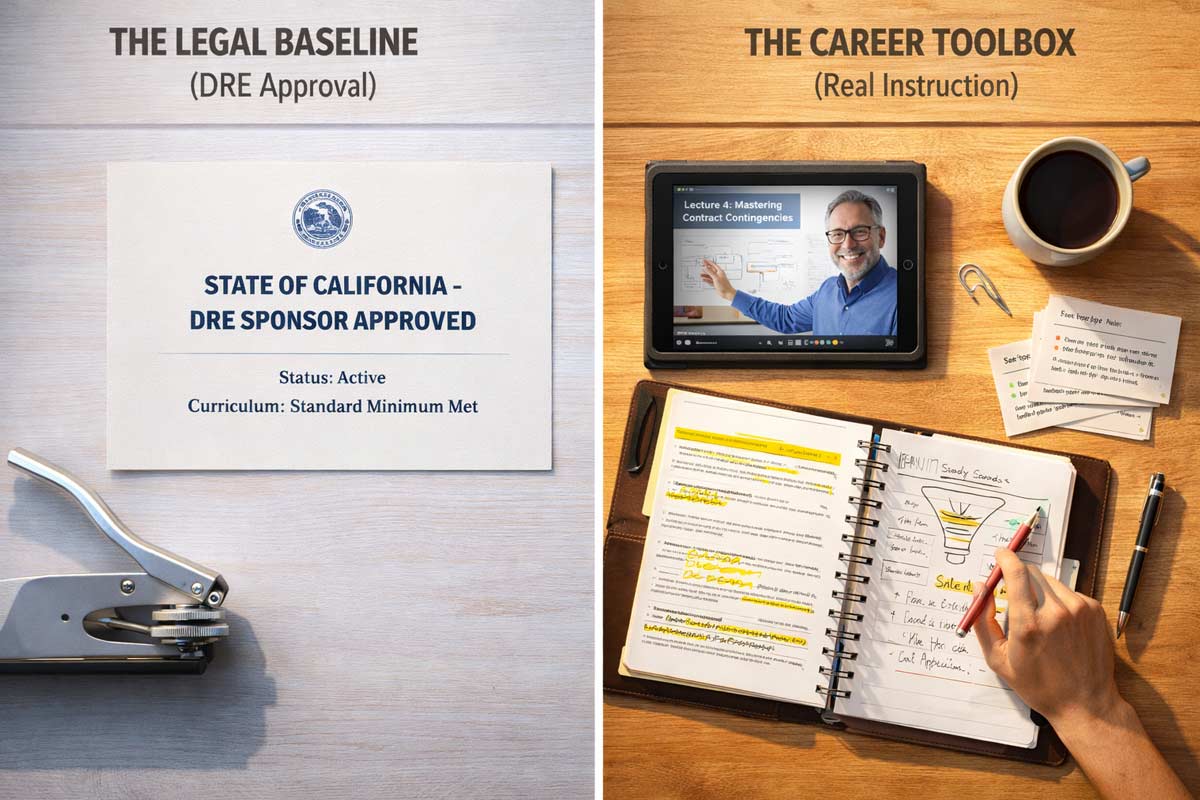
In California, you cannot sit for the state exam unless you complete three college-level courses from an approved provider. DRE approval is the absolute minimum legal requirement—it is not a rating of quality. It simply means the school has permission to offer the curriculum.
How to verify in minutes:
Ask the school for their DRE Sponsor ID.
Visit the DRE website to confirm their status is "Approved."
Check if they offer the three mandatory courses: Real Estate Principles, Real Estate Practice, and an elective.
To understand why this approval is just the starting line, read our guide on What Makes a Real Estate School DRE-Approved?
Step 2: Decide What Kind of Student You Are
The format of the school should match your lifestyle, not the other way around. A "self-paced" course is only a value if you have the discipline to finish it without a structured environment.
Learner Profile
Priority
Recommended Feature
The Full-Time Professional
Efficiency
High-quality mobile interface & clear PDF materials.
The Anxious Test-Taker
Stability
Live webinars or in-person coaching components.
The Fast-Tracker
Support
Responsive administrative teams for finishing certificates.
The Career Switcher
Practicality
Instructors who provide context through California examples.
Real-World Scenario: Many students choose a purely digital format because it's cheaper, only to realize months later they’ve stopped making progress because they have no one to ask for clarification.
Step 3: Instructor Access is the Hidden Difference-Maker
Many online schools are essentially "digital bookstores." They sell you the material and leave you to navigate it alone.
If you hit a wall while studying Agency or Valuation, you need a human answer. In high-volume, low-support environments, you might wait days for a canned email response. This delay kills your momentum.
When evaluating a school, ask: “If I don’t understand a concept, can I reach out to an instructor, or am I limited to a help-desk ticket?”
Instructional depth is what prevents failure. You can learn more about this in our guide on The Role of Instructors in CA Real Estate Education.
Step 4: Evaluate Prep Quality (Beyond the "Guarantee")
The goal is to pass the state exam on your first attempt. High-quality exam prep is about feedback loops, not just repetition.
The Baseline: A school that only gives you a score at the end of a quiz.
The Standard: A program that provides a detailed rationale for every answer (explaining why the correct answer is right and the others are wrong).
Scrutinizing the Guarantee:
Many schools market a Pass Guarantee. It is important to view these as administrative policies rather than trust signals. A guarantee is effectively a "post-failure" plan; it does not indicate the quality of the instruction itself. Often, the fine print requires multiple failures or specific prerequisites to qualify. Focus on the quality of the practice rationales—that is what keeps you from needing the guarantee in the first place.
Step 5: Know When a Crash Course Helps (and When It’s a Trap)
A crash course is a "gap-closer," not a foundation. If the primary pre-licensing courses were low-quality, a weekend session cannot replace 135 hours of lost learning.
The Readiness Benchmark: If you are scoring 70–75% on practice exams, a crash course can provide the "test-taking logic" to secure a pass. If you are scoring 50%, you likely need to revisit the core material.
For more on timing your prep, see: Are Crash Courses Worth It in California?
Step 6: Compare Total Cost & Friction
The "sticker price" of a real estate school is rarely the final cost. Look for "friction points" that lead to hidden expenses:
Extension Fees: Charges if you don't finish the course within a strict window.
Retake Fees: Fees for re-taking a course final exam.
Tech Friction: Outdated portals that don't work well on mobile or modern browsers.
Insider Tip: If a school’s support is slow during the enrollment process, it will likely be slower when you are waiting for your course completion certificates.
Step 7: The Simple Decision Checklist
Use this rubric to evaluate providers. Score them based on substance, not marketing.
DRE Approved: Verified Sponsor ID (Non-negotiable).
Direct Instructor Access: Can I get a human on the phone or email?
Feedback Loops: Does the exam prep explain the "why" behind the answers?
Policy Clarity: Are refund and retake policies written in plain English?
Format Fit: Does this match my actual daily schedule?
Frequently Asked Questions
Do I really need an exam pass guarantee?
Guarantees are secondary to instructional quality. A guarantee is relevant only after you have failed. Your priority should be finding a school with active instructor support and robust practice rationales—the tools that help you pass the first time.
Does DRE approval mean the school is "good"?
No. DRE approval only means the school meets the minimum legal curriculum requirements. It is a baseline for entry, not a measure of how well the school prepares you for a career or the state exam.
What should I prioritize if I work full-time?
Prioritize "support responsiveness." When your study time is limited to late nights or weekends, you cannot afford to wait days for a response to a question. You need a school that provides the resources to keep you moving forward.
Take the Next Step
Choosing a real estate school is about finding a partner for your licensure journey. A great school makes guarantees mostly irrelevant because the instruction is designed to help you pass the first time. To see how different programs compare across the state using this objective framework, view our guide to the best real estate schools in California.
|