When most students enroll in real estate classes and receive their textbooks, a frequent reaction is overwhelm.
You are staring at thousands of pages covering everything from freehold estates to trust fund accounting, and the pressure to memorize it all can be paralyzing. But here is the truth: You do not need to memorize every single word to pass. You need a specific strategy.
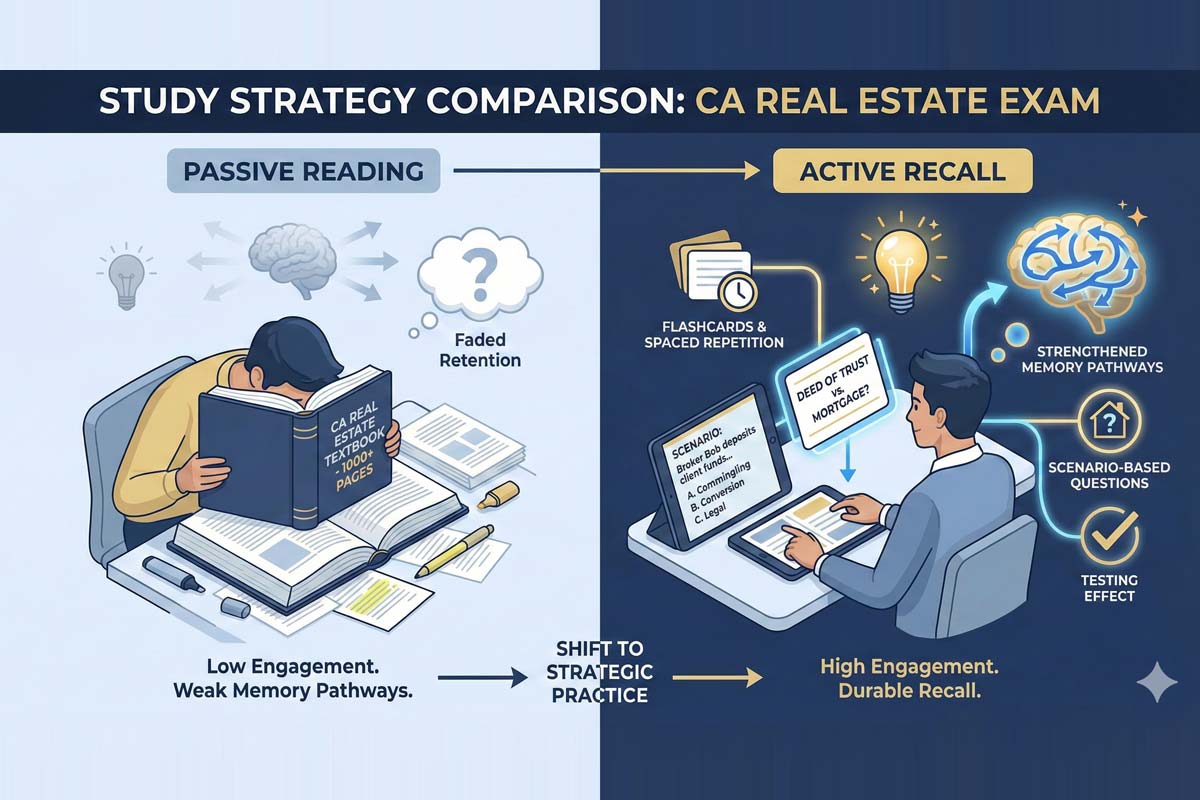
The best way to study for the California real estate exam is to shift from passive reading to active, strategic practice aligned with the DRE blueprint.
While our comprehensive California Real Estate Exam Guide covers the broader scope of eligibility and the application process, this article focuses entirely on the tactical side of preparation—the specific study methods that transform confusion into passing scores.
The most effective study method is a targeted approach that prioritizes high-weight content areas and learns them through application rather than mere memorization. Think of it this way: The student who reads the textbook three times often fails, while the student who reads it once but spends their time analyzing practice scenarios usually passes.
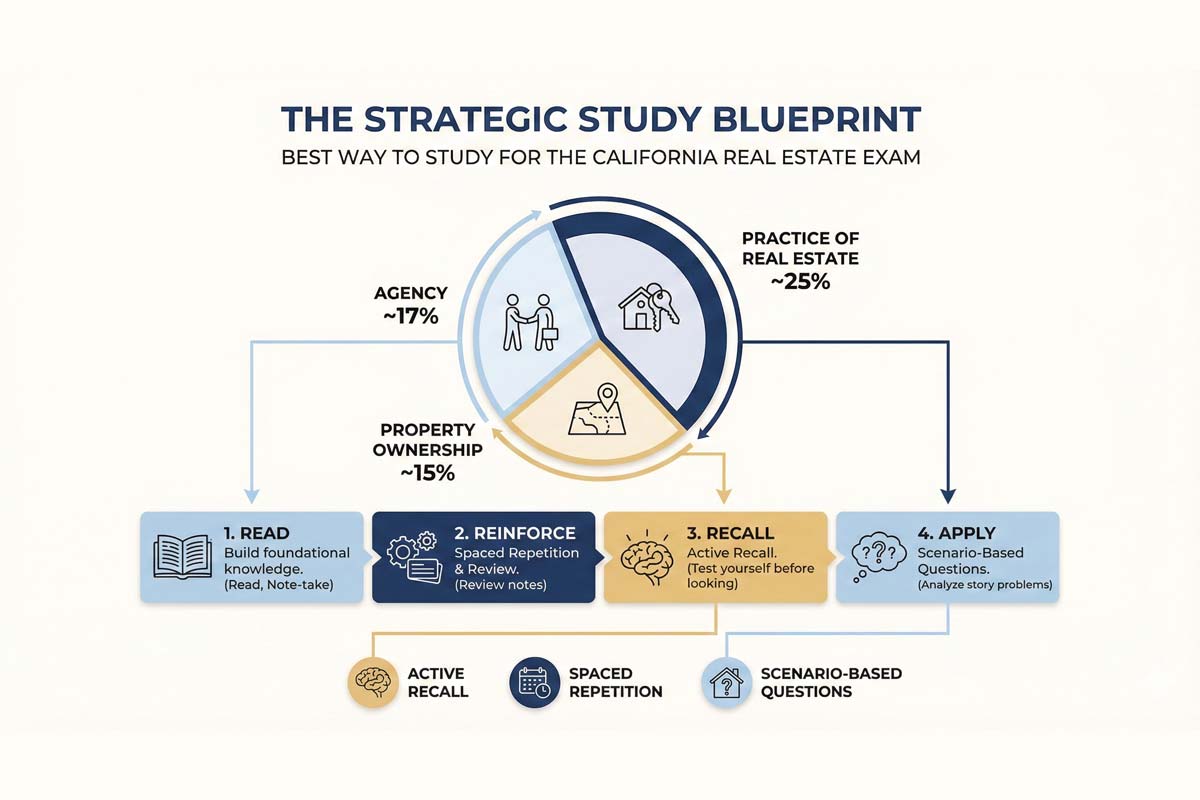
To study effectively, you must first stop studying "everything" and start studying what matters. Your study time gains the biggest return on investment when you prioritize the sections that appear most frequently.
The California salesperson exam consists of 150 multiple-choice questions to be completed in 3 hours. The broker exam is 200 multiple-choice questions and you are given up to 4 hours to complete it. To pass, you need a score of 70% or 75% respectively. However, remember that the questions are weighted toward specific areas. While the DRE may update specific questions, these category weights remain consistent year after year.
If you master Practice and Agency, you have already covered nearly half the exam. Your study time should reflect this distribution.
One of the biggest shocks for students on exam day is the format of the questions. They rarely ask for simple definitions. Instead, the DRE uses scenarios to test if you understand the spirit of the law, not just the letter of it.
Most questions are disguised as simple stories. These scenarios reflect how nearly every DRE question is structured—they present a situation and ask you to identify the legal implication. Success here comes down to pattern recognition.
If you study isolated terms without applying them to these “story problems,” you may struggle to recognize the answer when it is wrapped in a real-world situation especially if you haven’t memorized and internalized the vocabulary.
The “Forgetting Curve” is real. If you study contracts on Monday and don’t look at them again until Friday, you will have forgotten a significant portion of what you learned.
Simply re-reading a chapter feels comfortable, but it is passive. Remember: Comfort ≠ Learning. If it feels easy, you probably aren’t retaining it.
Active recall—testing yourself before looking at the answer—forces your brain to work harder to retrieve the information. For example, instead of reading a definition, cover the page and ask yourself: “What is the definition of constructive eviction?” This mental exertion strengthens neural pathways, making the memory more durable.
One of the biggest mistakes students make is waiting for "free time" to study. In our busy lives, free time rarely exists; it has to be created. You need a schedule that treats studying like a non-negotiable appointment.
This schedule focuses on consistency over intensity.
To maintain momentum, visualize your month like this:
Note: If you work full-time or have a busy family life, don’t force a 4-week timeline. Extend this roadmap to 6–8 weeks to ensure you retain what you learn.
Establishing a routine is crucial, but determining your total timeline is personal; understanding How Long Should You Study for the CA Real Estate Exam depends heavily on your background knowledge and how many hours per week you can honestly commit. A student with a legal background might need four weeks, while someone completely new to the industry might need three months of steady preparation.
Taking practice exams is not about seeing what score you get; it is about diagnosing why you are getting questions wrong.
Avoid taking full 150-question mock exams until you can consistently score 70–75% on topic-based quizzes. Taking them too early leads to discouragement. Once you hit that threshold, aim to take one full mock exam per week in a quiet environment to build stamina.
Track your errors by type to see which patterns repeat. Taking mock tests is essential, but simply churning through questions won't improve your score unless you know how to use Practice Exams for the CA Real Estate License Test to diagnose your weak spots effectively. The goal is to condition your brain to recognize how the state asks questions, which is often tricky and filled with double negatives.
Self-study requires immense discipline. Sometimes, despite your best efforts, certain concepts—like the difference between a trust deed and a mortgage—just don’t click when reading a book.
If you reach this point, deciding whether You Should Take a Crash Course for the CA Real Estate Exam often comes down to whether you need structured, instructor-led guidance—not just more reading or random YouTube videos. A well-designed crash course like crashcourseonline.com acts as a final filter, stripping away irrelevant information and focusing purely on what is likely to appear on the state exam. The right course clarifies confusing topics, shows you how questions are actually phrased, and reinforces the high-yield concepts that move your score the fastest.
Even smart students fail because they study inefficiently or panic on the big day. Avoid these common traps:
The Second-Guessing Trap: On exam day, avoid changing your answers unless you have found clear evidence you were wrong. Your gut instinct is usually based on your study prep; second-guessing is usually based on anxiety.
At ADHI Schools, we have spent nearly two years refining our curriculum not just to meet DRE standards, but to match how students actually learn. We don’t believe in drowning you in data. Our approach focuses on the “why” behind the laws. These methods mirror the principles we teach in our courses because they consistently produce results.
The most effective study method is a targeted approach that focuses on the highest-weighted exam topics and uses active recall and scenario-based practice. Students who move beyond passive reading and spend more time analyzing question patterns consistently score higher than those who simply reread the textbook.
Most students do well with 1–2 hours per day, 4–6 days a week. What matters more than total hours is consistency. Short, focused sessions with spaced repetition outperform long cram sessions. Your timeline also depends on your background—some students need four weeks; others need two to three months.
Start full-length practice exams only after you can consistently score 70–75% on topic-based quizzes. Taking them too early leads to discouragement and doesn’t improve retention. Once ready, take one mock exam per week and spend equal time reviewing your mistakes to identify patterns.
A crash course isn’t mandatory, but many students see their biggest score jumps after following a structured review program. When you’re stuck or unsure why answers are wrong, guided review—such as the approach used at crashcourseonline.com—can help you quickly identify weak areas and understand how the exam actually phrases its scenarios.

Founder, Adhi Schools
Kartik Subramaniam is the Founder and CEO of ADHI Real Estate Schools, a leader in real estate education throughout California. Holding a degree from Cal Poly University, Subramaniam brings a wealth of experience in real estate sales, property management, and investment transactions. He is the author of nine books on real estate and countless real estate articles. With a track record of successfully completing hundreds of real estate transactions, he has equipped countless professionals to thrive in the industry.

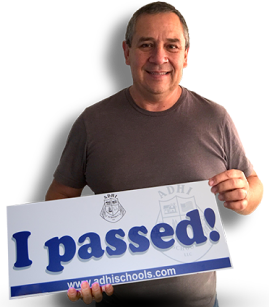
"Hey guys,
I took the exam today and passed!!!!
It only took me one try which was one of my goals. I took the online
classes and follow your suggestions so I took the crash course,
used the crash course app a lot, took 7 mock tests and went
confident to present the exam. Thank you for the great job you are
doing, you guys are awesome!!!! May God continue to bless you!"
Willie V.