
As the date of your California Department of Real Estate (DRE) exam approaches, a familiar panic often sets in. You’ve finished the mandatory 135 hours of pre-licensing coursework, but looking at a textbook filled with property codes and legalese can feel overwhelming.
Many students ask me, "Kartik, is it worth paying for a crash course, or should I just study on my own?"
It is a valid question. You have likely already spent money on the pre-license courses and application fees. However, the state exam is notorious for its difficulty—pass rates often hover around 50%. Students usually seek out crash courses because they feel unstructured, have run out of time, or simply don’t trust that their solo reading was enough to retain the information.
In my 20+ years of teaching real estate in California, I have seen crash courses save careers, but I have also seen students treat them like magic pills. A crash course amplifies existing knowledge; it doesn’t replace it. Let’s break down exactly what these courses offer, the learning science behind them, and whether one is right for you.
A crash course is distinct from your statutory college-level courses (Real Estate Principles, Practice, and an Elective). It is not about satisfying a legal requirement; it is about pure exam performance.
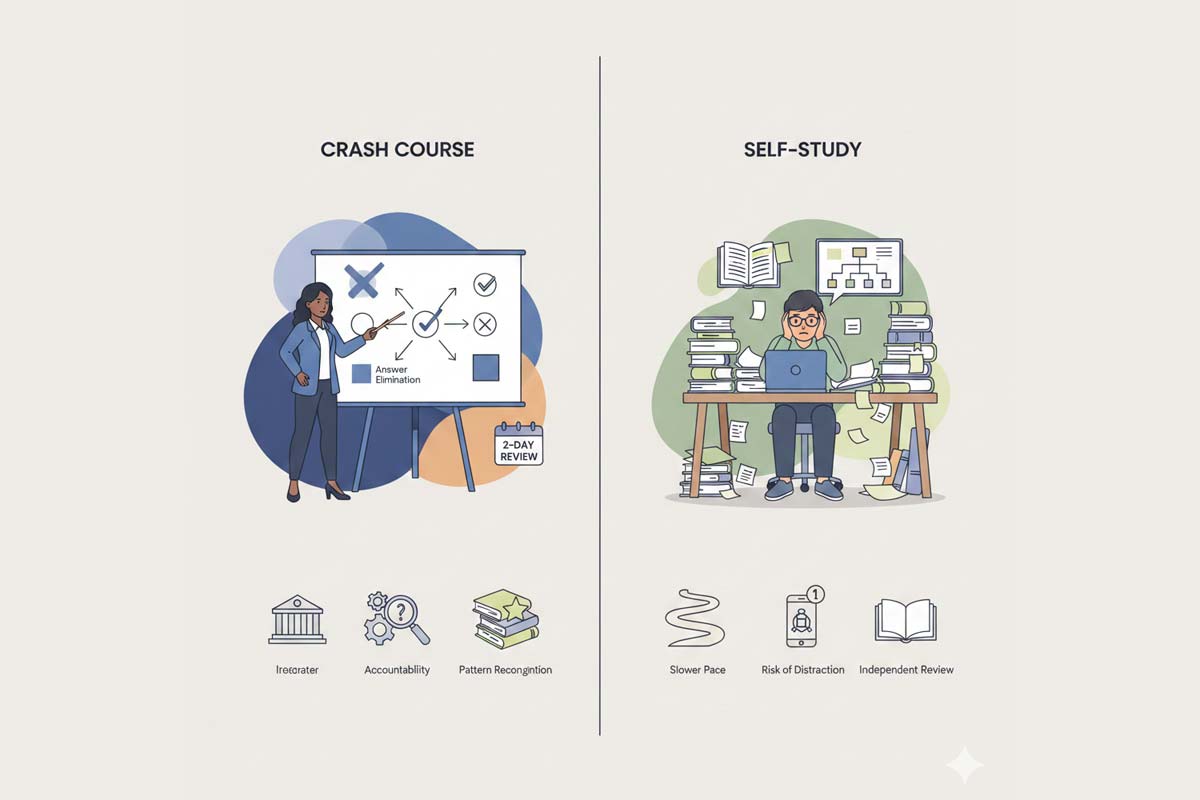
Think of it as the difference between learning to play a sport and studying the playbook right before the big game. A crash course typically takes place over a weekend (or two full days) and provides accelerated instruction focused on:
Not every student needs a crash course. Some people are autodidacts who can read a glossary once and retain it perfectly. However, based on thousands of students I’ve observed, the following learner profiles benefit the most from live or livestreamed exam prep:
A crash course also acts as a litmus test for your timeline. If you sit through a weekend review and feel completely lost, it is a sign you need to push your exam date back. Conversely, if you are unsure how long should you study for the CA real estate exam, a crash course can serve as a final validation that you are ready to schedule your test immediately.
There is cognitive science at play in a good cram session. It isn't just about stuffing facts into your brain; it’s about retrieval practice.
When you study alone, you often suffer from "illusion of competence"—you read a chapter and think you know it. In a crash course, the instructor asks questions that force you to retrieve information under pressure. This highlights your blind spots immediately.
Furthermore, these courses reduce decision fatigue. When studying alone, you waste energy deciding what to study. In a structured review, the instructor curates the curriculum based on the DRE’s weighted content outline.
Most importantly, expert instructors teach you how to practice exams for the California real estate license test by decoding the structure of the questions themselves. They show you how to identify the "stem" of the question, eliminate the two obviously wrong answers, and navigate the subtle differences between the remaining two choices.
I want to be transparent: a crash course is a catalyst, not a replacement for foundational knowledge. It cannot teach you an entire semester’s worth of law in 16 hours.
A crash course will likely fail you if:
If your grasp of the terminology is weak, you will need to spend time mastering specific memorization techniques that work for the CA exam — such as flashcards or mnemonics — before a weekend review can truly help you.
The students who pass on the first try rarely use only self-study or only a crash course. They use a hybrid strategy.
In my experience, best way to study for the California real estate exam involves a specific sequence:
This “sandwich” approach ensures you have the background knowledge to understand the crash course, and the practice time afterward to cement what you learned.
Deciding whether a crash course is worth it starts with understanding the critical tradeoff between time saved and clarity gained.
From a cost-benefit perspective, consider the cost of failure. If you fail the exam, you have to pay the state re-application fee, but more importantly, you lose weeks of potential income and momentum.
A crash course provides clarity, and it reduces anxiety by demystifying the exam. It allows you to walk into the testing center knowing you didn’t leave your preparation to chance. If the course helps you answer just five or six difficult questions correctly that you otherwise would have missed, it has paid for itself in the form of a passing grade.
Ultimately, the decision to take a crash course depends on your learning style and your confidence level. If you are disciplined, organized, and testing above 85% on practice exams at home, you might be fine on your own. But for most students, the structure, expert guidance, and pattern recognition taught in a weekend review are the difference between a confusing failure and a confident pass.
Assess your timeline, be honest about your study habits, and use the course to amplify your existing knowledge.
If you want to see how a crash course fits into the full licensing timeline and find resources for the next step, check out our comprehensive guide:
➡ California Real Estate Exam Guide
No. A crash course is optional and not required by the California Department of Real Estate (DRE). The mandatory requirement is completing the 135 hours of pre-licensing education. A crash course is simply a performance booster designed to improve exam readiness.
For most students, yes. Crash courses improve your chances by focusing on the highest-weighted exam topics, teaching test-taking patterns, and reinforcing retention through active recall. Many students say the review helped them answer tricky “distractor” questions they would have otherwise missed.
You may benefit from a crash course if you feel unstructured, haven’t studied in weeks, struggle with vocabulary, or score inconsistently on practice exams. If you’re unsure how long you should study for the CA real estate exam, attending a review session can confirm whether you’re ready to schedule the test.
No. A crash course amplifies what you already know—it does not substitute the foundational material in your Principles, Practice, and elective courses. If you haven’t mastered basic vocabulary or concepts, you should reinforce those first with memorization techniques that work for the CA exam.
Yes. Most students benefit most when they take a crash course 1–2 weeks before test day, then follow it with a week of timed practice exams. This sequence helps the material stay fresh and improves endurance for the 3+ hour state test.
Absolutely. Retakers often know the content but struggle with the DRE’s tricky question structure. Crash courses teach pattern recognition, how to identify the question “stem,” and how to eliminate wrong answer choices—skills that improve second-attempt success rates.
For most students, yes. Online crash courses still allow for real-time Q&A, instructor interaction, and guided pattern recognition. If you prefer learning from home or have limited time, a remote session can be equally effective.
The most important next step is taking full-length, timed practice exams to cement what you learned. This builds stamina and exposes any weak areas. Continue reviewing high-yield topics until you consistently score 85% or higher.

Founder, Adhi Schools
Kartik Subramaniam is the Founder and CEO of ADHI Real Estate Schools, a leader in real estate education throughout California. Holding a degree from Cal Poly University, Subramaniam brings a wealth of experience in real estate sales, property management, and investment transactions. He is the author of nine books on real estate and countless real estate articles. With a track record of successfully completing hundreds of real estate transactions, he has equipped countless professionals to thrive in the industry.

"Hey guys,
I took the exam today and passed!!!!
It only took me one try which was one of my goals. I took the online
classes and follow your suggestions so I took the crash course,
used the crash course app a lot, took 7 mock tests and went
confident to present the exam. Thank you for the great job you are
doing, you guys are awesome!!!! May God continue to bless you!"
Willie V.