
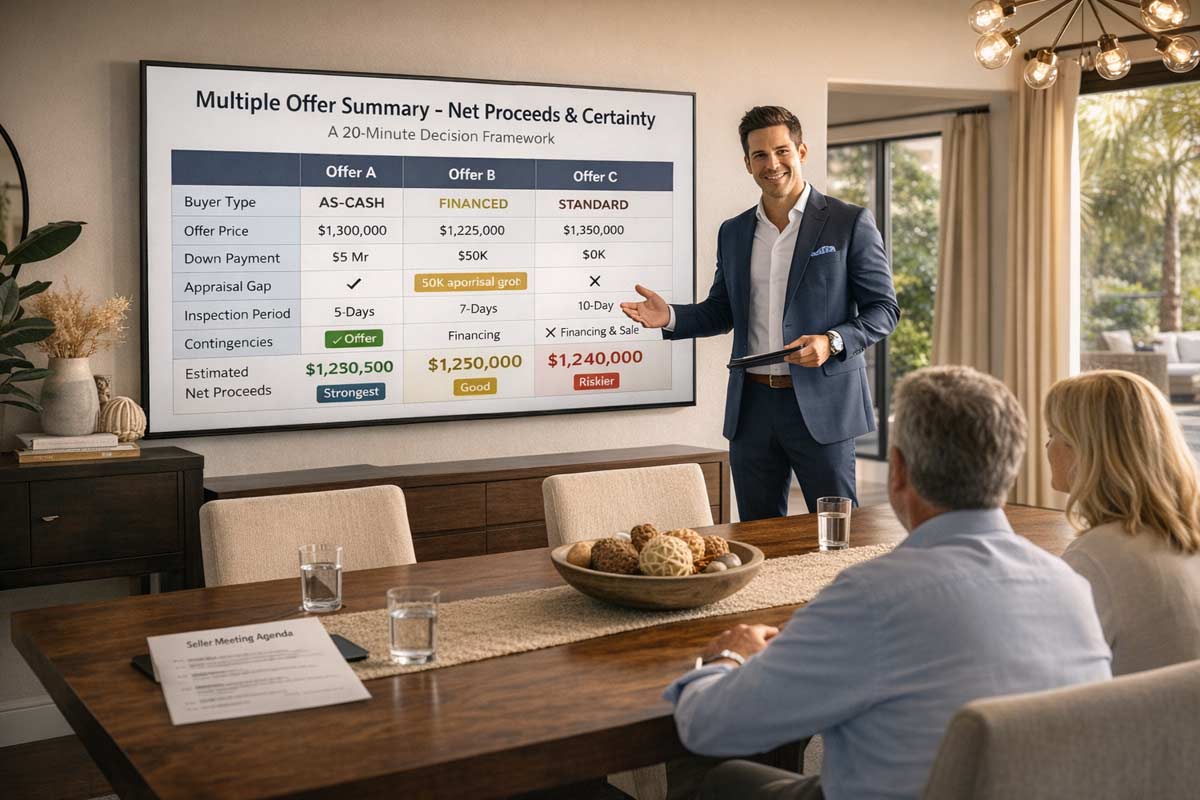
Imagine a Friday afternoon and you’ve just listed a well-priced three-bedroom home. Within 72 hours, your inbox is a graveyard of PDF attachments. You have 12 offers, three "love letters" (which must be handled with extreme caution related to Fair Housing), and a seller who is already mentally spending the overage.
In the high-velocity California real estate market, a multiple-offer situation isn't just a sign of success—it is a high-stakes test of your professional systems. At ADHI Schools, we teach this as a repeatable Multiple-Offer Operating System: a clinical, step-by-step method that removes emotion, protects the seller, and increases the odds of closing without post-acceptance drama.
This article serves as your field manual for presenting, positioning, and closing multiple offers without losing control of the transaction.
Navigation Cue:
To successfully present multiple offers in California, you must first acknowledge that your objective shifts depending on which side of the negotiating table you occupy.
Mastering these dynamics is a foundational component of the Real Estate Agent Skills California framework that separates top-tier producers from the pack.
Do not present offers one by one as they arrive, they should be presented together in a non-prejudicial manner. This creates emotional fatigue for the seller and leads to sloppy decision-making. Normalize the data using an Offer Summary Sheet. You are looking for more than just price; you are also looking for the buyer’s "skin in the game."
Before sitting down with your seller, vet every offer for these specific "lethal" details:
The Script: "Mr. and Mrs. Seller, we have 12 offers. Our goal today isn't just to find the highest price, but the one most likely to cross the finish line. We’re going to look at these through three lenses: Net Proceeds, Certainty of Close, and Post-Closing Flexibility (Rent-backs)."
To win a multiple-offer situation, you must address the listing agent's biggest fear: the deal falling out of escrow.
The Script: "I know the list price is $800,000, but in this micro-market, that’s just the starting whistle. To win, we need to look at what 'winning' actually costs. Are you prepared to cover an appraisal gap of $20,000 if the bank doesn't see value like we do?"
The Script: "Hi [Name], this is [Agent] with [Brokerage]. I’m calling to understand what ‘strength’ looks like for your seller beyond price. Is certainty of close, specific timing, or post-closing flexibility the biggest concern for them right now?"

Choosing the wrong response strategy is one of the most common deal-killing mistakes. Use this logic to decide your next move:
Consider Using “Highest & Best” (SMCO) When:
Avoid “Highest & Best” When:
Bottom line: “Highest & Best” is a blunt instrument. Use it to simplify decisions—not to abdicate strategy.
In a multiple-offer situation in California, the purchase price often outpaces recent comparable sales. This is why appraisal strategy is one of the most overlooked factors in a multiple-offer situation in California.
The Failure Scenario: I’ve seen sellers accept the highest offer—$60,000 over list—only to be back on the market 21 days later when the appraisal came in low and the buyer would not cover the difference. This costs the seller momentum, leverage, and credibility.
To prevent this, you must handle appraisal gaps proactively by requiring "Appraisal Gap Coverage" language in the counter-offer, ensuring the buyer has the cash to bridge the difference between the bank’s value and the contract price.
| Winning Terms | Deal-Killing Mistakes |
|---|---|
| Verified "Pre-Approval" (not Pre-Qual) | Vague "Seller Credits" for repairs |
| Shortened Inspection/Loan periods | Incomplete disclosures |
| Appraisal Gap Coverage | Escalation clauses with no "cap" |
| 21-day or shorter escrow | Misaligned closing dates with seller's move |
Winning these situations requires high-level negotiation tactics. It’s about finding the "hidden" needs of the other party—often, a seller needs a 30-day rent-back more than they need an extra $5,000.
This is the 20-Minute Seller Decision Framework we teach agents to use when emotions are highest. When you sit down with your seller to present multiple offers, follow this structure:
Agents who master multiple-offer situations don’t rely on luck—they rely on systems. Multiple-offer mastery sits at the intersection of communication, negotiation, contract control, and emotional regulation.
If this article exposed gaps in how you present, negotiate, or structure offers, your next step is to master the full Real Estate Agent Skills California framework. Stop reacting to the market and start commanding the transaction.

Founder, Adhi Schools
Kartik Subramaniam is the Founder and CEO of ADHI Real Estate Schools, a leader in real estate education throughout California. Holding a degree from Cal Poly University, Subramaniam brings a wealth of experience in real estate sales, property management, and investment transactions. He is the author of nine books on real estate and countless real estate articles. With a track record of successfully completing hundreds of real estate transactions, he has equipped countless professionals to thrive in the industry.


"Hey guys,
I took the exam today and passed!!!!
It only took me one try which was one of my goals. I took the online
classes and follow your suggestions so I took the crash course,
used the crash course app a lot, took 7 mock tests and went
confident to present the exam. Thank you for the great job you are
doing, you guys are awesome!!!! May God continue to bless you!"
Willie V.