Most students use practice tests to measure what they already know. That is a fatal mistake.
To pass the California real estate exam, you must use practice tests to diagnose how you think under pressure.
After twenty years of preparing students for the Department of Real Estate (DRE) exam, I have seen a consistent pattern. Students who score 85% on their couch often fail in the testing center.
Why?
Because the DRE doesn’t just test your memory. They test your ability to retrieve information while fighting decision fatigue. Understanding this disconnect is the key to designing a practice-exam strategy that actually prepares you for the conditions you’ll face at the DRE testing center.
This guide breaks down the exact system I’ve used to help thousands of California real estate students pass on their first attempt.
The most dangerous moment in exam prep isn’t when a student fails a practice test—it’s when they pass one too easily.
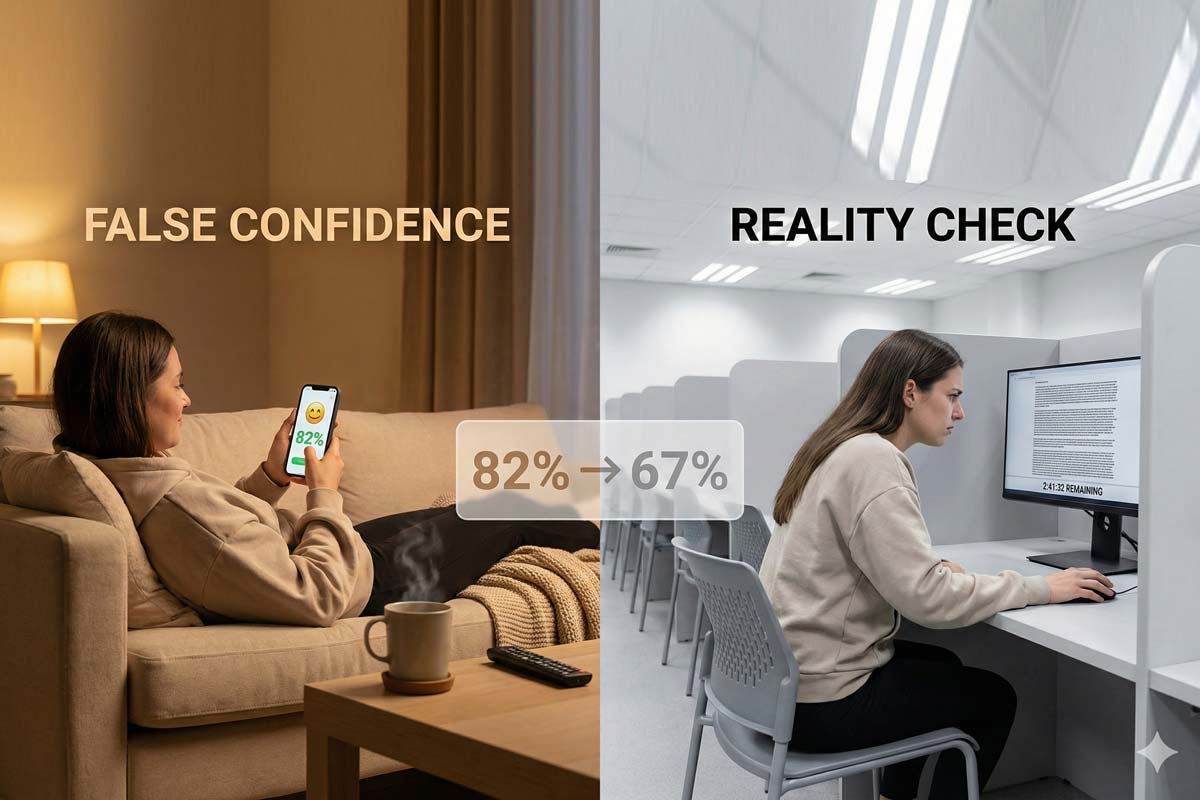
I see it constantly. A student taps through an untimed quiz on their phone while distracted. They score an 82% and assume they are ready.
But untimed success is an illusion.
The real exam is engineered to amplify pressure:
When you sit in a silent testing room with no phone, no breaks, and no instant feedback, that comfortable 82% quickly drops to a 67%.
To pass, you must stop "reviewing" and start "simulating." Before diving deeper into simulation strategy, if you’re still building your foundational study habits, I cover that process in much more depth in my guide on the best way to study for the California real estate exam.
You need to train for the physical and neurological reality of a 3-hour exam.
The California real estate sales exam consists of 150 questions. You have 3 hours and 15 minutes. That is roughly 1 minute and 18 seconds per question.
For the broker exam it’s 200 questions over 4 hours.
Cognitive science tells us that decision fatigue sets in significantly around the 90-minute mark. By question #75, your brain becomes less efficient at filtering out wrong answers. If you haven't trained for this endurance, you will make sloppy mistakes in the second half of the test. This is why students often miss easy vocabulary questions late in the exam—they're not fatigued intellectually, they're fatigued neurologically.
Here is something most students ignore.
Every time you switch from an advertising to a vocabulary question to a legal scenario, your brain incurs a "switching cost." You lose about 3 to 9 seconds resetting your mental context. Over lots of questions, that "tax" adds up to 10–15 minutes of lost time. Only timed simulations can train your brain to reduce this lag.

You cannot simulate a marathon by walking around the block. You must recreate the hostility of the testing environment.
Most students review their results incorrectly. They only check which letter they missed. A deep dive forces you to understand the thinking error behind each miss. Taking the test is only 50% of the work. The real learning happens here.
Here’s the framework my students use:
If you find that you are constantly making Knowledge Gap errors, you need to revisit how you are absorbing data. If specific terms won’t stick, incorporate the memorization techniques that work for the CA exam—like mnemonics or active recall—before your next simulation.
How often should you take a practice exam?
Your practice-test rhythm also depends on your overall study timeline—I outline typical timelines and prep durations in my breakdown of how long you should study for the CA real estate exam.
Generally, you want to align your testing with your body’s natural circadian rhythm. If your actual exam is scheduled for 8:00 AM, take your practice exams at 8:00 AM. Train your brain to be alert at that specific time.
When students run this five-day loop even twice, their scores typically jump 10–15 points.
However, if you find that certain topics still aren’t clicking even after targeted review, that’s a sign you may benefit from structured instruction. Sometimes hearing me explain concepts like “hypothecation” or “amortization” is the only way to make it click. This is often why students decide they should take a crash course for the CA real estate exam.
A common mistake is cramming heavy mock exams right up to the finish line. This is counterproductive.
48 Hours Before the Exam: Take full simulated tests with caution. You risk burnout or shaking your confidence with a difficult outlier score.
1. How many practice exams should I take before the real test?
I typically recommend students take at least 5 to 7 full, timed mock exams. You are looking for consistency. One passing score could be luck; three passing scores in a row is readiness.
2. How should I pace the exam to avoid timing out?
Aim to complete 50 questions every hour. This leaves you with roughly 15 minutes at the end to review flagged questions. If you aren’t at question #50 by the one-hour mark, you need to speed up slightly.
3. What percentage should I be scoring halfway through my prep?
Don't panic if you are scoring in the 50-60% range early on. That is normal. Your goal is to see a steady 5% increase with every "Autopsy" loop you complete.
4. How many questions should I expect to flag and return to?
On a healthy exam run, you should expect to flag about 15–25 questions. These are the ones where you narrowed it down to two answers but weren’t 100% sure. Flag them, guess, and move on. Do not let them stall your momentum.
5. Is the practice test harder or easier than the actual DRE exam?
Good practice exams for California real estate license test prep are designed to be slightly harder or equal to the difficulty of the real test. If a practice test feels easy, it’s likely not rigorous enough.
6. How does the DRE weight the content categories?
The exam covers seven major areas. “Practice of Real Estate” and “Agency” usually have the highest weight, often comprising 40-50 questions combined. There is no Real Estate Math on the test.
7. How do I handle “scenario” questions?
The DRE loves questions that start with “Broker A does X…” These test the application of law. Read the end of the question first to see what they are actually asking, then read the scenario to find the relevant facts.
8. What should I do if I keep failing my practice exams?
Stop testing and start studying. Repeated failure reinforces negative neural pathways. Go back to your course materials or try a different learning modality (like video or audio lectures) before testing again.
If you want to see how practice testing fits into the entire licensing journey, you can explore the full California Real Estate Exam Guide, which connects every stage of the process.

Founder, Adhi Schools
Kartik Subramaniam is the Founder and CEO of ADHI Real Estate Schools, a leader in real estate education throughout California. Holding a degree from Cal Poly University, Subramaniam brings a wealth of experience in real estate sales, property management, and investment transactions. He is the author of nine books on real estate and countless real estate articles. With a track record of successfully completing hundreds of real estate transactions, he has equipped countless professionals to thrive in the industry.

"Hey guys,
I took the exam today and passed!!!!
It only took me one try which was one of my goals. I took the online
classes and follow your suggestions so I took the crash course,
used the crash course app a lot, took 7 mock tests and went
confident to present the exam. Thank you for the great job you are
doing, you guys are awesome!!!! May God continue to bless you!"
Willie V.