
Deep knowledge of real estate principles is non-negotiable. However, even the most dedicated students can stumble if they rely on memorization alone.
That’s because the Department of Real Estate (DRE) isn’t simply checking your memory; the exam tests your professional judgment. They want to ensure you can protect a client in a complex scenario. To pass, you need to combine your command of the facts with a clear understanding of how the exam measures critical thinking.
This article teaches you how to think like the DRE—because passing is as much about mental process as it is about content.
This article is the strategic companion to our California Real Estate Exam (2026 Complete Guide). If that guide is your roadmap, this article is your instruction manual for driving the car.
To beat the exam, you have to deconstruct the weapon formed against you. The DRE does not write random questions; they write questions that follow a specific hierarchy of correctness.
If you take nothing else from this article, take this: In the DRE world, correct is not enough.
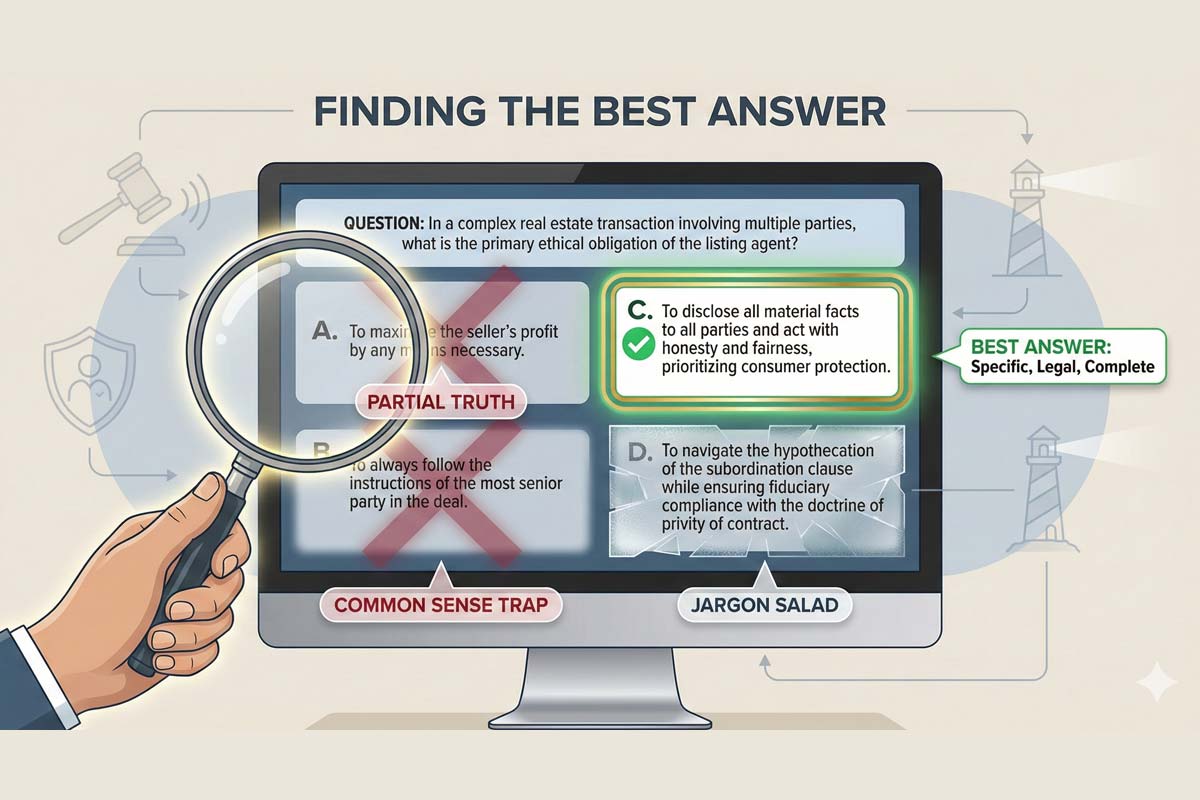
This is where smart people fail. They read option (A), see that it is technically a true statement, mark it, and move on. They never read option (C), which was more specific or more applicable to the exact scenario described.
Insider Insight: The DRE almost never rewards the answer that is merely technically accurate—they reward the one that aligns with legal intent and consumer protection.
Insider Tip: Never mark an answer until you have read all four choices. Often, option (A) is a "Partial Truth"—a statement that is true in a vacuum but doesn't solve the specific problem in the question stem.
This is the #1 anxiety point for students. You will see two answers that both look "right." Usually, the difference comes down to scope.
Let’s break down the components of the items you’ll face.
This is the setup. It might be a direct question (“What is an easement?”) or a scenario (“Broker Bob lists a property…”).
Insider Tip: Read the last sentence of the stem first. This tells you exactly what they are looking for before you get bogged down in the story details.
These are the wrong answers. They aren’t random; they are designed to trap you.
Now that you understand distractors, let’s look at the DRE’s favorite testing style: long scenario questions.
The DRE loves to test whether you can separate signal from noise. They will give you a paragraph full of details, but often only one fact matters. This is why it’s important to not only understand the content of the real estate exam but also how to cut through the fluff to get to what the state is actually asking.
The "Red Herring" Technique:The exam writers will include facts that have nothing to do with the legal issue.
Beware of Details That Seem Important but Aren't :
The English language is flexible. The law is not. The DRE uses specific qualifiers to signal whether an answer is likely right or wrong.
Real estate is rarely black and white. There are exceptions to almost every rule. If you see these words, the answer is highly likely to be incorrect:
The Exception: When the law deals with Fair Housing, "Never" is often correct. You never discriminate based on race.
The DRE prefers answers that leave room for nuance. If you are forced to guess, these words often signal the correct answer:
Based on the number of questions on the real estate exam, it’s evident that time management is crucial. You have roughly 1.2 minutes per question on both the sales and broker exams.
Do not let your ego lose you points.
If you encounter a scenario question that is a paragraph long: Mark it for review and skip it.
If you don’t know the answer, you can still manufacture a higher probability of passing.
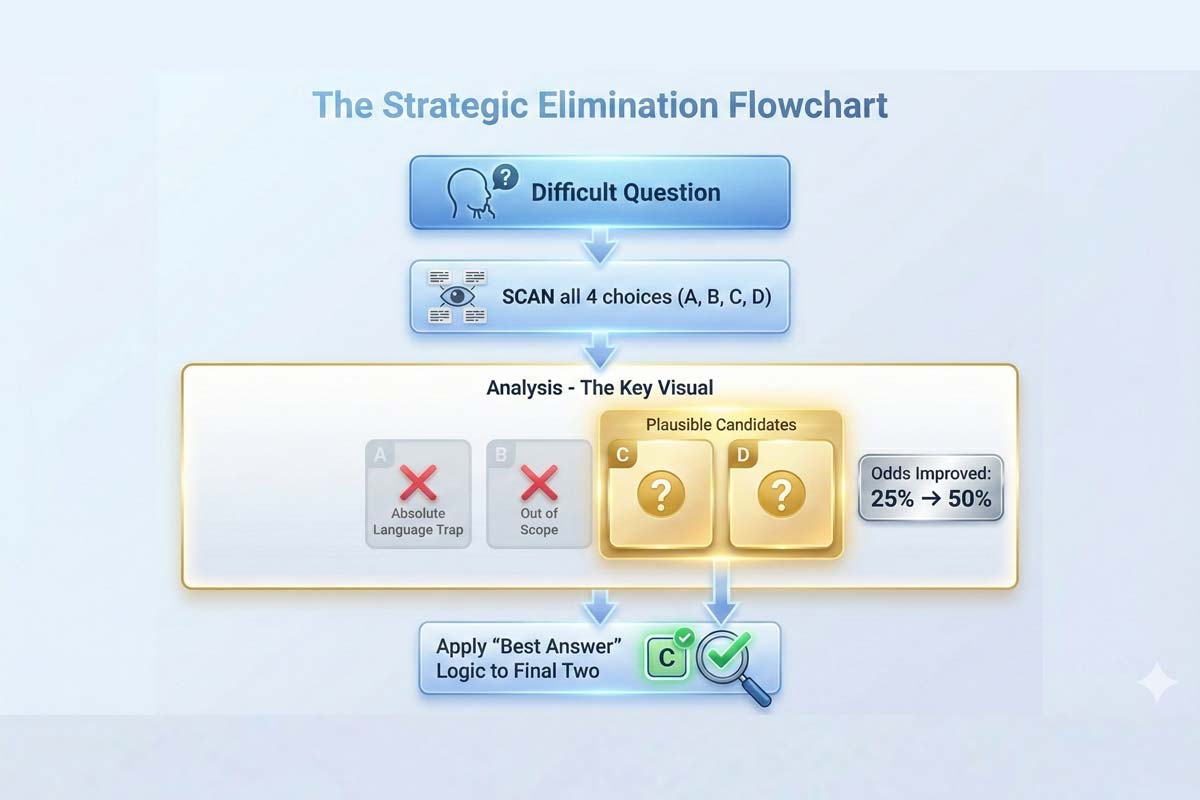
Psychometricians intentionally design four-option items with two distractors that are easy to eliminate—because this increases reliability and makes POE mathematically powerful.
The Math of Passing: As detailed in our guide on How the California Real Estate Exam Is Scored, you need a 70% to pass. That means you can miss 45 questions. If you can use POE to get your guessing success rate up to 50% on the hard questions, you are mathematically on the path to passing.
Speed is your enemy. The DRE writes questions that pivot in the middle.
The DRE loves negative stems:
If you read too fast, your brain skips "EXCEPT." You mark option (A) because it is necessary, and you fail the question.
Most test-takers sabotage themselves by letting adrenaline override logic—strategy is how you stay in control.
While the core mechanics of multiple-choice psychometrics remain consistent, the DRE updates its exam with some regularity to ensure that the content of the real estate exam reflects the reality of the real estate landscape.
In 2026, we are seeing a continued emphasis on ethics and transparency.
What to Expect:
Apply these four rules, and the exam becomes a formality rather than a hurdle.
Strategy is vital, but it cannot replace content mastery. You need to combine these test-taking tactics with a comprehensive study plan.
Start with the full roadmap here: California Real Estate Exam (2026 Complete Guide).
Inside, you'll find the complete content breakdown, registration steps, preparation timelines, and scoring explanations you need to pass on the first try.
Q: What is the "Best Answer" strategy for the CA Real Estate Exam?
A: "Best Answer" logic means ignoring options that are merely true and selecting the one that is most specific to the scenario. Based on how the DRE scores the exams, while two answers could “look” correct, choose the one that aligns with consumer protection and specific legal intent rather than a broad generalization.
Q: Are there specific "trap words" that signal a wrong answer?
A: Yes. Be suspicious of absolute words like "Always," "Never," "Must," and "Everyone." Since real estate law almost always has exceptions, these are usually incorrect. Exception: In Fair Housing questions, "Never" discriminate is often the right answer.
Q: How do I handle long, confusing scenario questions?
A: Use the "Last Sentence First" technique. Read the very end of the question prompt before reading the story. This tells you exactly what legal issue to look for so you can filter out "noise" like emotional descriptions or irrelevant house details.
Q: How can I improve my odds if I have to guess?
A: Use Process of Elimination (POE). The DRE includes two "distractors" (obvious wrong answers) in almost every question. By crossing these out, you mathematically double your chance of guessing correctly from 25% to 50%.
Q: What is the "Red Herring" technique on the exam?
A: A Red Herring is an irrelevant fact designed to distract you. For example, a question about Lead-Based Paint might mention a "messy divorce." The divorce is the Red Herring; the year the house was built is the only fact that matters.
Q: How should I handle "EXCEPT" or "NOT" questions?
A: These negative stems cause high failure rates due to speed reading. When you see "EXCEPT," mentally rephrase the question to: "I am looking for the FALSE statement." This prevents you from accidentally marking the first true statement you see.

Founder, Adhi Schools
Kartik Subramaniam is the Founder and CEO of ADHI Real Estate Schools, a leader in real estate education throughout California. Holding a degree from Cal Poly University, Subramaniam brings a wealth of experience in real estate sales, property management, and investment transactions. He is the author of nine books on real estate and countless real estate articles. With a track record of successfully completing hundreds of real estate transactions, he has equipped countless professionals to thrive in the industry.


"Hey guys,
I took the exam today and passed!!!!
It only took me one try which was one of my goals. I took the online
classes and follow your suggestions so I took the crash course,
used the crash course app a lot, took 7 mock tests and went
confident to present the exam. Thank you for the great job you are
doing, you guys are awesome!!!! May God continue to bless you!"
Willie V.