
You’re staring at pages of California real estate law and you still can’t explain “constructive notice” five minutes later. If that feels familiar, you’re not alone — the DRE exam overwhelms thousands of students every month.
The reason is simple: the CA real estate exam doesn’t reward passive readers. It rewards students who use the right memory techniques designed for scenario-based questions.
I’m Kartik. For more than 20 years, I’ve taught students exactly how to retain DRE vocabulary, apply it under pressure, and avoid the traps baked into the exam. Everything below comes from real results — these are the techniques that consistently produce ADHI passers.
For the full roadmap of your licensing journey, start with our master guide:California Real Estate Exam Guide.
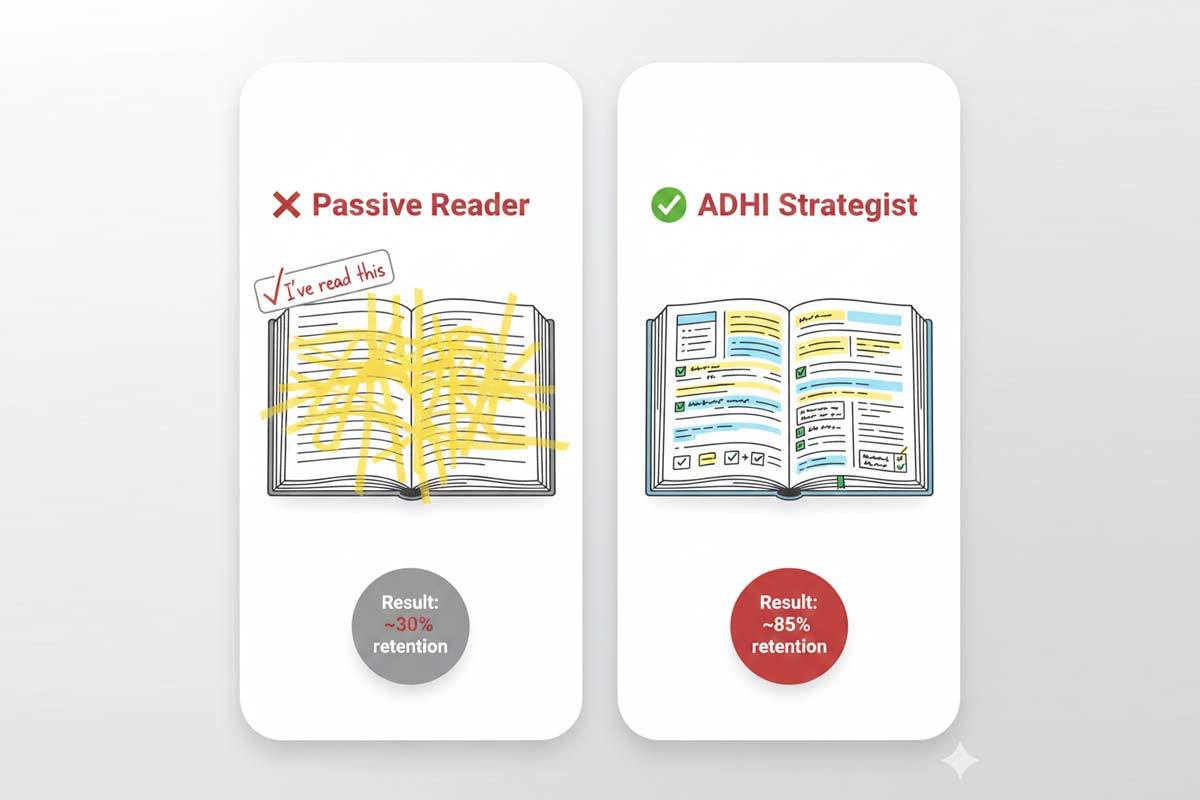
Most students rely on rereading definitions, which creates a false feeling of familiarity. But the DRE exam doesn’t test direct recall.
Compare these:
You can recognize the term and still get the question wrong. That is the trap.
Two things cause most CA test-takers to fail despite “studying”:
You highlighted the page.
You nodded as you read.
You saw the term before.
But you can’t distinguish easement appurtenant from easement in gross when the DRE mixes them into four answer choices.
The DRE doesn’t ask for definitions — it tests your ability to classify.
Examples:
If you want to avoid these traps, you need a system built for real estate exam thinking, not for a psychology class. These principles make far more sense once you see how they fit into a structured study routine, which I outline in Best Way to Study for the California Real Estate Exam.
This is not abstract theory. This is the exact memory system ADHI students use to pass — built around how the DRE writes questions.
The DRE exam is vocabulary-heavy: encumbrances, estates, liens, agency, contracts — hundreds of terms that must be instantly recognizable.
We compress big concepts into tight, memorable anchors:
These mnemonics accomplish two goals:
Action Step:
Pick a chapter (like Agency) and rewrite every major idea into a 3–5 letter mnemonic or short phrase.
Passive reading builds recognition — retrieval practice builds retention. The DRE exam rewards the latter.
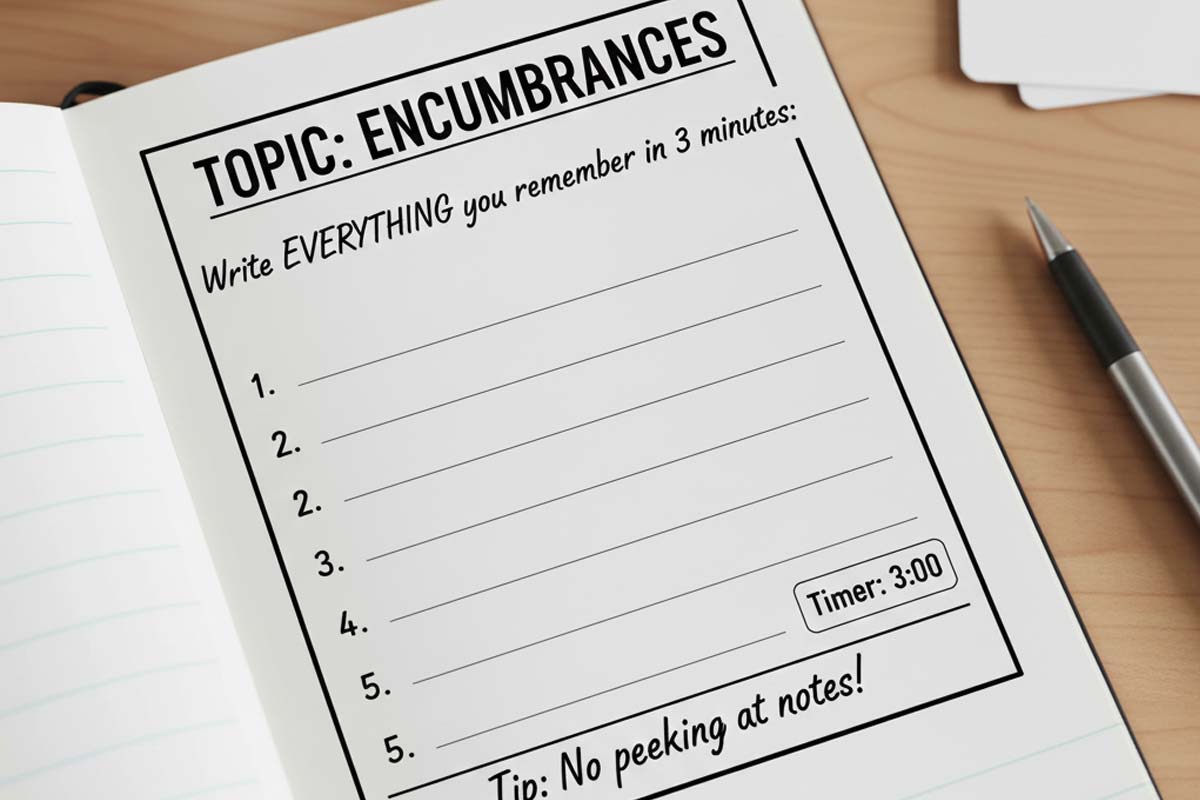
Action Step: The Brain Dump
Choose a topic (e.g., Encumbrances). Close your notes.
Write down everything you know — cold.
Most ADHI students see a 25–40% jump in recall after one week of doing this instead of rereading.
Retrieval, not rereading, is the reason ADHI students outperform passive readers.
This is where the DRE separates passers from near-missers.
A definition alone won’t help you. You need to be able to apply it.
Action Step: Teaching-Back
Explain the difference between a Net Lease and a Gross Lease without looking at your notes.
If you can explain it, you own it.
If you stumble, the memory is incomplete.
Action Step: Build 1-Page Maps
Create a simple mind map for categories like:
These maps train your brain to identify categories — exactly what the exam demands. You’ll see how these category skills translate into higher accuracy on practice questions in our guide on How to Practice Exams for the CA Real Estate License Test.
Cramming works for 24 hours.
Spacing works for 30 days.
This layer builds long-term exam recall.
Flashcard Triage System (A/B/C)
Sort your flashcards into:
Your schedule:
If you struggle with the time management needed for reinforcement, you’ll benefit from the structured study timelines we outline in How Long Should You Study for the CA Real Estate Exam?
Before your official exam, test recall the same way the DRE will:
20-Question Sprint
If you can do this, you’re ready.
If you can’t, stay in Layers 2 and 3 until you can.
These mistakes destroy DRE scores:
You highlighted entire pages. That’s recognition, not retention.
If you can’t explain easement appurtenant out loud, you don’t know it.
They guarantee you will forget the material by test day.
Without a mental map, the test’s scenario questions will crush you.
A crash course doesn’t replace memorization — it accelerates Layer 3.
During the crash course, we:
It’s the difference between knowing a term and being able to use it under pressure. For help deciding if a crash course fits your study plan, read our guide on Should You Take a Crash Course for the CA Real Estate Exam?
What is the best memorization technique for the CA real estate exam?
Retrieval practice (Layer 2). Nothing beats it.
How do I memorize real estate vocabulary faster?
Use mnemonics like TTIP and DEEP C to compress information.
Does the CA real estate exam require a lot of memorization?
Yes — but success comes from applying the vocabulary, not just knowing it.
72 Hours Out → Review TTIP, DEEP C, and your Pile A flashcards
48 Hours Out → Take a full 150-question timed exam
24 Hours Out → Review scenario maps only
Exam Morning → Quick review of B-pile only
The California real estate exam is a test of application, not just recognition. If you walk into the testing center relying on passive reading, you will fall victim to the traps of Recognition Illusion and Category Confusion that defeat most test-takers.
The good news is that passing is a matter of strategy. By adopting the ADHI 4-Layer Memory Method, you shift your focus from simply reading the law to actively owning it.
Your success hinges on your ability to confidently move from knowing the definition of an easement to correctly classifying it in a complex scenario. Start implementing the Brain Dump today and begin turning your hard work into a guaranteed result.

Founder, Adhi Schools
Kartik Subramaniam is the Founder and CEO of ADHI Real Estate Schools, a leader in real estate education throughout California. Holding a degree from Cal Poly University, Subramaniam brings a wealth of experience in real estate sales, property management, and investment transactions. He is the author of nine books on real estate and countless real estate articles. With a track record of successfully completing hundreds of real estate transactions, he has equipped countless professionals to thrive in the industry.

"Hey guys,
I took the exam today and passed!!!!
It only took me one try which was one of my goals. I took the online
classes and follow your suggestions so I took the crash course,
used the crash course app a lot, took 7 mock tests and went
confident to present the exam. Thank you for the great job you are
doing, you guys are awesome!!!! May God continue to bless you!"
Willie V.