One of the most frequent questions we hear from students after they finish thceir statutory college-level courses is, "Okay, I’m done with the classes. Now, how long will it take me to actually prepare for the state test?"
Valid.
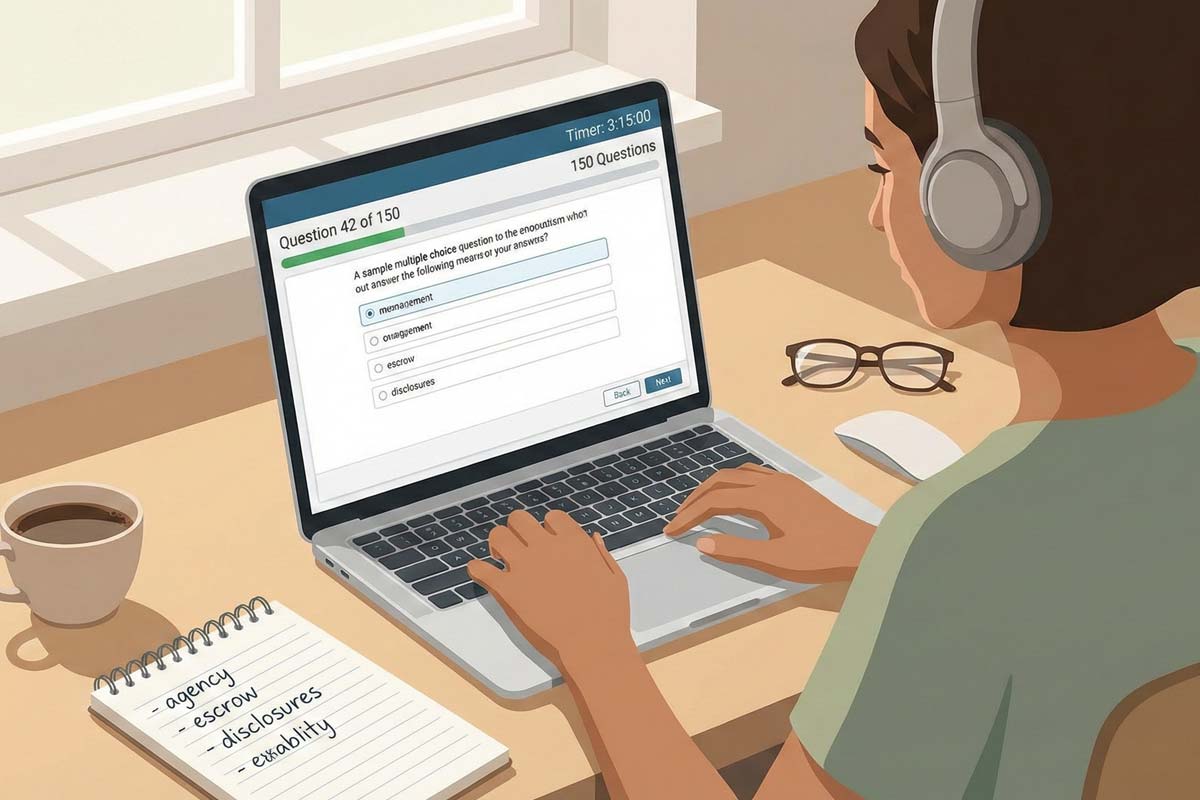
The California Department of Real Estate (DRE) salesperson exam consists of 150 multiple-choice questions to be answered in 3 hours and 15 minutes. It covers everything from property ownership to mandated disclosures. Study too little, and you risk failing and waiting weeks for a re-test. Study too long, and you risk "information decay"—forgetting the material you learned at the start of your prep.
The broker exam is 200 questions and you are given up to 4 hours to complete it.
After over 20 years of teaching real estate in California and analyzing the habits of thousands of successful agents, I can tell you there is no single "magic number" that applies to every human being. However, by looking at data from our most successful students, we can identify a distinct "success window."
This guide will help you determine where you fall on that spectrum so you can build a study timeline that maximizes your chances of passing on the first try.
For the vast majority of students, the sweet spot for exam preparation lies between 40 and 90 hours of focused study after completing the three required pre-licensing courses.
While outlier students with extensive legal or financial backgrounds sometimes pass with 20–30 hours of prep, we strongly advise against it. The DRE exam relies heavily on specific vocabulary and tricky syntax. Under-preparing significantly increases the risk of failing, which triggers a mandatory waiting period before you can re-test.
Most successful candidates schedule their exam 4 to 8 weeks after finishing their college-level courses. Extending the process beyond 8 weeks often leads to diminishing returns, as you begin to forget early material while trying to learn new concepts.
If you have worked as an assistant to a broker or in property management, you might be familiar with terms like "escrow" or "fiduciary." However, be careful—real estate "street knowledge" is often different from the "book knowledge" the DRE tests. You still need to study, but you may grasp concepts faster.
The California real estate exam is a vocabulary and reading comprehension test. Questions are often complex scenarios spanning 2–4 sentences. If you have working memory limitations or cognitive bottlenecks that make it hard to hold multiple variables in your head while reading, you will need more time to practice deconstructing these questions.
When do you study? Data suggests that aligning study blocks with your natural circadian rhythm (chronotype) can improve retention by 20–30%. A morning person studying at 8:00 AM retains significantly more than when they force themselves to study at 10:00 PM while exhausted.
If you spend the first 15–20 minutes of every study session deciding what to study, you are wasting valuable cognitive energy. Students who use a structured syllabus or prep course move faster because they eliminate decision fatigue.
Are you studying in a quiet office or at a kitchen table with distractions? Studies show that multitasking and constant interruptions can reduce retention by up to 40%. A fragmented hour of study is worth only about 20 minutes of "deep work." Students with high-distraction environments inevitably push their timeline toward the 90-hour mark.
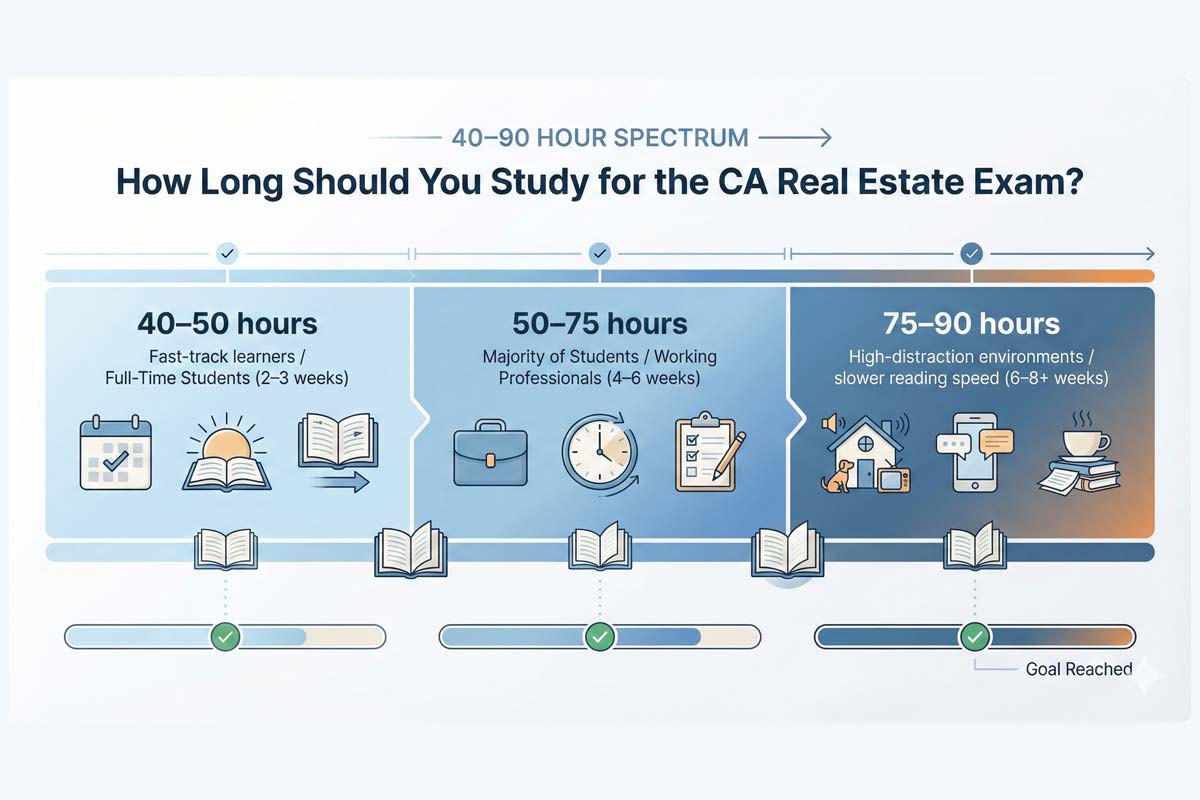
Note: These timelines assume you have already completed the required 135 hours of statutory coursework. Your actual pace may shift depending on your learning environment and retention style.
Based on our experience at ADHI Schools, here are three structured plans. Choose the one that fits your life.
If you struggle with self-motivation or complex legal jargon, a crash course acts as a force multiplier. Instructors help identify the most frequently tested concepts, cutting down your self-study time.
Note: Determining your timeline is just one step. To see how this fits into the broader roadmap of prerequisites and applications, refer to our comprehensive California Real Estate Exam Guide.
While under-studying is dangerous, over-studying is a real trap. We generally advise against study timelines extending beyond 8 to 10 weeks.
If your prep stretches past three months, you encounter The Forgetting Curve. By the time you are studying Week 10's topic (e.g., Taxation), you have likely forgotten the nuances of Week 1's topic (e.g., Estates in Land).
Extended timelines also can lead to emotional fatigue and procrastination. The urgency to study fades, and confidence erodes as the material starts to feel stale rather than fresh. If life circumstances force a long timeline, you must dedicate specific days to reviewing older material to keep it active.
How do you know when you have studied enough? It isn't a feeling; it's a metric. The biggest mistake students make is scheduling their exam date based on a hope rather than data. You are ready when:
You can brute-force your way through 100 hours of reading, or you can use learning science to get the same result in 50 hours.
In teaching thousands of students through ADHI Schools, I have found that those who pass fastest use these specific techniques:
If you are eager to get your license, it is tempting to rush. However, postpone your exam date if:
There is no badge of honor for studying 200 hours if you could have passed with 60 hours of focused effort. Your goal is to reach a level of "unconscious competence" where the definitions and laws come to you naturally.
Start with a diagnostic practice exam to see where you stand.
Commit to a schedule. Bring the same discipline to studying that you plan to bring to the job, and this exam becomes just the first of many deals you close.
For a full understanding of the entire testing journey, see our comprehensive California Real Estate Exam Guide.
Founder, Adhi Schools
Kartik Subramaniam is the Founder and CEO of ADHI Real Estate Schools, a leader in real estate education throughout California. Holding a degree from Cal Poly University, Subramaniam brings a wealth of experience in real estate sales, property management, and investment transactions. He is the author of nine books on real estate and countless real estate articles. With a track record of successfully completing hundreds of real estate transactions, he has equipped countless professionals to thrive in the industry.

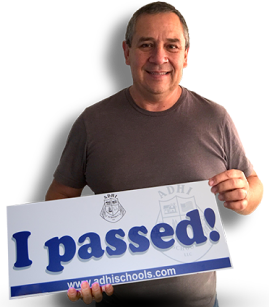
"Hey guys,
I took the exam today and passed!!!!
It only took me one try which was one of my goals. I took the online
classes and follow your suggestions so I took the crash course,
used the crash course app a lot, took 7 mock tests and went
confident to present the exam. Thank you for the great job you are
doing, you guys are awesome!!!! May God continue to bless you!"
Willie V.