Key Takeaways
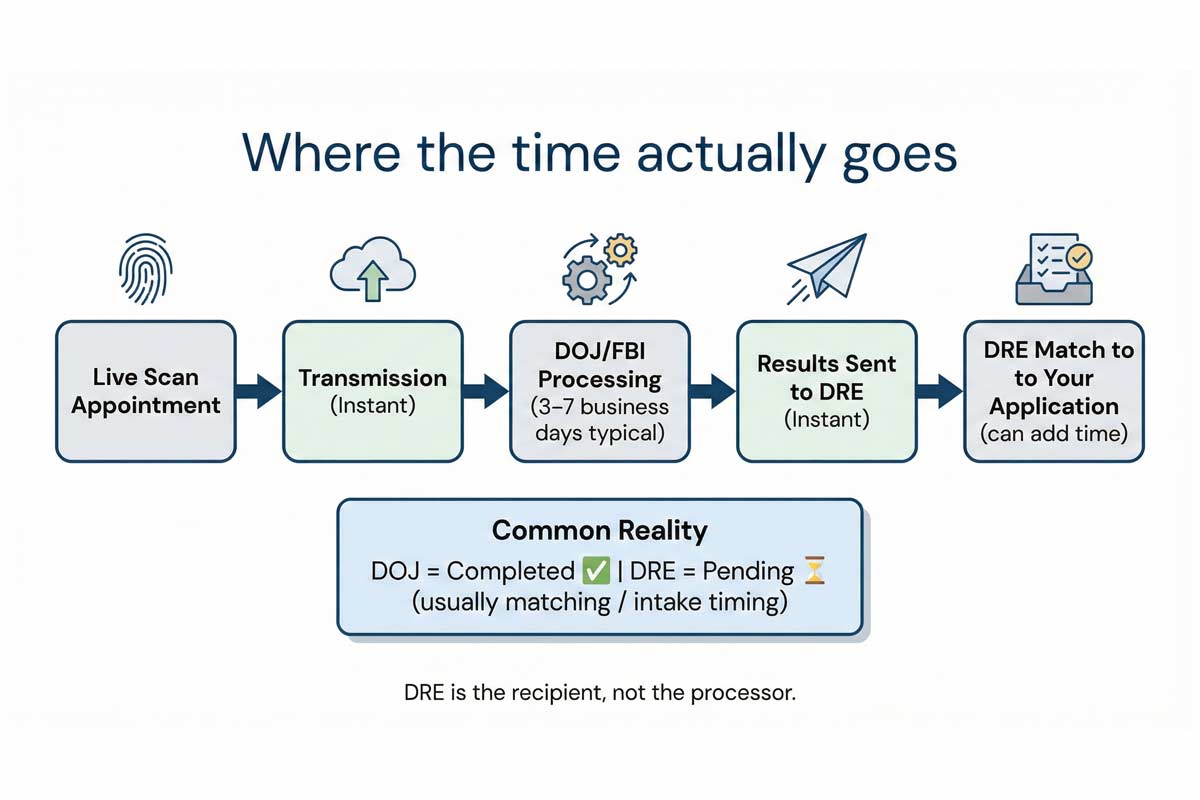
- Common Live Scan Timing: DOJ often completes initial processing within 3–7 business days, though file matching at the DRE may add time.
- The reader should treat all timelines as highly variable: Estimates and always consult the DRE and DOJ websites for the most current official information.
- Out-of-State Hard Cards: This process relies on mail and manual handling; plan for a timeline that can extend several weeks or longer.
- Critical Dependency: The DRE cannot issue your license until they receive your fingerprint results and complete required review steps.
- Common Delay Cause: Mismatched names (e.g., “Ben” vs. “Benjamin”) or using the wrong ORI code (A0075). The ORI code is input at the Livescan provider and must be input exactly as A0075 to ensure that the prints and background are transmitted to the DRE.
Waiting for your background check to clear can feel like the longest part of getting your real estate license. You’ve passed the real estate school exams, submitted your application, and now you’re stuck in limbo, wondering if something minor in your past is holding everything up.
Fingerprinting is a standard dependency step. While it can be nerve-wracking, delays are usually bureaucratic rather than catastrophic. For most applicants using Live Scan within California, the process is automated and relatively quick. For out-of-state applicants using physical fingerprint cards, a little more patience is required.
In my 20+ years of helping students navigate the California Department of Real Estate (DRE) system, we have found that most “stalled” applications aren’t actually stuck—they are simply moving through the standard queues. This guide breaks down exactly how long the process usually takes, why it might slow down, and how to keep it moving.
Disclaimer: This article is for informational purposes only and does not constitute legal advice. Processing times are estimates based on typical DRE and DOJ workflows. For individual eligibility questions, consult an attorney.
The 30-Second Answer: When Will My Fingerprints Be Processed?
If you are looking for a timeline to plan your career launch, here are the common benchmarks we see.
- In-State (Live Scan): Often 3 to 7 business days.
- Best case (sometimes): ~48 hours.
- Standard: 1 week.
- Buffer: It is wise to plan for 2 weeks to account for volume spikes or matching delays.
- Out-of-State (Hard Cards): Can take several weeks to months.
- Why: These often involve more manual handling and mailing time before they even reach the DRE.
- The "Smart Applicant" Buffer: Do not schedule your “I’m a Realtor party!” until you have your license number in hand. Even after the DRE receives your results, they still need to process the file and complete issuance.
What "Fingerprinting" Actually Is
Many applicants think the DRE is scanning their prints personally. They don’t.
When you get fingerprinted, you are submitting your biometric data to the California Department of Justice (DOJ) (and, when applicable, FBI checks).
This is a "Live Scan." Your prints are digitized and cross-referenced against criminal records (arrests and convictions). The DOJ and FBI then generate a report—either "no record match" or a list of "Hits" (records found)—and transmit that report electronically to the DRE.
Important: The DRE is the recipient, not the processor. They are waiting on the DOJ just like you are.
Step-by-Step Timeline: From Scan to License
Understanding the invisible relay race helps you spot where things might be stuck.
- Scheduling & Submission: You download Form RE 237(Live Scan Service Request) and visit a certified Live Scan provider (often a shipping center, notary, or law enforcement office). You pay the processing fee plus the operator’s rolling fee.
- Transmission (Instant): The operator hits “send.” Your encrypted prints go directly to the DOJ and FBI.
- Processing (Variable): The DOJ and FBI automated systems run the check (often within a few days, sometimes longer if a manual review is triggered).
- Results Transmission (Instant): The system automatically sends the result code to the agency linked to the ORI code you used (specifically, the DRE).
- DRE Match & Update (Variable): This is where delays often happen. Even if the DOJ status shows "Completed," the DRE’s system must receive that digital result and match it to your open license application.
Note on Delays: If DOJ shows "Completed" but DRE still says pending: it’s usually a matching or intake timing issue—not a denial.
The Biggest Reasons It Takes Longer (And How to Fix Them)
If it has been more than two weeks and you haven’t heard anything, one of these culprits is likely to blame.
1. The "Name Mismatch" Trap
- Symptom: You passed your test and did Live Scan weeks ago, but the DRE still says "Pending."
- Likely Cause: You applied for your license as "Michael Smith" but your driver's license (and thus your Live Scan) says "Mike Smith." The DRE’s computer system cannot automatically link the two files.
- Fix: Ensure your name on Form RE 237 matches your DRE application character for character. If you suspect a mismatch, you may need to call the DRE to manually merge the files.
2. Wrong ORI Code
- Symptom: Your results were sent to the wrong agency (like the Board of Nursing or a school district).
- Likely Cause: The operator typed in a generic code or you used an old form.
- Fix: Always use the pre-printed Form RE 237. The ORI Code for the CA DRE is A0075. If this was entered incorrectly, you may need to redo the Live Scan entirely to ensure the DRE receives the data.
3. Application Intake Volume
- Symptom: DOJ completed days ago, but DRE status hasn't budged.
- Likely Cause: Your application itself is still in the intake queue, or there is a backlog in manually associating results during peak seasons.
- Fix: Call the DRE to confirm they have received the transmission and ask if your application is simply in the intake queue.
4. Poor Fingerprint Quality
- Symptom: You receive a rejection notice or a request for a resubmission.
- Likely Cause: Faint ridges due to manual labor, frequent hand-washing, or dry skin. The DOJ system couldn't read the prints.
- Fix: Use a high-quality lotion for a few days before your rescan.
5. Manual Review (The "Hit" Delay)
- Symptom: DOJ processing time drags on for 30+ days.
- Likely Cause: A "Hit" (criminal record) or a name common enough to trigger a manual check against someone else's record. If you're worried about what a "hit" could mean for your license eligibility, this is a good read What the DRE Looks for in Your Background Check.
- Fix: Patience is required here. The DOJ must manually verify that the record belongs to you (or clear you if it's a false match).
Live Scan vs. Out-of-State: Two Different Worlds
Track 1: Live Scan (California Residents)
This is the standard path. It is digital, efficient, and trackable. You walk into a participating Live Scan provider, put your hands on the glass, and you are done in 10 minutes. You get an ATI Number (Applicant Transaction Identifier) at the bottom of your form. Keep this number—it is your tracking ticket.
Track 2: Hard Cards (Out-of-State)
Live Scan is primarily available in California. Most out-of-state applicants must use physical fingerprint cards (FD-258) unless they travel to CA.
- The Delay: The DRE has to physically receive the cards, process the payment, and then forward the cards to the DOJ. The DOJ then has to manually scan them. Hard-card timelines vary based on mail time, card quality, and backlog.
- The Risk: Ink smudges easily. If your hard cards are rejected for quality after waiting several weeks, you often have to start over.
- Pro Tip: If timing is critical, some applicants choose to travel to California to complete a Live Scan in person and reduce potential delays.

Delay-Proof Checklist
To minimize friction, treat the paperwork as seriously as the exam:
If It’s Taking Too Long: Escalation Ladder
What to do today:
- Check your ATI number.
- Verify your name spelling on your receipt.
- Check the online DOJ status tool.
If it has been longer than typical timeframes, follow this ladder:
- Check the DOJ Status: Go to the California DOJ Background Check Status website. Enter your ATI Number and Date of Birth.
- Note: This tool reflects DOJ processing status; it doesn’t guarantee the DRE has matched it to your application yet.
- Status "In Process": The delay is at the DOJ/FBI level. The DRE cannot help you yet.
- Status "Completed": The results were sent to the DRE. Now the ball is in their court.
- Verify Your Info: Double-check your copy of the form. Did the operator transpose digits in your identifying information?
- Contact the DRE: If the DOJ says "Completed" but the DRE status hasn't updated in 10 business days, call the DRE Licensing line. Have your ATI number ready and ask if there is a "matching issue" with your file.
Important Distinction: Processing vs. Evaluation
It is vital to understand that "processing" and "evaluation" are two different steps.
Processing is simply the DOJ confirming your identity and sending a list of records (if any) to the DRE.
Evaluation is the DRE reviewing those records to decide if you meet the standards of honesty and truthfulness required to hold a license. If you have a past conviction, the "processing" might finish quickly, but the "evaluation" could take weeks while a DRE review team examines your case.
Your Next Step
Fingerprinting is a hurdle, not a wall. While you wait for the results, focus on what you can control: preparing for your exam and interviewing brokerages.
Most delays are solvable, and the vast majority of applicants see their results clear without issue. If you are just starting your journey and want to ensure every step—from coursework to application—is handled correctly, check out our comprehensive California Real Estate License Guide.