

Disclaimer: This article is for educational purposes. It is not legal advice. Always consult your managing broker and/or attorney for guidance.
In the high-speed environment of California real estate, paperwork can feel like an obstacle to a deal. However, the Agency Disclosure (Form AD) is not just "another form"—it is a consumer protection shield. For a new agent, the goal is to present this document as a tool for clarity.
Agent Script: "This form answers one question: Who do I work for? It’s not about commission—it’s about loyalty. It explains your options—buyer’s agent, seller’s agent, or dual agency—so you know exactly where my loyalty sits before we go any further."
The sole purpose of Form AD is transparency. It educates the consumer on the types of real estate agency relationships available and the "fiduciary duties" (utmost care, integrity, and loyalty) that brokers owe their clients.
Where You’ll See This Form: Agency disclosure rules apply to transactions covered by the statute’s definitions—commonly 1–4 residential sales/leases, and they also extend to commercial real property transactions under the Civil Code definitions.
California licensing law and brokerage policy still require clear disclosure and consent when your role changes—especially regarding dual agency.
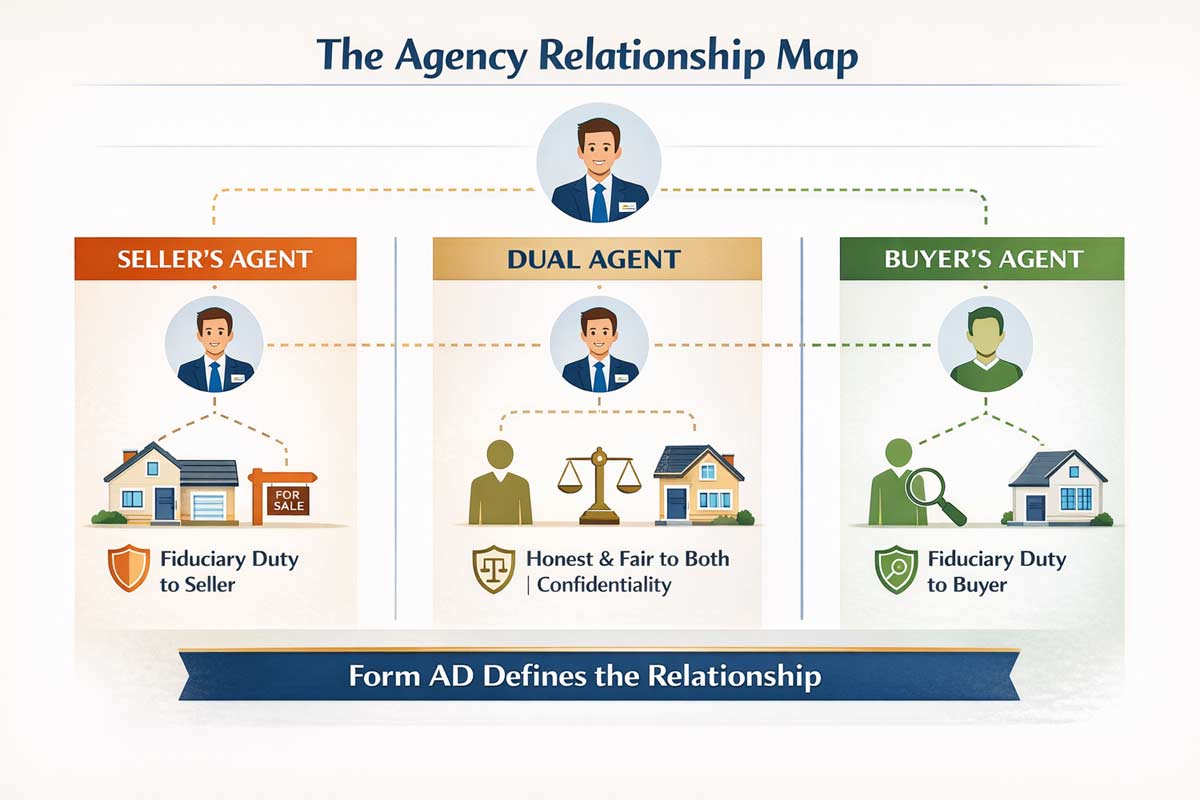
As we emphasize in our training courses, you must be able to explain the "Big Three" relationships without hesitation.
| Agency Type | Who is the Client? | What You Owe | What You Cannot Do | One-Sentence Client Explanation |
|---|---|---|---|---|
| Seller’s Agent | The Seller | Utmost care, integrity, honesty and loyalty. | Cannot disclose the client’s confidential bargaining position (bottom line, motivations, price flexibility) without permission. | "I represent the Seller's interests exclusively to get them the best terms possible." |
| Buyer’s Agent | The Buyer | Utmost care, integrity, and loyalty. | Cannot disclose the client’s confidential bargaining position (bottom line, motivations, price flexibility) without permission. | "I am your advocate, focused solely on finding you the right home and protecting your interests." |
| Dual Agency | Both Parties | Fiduciary duty (utmost care, integrity, honesty, loyalty) to both parties; honest and fair dealing/good faith; reasonable skill and care; disclosure of known material facts; and required confidentiality. | Cannot disclose the client’s confidential bargaining position (bottom line, motivations, price flexibility) without permission. | "I facilitate the deal for both sides, but I cannot use one side's confidential info to advantage the other." |
These are three separate legal requirements. Treat them like three boxes you must check—for every file.
Use this table to guide your client through the document visually.
| Chunk | What it Means | What to Say (Script) |
|---|---|---|
| Definitions | Explains the legal roles of agents. | "This front page defines our potential roles so you know exactly how the law views our relationship." |
| Affirmative Duties | Lists the broker's legal obligations. | If I represent you exclusively, I’m legally bound to put your interests first while treating the other party honestly. If dual agency happens, I owe duties to both sides and can’t use one side’s confidential info to benefit the other. |
| Dual Agency Limits | Sets rules for representing both sides. | "If dual agency happens, I can't reveal your bottom line price or motivations to the other side without your permission." |
| Acknowledgment | Confirms receipt of the information. | "Your signature here just confirms I’ve given you this disclosure as required by California law." |
"So does this mean you represent me now?"
"Not by itself. This form explains the possible agency relationships. Whether I represent you depends on what we agree to and how we proceed—but I’m treating this seriously up front so there’s no confusion later."
"Are you saying you might represent the other side too?"
"It’s a possibility. If it happens, I move into a 'Dual Agency' role. My job is to handle the transaction for both sides, but the law forbids me from sharing your confidential bargaining position with the seller. And if dual agency ever becomes a possibility, we stop and get your written consent before moving forward."
Q: Why is agency discussed again in the purchase contract?
A: Because California law requires the agency relationship to be confirmed in the purchase contract (or a separate writing) prior to or coincident with execution.
Q: What if my client refuses to sign?
A: Under Civil Code §2079.15, if a client refuses to sign, you must prepare, date, and sign a written declaration that explains the form was provided but the client declined to acknowledge it.
Mastering Form AD is the first step in becoming a high-level professional. This transparency prevents the misunderstandings that lead to cancellation rights in California real estate transactions being invoked later.
For more, visit our guide on C.A.R. forms every new agent should know or learn about California anti-fraud rules.
Ready to master the business? Visit our California Real Estate Laws & Compliance Guide for advanced training.

Founder, Adhi Schools
Kartik Subramaniam is the Founder and CEO of ADHI Real Estate Schools, a leader in real estate education throughout California. Holding a degree from Cal Poly University, Subramaniam brings a wealth of experience in real estate sales, property management, and investment transactions. He is the author of nine books on real estate and countless real estate articles. With a track record of successfully completing hundreds of real estate transactions, he has equipped countless professionals to thrive in the industry.


"Hey guys,
I took the exam today and passed!!!!
It only took me one try which was one of my goals. I took the online
classes and follow your suggestions so I took the crash course,
used the crash course app a lot, took 7 mock tests and went
confident to present the exam. Thank you for the great job you are
doing, you guys are awesome!!!! May God continue to bless you!"
Willie V.