
Written and reviewed by Kartik Subramaniam, California Real Estate Broker, DRE License #01356544, and Founder of ADHI Schools
Last reviewed for accuracy: July 15, 2026
California real estate license renewal is a compliance process—not simply the purchase of a 45-hour course package. A salesperson, broker, or licensed corporation officer must determine the applicable continuing education requirement, complete qualifying courses, submit the correct renewal filing, answer the application’s disclosure questions, pay the Department of Real Estate fee, and verify that the public license record has been updated.
California real estate licenses are generally issued for four years. Most salespersons and brokers must complete 45 clock hours of DRE-approved continuing education during the applicable qualifying period. The required course composition changes depending on whether the licensee is renewing an original license for the first time or completing a second or subsequent renewal. Brokers have an additional Management and Supervision subject requirement at the first renewal of the original broker license.
An expired license does not ordinarily authorize continued licensed activity. A licensee who files a qualifying renewal on time may be permitted to continue operating while the DRE processes the application under Business and Professions Code section 10156.2, unless the DRE notifies the licensee otherwise. That protection is different from the two-year late-renewal period available after a missed expiration date.
Use this guide to identify the correct renewal path, avoid an interruption in licensed authority, and reach the detailed supporting guide for each issue. For unusual facts involving discipline, restricted status, criminal disclosures, military service, entity licensing, or mortgage-loan-originator endorsements, confirm the current procedure directly with the DRE or qualified counsel.
The DRE—not the CE provider—renews the license. Current requirements appear in the DRE’s continuing education guidance, while filing rules and renewal options appear in itslicense-renewal instructions. Fees and administrative procedures can change, so confirm the current requirements before filing.
Use the expiration date and the DRE public record to place the license into the correct operating category before buying courses or filing forms.
Confirm whether the upcoming renewal is the first renewal of the original license or a subsequent renewal. Inventory any CE already completed during the applicable four-year period, verify that each course was approved, and identify missing mandatory subjects. The application ordinarily cannot be submitted until the 90-day filing window opens, but qualifying CE may be completed earlier.
Complete any remaining CE, gather course numbers and completion dates, review the application’s disclosure questions, and submit the renewal. eLicensing is generally the most efficient path for an ordinary individual renewal, although certain exemptions, extensions, restricted licenses, officer licenses, and disclosure situations may require paper forms or supporting documentation.
A non-working license status is not the same as an expired license. A salesperson shown as “Licensed NBA” generally has no responsible-broker affiliation and cannot perform acts requiring a real estate license. The license can still be renewed, and the normal CE requirement still applies unless the licensee qualifies for a recognized exemption or extension.
The license generally remains eligible for late renewal, but the licensee cannot perform licensed activity until the late-renewal requirements have been satisfied and the DRE has processed the renewal. The higher late fee applies. Do not wait until the final days of the two-year period to begin CE or prepare the filing.
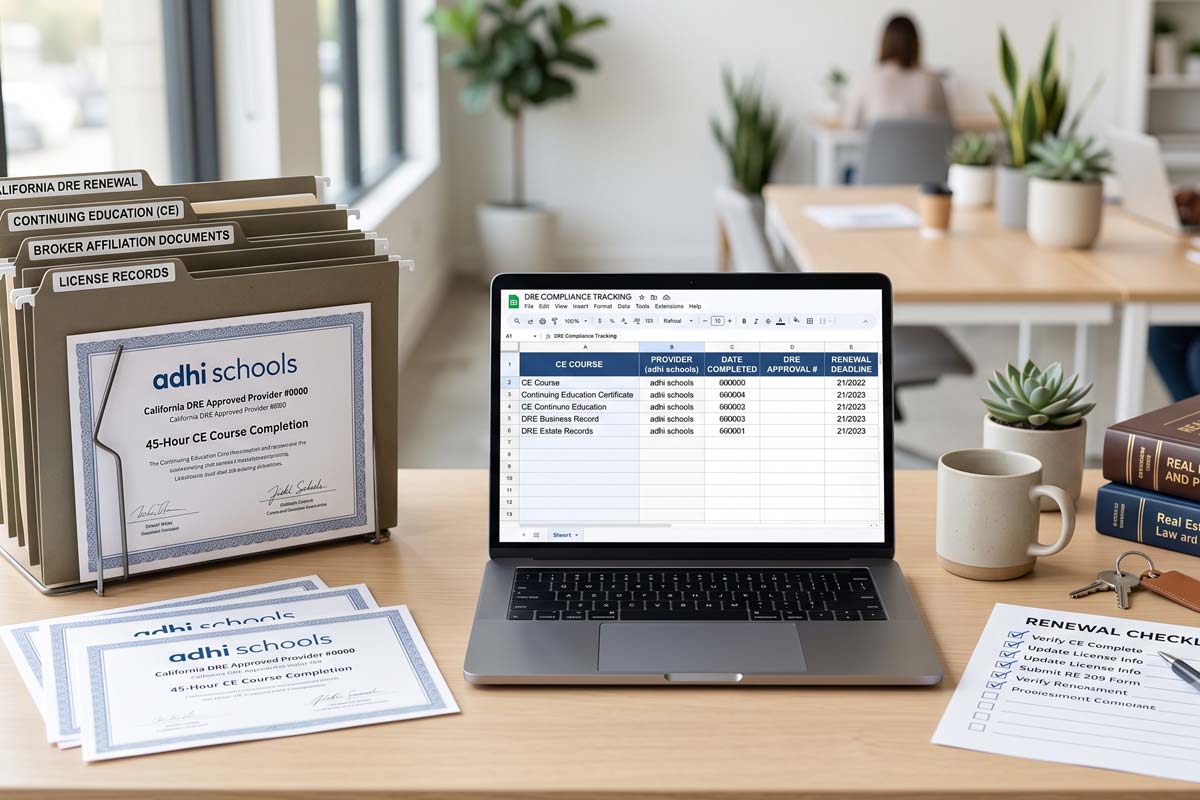
The baseline California real estate license renewal requirements for 2026 are straightforward: identify the license type, determine whether this is a first or subsequent renewal, complete the correct CE combination, file within the proper window, answer every application question accurately, and pay the required fee.
Problems begin when a licensee treats every advertised “45-hour package” as interchangeable. The total hours may be correct while the mandatory-subject mix is wrong for the license type or renewal number.
A salesperson renewing an original salesperson license for the first time generally must complete:
A broker or corporation officer renewing an original license for the first time generally follows the same structure but must also complete three hours of Management and Supervision.
For a second or subsequent renewal, a salesperson or broker may generally complete one nine-hour survey course covering the seven mandatory subjects or complete those subjects through separate courses. The renewal must also include at least 18 hours of Consumer Protection education, with the remaining hours in approved Consumer Protection or Consumer Service courses.
The detailed California continuing education hour requirements matter because certificates adding up to 45 numerical hours can still produce a deficient renewal.
The DRE considers whether:
For an on-time renewal, CE generally must fall within the four-year period applicable to the renewal. For a late renewal, the relevant four-year lookback generally runs from the date the DRE receives the late application. CE credit expires four years after completion and cannot be reused for a later renewal.
Course-provider study and examination controls also affect how quickly a package can be completed. Do not wait until the expiration date and assume 45 hours can be compressed into a few hours of clicking. Allow time for study requirements, examinations, certificate issuance, corrections, and the state filing itself.
Only qualifying DRE-approved offerings should be claimed. The guide to courses that count toward California continuing education explains how to verify the course title, DRE approval number, sponsor identity, approved hours, category, approval period, and completion date.
Prelicensing courses, examination-preparation products, association designations, NMLS education, brokerage onboarding, coaching programs, and general professional-development courses do not automatically satisfy California real estate CE. A course may be useful and still be ineligible for renewal credit.
During renewal, licensees ordinarily enter course information through eLicensing or report it on the applicable CE verification form. Completion certificates are generally retained rather than routinely submitted, unless the DRE requests them during an audit or deficiency review.
The current California implicit bias training requirement is not an optional elective. A first renewal includes a separate two-hour Implicit Bias Training course, and implicit bias is one of the seven mandatory subjects covered during subsequent renewals.
Fair Housing is a separate three-hour requirement. The fair housing course must include the DRE-required interactive participatory component, including role-play from both the consumer’s and real estate professional’s perspectives.
A licensee whose previous renewal occurred before the current rules took effect should not assume that an older CE package remains sufficient. Verify that the current package includes both compliant Fair Housing education and Implicit Bias Training.
The California broker continuing education requirements reflect the broker’s responsibility for affiliated licensees, trust funds, advertising, office systems, document review, and licensed activity.
At the first renewal of an original broker license, Management and Supervision is a separate three-hour mandatory course. During a second or subsequent renewal, it is included among the seven subjects covered by the nine-hour survey course or separate-course alternative.
A broker who is also a designated corporation officer should confirm which license or licenses are being renewed. An individual broker license and an officer license should not automatically be treated as a single administrative filing.
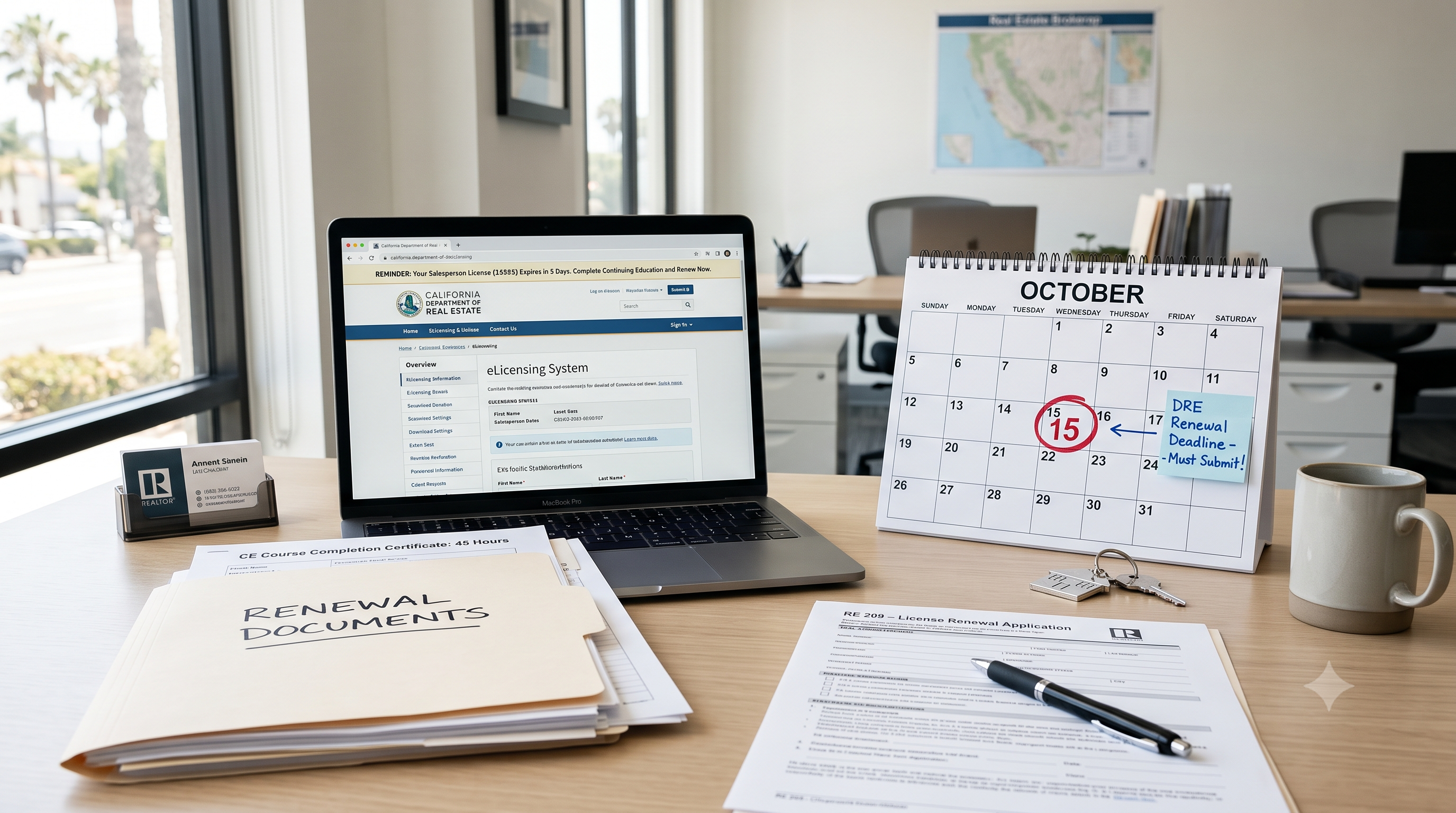
The safest process for renewing an active California real estate license begins before the 90-day filing window.
The licensee should:
Most eligible individual licensees can renew through eLicensing. Enter each course exactly as shown on the completion certificate, answer every background and disciplinary question accurately, pay the fee, and retain the final confirmation.
Do not assume that a credit-card charge, course certificate, or provider completion email proves the state license was renewed.
When a qualifying renewal is filed on time, Business and Professions Code section 10156.2 may permit continued operation after the printed expiration date while the DRE processes the application. That protection depends on timely filing and can end if the DRE sends notice otherwise.
The procedure to renew a recently expired California license is a late renewal—not an extension of active status.
An individual salesperson or broker generally has two years immediately following expiration to satisfy the late-renewal requirements. Those requirements ordinarily include:
During the expired period, acts requiring a California real estate license may not be performed. A salesperson should stop solicitation, negotiation, transaction work, property-management activity requiring a license, and other licensed services. The responsible broker should remove the salesperson from active production systems and confirm renewed status before authorizing a return to work.
A late renewal is not effective simply because the application was mailed or submitted. The required filing must be received, accepted, and processed by the DRE.
The practical consequences of a California real estate license expiring extend beyond the status shown in the public record.
Expiration can affect:
A salesperson should notify the responsible broker immediately so active files can be reassigned or handled properly. Compensation questions can depend on when services were performed, whether additional licensed activity occurred after expiration, and the brokerage agreement. Do not assume that compensation is automatically payable or automatically forfeited without reviewing the facts.
Expiration also affects the CE lookback. Courses that would have qualified on the original expiration date can age out while the former licensee waits to file a late renewal.
The two-year period is not a grace period to continue practicing. It is a limited opportunity to apply for late renewal.
A person seeking to reinstate a long-expired California real estate license should first calculate the exact date on which the two-year late-renewal right ended.
Once that right is forfeited, the DRE does not ordinarily process the matter as a renewal. The former licensee generally must apply for a new license under the requirements in effect at that time. The process may involve:
Do not state categorically that every former licensee must repeat every prelicensing course. Previously accepted education may remain on file, while changes in law or the applicant’s individual history may create additional requirements.
A formerly licensed broker should not assume that previous broker status can be restored automatically.
The California late-renewal fees and deadlines should be treated as hard operating controls.
The late-renewal deadline is measured from the actual expiration date—not from the date the former licensee discovers the lapse, stops working, receives a reminder, or decides to return to the industry.
Fees are subject to change. Confirm the current amount on the DRE's official fee schedule immediately before filing.
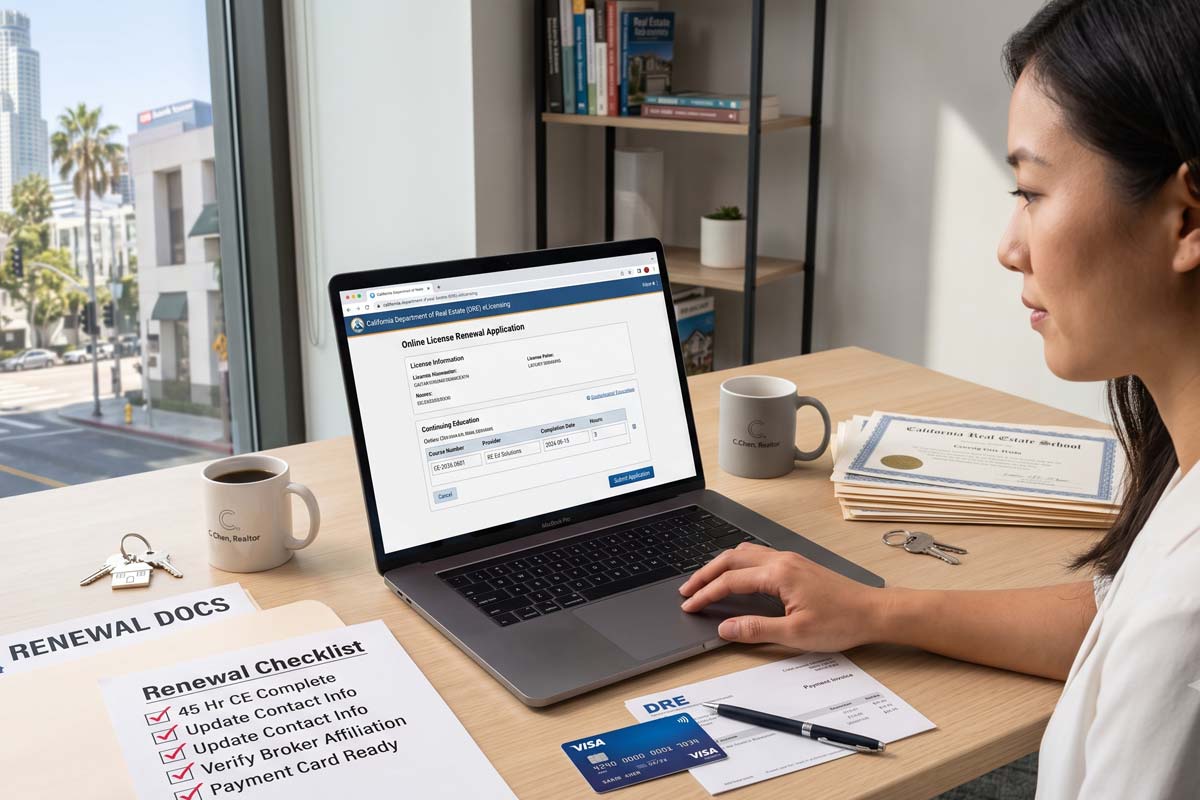
The procedure to submit a California license renewal application should be completed in a controlled sequence:
For an on-time paper filing, preserve evidence of the official U.S. Postal Service postmark. A private postage-meter date may not provide the same proof of timeliness. Use a trackable mailing method and retain the receipt.
Avoid duplicate online and paper submissions unless the DRE instructs you to file again.
The current California real estate license renewal processing times should be checked close to the filing date because DRE workload and queue dates change.
Processing can differ based on:
eLicensing is generally faster for an eligible ordinary renewal, but online filing does not cure an incomplete or inaccurate application. Do not promise a universal number of processing days. Consult the DRE’s current processing timeframes when timing is material.
The cost to renew a California real estate license has at least two components:
Additional costs can arise from:
Do not choose a CE provider solely on the advertised price. A package that omits a mandatory subject or does not match the renewal type may cost far more in delay and correction than the original savings.
A dedicated California real estate license renewal checklist reduces errors by assigning a completion date to each task.
The renewal file should include:
Brokerages should also maintain an internal license-control calendar for affiliated salespersons and broker associates. Office reminders should begin well before the DRE courtesy notice.
The most common California license renewal mistakes are usually operational rather than legally complex.
Typical failures include:
When criminal, disciplinary, tax, child-support, or restricted-license issues are involved, obtain case-specific guidance before certifying the application.
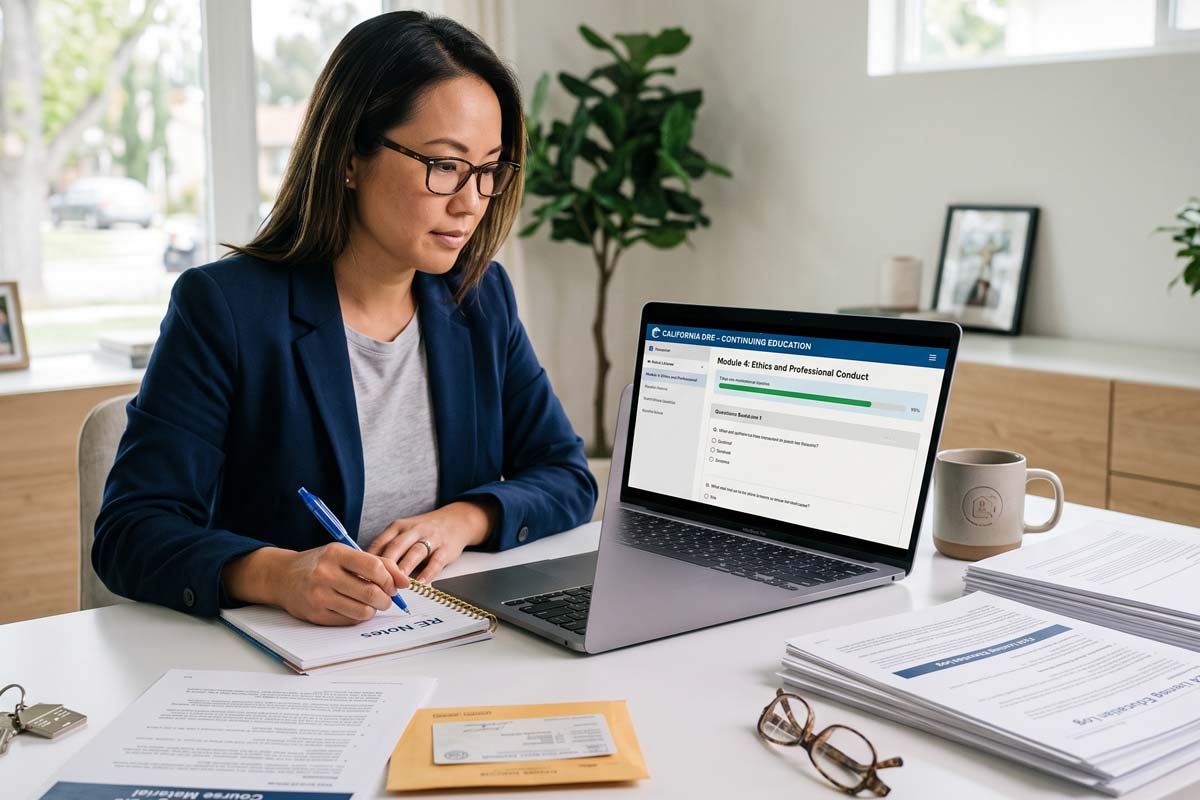
The DRE advertising rules that apply after renewal continue to govern websites, email, social profiles, signs, direct mail, listing presentations, and automated campaigns.
Renewal does not validate advertising that uses an inaccurate:
California first-point-of-contact solicitation materials generally require the appropriate licensee and responsible-broker identification. Advertising must also be truthful and not misleading.
After renewal, audit every live profile and automated campaign. If the license expired, pause scheduled advertising and other licensed solicitation until the authority to operate has been restored and verified.
Use the proper process for updating a name, address, or brokerage with the DRE whenever the licensing record is inaccurate.
eLicensing can handle many address and affiliation changes. Name changes and certain broker, corporation officer, entity, or restricted-license changes may require forms and supporting documentation.
Current email and mailing information are critical because the DRE may send:
Failure to receive a courtesy reminder does not extend the expiration date. Review privacy implications before using a residence address on a filing that may become part of the public record.
A reliable method for choosing a legitimate California CE provider is to verify the exact courses in the DRE’s approved-course database before enrolling.
Check:
The provider should clearly explain whether the package is designed for a salesperson’s first renewal, a broker’s first renewal, or a second or subsequent renewal.
The DRE conducts CE audits. Its current guidance recommends retaining completion certificates for up to five years. Store the records in a durable personal file that will remain accessible after a brokerage, employer, or email-account change.
A licensee can generally renew a California real estate license from out of state through eLicensing when eligible.
Living elsewhere does not eliminate California:
An out-of-state licensee should confirm that the DRE has current contact information and that any required Consent to Service of Process is on file. A broker conducting California business may also need to address California business-location requirements.
Proposed activity can implicate the licensing laws of more than one state. Maintaining a California license does not automatically authorize brokerage activity in another jurisdiction.
The California military renewal rules and exemptions are narrower than a blanket waiver.
Under qualifying circumstances, active-duty service with a permanent assignment outside California during the final portion of the license period may support a request for a limited CE extension. The request ordinarily requires:
Military status can also intersect with separate statutory protections or registration pathways for qualifying servicemembers and spouses. Apply the rule to the individual’s actual status and orders rather than assuming every military connection produces the same result.
The California renewal rules for attorneys are frequently misunderstood.
Membership in the State Bar of California can affect certain original-license educational prerequisites. It does not create a general exemption from the DRE’s 45-hour renewal CE requirement.
An attorney-licensee should expect to complete the applicable real estate CE unless the person independently qualifies for a recognized exemption or extension. Continuing legal education and DRE continuing education are separate systems unless a particular course has the approvals required for both.
The industry term “referral status” does not itself create a DRE exemption. A salesperson renewing a California license while on referral status may be shown as Licensed NBA, indicating no responsible-broker affiliation and no current authority to perform licensed acts.
The license can still be renewed to preserve future options. The ordinary CE and filing rules continue to apply unless a recognized exemption or extension applies.
Before making or accepting a referral, confirm:
A private company’s “referral status” label cannot expand the authority shown in the DRE record.
The renewal requirements for dual-licensed mortgage and real estate professionals operate on separate calendars.
A California salesperson or broker license generally renews on a four-year cycle and ordinarily requires 45 hours of DRE-approved CE. A mortgage-loan-originator endorsement generally renews annually through NMLS and has separate education, sponsorship, filing, and fee requirements.
DRE CE does not automatically substitute for NMLS CE. The DRE 70/30 exemption does not automatically waive NMLS requirements.
Maintain separate compliance records for:
A California real estate licensee may request a continuing education exemption when the licensee:
The exemption is not automatic. A first-time request generally requires the applicable DRE extension/exemption form, the renewal application, the renewal fee, proof of age, and documentation of the qualifying license history.
Once approved, the exemption generally continues for later renewals while the license remains in good standing. If good standing is lost, the previously approved exemption can terminate. Verify the current procedure through the DRE’s 70/30 exemption guidance.
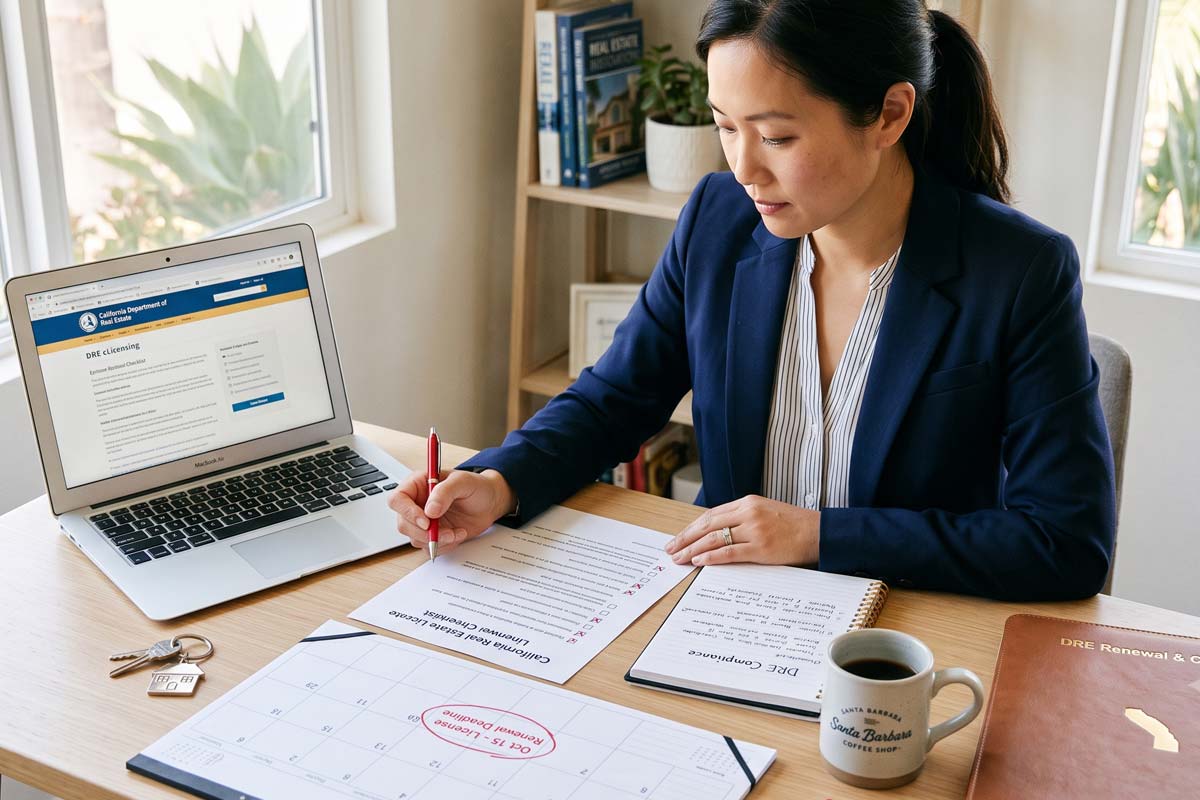
The operating checklist for what to do after renewing a California real estate license begins with the DRE public record.
Confirm:
Save the renewed license certificate and provide the updated record to the responsible broker, compliance department, MLS, association, referral company, lender, or employer where appropriate.
Then review:
For a late renewal, do not assume the renewed license retroactively authorized work performed while the license was expired.
The practical value of continuing education in preventing DRE violations depends on whether the material is converted into office procedures.
Mandatory subjects correspond to recurring compliance risks:
After renewal, select at least one control to update from each major subject. Examples include:
Renewal should close one compliance cycle and begin the next.
Use this checklist for an ordinary salesperson or broker renewal. Add case-specific items for disclosures, restricted licenses, corporation officers, entities, military extensions, or MLO endorsements.
A 45-hour requirement should not be managed as a final-day task. Study periods, examination controls, certificate corrections, and filing problems consume time. Begin several weeks before expiration and preferably before the 90-day filing window opens.
A CE provider issues education records. It does not renew the state license.
The licensee must still:
The two-year late-renewal right preserves an application option. It does not ordinarily preserve authority to perform licensed activity.
Stop licensed work until the renewal becomes effective unless a documented on-time filing provides continued authority under section 10156.2.
Confirm whether the package is designed for:
The phrase “45-hour package” does not prove that the subject combination is correct.
Course numbers, completion dates, and hours should match the certificates. Do not substitute a sponsor number for a course number or guess when eLicensing rejects an entry.
Incomplete or inaccurate disclosure responses can delay the application and may create separate compliance problems. Obtain records and appropriate advice before certifying an answer when the response is uncertain.
The DRE sends important correspondence to the addresses on file. Update email and mailing information promptly and monitor both during processing.
The final control is the DRE public record. A submitted transaction, payment receipt, or course certificate is not a substitute for verifying the renewed license, new expiration date, and correct broker affiliation.
California salesperson and broker licenses are generally issued for four-year periods. The exact expiration date appears in the DRE public license record and on the license certificate.
Most renewing salespersons and brokers must complete 45 clock hours of DRE-approved continuing education unless an approved exemption or extension applies.
A first renewal requires separate mandatory courses, including the current Fair Housing and Implicit Bias Training requirements. A second or subsequent renewal may use the nine-hour survey course covering the seven mandatory subjects or complete those subjects separately.
No. Brokers generally complete the same 45-hour total. The first renewal of an original broker license includes Management and Supervision as a separate mandatory three-hour subject.
The current on-time DRE fee is $350 for a salesperson and $450 for a broker. The current late-renewal fees are $525 and $675, respectively. CE tuition is separate.
The DRE ordinarily accepts a renewal beginning 90 days before the expiration date. Qualifying CE can be completed earlier, provided it remains within the applicable period when used.
An online filing is generally on time when the eLicensing transaction is completed before midnight on the expiration date. A paper filing generally requires a qualifying official postmark by that deadline. Preserve proof.
Possibly. Business and Professions Code section 10156.2 may permit continued operation when a qualifying renewal was submitted on time, unless the DRE provides notice otherwise. This is not the same as filing after expiration.
The licensee ordinarily loses authority to perform acts requiring a real estate license. A salesperson should notify the responsible broker immediately and stop licensed activity until the license is renewed.
No. The two-year period provides an opportunity to apply for late renewal. It is not authority to practice while the license remains expired.
Ordinary renewal rights are forfeited. The former licensee generally must apply for a new license under the requirements then in effect and pass the applicable examination.
Not ordinarily. Licensees generally report and certify the course information through eLicensing or the applicable paper form. Keep the certificates because the DRE can request them during an audit or deficiency review.
The DRE currently recommends retaining completion certificates for up to five years. Keep them in a personal compliance file rather than relying only on a brokerage or old email account.
Yes. A salesperson can generally renew without a responsible-broker affiliation and remain or become inactive. The salesperson must be properly affiliated before performing activities requiring a license.
Generally, yes. The licensee must still satisfy California CE, filing, fee, disclosure, and recordkeeping requirements and should verify any applicable nonresident filing requirements.
A narrow exemption is available to qualifying licensees who are at least 70 years old and have been licensed in good standing in California for at least 30 continuous years. The exemption requires DRE approval and is not automatic.
A compliant California real estate license renewal has four completed controls:
Begin before the deadline, use only approved courses, distinguish on-time-processing protection from late-renewal eligibility, and stop licensed activity whenever the public record does not support it.
For an ordinary renewal, the workflow is direct: complete the correct 45-hour package, submit the renewal, save the evidence, and verify the new expiration date.
For an expired license, exemption, extension, restricted status, military issue, officer license, out-of-state record, or MLO endorsement, resolve the exception before certifying the application.
California Real Estate Broker, DRE License #01356544
Founder, ADHI Schools
ADHI Schools DRE Statutory Sponsor ID S0348
ADHI Schools Continuing Education Sponsor No. 6404

Founder, Adhi Schools
Kartik Subramaniam is the Founder and CEO of ADHI Real Estate Schools, a leader in real estate education throughout California. Holding a degree from Cal Poly University, Subramaniam brings a wealth of experience in real estate sales, property management, and investment transactions. He is the author of nine books on real estate and countless real estate articles. With a track record of successfully completing hundreds of real estate transactions, he has equipped countless professionals to thrive in the industry.

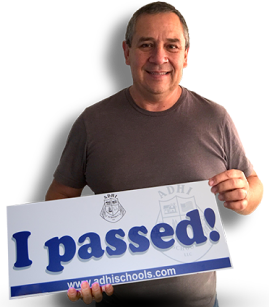
"Hey guys,
I took the exam today and passed!!!!
It only took me one try which was one of my goals. I took the online
classes and follow your suggestions so I took the crash course,
used the crash course app a lot, took 7 mock tests and went
confident to present the exam. Thank you for the great job you are
doing, you guys are awesome!!!! May God continue to bless you!"
Willie V.