

If you're thinking about a career in real estate, the question often isn't "can I do this?"
It's "how long is this going to take — and can I dedicate the time?"
Maybe you're working full-time. Maybe you've seen ads promising you can "get licensed in days" and something about that felt too good to be true.
Your instincts are right.
In my 20-plus years of training California licensees, I've heard of some students who plan their careers around a marketing claim, only to discover the Department of Real Estate (DRE) has its own timeline — and it always wins.
So let's clear up the confusion between what the ads promise and what the rules actually allow, and give you a realistic path forward.
Key Takeaways
Here's the answer up front, because you deserve one. The fastest legal path through California's required pre-licensing education is roughly 7.5 weeks or 54 days — that's the floor set by DRE course-timing regulations, not by any school. Most students, balancing coursework with a job and a life, finish in 3 to 4 months. Students studying part-time on nights and weekends typically land in the 5 to 6 month range. Anyone promising you a licensed-in-two-weeks shortcut is selling something the DRE doesn't allow.
California requires every real estate salesperson candidate to complete three college-level courses totaling 135 hours of instruction: Real Estate Principles, Real Estate Practice, and one elective (many students choose Legal Aspects of Real Estate or Real Estate Finance).
Each course carries 45 hours of coursework and ends with a final exam you must pass to earn your required certificate of completion for each course. If you want the full breakdown of what each course covers and how the electives compare, see our guide to the mandatory 135-hour real estate course.
Keep in mind, too, that finishing your classes is just one step in the full California real estate license process — the exam application, background check, and state exam all come after.
Now look at that fast-track row again, because this is where most students get tripped up.
The Misunderstanding: "I have a free week off work. I'll just knock out all 135 hours in seven days."
The Reality: You can't — and it has nothing to do with your school. DRE regulations impose a minimum completion time per course, commonly cited as 18 days per 45-hour course, with limits on how the three courses can be staggered. In practice, that puts the floor for the full three-course package at roughly 7.5 to 8 weeks no matter how many hours a day you study.
The reasonable read on why the rule exists: it's meant to ensure students actually absorb the material rather than speed-clicking through screens. Whatever the rationale, the rule is the rule, and reputable schools build their pacing around it.
The Scenario: A student I'll call Maria gave notice at her job after seeing an ad implying she'd be licensed within the month. She blazed through Real Estate Principles, then hit the regulatory clock — and spent six weeks between paychecks, watching her savings shrink while she waited out a timeline she could have planned around from day one.
The Takeaway: Build your calendar around the DRE minimum, not the marketing. If speed matters to you, there are smart, legitimate ways to compress the schedule — we cover them in our guide to the fastest way to complete the 135-hour course.

Beyond the regulatory floor, three variables do most of the work in determining your finish date.
Course format. Self-paced online programs let you study at 6 a.m. or midnight, which usually means faster completion for disciplined students. Live classes provide structure and accountability but run on a fixed schedule. Weigh the trade-offs in our comparison of online vs. in-person classes before you enroll — format choice alone can swing your timeline by a month or more.
Course final exams and retakes. Each of the three courses ends with a final exam, and a failed attempt can add days or weeks while you review and wait to retest. It happens more often than students expect, and it's recoverable — our article on whether you can fail real estate school walks through the retake process and practical steps to avoid needing it.
Life. Work deadlines, family obligations, and plain old procrastination stretch more timelines than any regulation does. In my experience, the students who finish fastest aren't the smartest — they're the ones who put study blocks on the calendar and protect them like client appointments.
One last reality check: completing your 135 hours doesn't make you licensed. After your coursework, you'll submit your state exam application to the DRE, wait for processing, schedule and pass the state exam, and complete fingerprinting and the background check. DRE processing times fluctuate with application volume, so budget additional weeks — sometimes a couple of months — between your last course final and your first day as a licensee.
Speed matters, but it isn't the goal — passing the state exam on your first attempt is. A student who finishes in eight weeks but retained nothing will lose all that saved time (and exam fees) on the back end. At ADHI Schools, we build our courses to move you through the 135 hours as efficiently as the DRE allows while making sure the material actually sticks. If you're ready to start the clock, we're ready to help you finish it.
Disclaimer: This article is educational information, not legal advice or a guarantee. Individual timelines vary based on pace, format, and scheduling. DRE processing times and course-timing regulations are subject to change; the figures here are estimates, and current requirements should be verified directly with the California Department of Real Estate.
What is the minimum time the DRE allows to finish real estate classes in California?
DRE course-timing regulations set a minimum completion time per course — commonly cited as 18 days per 45-hour course — which puts the practical floor for the full 135-hour, three-course package at roughly 7.5 to 8 weeks, regardless of how quickly a student works.
Can I finish California real estate school in 2 weeks?
No. Even studying full-time, DRE regulations prevent completing the three required courses in two weeks. The fastest legal timeline is roughly 7.5 to 8 weeks. Any advertisement implying a two-week path to licensure is misleading about what state rules allow.
Is online real estate school faster than in-person classes in California?
Often, yes. Self-paced online programs let disciplined students study on their own schedule and finish closer to the DRE minimum. Live classes sometimes follow a fixed calendar, which adds structure but less flexibility. Both formats should satisfy the same 135-hour requirement.
What happens after I finish the 135 hours?
You'll apply to the DRE for the state salesperson exam, complete fingerprinting and a background check, then schedule and pass the exam. DRE processing times vary with volume, so expect additional weeks — sometimes longer — between finishing coursework and becoming licensed.
Does failing a course final exam delay my timeline?
It can. Each of the three courses requires a passing final exam, and a failed attempt adds review and retake time. Most schools allow retakes, so a failure is a delay rather than a dead end — but building in solid study habits helps you avoid it.

Founder, Adhi Schools
Kartik Subramaniam is the Founder and CEO of ADHI Real Estate Schools, a leader in real estate education throughout California. Holding a degree from Cal Poly University, Subramaniam brings a wealth of experience in real estate sales, property management, and investment transactions. He is the author of nine books on real estate and countless real estate articles. With a track record of successfully completing hundreds of real estate transactions, he has equipped countless professionals to thrive in the industry.

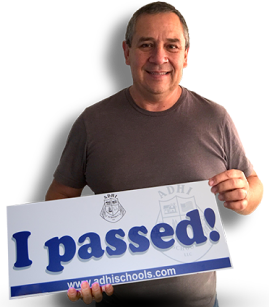
"Hey guys,
I took the exam today and passed!!!!
It only took me one try which was one of my goals. I took the online
classes and follow your suggestions so I took the crash course,
used the crash course app a lot, took 7 mock tests and went
confident to present the exam. Thank you for the great job you are
doing, you guys are awesome!!!! May God continue to bless you!"
Willie V.