Choosing to start a career in real estate is exciting and full of opportunities. But before jumping in, it makes sense to find out what real estate school is about. Doing your homework helps you know what Read more...
Choosing to start a career in real estate is exciting and full of opportunities. But before jumping in, it makes sense to find out what real estate school is about. Doing your homework helps you know what to expect, making it easier to handle the challenges and succeed.
Real estate school should teach you more than just how to pass an exam; it gives you the skills and knowledge you need for your future job. It's essential to check that the school's courses match what you want from your career and that you're ready for the time and work it requires.
Knowing about our school's setup and what the classes are like helps you prepare better. It also shows you what it means to work in real estate, not just how to get your license.
In short, learning about real estate school before you enroll is a smart move. It helps you go in prepared and confident, ready to take on the challenges and grab the opportunities that come with a career in real estate.
Curriculum Deep Dive: Core Components of Your Real Estate Education
To become a licensed real estate agent in California, three specific courses are required: Real Estate Principles, Real Estate Practice, and one elective. Each course is designed to equip aspiring real estate professionals with the knowledge they need to succeed in the industry. Let's explore what each course covers, their importance, and why ADHI Schools recommends "Legal Aspects of Real Estate" as the elective course.
Real Estate Principles
The Real Estate Principles course lays the foundational knowledge every agent needs. It covers a broad spectrum of topics, including property ownership and land use controls, real estate law, and the nuances of property valuation. Understanding these principles is crucial as it provides the groundwork for making informed decisions in buying, selling, leasing, and managing real property. This course is essential because it teaches the theoretical aspects of real estate that are critical for passing the state licensing exam and effectively serving future clients.
Real Estate Practice
Real Estate Practice focuses on the day-to-day operations in real estate, such as listing, selling, leasing, buying, and managing property. This course provides practical knowledge on conducting real estate transactions, including marketing properties, understanding buyer and seller needs, and completing some contract forms. It also teaches critical skills in negotiation and closing transactions. This vital course bridges the gap between theoretical knowledge and practical application, preparing students for real-world real estate activities.
Elective Course: Legal Aspects of Real Estate
ADHI Schools strongly recommends "Legal Aspects of Real Estate " for the elective. This course dives deeper into the legal intricacies of real estate transactions and property law. It covers topics such as contracts, property rights, the legal implications of real estate finance, and recent changes in real estate law and tax regulations. Understanding these aspects is vital for anyone in the field, as it helps protect agents and their clients from legal pitfalls.
By completing these courses, students are well-prepared to take the California real estate licensing exam and embark on a successful career.
Learning Formats & Study Tips: ADHI's Modern Approach to Real Estate Education
At ADHI Schools, we recognize that real estate education needs to be flexible, accessible, and efficient. That's why we've tailored our course offerings to meet the demands of today's learners and industry standards, emphasizing the advantages of remote learning while addressing the limitations of traditional classroom settings.
Self-Study and Instructor-Led Courses
We offer two primary learning formats: self-study and instructor-led courses. Our self-study options provide the utmost flexibility, allowing students to progress at their own pace and schedule. This is ideal for those who need to balance other commitments, such as work or family, but still want comprehensive access to quality educational content.
Our instructor-led courses are delivered via Zoom for those who thrive under guided instruction. This format combines the convenience of online study with the benefits of live interaction. Students can engage directly with experienced instructors and peers in real time, enjoying a dynamic learning environment without commuting. This saves time, reduces travel costs, and lessens the environmental impact of traditional classroom settings.
The Outdated Model of In-Person Classes
Traditional in-person coursework must be updated for today's fast-paced, digital world. The future of real estate education lies in digital accessibility and interactive learning environments. In-person classes often need more flexibility than many aspiring real estate professionals. They can be a barrier to those who cannot commit to rigid schedules or travel to distant locations.
The Best of Both Worlds
Our Zoom-led instructor courses offer the best of both worlds: the ease of online access with the personalized touch of in-person training. This hybrid model ensures that all students, regardless of location or schedule, can benefit from high-quality real estate education and interactive sessions that foster a more profound understanding and retention of course material.
By choosing ADHI Schools, you're not just enrolling in a real estate school—you're embracing a modern, innovative approach to learning that prepares you for success in the real estate market. Our formats are designed to equip you with the knowledge and skills necessary to excel, utilizing traditional educational principles and cutting-edge technology.
Embarking on a new educational journey in real estate shouldn’t have to mean putting your life on hold. You don't need to be a full-time student to achieve your dreams of becoming a licensed real estate professional.
Prepping for the Real Estate Exam with CrashCourseOnline.com
Once you finish the pre-license courses, the next step is to prepare for the real estate exam. This is where you consolidate all your learning and prepare to succeed. A robust tool in your arsenal should be CrashCourseOnline.com, specifically designed to optimize your exam preparation.
CrashCourseOnline.com offers a comprehensive suite of resources tailored to the real estate license exam's structure and content. Familiarizing yourself with the exam format is essential, and our platform covers multiple-choice questions, simulations, and potential essay components. What sets CrashCourseOnline.com apart is its focus on interactivity and real-world simulation, providing practice exams that mimic the testing environment.
Our iPhone and Android apps make studying flexible and accessible, allowing you to prepare on the go and fit study sessions into your busy schedule. The apps are designed to enhance learning efficiency with features like timed quizzes, answer explanations, and progress tracking.
These tools help you master test-taking strategies such as question analysis, time management, and critical thinking under exam conditions.
Encouragement Every Step of the Way
We believe in encouraging our students through every step of their real estate education. At ADHI Schools, you're not just another student but part of a community that cares about your success. Our instructors are dedicated professionals who are as invested in your achievements as you are. They are readily available to help you navigate your courses and confidently prepare for the real estate exam.
Becoming a real estate agent is a personal and professional growth journey. With ADHI Schools, you have a partner in education who provides the tools and support you need to excel without overwhelming your daily life. Enroll with us, and take the first step towards a successful career in real estate with the flexibility and encouragement you deserve.
Love,
Kartik
|

Choosing the right real estate license school is a major step for anyone looking to succeed in California’s real estate market. A good real estate school will do more than teach you facts; they lay the Read more...
Choosing the right real estate license school is a major step for anyone looking to succeed in California’s real estate market. A good real estate school will do more than teach you facts; they lay the groundwork for your career. In California, to become a licensed real estate agent, you must pass a state exam that tests your knowledge and readiness to work professionally.
Your school should teach you about real estate laws, how to help clients buy and sell properties, and how to act ethically in your job. The education you get not only helps you pass your exam but also prepares you to face the challenges and grab the opportunities in the real estate world. So, picking the right school is crucial because it shapes your future as a professional agent.
The Importance of Accreditation
Accreditation is another crucial factor to consider when selecting a real estate license school. Accredited schools like ADHI Schools have been reviewed and validated for quality and efficacy by the Department of Real Estate. This isn’t just about meeting minimum standards; accreditation is a seal of quality that ensures the education you receive will be respected and recognized. It also signals to employers and clients that you have been trained under rigorous educational standards, boosting your credibility and professional standing in the competitive real estate industry.
Benefits of Online and Online “Live” Real Estate Courses
Online real estate courses offer several advantages, particularly in terms of flexibility, accessibility, and self-paced learning. These courses are ideal for those who have busy schedules or who live far from traditional classroom locations. They allow students to access materials at any time and from anywhere, making it easier to fit learning into a hectic lifestyle. Standout features of our online courses often include:
Video Tutorials: Engaging video lessons that can be paused and replayed, helping you to understand complex topics at your own speed.
Interactive Modules: Interactive learning experiences that keep you engaged and test your knowledge as you progress.
Mobile-Friendly Platforms: The ability to study on the go with courses optimized for smartphones and tablets, ensuring you can learn even when you’re away from your computer.
Hybrid Learning Options
Hybrid courses combine the best aspects of online and classroom learning. These programs typically involve a mix of online coursework to cover theoretical knowledge and scheduled in-person sessions for more practical, hands-on training. This format can be particularly beneficial as it offers:
Flexibility and Interaction: You can enjoy the flexibility of online learning while still benefiting from the interpersonal and experiential advantages of traditional classroom attendance.
Balanced Structure: The structure of hybrid models provides a balanced approach, catering to different learning preferences and needs.
The Value of Experienced Instructors
The experience and teaching styles of instructors at a real estate license school play a critical role in shaping the quality of education. Experienced instructors bring a wealth of real-world knowledge to their teaching, offering insights that go beyond textbooks and theoretical concepts. They are often well-versed in the latest industry trends and regulatory changes, which can provide students with a more comprehensive understanding of the real estate landscape.
Teaching style also significantly impacts learning outcomes. Instructors who employ interactive and adaptive teaching methods can cater to various learning styles, ensuring that all students grasp complex topics. This versatility is crucial for effectively preparing students for the varied scenarios they will encounter on the real estate exam and in their future careers.
The presence of knowledgeable instructors is particularly important for real estate exam success. These professionals can pinpoint the most important content that is likely to appear on the exam and provide students with strategies to tackle difficult questions. Moreover, their ability to clarify doubts and provide real-time feedback is invaluable in building confidence and competence among students.
CrashCourseOnline.com
CrashCourseOnline.com offers a unique advantage in real estate exam preparation with its comprehensive suite of study tools designed specifically for California real estate licensure. What sets CrashCourseOnline.com apart includes:
Tailored Content: All resources are specifically designed to meet the requirements of the California real estate exam, ensuring that students study the most relevant and up-to-date information.
Interactive Learning Tools: The platform includes interactive features like practice quizzes and real-time feedback, which help reinforce learning and build confidence as students see their progress.
Accessibility and Flexibility: With courses and materials available online, students can prepare on their schedule and at their pace, which is crucial for adult learners who may be balancing other responsibilities.
Expert Guidance: CrashCourseOnline.com provides access to seasoned real estate educators who offer live exam prep sessions. These sessions delve into exam strategies, breakdown challenging areas, and answer student questions in real time, providing a level of personalized preparation that can be hard to find elsewhere.
By using these preparation materials and engaging with platforms like CrashCourseOnline.com, students can greatly enhance their chances of success on the California real estate exam. The comprehensive resources and expert guidance available can give them a competitive edge in a challenging field.
Choosing the right real estate license school is a pivotal decision that can impact your career for years to come. As you make this decision, consider the following key factors:
Accreditation and DRE Approval: Ensure that the school is approved by the California Department of Real Estate and accredited by relevant authorities.
Learning Formats: Reflect on whether online, classroom-based, or hybrid learning environments suit your learning style and schedule best.
Experienced Instructors: Look for schools with knowledgeable and experienced instructors who can provide not only the curriculum but also valuable industry insights.
Support Resources: Evaluate the availability of student support services such as tutoring, forums, and dedicated staff to help you through your studies.
Exam Preparation: Consider the quality and effectiveness of the exam preparation materials offered, such as mock exams, study guides, and live prep courses.
It’s essential to do thorough research and choose a school that aligns with your career goals and educational needs. Take the time to read reviews, talk to alumni, and perhaps attend a few introductory sessions or webinars to get a feel for the school’s environment and offerings.
Ready to take the first step towards a successful career in real estate? Enroll today at ADHI Schools or start your preparation with CrashCourseOnline.com.
Love,
Kartik
|

How Long Does the California Real Estate Exam Take?
If you’re planning to become a real estate agent in California, one of the key steps is passing the California real estate exam. Knowing how long Read more...
How Long Does the California Real Estate Exam Take?
If you’re planning to become a real estate agent in California, one of the key steps is passing the California real estate exam. Knowing how long the exam will take helps in preparing effectively and managing your time on the day of the test. This article will cover everything you need to know about the duration of the exam and how to approach it efficiently.
Total Duration of the Exam
The California real estate exam is designed to test your knowledge in various real estate topics, including property ownership, laws, valuation, financing, and contracts. For the sales license exam, it consists of 150 multiple-choice questions, and you are given up to 3 hours to complete it. This means you have about 1 minute and 11 seconds per question on average. It’s a manageable pace if you're prepared, but rushing or spending too much time on a single question can impact your ability to finish the exam.
For those taking the broker exam, it is longer, consisting of 200 multiple-choice questions with 4 hours allotted to complete the exam.
Breakdown of the Exam:
Sales License Exam:
Number of Questions: 150 multiple-choice questions.
Time Allotted: 3 hours (180 minutes).
Broker Exam:
Number of Questions: 200 multiple-choice questions.
Time Allotted: 4 hours (240 minutes).
Key Considerations
Here are some tips to manage your time during the exam:
Practice Time Management: When practicing for the exam, completing practice tests within the time limit is crucial. This builds comfort with the pacing and prepares you for the actual test day. Our blog on Effective StudyTechniques for the Real Estate Exam offers additional insights and strategies.
Skip and Return to Hard Questions: If you encounter a tough question, it’s often better to move on and come back to it later. This approach ensures you don't waste too much time on any single question and that you cover more ground.
Read Questions Carefully: While keeping an eye on the clock, make sure to read each question thoroughly. Misreading can lead to easy mistakes.
Watch the Clock: Monitoring your time can help adjust your strategy on the fly, ensuring you answer as many questions as possible. Our additional resources provide tactics on maintaining a good pace throughout the test.
What Happens After the Exam?
Once you’ve completed the exam, the next step is to wait for your results. The California Department of Real Estate (DRE) typically provides results at the time the test is concluded, but sometimes it could take a few days.
The California real estate exam is a comprehensive test that requires thorough preparation and good time management. With different durations for the sales license and broker exams, it’s important to practice completing sample exams within the time limits to ensure you’re comfortable with the pacing. By preparing effectively, you’ll increase your chances of passing the exam and moving closer to your goal of becoming a licensed real estate agent.
|

Recent Changes to the California Real Estate License Exam
The California Department of Real Estate (DRE) has recently implemented changes to the real estate license exam, which may impact how Read more...
Recent Changes to the California Real Estate License Exam
The California Department of Real Estate (DRE) has recently implemented changes to the real estate license exam, which may impact how you prepare and take the test. Over the past few months, the DRE has stopped providing calculators and whiteboards during the exam. This shift means that test-takers will need to adjust their strategies to succeed without relying on these tools.
What This Means for You
No Calculators: The removal of calculators means you will have to complete any math-related questions manually. While there are hardly any math problems in the real estate exam, it’s still important to practice solving basic calculations, such as determining commission splits, prorations, or property taxes, without a calculator.
No Whiteboards: Previously, whiteboards were provided for taking notes or working through questions. Without them, you’ll need to rely on mental calculations and keep track of important points without jotting them down. This change highlights the importance of sharpening your memory and mental math skills during preparation.
How to Prepare for the California Real Estate Exam Without Calculators or Whiteboards
To succeed under these new conditions, follow these tips:
Practice Mental Math: Get comfortable doing basic real estate calculations in your head or on scratch paper. You can practice solving simple math problems regularly to ensure you’re prepared for the exam.
Memorize Key Formulas: Memorizing common real estate formulas (such as commission calculations, loan-to-value ratios, and property tax estimations) will help you tackle math questions confidently without needing a calculator.
Focus on Conceptual Understanding: The real estate exam is not just about numbers; it’s also about understanding important concepts such as property law, real estate finance, and contracts. The better you understand these topics, the more you can rely on your knowledge, even in math-related questions.
Take Mock Exams: Practice real estate exams are a great way to prepare under the new conditions. These simulations can help you get used to solving problems without additional tools and will give you a better sense of your readiness for test day.
How to Pass the California Real Estate Exam
Passing the California real estate exam requires more than just adjusting to the new no-calculator and no-whiteboard rules. Here are some key strategies to increase your chances of success:
Thoroughly Review the Course Material: A solid understanding of the topics covered in your real estate courses is crucial. Make sure you go over everything from property management to ethics and legal issues.
Attend Our Crash Course: Consider enrolling in our real estate crash course that focuses on exam preparation. These intensive reviews can sharpen your knowledge and fill any gaps before test day.
Take Multiple Mock Exams: Aim to consistently score above 80% on your practice tests. This will ensure you’re prepared and confident about your understanding of the material.
Stay Calm and Focused: Test anxiety can affect your performance, so be sure to approach the exam with confidence and a clear mind. Practice mindfulness or relaxation techniques leading up to the exam.
The recent changes to the California real estate license exam may seem daunting, but with the right preparation, you can still succeed. Focus on understanding key concepts, practice solving math problems manually, and simulate exam conditions to ensure you're ready.
Remember, passing the exam is just the first step toward a successful real estate career. Stay persistent and dedicated, and you’ll be well on your way to becoming a licensed real estate agent in California.
Love,
Kartik
|

Passing the California real estate exam on your first attempt is a milestone that sets the tone for your entire career. Every day, students ask me some version of the same question:
“What’s the Read more...
Passing the California real estate exam on your first attempt is a milestone that sets the tone for your entire career. Every day, students ask me some version of the same question:
“What’s the fastest, most reliable way to pass the real estate exam the first time?”
The answer isn’t mysterious.
Success comes from preparation, strategy, and understanding how the exam actually works. If you want the big-picture roadmap—everything from application requirements to how scoring works—start with our California Real Estate Exam Guide. It gives you the full context before you dive into the specifics.
With that foundation in place, let’s walk through the proven strategies that help first-time test-takers succeed.
Understanding the Challenge
Many aspiring agents wonder, “Is the California real estate exam hard?”
It can feel challenging — but mostly because the Department of Real Estate (DRE) tests judgment as much as knowledge.
It isn’t enough to memorize definitions. You must understand how to apply California-specific laws, disclosures, ethics, and principles to scenario-based questions.
In fact, relying too heavily on memorization rather than comprehension is one reason why people fail the real estate exam to begin with.
Choose the Right School
Your choice of real estate school determines whether you barely scrape by—or whether you build the depth of understanding required to pass confidently on test day.
The right school provides:
Experienced instructors who understand how the DRE thinks
Comprehensive materials aligned to the DRE’s official exam blueprint
Ongoing support, practice testing, and review tools
A strong instructional foundation improves your odds of passing dramatically.
Why a Crash Course Is Your “Turbo Boost”
A real estate crash course is like activating a turbo boost in a video game — fast, focused, and designed to maximize performance right before the final challenge.
Just as a sprinter trains intensely before a major race, a crash course helps sharpen your recall, solidify your understanding, and tighten your exam-day strategy.
In the ADHI Schools crash course, you get:
Deep coverage of high-value DRE exam topics
Real exam-style practice questions
Insights into how the DRE frames distractor answers
Strategies to eliminate wrong choices under pressure
A Study Strategy Designed for a First-Time Pass
Here’s the blueprint our most successful first-time pass students follow:
1. Study Consistently — Not Sporadically:
Short, regular study sessions beat cram sessions every time.
Build a schedule that rotates through all seven DRE content categories.
2. Use Practice Tests to Build Exam Awareness:
Practice tests help you:
Identify weak spots
Build familiarity with four-option multiple choice
Learn common test traps.
3. Understand Key Concepts Deeply
The DRE expects mastery of critical areas including:
Property ownership forms
Agency law and mandated disclosures
Financing and appraisal
Contracts and transfer of property.
Surface-level memorization isn’t enough.
You need to apply the concepts.
4. Stay Updated on California Law:
Unlike many states, California has no national portion — everything is state-specific.
Rules around:
Agency
Disclosures
Fair housing
Real estate practice
…can evolve. Always use current study materials like those from ADHI Schools
Managing Exam Day With Confidence
Even highly prepared students slip due to nerves.
Here’s how to stay in control:
Arrive early to avoid last-minute stress
Read carefully, especially for trap words like “NOT,” “EXCEPT,” or “ALWAYS”
Manage your time — answer all questions and return to difficult ones later
Knowing that the DRE allows unlimited attempts within your two-year application window often gives students the mental space they need to perform better on attempt #1.
You Can Absolutely Pass on Your First Try
Passing the California real estate exam the first time is completely achievable.
Your results will directly reflect:
Your preparation
Your study strategy
Your ability to use the highest-quality resources
Your mindset on exam day
Approach your journey with intention, structure, and confidence — and you’ll be well on your way to becoming a licensed California real estate professional.
You've got this.
Frequently Asked Questions
1. Is the California real estate exam actually hard? Yes, it is challenging because it tests judgment, not just memorization. The state pass rate hovers around 50%, but with consistent study and a focused crash course, passing on the first attempt is very achievable.
2. What happens if I fail the real estate exam the first time? Don’t panic—you can retake it as many times as you need within your two-year application window. You simply have to pay a re-examination fee and schedule a new date. There is no waiting period enforced by the DRE other than the time it takes to get back on the schedule.
3. How long should I study before scheduling my exam? Most successful students spend 2–4 weeks consistently reviewing material after finishing their college-level courses. We recommend scheduling your exam date first to create a deadline, then working backward with a daily study plan and a crash course right before test day.
4. Can I bring a calculator to the exam? Yes, but it must be a basic, silent, battery-operated, non-programmable calculator that does not have a print-out capability or an alphabetic keyboard. You cannot use the calculator on your phone.
5. How many questions do I need to get right to pass? There are 150 questions on the salesperson exam, and you need a score of 70% to pass. That means you need to answer at least 105 questions correctly. You have 3 hours and 15 minutes to complete the test.
|
Is the California Real Estate Exam Multiple Choice?
If you're considering a career in real estate in California, attending a California real estate school will prepare you for an important milestone: Read more...
Is the California Real Estate Exam Multiple Choice?
If you're considering a career in real estate in California, attending a California real estate school will prepare you for an important milestone: the California real estate exam. Many aspiring agents ask: "Is the California real estate exam multiple choice?" This is often asked alongside the question of “How hard is the California real estate exam?”
Let's examine the exam's structure and discuss the advantages and disadvantages of being a multiple-choice test.
Structure of the California Real Estate Exam
The California real estate exam is indeed a multiple-choice test. This format assesses your knowledge and understanding of California real estate principles and laws. When you enroll in a real estate school in California like ADHI Schools, you'll be trained to tackle this exam, which is crucial for obtaining your real estate license.
The sales license exam consists of 150 questions (the broker test in California has 50 more); you are given three hours to complete it (four hours for the broker exam). The questions cover a wide range of topics, including property ownership, land use controls and regulations, valuation and market analysis, property disclosures, contracts, financing, and much more. This comprehensive test requires a solid understanding of all these areas, which is why attending a reputable real estate school like ADHI Schools is beneficial.
Pros of Multiple Choice Exams
Straightforward and Fast to Answer: Multiple-choice questions allow for quick answers. You select the option that best fits the question. This can make the testing process faster and less subjective than essay-type questions.
Objective Grading: One of the most significant advantages of multiple-choice tests is their objectivity in grading. Since the answers are fixed, there is no room for bias, and scoring is clear-cut.
Covers Broad Material: Multiple-choice exams can cover a more comprehensive range of topics than other exams, ensuring a thorough assessment of a candidate's knowledge.
Cons of Multiple Choice Exams
Guesswork: One downside is the possibility of guessing. Test-takers might select the correct answer by chance without truly understanding the material.
Test-Taking Strategies Over Knowledge: Sometimes, students focus more on mastering
test-taking strategies than on the actual content. This can lead to a lack of deep understanding of real estate principles.
Limited Depth of Knowledge Testing: Multiple-choice questions often test recognition of facts rather than a deep understanding. This can be a drawback for subjects that require complex problem-solving skills.
Exam Format: Multiple Choice Only
A significant feature of the California real estate exam is its exclusive use of multiple-choice questions. Unlike many other exams you might encounter during your educational or professional career, this test does not include true/false questions, essays, or short-answer questions.
Here's what this means for you as a test-taker:
No True/False Questions: True/false questions can sometimes be tricky, requiring absolute certainty. The California real estate exam avoids this format, so you won't have to worry about oversimplifications or the nuances that often make true/false questions challenging.
No Essays: Without essay questions, you won't need to formulate complex arguments or write lengthy responses during the exam. While this can be seen as a relief to those less confident in their writing skills, it also means that the exam focuses on assessing your quick recall and recognition of fundamental concepts rather than your ability to elaborate on or argue a point in depth.
No Short Answer Questions: The exam avoids testing your ability to recall and concisely explain specific details without short answer questions. This format removes the stress of remembering exact terminology or definitions without the cue of multiple-choice options.
Focused Preparation: Knowing that the exam consists solely of multiple-choice questions allows you to tailor your study strategy. Focus on understanding key concepts thoroughly enough to recognize the correct answer among the options provided. This involves more than memorization; it's about understanding relationships, processes, and principles in real estate practice.
Strategic Answering: In a multiple-choice format, you can use strategies like the process of elimination to work towards the correct answer, even if you're initially unsure. This can be particularly helpful in a comprehensive test like this, where your breadth of knowledge is as crucial as your depth.
Time Management: Without essays or short answers to slow you down, you can manage your time more effectively during the exam. Allocate enough time to read each question carefully and consider all the options before selecting.
The structure of the California real estate exam as a multiple-choice-only test influences both the preparation approach and the testing experience. While it eliminates the challenges associated with other question types, it emphasizes a solid understanding of various topics. Adequate preparation at a California real estate school can equip you with the necessary knowledge and test-taking strategies to excel, ensuring you're not just choosing answers at random but making informed decisions throughout the exam.
This focused approach to the format and implications of the exam's structure should help bolster your preparation efforts and increase your confidence as you prepare to take the California real estate license examination.
TLDR: Both the sales and broker exams in California are multiple choice.
Love,
Kartik
|

What is the Hardest Part of the Real Estate Exam?
Becoming a licensed real estate professional in California is a significant achievement that opens many doors in the industry. However, obtaining your Read more...
What is the Hardest Part of the Real Estate Exam?
Becoming a licensed real estate professional in California is a significant achievement that opens many doors in the industry. However, obtaining your license, specifically passing the California real estate exam, can be daunting. At ADHI Schools, we understand the complexities and challenges of this crucial test.
After all, we have been training and licensing students in California for over 20 years.
The Challenge of Focus and Stamina - The hardest part of the real estate exam process
Based on all the students we have spoken to over the years, the most challenging part of preparing for the California real estate exam isn't necessarily the content itself but the ability to maintain concentration and stamina throughout the exam. The salesperson exam lasts up to 3 hours, while the broker exam lasts 4 hours. This requires a sustained focus that can be challenging for many candidates. Preparing to stay mentally alert for such a lengthy period is crucial and often determines one's success on the exam day.
Cell phones have changed the way we focus. They constantly send us notifications and alerts from social media, emails, and news apps, which can be distracting. Every time we get a notification, it interrupts whatever we're doing. This can make it hard to stay focused on any one thing for a long time. Plus, because everything on our phones happens so fast, we always expect quick answers and results. This can make us less patient and less likely to stick with tasks requiring more effort.
This can cause a problem not just on exam day, but also in the process of studying and preparing for the test.
Practice of Real Estate and Mandated Disclosures - A Big Deal
The "Practice of Real Estate and Mandated Disclosures" section, makes up approximately 25% of the real estate license exam in California, is often regarded as the hardest part of the real estate test. This significant portion challenges candidates attending any real estate school in California due to its comprehensive nature and the depth of understanding required.
Trust Account Management and Record Keeping Requirements demand strict adherence to financial and documentation standards, which are critical for legal compliance in real estate practice. Mastery of these topics is crucial, as any misstep can lead to severe consequences, illustrating how hard the real estate exam can be.
Fair Housing Laws, Truth in Advertising, and General Ethics cover essential ethical and legal standards designed to ensure fairness and honesty in real estate transactions. These areas not only require memorizing specific regulations but also a profound understanding of their ethical implications across various scenarios, making them some of the most complex topics for students.
Agency Supervision and Permitted Activities of Unlicensed Sales Assistants involve precise knowledge of the legal responsibilities within a real estate agency, including understanding the tasks that can legally be delegated, which is vital for maintaining operational legality.
DRE Jurisdiction and Disciplinary Actions, Licensing, and Continuing Education Requirements and Procedures, along with the California Real Estate Recovery Fund, cover lots of regulatory details. These segments are often challenging to grasp without a solid understanding of the legal framework, contributing to discussions around how hard the real estate exam is.
Technology and Property Management require both practical application and theoretical knowledge, from utilizing real estate software to managing properties effectively, demanding both technical skills and strategic insight.
Lastly, critical disclosures such as the Transfer Disclosure Statement, Natural Hazard Disclosure Statements, and Disclosure of Material Facts Affecting Property Value emphasize the importance of transparency. Understanding the intricacies of what must be disclosed and the procedures for inspections and verifications reflects the detailed and complex nature of the hardest part of the real estate test.
This extensive coverage in the exam underlines why attending a well-structured real estate school in California is crucial for candidates, as it equips them with the necessary knowledge and skills to navigate these challenging topics effectively.
Exam Content Overview
The California real estate exams cover various topics to assess candidates' understanding of real estate principles, practices, and laws relevant to their future careers. The Salesperson Exam Content and Broker Exam Content provided by the California Department of Real Estate (DRE) give detailed outlines of the subjects tested.
The real estate license exam in California tests your knowledge and understanding of real estate principles, practices, and laws. The sales license exam consists of multiple-choice questions; you are given up to 3 hours to complete it. The total number of questions is 150, covering various topics relevant to California's real estate transactions and regulations.
To pass the exam, you need to score at least 70%. This means you must answer at least 105 questions correctly.
The broker exam has 200 questions, and you have up to 4 hours to complete it. The passing score is 75%.
The format of the exam is straightforward, with each question providing four options to choose from. It's essential to prepare thoroughly, as the exam covers a wide range of material, and passing it is a critical step towards becoming a licensed real estate professional in California.
Minimal Mathematical Calculations
A common misconception about the California real estate exam is the emphasis on math. In reality, there is very little math involved. The exam focuses more on legal aspects, ethical practices, real estate principles, and problem-solving through scenario-based questions.
Strategic Exam Preparation Tips
Structured Study Schedule: Dedicate specific hours each day to studying the different topics outlined in the DRE's content specifications. This systematic approach helps you cover all necessary material without overwhelming yourself.
Practice Tests: Regularly taking practice exams can help you understand the exam format and identify weaker areas. At ADHI Schools, we provide extensive practice materials tailored to the California real estate exam structure.
Rest and Nutrition: Do not underestimate the power of good rest and proper nutrition before your exam. A well-rested mind is more efficient, and a nourished body can maintain energy levels throughout the exam.
Focus on Weak Areas: Spend additional time reinforcing your understanding of the topics you find most challenging on our real estate crash course system. This targeted study can transform weaknesses into strengths.
Relaxation Techniques: Learn and practice relaxation techniques to manage exam stress. Techniques such as deep breathing or visualization can help maintain calm and focus during the test.
So to answer the question of “How Hard is the California Real Estate Exam” - In California, the pass rate for the real estate license exam typically hovers around 50%, a statistic that remains consistent regardless of the exam period. This notably low success rate is primarily attributed to inadequate preparation by candidates. Folks tend to underestimate the required breadth and depth of knowledge and need to spend more time studying the necessary material.
Thorough preparation is crucial to increasing your chances of passing. A resource like crashcourseonline.com can be highly beneficial. Our site offers comprehensive study materials tailored to the specifics of the California real estate exam. Using the "Training" mode on the website is advisable, ensuring that you go through all the questions at least twice.
Additionally, scoring consistently at 90% or better on mock exams provided by the site can give you a reliable indication of your readiness for the test. This level of preparation can significantly boost your confidence and competence, improving your odds of passing the exam on your first attempt.
At our California real estate school, we are committed to providing the highest-quality education to future real estate professionals. Whether you are preparing for your salesperson or broker exam, we offer a variety of resources and courses to ensure you are fully prepared to pass it and excel in your career.
Remember, the key to conquering the California real estate exam is not just understanding the material but mastering the art of test-taking. Equip yourself with the right tools and mindset with ADHI Schools, your partner in real estate education.
Love,
Kartik
|

Demystifying the California Real Estate Exam: Is It Open Book?
The California real estate exam is a pivotal step for aspiring real estate professionals aiming to launch their careers. A common question Read more...
Demystifying the California Real Estate Exam: Is It Open Book?
The California real estate exam is a pivotal step for aspiring real estate professionals aiming to launch their careers. A common question that often surfaces is whether this exam is open book. Since we get this question so often at our school, I wanted to write an article to explore the exam format, clearly define its closed book nature, and contrast this with the open book format of the qualifying courses, and provide valuable insights for effective exam preparation.
Understanding the California Real Estate Exam: A Closed Book Format
I hate to be the one to have to tell you this if you’re wondering, but the California real estate exam is closed book. Virtually nothing can be taken into the exam site with you when you go to take the real estate test.
There are lockers at the state testing site in case you need to store your cell phone or other items you may have brought into the facility.
Both exams are multiple choice. The sales license exam is 150 questions and candidates are given up to three hours to take it. The broker exam is 200 questions and must be completed in four hours. Passing scores are 70% and 75% respectively.
Unlike the qualifying courses, this crucial exam is not open book.
Why the California Real Estate Exam Is Not Open Book
The closed book format of the exam is designed to assess a candidate's ability to internalize and recall critical real estate principles, terminology, and laws without external aids. This ensures that future real estate agents are well-equipped to handle transactions confidently and competently.
The Open Book Nature of Qualifying Courses
In contrast to the final exam, the three qualifying courses (Real Estate Principles, Real Estate Practice and one Elective course) required for the California real estate license are generally open book. This format allows candidates to use textbooks and notes, fostering a deeper understanding of the material through active learning and reference. This approach helps ensure that candidates are thoroughly prepared when it comes time to take the closed book exam.
Challenges of a Closed Book Exam and How to Overcome Them
Recalling extensive information under exam conditions can be nerve-racking. However, effective preparation strategies can mitigate these challenges:
Thorough Study: Leverage comprehensive study materials including textbooks and online resources.
Going through the correct pre-license program: Going through the correct pre-license program is crucial. Choosing the right real estate license course prepares you thoroughly for the licensing exam and equips you with the practical knowledge and skills essential for a successful career in real estate.
Practice Tests: Engage with practice exams to become comfortable with the exam format and identify areas for improvement.
Focus on Key Areas: Emphasize real estate laws, contracts, financing, and ethical practices in your studies.
Preparing for Success in the California Real Estate Exam
Effective exam preparation combines active learning with practical application:
Create a Study Schedule: Allocate regular periods for study and revision.
Enroll in a Prep Course: Consider courses from reputable real estate schools like ADHI Schools, designed to enhance understanding and retention of essential real estate concepts.
Utilize Practice Exams: These simulate the testing environment and help assess readiness.
Frequently Asked Questions (FAQ)
How long should I prepare for the exam? Preparation times vary, but at least 3 weeks of dedicated study is typically recommended.
What topics are covered in the California real estate exam? Topics include real estate principles, law, practice, financing, appraisal, and ethics. Learn more about the distribution of questions on the exam here.
Are practice exams available? Numerous practice exams are available through various educational resources and online platforms.
The California real estate exam is a closed book assessment designed to evaluate foundational knowledge in real estate. Through effective study techniques and resource utilization, aspiring agents can significantly enhance their chances of success.
Ready to Start Your Real Estate Career?
Contact ADHI Schools today to learn more about our comprehensive real estate exam preparation courses and resources. Let us guide you through your real estate educational journey and help you unlock the doors to your successful career!
|
How Fast Can I Get My Real Estate License in California?
After being in real estate education for over 20 years, I can confirm that embarking on a career in real estate in California is an exciting Read more...
How Fast Can I Get My Real Estate License in California?
After being in real estate education for over 20 years, I can confirm that embarking on a career in real estate in California is an exciting journey that opens up a world of opportunities. The first step towards this venture is obtaining your real estate license. This process involves meeting specific requirements, each with its timeline. In this article, I’ll break down these requirements, the time it typically takes to complete each one, and the overall process to give you a clear picture of how quickly you can start your new career in real estate.
What are the Licensing Requirements?
To qualify for a real estate license in California, candidates must complete a handful of key steps:
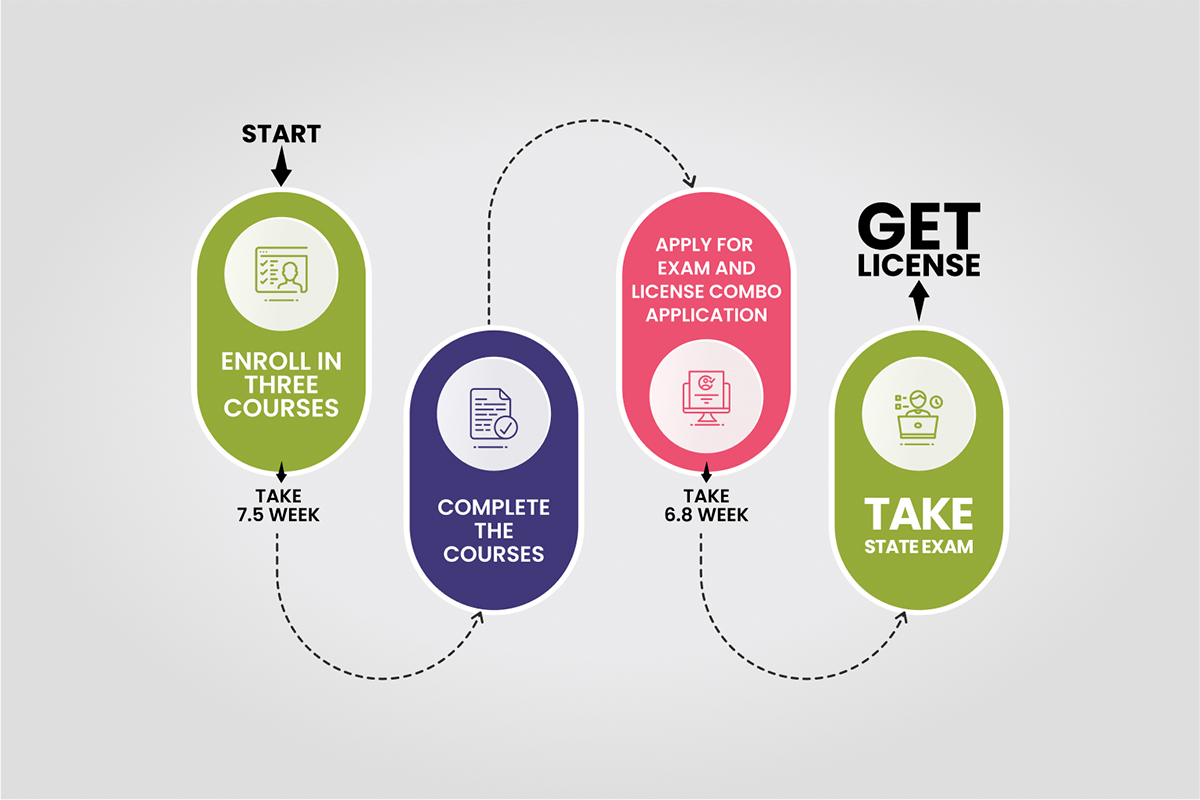
Education: Aspiring real estate agents must complete 135 hours of Pre-Licensing education. This includes three courses: Real Estate Principles, Real Estate Practice, and one elective course with courses approved by the Department of Real Estate in California. [This can be finished in as fast as 54 calendar days]
Examination and License Application: After completing the educational requirements, you must apply to take the California real estate license exam. You can apply for the exam and license simultaneously, but it’s important to bear in mind that this step can’t be completed without first completing the pre-license courses. [This processing typically runs 6-8 weeks.]
Background Check: A fingerprinting process through Livescan is required for a background check. These fingerprints should be completed before applying for the real estate exam but after completing the three pre-license courses.
State Examination: Pass the California real estate license exam and apply for your license. Just as a heads up, the real estate license exam is given in a computerized format.
How Soon Can I Do Each One?
Education: The 135 hours of Pre-Licensing education can be completed at your own pace through ADHI Schools We have online courses for flexibility, so you can potentially complete this step in as little as 54 days. However, you have up to one year to complete the program. We want to give you more time, but the DRE in California says that all courses must be completed within one year of enrollment.
Exam and License Application: Once you complete the three open-book exams on our website, the next step is to apply for the state exam. You can apply online through a California Department of Real Estate eLicensing system. Processing times for the application to take the state exam can vary, but planning is critical. Currently, the processing time is typically between 6-8 weeks. This period can vary, so checking the DRE website for the most current timeframes is advisable.
Background Check: The fingerprinting process can be completed relatively quickly, often within a week, but scheduling might vary based on location and availability.
Where Do I Take My Real Estate License Test?
The California real estate license exam is administered at several DRE locations throughout the state. Candidates can choose the most convenient location when scheduling their exam. The DRE website lists the locations and provides addresses and contact information for planning your exam day.
The five locations where exams can be taken are Fresno, Oakland, Sacramento, San Diego, and La Palma. (La Palma is considered the "Los Angeles area" location for the state exam.)
To summarize, completing the pre-license courses can take up to 2 months, followed by an additional 1.5 to 2 months for the state to process the application. This means the entire process will take approximately 3.5 to 4 months in total.
Obtaining your real estate license in California requires dedication and planning. By understanding the steps involved and the time each takes, you can efficiently navigate the journey toward becoming a licensed real estate agent.
Remember, the time it takes to get licensed varies based on individual circumstances. Still, with a clear plan and a commitment to your goal, you can achieve your real estate aspirations in California. ADHI Schools would love to be a part of your journey!
TLDR: Ideally the whole process should take around 4 months if you hustle!
Love,
Kartik
|

Embarking on a real estate career can be exciting and daunting, especially when meeting the qualifications for obtaining a license. One question that arises among aspiring real estate professionals in Read more...
Embarking on a real estate career can be exciting and daunting, especially when meeting the qualifications for obtaining a license. One question that arises among aspiring real estate professionals in California is: "Can you take the real estate exam in California without any classes?" This question is crucial for those eager to dive into the industry but must decide on the required educational commitments. I wanted to address this question head-on while incorporating insights from related topics pertinent to launching a successful career in real estate.
California, known for its dynamic real estate market, sets forth specific requirements for individuals aiming to become licensed real estate agents. The California Department of Real Estate (DRE) mandates that applicants complete some coursework before sitting for the state licensing exam. Specifically, you must complete three college-level courses in real estate principles, practice, and one elective course from a list from an approved California real estate license school However, exceptions exist for individuals if they are a lawyer who wants a real estate license in California. Lawyers who are members of the State Bar of California are exempt from the college-level course prerequisites, allowing them to proceed directly to the licensing exam. This exemption acknowledges the extensive legal education that lawyers undergo, which overlaps significantly with real estate law and practices. However, California attorneys still must take and pass the real estate license exam.
For those not exempted by a legal career, the educational requirement is more than just a bureaucratic hoop to jump through. It is designed to equip you with a foundation to navigate the complexities of real estate transactions. These courses cover various topics, from property rights and contracts to finance and ethics, ensuring that you are well-prepared to serve your clients effectively.
Preparing for the California real estate exam is a rigorous process that demands a comprehensive understanding of various subjects. Our real estate exam prep guide offers a valuable resource for those studying for the exam, providing structured guidance and strategies to tackle the exam confidently. The guide includes practice questions, outlines of key topics, and test-taking tips to enhance your chances of passing on your first attempt.
Passing the California real estate exam is a notable achievement, but it's just the beginning of your journey. A Guide to Your First 30 Days as a Real Estate Agent outlines essential steps for newly licensed agents, from joining a brokerage to developing a marketing plan and building your client base. This critical period can set the tone for your career, emphasizing the importance of a strong start.
Once licensed, continuous learning and adaptation are key to longevity and success in the real estate profession. California requires real estate agents to complete continuing education courses to renew their licenses. This requirement ensures that agents stay updated on the latest laws, regulations, and market trends, reinforcing the value of lifelong learning in this dynamic field.
In addition to formal education and licensing requirements, building a successful real estate career involves mastering practical skills and leveraging personal networks. Referrals 101: How to Ask Your Friends and Family for Referrals highlights the significance of referrals in generating business. Cultivating a solid referral network can be instrumental in establishing and growing your real estate practice, underscoring the industry's relational nature.
Understanding the financial aspects of real estate, such as understanding off-the-top fees as a Realtor is also crucial. This knowledge helps agents manage their finances effectively, from navigating commission structures to budgeting for business expenses. Financial understanding is essential for maximizing earnings and ensuring the sustainability of your real estate career.
While it may seem appealing to bypass educational requirements and jump straight into taking the California real estate exam, the state mandates these courses for good reason. They provide a solid foundation of knowledge and skills essential for success in the real estate industry. For lawyers, exemptions offer a streamlined path to licensure, yet the principles of thorough preparation and continuous learning apply universally across the profession. By embracing these educational opportunities and leveraging resources like exam prep guides and practical advice for new agents, aspiring real estate professionals in California can set themselves up for a rewarding and prosperous career.
TLDR: For the most part, classes are required. Lawyers in California are exempt from the classes, but nobody is exempt from the licensing exam.
Love,
Kartik
|

Starting your real estate career is exciting, but it also comes with a few nerves—especially when it comes to the California licensing exam. One of the most common questions we hear from new students Read more...
Starting your real estate career is exciting, but it also comes with a few nerves—especially when it comes to the California licensing exam. One of the most common questions we hear from new students at ADHI Schools is:
“How many times can I retake the California real estate exam if I don’t pass on my first attempt?”
The good news: California allows unlimited exam attempts within your two-year application window.
Below, we’ll walk you through how the retake process works and what to do differently to maximize your chances of passing on your next try.
The Short Answer: Unlimited Attempts (Within Two Years)
This is the rule that surprises most students.
➡️ The California Department of Real Estate (DRE) allows unlimited retakes within two years of your original application date.
There are:
No penalties for failing (except having to pay the exam fee again)
No mandatory waiting period (beyond waiting for your official results)
No cap on the number of tries during that two year period
This flexibility removes a lot of pressure.
If you want to understand the entire licensing process—not just retakes—review our full California Real Estate Exam Guide, which outlines exam structure, scoring, timelines, scheduling, and preparation strategy.
Essential DRE Retake Rules
You do have unlimited attempts, but the DRE has specific administrative rules you must follow to avoid delays.
1. Wait for Your Official Results
Before doing anything, wait until you receive your results from the DRE. Until you receive your score, do not:
submit a new application
pay another exam fee
attempt to schedule a new date
Doing so may flag your record or cause your newly scheduled date to be canceled.
2. How to Re-Apply
If you didn’t pass, the fastest way to get back on the schedule is through the DRE’s eLicensing system:
➡️ https://secure.dre.ca.gov/
It typically processes retakes more quickly than mailing paperwork.
3. The Two-Year Rule
Once two years pass from the date of your original application:
your application expires
you must submit a new exam application
you must requalify (education requirements must still be valid)
and pay the fee again
Most students pass long before reaching this point, but the deadline is important to keep in mind.
Why Students Need Retakes
If you’re preparing for a second attempt, you may be wondering:
Is the California Real Estate Exam Hard?
The exam is intentionally challenging. It’s designed to measure whether you can apply real estate principles—not just memorize them.
A quick look at the California Real Estate Exam Pass Rate Statistics makes it clear that failing once (or even twice) is more common than most people expect. It doesn’t mean you won’t be a great agent—it just means you need a better plan for your next attempt.
How to Make Your Next Attempt Your Last
Most retakes happen because students studied inefficiently, misunderstood the exam format, or didn’t manage the questions well. The good news is that these issues are fixable.
1. Analyze Your Performance
If you fail, the DRE gives you a breakdown of how you scored in each content area.
Use it—it’s your roadmap.
For even deeper insight, read Why People Fail the California Real Estate Exam.
It outlines the most common reasons students struggle, from content gaps to test-taking errors
2. Study the Right Way
Don’t just study harder—study smarter.
Use updated materials aligned with the DRE blueprint:
ADHI Crash Course Materials: https://www.adhischools.com/real-estate-crash-course/california
Free Real Estate Practice Exam: https://www.adhischools.com/free-real-estate-practice-exam
Crash Course Online (live instruction + strategy): https://www.crashcourseonline.com
These tools reinforce high-yield topics that appear most frequently on the exam.
3. Use a First-Try Mindset—Even on a Retake
Even if this is your second or third attempt, treat it like a fresh first attempt.
Our guide Tips for Passing the CA Real Estate Exam on the First Try covers how to:
break down tricky questions
avoid psychometric distractors
manage test-day anxiety
pace yourself efficiently
These strategies are just as valuable for retakers as they are for first-time candidates.
Final Thoughts
Retaking the California real estate exam can feel stressful, but the system is designed to give you every opportunity to succeed. With unlimited attempts in your two-year window—and a stronger, more strategic study plan—you can absolutely pass this exam.
Persistence is part of the real estate business.
ADHI Schools is here to support you until your license is in hand.
Frequently Asked Questions
Is there a limit to how many times I can fail? No. You can retake the exam as many times as you need within your two-year application window.
Do I have to pay every time I retake the exam? Yes. You must pay the exam fee for every single attempt.
Is there a waiting period before I can try again? There is no mandatory waiting period, but you must wait until you receive your official result notice from your previous attempt before scheduling a new one.
Do I have to retake my real estate classes if I fail? No. Your course completion certificates are valid for life. You only need to re-verify your education if your two-year application window expires.
Will the retake questions be the same? No. The DRE pulls from a large bank of questions, so expect a completely different version of the exam on your next attempt.
|

The path to becoming a real estate professional in California is often perceived as a straightforward journey. However, the reality is quite different. The California real estate exam is a non-negotiable Read more...
The path to becoming a real estate professional in California is often perceived as a straightforward journey. However, the reality is quite different. The California real estate exam is a non-negotiable step in this journey, posing a challenge to lots of folks who want to enter our industry.
Before diving into the specific statistics of who passes and who fails, it is helpful to understand the big picture. If you are looking for a complete roadmap of the entire licensing process—from requirements to application—check out our Ultimate Guide to the California Real Estate Exam.
Qualifying to Take the Exam: The First Hurdle
In order to take the real estate license exam in California, you must successfully complete three college-level courses. These courses are "Real Estate Principles," "Real Estate Practice," and one elective course.
Once certificates of completion are obtained for each of these three required courses, the candidate may then sit for the state license exam. If a real estate broker license is desired, the candidate must complete the above three courses as well as five additional college-level courses and have a couple of years of experience.
Scheduling vs. Taking the Exam: The Second Hurdle
A surprising phenomenon in the California real estate exam process is the discrepancy between the number of individuals who schedule their exams and those who actually show up and take it.
In July 2025, 259 broker examinees scheduled their exam, but only 223 actually took the test. Similarly, out of 2,662 salespersons who planned to take the exam, only 2,328 followed through and actually took the test.
That’s over 300 people who scheduled their salesperson exam but never took the test! This gap suggests a range of factors—from last-minute jitters to personal circumstances—that prevent candidates from even attempting the exam.
Passing the Exam: A Steeper Challenge
For those who actually do take the exam, success is not guaranteed. The failure rate is a stark reminder of the exam's difficulty and the level of preparation required. A recent examination of the pass rates might be super surprising.
Broker Exam: 223 people took the broker exam in a recent month and only 107 of those passed.
Salesperson Exam: The salesperson exam is only slightly better. In the same month, 2,328 people took the sales license exam and only 1,280 of those passed.
Unpacking the Low Pass Rates
The real estate license exams in California have yielded intriguing results, with notably low pass rates that might raise eyebrows among novices and experts alike. You might be looking at these numbers and asking yourself, Is the California Real Estate Exam Hard?
The Factors Contributing to Failure
The Factors Contributing to Failure Let's delve into the factors that contribute to such challenging scenarios to really understand why people fail the real estate exam.
Exam Difficulty & Scope: The exams encompass a broad spectrum of topics, from intricate laws and regulations to real estate principles and practices. This extensive range demands a high level of understanding.
Preparation Level: Often, examinees may find themselves inadequately prepared due to limited study time or a simple underestimation of the exam's difficulty.
Test Anxiety: Many candidates grapple with test anxiety or lack effective test-taking strategies.
If you fall into the statistical group that doesn't pass on the first try, don't panic. It is a common setback. It is important to know your options regarding your options on retaking the real estate exam.
How to Be in the Passing Group
The pass rates for California's real estate license exams are indicative of a demanding professional standard. They underscore the necessity for thorough, well-rounded preparation.
To ensure you are part of the 46% who pass rather than the majority who fail, you need a strategy. We have compiled a list of specific strategies to help you navigate these challenges so you can pass the real estate exam on the first try.
Next Steps
For those embarking on this journey, understanding and addressing these factors can pave the way to success in this challenging yet rewarding field.
If you need help passing the real estate license exam, visit www.crashcourseonline.com for the most up-to-date and comprehensive test prep available.
FAQ
Q: Is getting a real estate license in California as easy as people think?
A: No. While often perceived as a straightforward journey, the reality is much harder. The exam is a major hurdle that blocks many from entering the industry.
Q: What do I have to do before I can even sit for the exam?
A: You must complete three college-level courses: Real Estate Principles, Real Estate Practice, and one elective. (Aspiring Brokers need to finish these three plus five additional courses).
Q: Does everyone who schedules the test actually show up?
A: Surprisingly, no. In July 2025, over 300 salesperson candidates scheduled the exam but never took it, likely due to last-minute jitters or personal circumstances.
Q: What are the actual pass rates?
A: They are steep. In a recent month:
Brokers: Only 107 passed out of 223.
Salespersons: Only 1,280 passed out of 2,328.
Q: Why is the failure rate so high?
A: It usually comes down to three factors:
Scope: The exam covers a massive range of topics, including intricate laws.
Preparation: Candidates often underestimate the difficulty and don't study enough.
Anxiety: Poor test-taking strategies and nerves cause many to freeze up.
Q: What if I fail on the first try?
A: Don't panic—it is a very common setback. You have options to retake the exam.
Q: How do I ensure I’m in the group that passes?
A: You need a strategy. To be part of the ~46% who pass, you must move beyond basic studying and utilize comprehensive test prep.
|

Are you gearing up to carve out your niche in the competitive world of California real estate? Before you start showcasing homes and closing deals, there's one crucial hurdle to cross: the California Real Read more...
Are you gearing up to carve out your niche in the competitive world of California real estate? Before you start showcasing homes and closing deals, there's one crucial hurdle to cross: the California Real Estate License Exam Now, you might wonder, "Is the examination digital, or do I have to tackle it the old-fashioned way, with paper and pencil?" Let's dive into the evolution of the exam process, transitioning from paper to computer, and what that change means for aspiring real estate moguls like you.
The Evolution of the California Real Estate Exam
Years ago, the California Real Estate Exam was a paper-based test format many of us remember from school. Picture it: a room full of anxious individuals, the sound of pages turning, and the scratching of pencils against paper. This method, while traditional, presented various logistical issues, like scheduling constraints, potential for error in grading, and delays in scoring of the real estate exam.
However, as technology advanced, so did the examination methods. Over ten years ago (2011), the state recognized the need for a more streamlined, efficient process through computer-based testing (CBT). Today, the California Real Estate Exam is administered electronically, a transformation that has modernized the examination process. This change means quicker results, enhanced security, easier accommodations for those who need them, and a more flexible exam schedule.
But what does taking the exam on a computer entail for you? Let's unpack that.
Real Estate Exam Locations: Know Before You Go
The California Department of Real Estate (DRE) offers several convenient locations to take your computerized exam. These sites are strategically located to cover the widest possible area, ensuring candidates can find a testing center without traveling extreme distances.
Testing locations are in Fresno, Sacramento, La Palma (Los Angeles area location), San Diego, and Oakland.
What's important is selecting a location that suits your needs. Consider factors such as distance, ease of travel, and availability of dates. You'll want to register for your exam beforehand using eLicensing eLicensing and remember that slots fill up quickly, especially in busy seasons.
A pro tip? Be flexible with your dates, and monitor any slot openings due to cancellations.
Mastering the Digital Arena: Requirements to Pass the Real Estate License Exam
Switching to a computerized format doesn't change the essence of the exam; it's the medium, not the content, that's different. You will still be tested on your knowledge of real estate laws, principles, and practices. The exam consists of multiple-choice questions, requiring a keen understanding of various topics and the ability to apply that knowledge in scenario-based questions.
So, how do you conquer this digital giant? Preparation is key. Invest in up-to-date study materials take practice exams, and consider enrolling in reputable real estate exam prep courses Since the exam is on the computer, try simulating the test environment by taking online practice tests. This approach will familiarize you with the content and digital format, reducing any test-day jitters related to navigating the computer interface.
Now, let's talk scores. To pass, you need to correct a specific number of questions, reflecting a thorough understanding of the material. The DRE doesn’t require perfection but demands a passing score. After submitting your test, one of the beauties of computer testing is that you won't have to wait weeks to receive your score. Instead, you'll know soon whether you've cleared the hurdle or need to jump again.
License Type
Broker
Salesperson
Number of questions
200
150
Number of exam
4 hours
3 hours
Passing score
75%
70%
Test Day Essentials: Remember the Parking!
You've studied and are ready to excel in the digital test-taking environment, but your test-day preparations continue beyond there. Picture this nightmare: You arrive at the testing center and are already nervous. Your heart sinks as you realize there's no parking, or worse, you need to have a permit you didn't know about. Now you're racing against the clock, with the added pressure of finding parking.
To avoid this added stress, plan your visit. Check out the testing location, noting the parking situation, whether you need to pay, where you can park, or if you need a permit. Some test centers may need more parking, especially during busy times. Others might share a parking lot with other businesses, and specific restrictions may apply. Check with the DRE for parking information or scope the location before your exam.
Knowing the parking logistics will spare you unnecessary test-day tension. Consider doing a trial run, especially if you are unfamiliar with the area. Knowing exactly where you're going will provide peace of mind, letting you focus on what's truly important: passing that exam.
Embracing the Future of Real Estate Examinations
Ultimately, the shift from paper to computer for the California Real Estate License Exam reflects our broader societal shift towards digitalization. It's about efficiency, security, and accessibility. For test-takers, computer-based testing represents convenience and quicker results, allowing you to embark on your real estate career sooner.
Remember, while the testing method has changed, the key to success remains unchanged. So, embrace the change, plan your test day down to the parking details, and you'll navigate this digital challenge like a pro, setting the stage for many successful transactions in your promising real estate career.
TLDR: Exams are given at DRE testing centers electronically.
Love
Kartik
|
Navigating the complexities of real estate and passing the real estate exam often requires a way to remember concepts, and acronyms can help. I wanted to write an article to share a few acronyms to Read more...
Navigating the complexities of real estate and passing the real estate exam often requires a way to remember concepts, and acronyms can help. I wanted to write an article to share a few acronyms to aid real estate license examinees to understand and recall critical concepts for the exam. I wanted to review terms like the "bundle of rights", factors determining property value, criteria to determine whether or not something is a fixture, the specifics of joint tenancy, the fiduciary responsibilities of agents, and the government's powers concerning property to help you pass the real estate exam.
Each one of these acronyms, from TEEUP to PETE, offers a snapshot of a broader principle. By familiarizing yourself with these, you'll better grasp concepts and be prepared for the California real estate exam. Let's break down these acronyms and highlight their significance in real estate.
Bundle of Rights
The "bundle of rights" is a foundational concept in real estate that refers to the rights associated with property ownership. When someone owns a property, they don't just own the physical land and buildings; they possess legal rights that can be separated and individually sold, transferred, or leased. These rights encompass various ways an owner can use, enjoy, or dispose of the property.
TEEUP: This represents a buyer's bundle of rights, which are:
Transfer: Lawfully transferring ownership.
Encumber: Borrowing against the property.
Enjoy: Peaceful enjoyment without disturbances.
Use: The lawful use of the property.
Possess: Exclusive possession rights.
Factors That Influence Value
Understanding the underlying factors that drive property value is essential. These are commonly represented by the acronym 'DUST' and are intertwined and play a critical role in the valuation process.
DUST: The pillars of property value:
Demand: How many qualified buyers are interested in the property.
Utility: Its usefulness.
Scarcity: Availability in the market and how many other properties are competing with the property in question.
Transferability: Ease of changing ownership.
Determining Whether or Not Something Is a Fixture
In real estate, distinguishing between personal property and fixtures can often lead to intricate debates and discussions. The line between an item considered a movable personal possession and a permanent property fixture is not always clear. Think about kitchen appliances, pool equipment, or even home theater components. To demystify this gray area and provide clarity, professionals often rely on a set of criteria aptly summarized by the acronym 'MARIA.' Let's unpack each of these criteria to understand better what makes an item a fixture in real estate.
MARIA: Criteria to determine if an item is a fixture:
Method of Attachment - The degree of permanence is based on the means of attachment.
Adaptability - Can the item be used elsewhere.
Relationship of parties - Between buyer and seller, the law tends to favor the buyer.
Intention during attachment - Was the intent of the owner to make the item a permanent part of the structure?
Agreement between parties - What did the purchase contract say about the item?
Unities to a Joint Tenancy Holding
Real estate ownership can be complex, especially when multiple parties are involved. Joint tenancy, a common form of co-ownership, allows multiple individuals to hold a shared interest in a property. However, specific conditions must be met for a joint tenancy to be established. These conditions ensure that each tenant's rights are protected and clearly defined. Summarized by the acronym 'TTIP,' these factors are crucial in defining and understanding the nuances of joint tenancy. Let's delve into each of these factors for a clearer perspective.
TTIP: Factors determining joint tenancy:
Time: Acquiring at the same time - All joint tenants must take title to the property at the same time.
Title: Acquiring via the same document - All joint tenants names must be listed on the same deed.
Interest: Equal stake in the property - All joint tenants must own an equal share of the property, regardless of capital contribution.
Possession: Equal possession rights - All joint tenants have the right to touch, use and occupy the entire property and cannot be physically divided.
Fiduciary Duties
Agents play a pivotal role in guiding, assisting, and representing clients. Yet, with this role comes a set of profound responsibilities. An agent's commitment isn't just about facilitating transactions - it’s anchored in a deep-rooted sense of trust and duty to their clients. These obligations, often termed fiduciary responsibilities, are essential in preserving the integrity of the agent-client relationship. Represented by the acronym 'OLDCAR,' these duties underscore the essence of being a trusted real estate professional. Let's explore each of these responsibilities in detail.
OLD CAR - Agent's fiduciary responsibilities:
Obedience - The agent must obey the lawful instructions of the principal.
Loyalty - The agent must be loyal to the client.
Disclosure - The agent must disclose all known material facts to the client.
Confidentiality - The agent must keep the client data confidential.
Accounting - The agent must account for the client funds.
Reasonable care/diligence - The agent must use reasonable care when dealing with the client.
Government Power Over Property
While property ownership bestows certain rights and privileges upon individuals, it's essential to recognize that these rights exist within a framework governed by higher authorities. Every government maintains inherent powers over properties within its jurisdiction, ensuring societal order, public interest, and the equitable use of land. Summarized by the acronym 'PETE,' these powers reflect the delicate balance between individual rights and the collective good. This section will delve into the government's four primary powers over property and their implications for owners.
PETE: The government's powers over property:
Police Power: Regulating for the health, safety and general welfare of the public.
Eminent Domain: Acquiring property for public use.
Taxation: Levying property taxes.
Escheat: Claiming property when an owner dies intestate (without a will).
TLDR
In a Nutshell: Acronyms are invaluable tools when studying for the California real estate exam aiding in efficiently recalling vital concepts. Commit these to memory to ensure a successful exam outcome. Remember, these aren't just random letters; they encapsulate essential real estate principles. Best of luck with your studies and the exam!
Love,
Kartik
|

In real estate school, you learn that contracts are the backbone of all real estate deals. But there's more to contracts than meets the eye, especially when they go sideways. In this article, we'll demystify Read more...
In real estate school, you learn that contracts are the backbone of all real estate deals. But there's more to contracts than meets the eye, especially when they go sideways. In this article, we'll demystify the difference between two confusing terms: 'void' and 'voidable' as it relates to contracts.
Contracts 101
A contract is a promise that the law will enforce. It comprises a few parts: an offer, acceptance of the offer, and something valuable being exchanged by capable parties.
Void Contracts in Real Estate
A void contract is a promise that the law won't enforce. Imagine a person who isn't the actual owner of a property trying to sell a property they don't own. If someone tries to sell a house they don't own, that's likely an example of a void contract. In these cases, the law assumes that the contract never existed.
Another example of a void contract would be a contract to sell someone illegal drugs. The legality of the contract is a fundamental requirement for it to be valid. This means an agreement has to be for something legal. If it's not, the law won't recognize or enforce it
Therefore a contract to sell illegal drugs is void because selling illicit drugs is against the law. Since it's illegal, a contract to sell illegal drugs doesn't fulfill the requirement of legality.
In other words, you can't have a contract to do something illegal. That's why a contract like this is void - it's invalid from the start. So, if someone made a contract to sell illegal drugs and broke that contract, the other person couldn't take them to court. The court would say that the contract was void. The contract couldn't be enforced because it was to do something illegal.
Voidable Contracts in Real Estate
A voidable contract, on the other hand, is a contract that could work, but one person involved has the choice not to follow through with it. In these situations, the contract could become voidable.
A voidable contract is different from a void contract - It's a valid contract, but one party can agree or say no. Only one party is truly bound to the contract. The other party, who isn't bound, can say they don't want the contract anymore, and at that point, it becomes void or non-existent.
There are several reasons a contract might be voidable. These can include someone being forced or tricked into the contract, not understanding what they're agreeing to because of mental issues, being drunk, or lying about something important. Contracts made by minors (people under 18) are usually voidable, but they can only say no to the contract while they're still a minor and for a short time after they become an adult.
If a contract is made without the true agreement of one of the parties, it's considered a voidable contract. The law says a voidable contract can be enforced if one or more parties want it but not if the other parties don't want it to be. A voidable contract can become valid if the party who was wronged doesn't say they want to cancel it within a reasonable time.
Key Differences Between Void and Voidable Contracts
Although 'void' and 'voidable' may sound similar, they are distinct regarding contracts. Here's a breakdown of the major differences between them:
Validity: Void contracts are invalid from the outset. They lack legal standing from the moment they're created because they're based on an illegal act or lack a critical element necessary for a contract to be legally binding. On the other hand, voidable contracts are initially valid and legally enforceable. However, they may become void if the party having the right decides to nullify or reject the contract.
Option to Cancel: Void contracts do not offer the option to affirm or reject the contract. They are null from the start. In contrast, voidable contracts give one party the option to either continue or reject the contract, thereby making it void.
Enforcement: Void contracts cannot be enforced by any party or law because they are fundamentally flawed. But voidable contracts can be enforced, especially if the party with the right to reject the contract decides not to do so and proceeds with the agreement.
Participation: In a void contract, the parties involved can only be legally obligated to fulfill the terms if the contract is valid. All parties may be obliged to fulfill the contract terms for voidable contracts until the aggrieved party decides to reject the contract.
Examples of void contracts include contracts for illegal activities or contracts with impossible terms. Voidable contracts, however, often involve situations where one party was coerced, under undue influence, or somehow tricked into entering the contract.
Understanding these differences is crucial when dealing with real estate contracts. Carefully examining all terms and conditions can save you from unknowingly entering into void or voidable contracts, thus avoiding potential legal disputes or financial losses. Always consult a legal professional if you need clarification on a contract's terms or legality.
One other way to look at void and voidable
When you hear "void" about contracts, it means it's "nonexistent." It's like a rule that never counted from the start because it breaks some important laws or needs to include something required to make it a real contract.
Then there's "voidable," which suggests it could be void but not yet. The contract can still work, but there's a choice. One person in the contract can say it's void or let it stay as it is.
A void or "nonexistent" contract doesn't give any choices - it's just void. But a voidable or "potentially void" contract lets one person decide if it becomes void. That should help you tell the difference between the two.
Understanding the difference between void and voidable contracts is vital in real estate. It's as crucial as knowing when to when to walk away from a listing or the importance of a home inspection. Always remember to get professional help and check all contracts carefully.
As your online real estate school, we're here to help you understand these complex topics. We'd love to hear from you if you have any questions and remember, if you need more clarification, always ask a professional for help.
Love,
Kartik
|

There are lots of new things to learn when you are getting into real estate, and knowing about the mortgage markets is one of them. As a real estate student preparing for your exam, comprehending these Read more...
There are lots of new things to learn when you are getting into real estate, and knowing about the mortgage markets is one of them. As a real estate student preparing for your exam, comprehending these markets in depth is not just a requirement, but a stepping stone towards securing your real estate license.
This comprehension won't only serve you in passing the exam, but it will also equip you with the tools necessary to provide informed advice to future clients. After all, understanding the mechanisms of the mortgage markets will be key to your ability to guide your clients effectively through their journey toward homeownership.
So, what exactly are mortgage markets? Mortgage markets involve the process of lending, borrowing, buying, and selling mortgage loans. Essentially, they are the conduits that make home ownership possible. And to fully grasp their workings, it's important to understand that they're divided into two sectors – the primary and secondary mortgage markets.
This blog post is designed as a guide for real estate students to help differentiate between the primary and secondary mortgage markets. I want to cover the definitions, roles of parties market. With this knowledge, you'll be better equipped to navigate and succeed in your future real estate endeavors. So let's delve into the world of mortgage markets and enhance your journey towards becoming skilled real estate professionals.
Primary Mortgage Market: An Overview
The primary mortgage market is where it all begins for homebuyers. It's the marketplace where borrowers and mortgage originators come together to negotiate and agree on the terms of new mortgage loans. In simple terms, it's where you, as a potential homeowner, would obtain a loan to buy - or refinance - a property.
The key players in the primary mortgage market are borrowers and lenders. These banks (or mortgage companies) often provide the funds for borrowers to purchase their dream homes. They are responsible for setting the loan terms, including interest rates and repayment schedule, and verifying the borrower's creditworthiness and ability to repay the loan.
Obtaining a mortgage loan from the primary market is straightforward. A potential homeowner applies for a mortgage loan from a lender. The lender then scrutinizes the applicant's credit history, current income, employment status, and other factors before approving the loan. Once the loan is approved and the agreement is signed, the borrower begins to repay the loan, typically for 15 to 30 years.
Consider this scenario: John and Sarah, eager to buy their first home, approach their local bank for a mortgage loan. After reviewing their application and assessing their financial position, the bank approves their loan at a fixed interest rate for 30 years. This entire transaction is part of the primary mortgage market.
As real estate students, understanding the primary mortgage market's functioning is crucial. It provides the foundation of the mortgage industry and is the starting point of most real estate transactions.
Secondary Mortgage Market: An Overview
While the primary mortgage market involves the creation of new mortgage loans, the secondary mortgage market revolves around the buying and selling of existing mortgages and mortgage-backed securities. Home buyers do not directly participate in the secondary mortgage market as this is largely the domain of large financial institutions and investors.
Investors and financial institutions, like Fannie Mae and Freddie Mac, play a significant role in the secondary mortgage market. These government-sponsored entities buy existing mortgage loans from lenders, bundle them into mortgage-backed securities, and then sell them to investors. This process frees up the lender's resources, allowing them to issue more loans in the primary mortgage market.
For instance, let's revisit John and Sarah's story. After their bank granted them a mortgage, the bank could then sell it to a larger financial institution like Fannie Mae. Fannie Mae then pools John and Sarah's mortgage with hundreds of similar mortgages to create a mortgage-backed security, which is then sold to investors. This entire transaction takes place in the secondary mortgage market.
Why does this matter to real estate students? Understanding the secondary mortgage market is essential as it directly influences the primary mortgage market. It dictates mortgage rates and availability of loans and contributes significantly to the overall health of the real estate market. It’s a key component of the knowledge you'll need to obtain your real estate license.
Secondary Mortgage Market: An Overview and Its Significance
As discussed, while the primary mortgage market is initial loan creation, the secondary mortgage market is where existing mortgages and mortgage-backed securities (MBS) are bought and sold. It may seem abstract compared to the more direct borrower-lender interactions of the primary market. Still, its impact is far-reaching and fundamental to the functioning of the broader economy.
The secondary mortgage market's leading players are large financial institutions and investors, including government-sponsored entities like Fannie Mae and Freddie Mac. These entities buy existing mortgage loans from lenders, package them into MBS, and then sell these securities to investors on the open market. This cycle is an economic engine that keeps mortgage funds flowing – but how exactly does it work, and why is it so crucial?
Liquidity and the Recycling of Capital
In essence, the secondary mortgage market provides liquidity to the banking system. When lenders, such as banks, originate a loan in the primary market, that loan is an asset tied up in the property for the duration of the mortgage term, often 15 to 30 years. This represents a significant commitment of the lender's capital, limiting their ability to offer new loans.
Lenders can recycle their capital by selling these loans on the secondary market. The sale frees up their resources, allowing them to originate more loans. It's akin to a fresh injection of cash into the primary market. The more active the secondary market, the more liquidity lenders have, ultimately making mortgages more accessible to potential homeowners.
Why Investors Buy Mortgage-Backed Securities
But why would investors want to buy MBS? The answer lies in the appeal of these instruments as investment vehicles. Mortgage-backed securities are income-generating assets. The monthly mortgage payments made by borrowers (consisting of principal and interest) pass through to MBS investors as regular income, making them an attractive long-term investment.
Furthermore, MBS are often considered lower-risk assets. Real estate, a physical asset, backs them and often carries guarantees from government-sponsored entities against defaults on the underlying loans. This combination of regular income and lower risk makes MBS popular among many investors.
So you can see that the secondary mortgage market plays an essential role in maintaining liquidity in the banking system and ensuring the availability of mortgage loans. It's the lifeblood of the housing market, turning individual home loans into a cycle of capital that benefits lenders, investors, and homeowners alike. It's a foundational concept for any real estate professional to understand, as it influences mortgage availability and rates and the broader health and vibrancy of the real estate market.
Navigating the labyrinth of the real estate market can be challenging, especially for students preparing for their real estate license exam. Hoping this guide helps as we now understand that the primary mortgage market is where loans are originated, with lenders and borrowers negotiating the terms of new mortgage loans. In contrast, the secondary mortgage market involves the buying and selling existing loans by investors and financial institutions like Fannie Mae and Freddie Mac.
The key takeaway is the interdependence of these two markets. They influence each other significantly, dictating mortgage rates, the availability of loans, and, thus, the overall health of the real estate market.
Understanding these markets equips real estate students with the knowledge necessary for acing their real estate license exam and launching successful careers in real estate. It enables you to provide comprehensive advice to your future clients and better understand the factors influencing the market conditions.
We encourage you to continue exploring these concepts, digging deeper into how they function and their influence on the broader real estate market. Remember, every bit of knowledge gained now is a step towards becoming a proficient real estate professional, ready to make your mark in the dynamic world of real estate.
As always, if you are interested in getting your real estate license or building a career in real estate sales visit www.adhischools.com or call us at 888-768-5285.
Love,
Kartik
|
Entering the world of real estate can feel like learning a new language. As in any industry, real estate comes with its unique terminology, which can be daunting for those new to the field. But fear not; Read more...
Entering the world of real estate can feel like learning a new language. As in any industry, real estate comes with its unique terminology, which can be daunting for those new to the field. But fear not; mastering this language is not only possible but also a critical component of becoming a..
|
What Is A Real Estate Exam Prep Course?
A prep course for the real estate exam is an essential tool for any aspiring real estate agent. These courses provide comprehensive learning materials and resources Read more...
What Is A Real Estate Exam Prep Course?
A prep course for the real estate exam is an essential tool for any aspiring real estate agent. These courses provide comprehensive learning materials and resources designed to prepare and ensure exam success. Often
|

Unveiling the Math Aspect of the California Real Estate Exam: Is There a Lot of Math?
The California Real Estate Exam is a formidable stepping stone for all those seeking to wear the hat of a Read more...
Unveiling the Math Aspect of the California Real Estate Exam: Is There a Lot of Math?
The California Real Estate Exam is a formidable stepping stone for all those seeking to wear the hat of a licensed real estate professional in the Golden State. As part of their preparation, many potential test-takers ask, "Is there a lot of math on the California Real Estate Exam?" The question is an understandable one. Let's explore this question in detail, assessing the quantitative aspects and providing guidance on navigating this portion of the examination successfully.
The Math Component of the California Real Estate Exam
To put it in plain terms, yes, the California Real Estate Exam contains math - but very little. And the level of math involved may not be as extensive or intimidating as you might think. On average, there are only a small number of questions that focus on mathematical problems. These problems test your ability to perform real estate related calculations like computing real estate taxes, property values, commission rates, prorations, interest, mortgage payments, and depreciation.
The Good News: It's Not Rocket Science!
The type of math encountered on the California Real Estate Exam primarily involves basic arithmetic and some simple algebra, including the ability to work with fractions, decimals, and percentages. So, if you have been fretting over complicated equations, exhale a sigh of relief – calculus and advanced mathematics do not feature on this exam!
And there isn’t a lot of it on the state test.
Preparation is Key
Even though the math portion of the exam only makes up a very small fraction of the total questions, it's essential not to take it lightly. As with any other exam section, diligent preparation is key to success. Many resources are available, including textbooks, our real estate exam prep, and practice problems, specifically designed to help candidates understand and master the types of math questions they encounter.
A good starting point would be to familiarize yourself with real estate terminology and principles. Once you grasp these well, you can start working on the calculations. Solve many practice problems related to loan amortization, property valuation, real estate taxes, etc. Understand the formulas rather than just memorizing them. Knowing when and how to use them effectively will make all the difference on exam day.
Remember, speed and accuracy are crucial for these exams. While you need to work quickly, double-checking your answers is equally important to avoid careless mistakes.
Take a Crash Course
A candidate preparing for the real estate test would significantly benefit from taking a crash course prior to their exam. The real estate field encompasses many complex topics, including property laws, contract laws, real estate principles and practices, ethics, and market dynamics.
A crash course is an intensive, fast-paced program that condenses these vast subject matters into digestible chunks, ensuring the candidate comprehensively understands all the necessary information. Additionally, such a course often incorporates practice tests that mimic the actual exam's format and difficulty, providing the candidate with invaluable experience under realistic conditions. It also allows the candidate to pinpoint their strengths and weaknesses, allowing them to focus on areas that need improvement. Overall, a crash course fosters confidence, thoroughness, and strategic examination techniques, thereby improving the chances of success in the real estate exam.
To sum it up, while the California Real Estate Exam does include math problems, they are relatively straightforward and can be tackled efficiently with consistent practice and understanding. Don't let the fear of math deter you from your goal. Remember, every licensed real estate agent in California has passed this test. With the right mindset, diligent preparation, and extra help, you will, too. The pathway to success on the California Real Estate Exam may require you to crunch some numbers, but the rewards of a career in real estate are certainly worth it.
Math-related vocabulary for the state exam:
Benchmark : A reference point used in surveying, marked on a fixed, stable object. Its position and elevation are known and utilized in tidal observations, land surveys, and other geodetic operations.
Board Foot : A unit of measurement for lumber, signifying a volume equal to a one-foot cube of one inch thick wood. It's often used in the lumber industry to price and sell wood.
Decimal : Related to the base-10 system. It signifies a number or fraction expressed in the decimal system. In a decimal number, such as 125.67, the decimal point (.) separates the whole number (125) from the decimal fraction (67).
Denominator : The bottom number in a fraction, indicating the total number of equal parts that constitute the whole. For instance, in the fraction 3/5, '5' is the denominator, representing that the whole is divided into five parts.
Fraction : A mathematical expression representing the division of two numbers or quantities. It's also used to describe a portion or segment of a whole.
Front Foot : A real estate term, denoting a property's linear footage along the frontage (like a street or road). It can be used for pricing properties but needs to account for the property's depth.
Governmental Survey System/Rectangular Survey System : A land division system used in the US. It divides land into 24-square-mile quadrangles using north-south and east-west lines.
Latitude : The geographic coordinate representing the angular distance of a point north or south of the Earth's equator, measured in degrees along a meridian.
Lineal Foot : Another term for a 'foot' in measurement, mainly used to measure the length of items.
Longitude : The geographic coordinate that specifies the east-west position of a point on the Earth's surface. It's an angular measurement, usually expressed in degrees, minutes, and seconds.
Lowest Common Denominator : The smallest multiple that is exactly divisible by every denominator of a set of fractions. It is used to simplify the process of adding, subtracting, and comparing fractions.
Meridian : An imaginary line running from the North Pole to the South Pole on the Earth's surface. All locations along a given meridian share the same longitude.
Numerator : The top number in a fraction, indicating the number of parts of the whole that are considered. For example, in the fraction 3/5, '3' is the numerator.
Point of Beginning : The starting point in land surveying from which the boundaries of a parcel of land are described. This is most often associated with the “metes and bounds” method of land description.
Product : The result obtained from the multiplication of two or more numbers.
Range : In the U.S. public land surveying system, a 'range' refers to a vertical column of townships in a grid layout. It is six miles wide, running north to south, and is numbered based on its distance east or west from a specified meridian.
Rounding : A mathematical process to approximate a number to its nearest whole number, tens, hundreds, etc. It simplifies numbers while still maintaining a reasonable level of accuracy.
Running Foot : A measurement unit used in the lumber industry to measure the length of a piece of wood, irrespective of its width or thickness.
Square Foot : A unit of area measurement equal to a square with sides each one foot long.
|

Buying a house and obtaining a real estate loan can be confusing, especially if you're doing it for the first time. One important real estate finance term you should know about is a "subordination clause." Read more...
Buying a house and obtaining a real estate loan can be confusing, especially if you're doing it for the first time. One important real estate finance term you should know about is a "subordination clause." I wanted to write an article explaining this clause and why it matters. We'll also show you how attending a real estate school or taking a real estate crash course can help you learn more about this and other real estate topics.
How Are The Priority of Liens Generally Determined?
In real estate financing, lien priority refers to the order in which various lenders and creditors have a legal claim or right to the property as collateral in the event of a default by the borrower. The lien priority determines who gets paid first and how much they receive when the property is sold or foreclosed upon.
Generally, lien priority is determined by the date and time when the liens were recorded. Liens recorded earlier typically have higher priority than those recorded later.
Here's an example to illustrate how lien priority works:
Let's say John owns a property and takes out a mortgage loan with Bank A, which is recorded on January 1, 2021. Later that year, John took out a home equity line of credit (HELOC) with Bank B, which was recorded on October 1, 2021. Finally, in 2022, John defaults on both loans, and the property is sold at a foreclosure auction for $500,000.
In this case, Bank A's mortgage lien has priority over Bank B's HELOC lien because it was recorded earlier. Therefore, Bank A will receive its total outstanding balance of $400,000 from the foreclosure sale proceeds first, while Bank B will only receive the remaining $100,000 (if there is any left after paying off Bank A).
What is a Subordination Clause?
A subordination clause is part of a mortgage or loan agreement where what would otherwise be a senior lender agrees to stay in a subordinate position and allow a new loan to have priority over an existing one.
Why is a Subordination Clause Important?
If you have more than one loan on your house, like a first and a second mortgage, a subordination clause helps determine which loan gets paid back first if you can't pay. This is especially important if you want to refinance (get a new loan with better terms) or get a second mortgage.
How Does a Subordination Clause Affect Homeowners?
A subordination clause can make it harder to refinance your primary mortgage or get a second mortgage. If the lender for your second mortgage doesn't agree to a new subordination clause, you might not be able to refinance. Also, getting a second mortgage will have a higher interest rate and not as good loan terms since it will be in a lower priority position.
How to Learn More About Subordination Clauses and Real Estate
Understanding real estate can be challenging, but attending a real estate school online or taking a crash course can make it easier.
Subordination clauses in development deals - an example
Imagine a developer named Emily who sees an opportunity to build a new residential complex on vacant land. To acquire the land and finance the construction, she needed to secure two loans: one for the land purchase and another for the construction costs.
Emily approached Big Bank to obtain a loan for purchasing the land. Big Bank agreed to lend her the necessary funds and make a first mortgage on the property using the land as collateral. This meant that in case of a default, Big Bank would have the first claim on the property. Now, Emily also needed a construction loan to cover the costs of developing the residential complex. She went to another lender, Builder Finance, which agreed to lend her the construction funds. However, Builder Finance needed assurance that they would also have a claim on the property if Emily defaulted on her loan.
Emily, Big Bank, and Builder Finance agreed to a subordination clause in their contracts to resolve this issue. The subordination clause stated that although Builder Finance's lien on the property was recorded later, Builder’s Finance would have a first loan on the property, and Big Bank agreed to a subordination clause. This meant that if Emily defaulted on her loans, Builder’s Finance would have the first right to recover its funds from the property, and Big Bank would have the subsequent claim after Builder’s Finance was fully satisfied.
This arrangement allowed Emily to secure both the land and the construction loan she needed to complete her project.
Using a subordination clause, Emily and her lenders created a clear and fair hierarchy of claims on the property, facilitating the successful financing and development of her residential complex.
Are you studying for the real estate exam and need expert instruction related to complex topics? Visit www.crashcourseonline.com
Love,
Kartik
|